NRAO Newsletter
Volume Vol#, Issue Iss#
Day# Month# Year#
NRAO Newsletter
Volume Vol#, Issue Iss# • Day# Month# Year#
 The Atacama Large Millimeter/submillimeter Array (ALMA) with the center of our Milky Way Galaxy in the background of the southern night sky. Photo by Bettymaya Foott (U.S. NSF / AUI / NSF NRAO / ALMA).
Upcoming Science Events

AAS 247
January 4-8, 2026 | Phoenix, Arizona

The End of Star Formation
March 2-6, 2026 | University of Illinois, Urbana-Champaign

21st Synthesis Imaging Workshop
May 19-27, 2026 | Socorro, NM
Special Call for GBO 25B-26A Filler Time Proposals

Photo by Jay Young (US NSF / AUI / NSF NRAO / NSF GBO).
The Green Bank Observatory (GBO) invites the scientific community to submit Special Call proposals for filler-time observations on the Green Bank Telescope (GBT) during the 25B and 26A semesters. Approved projects will be conducted through July 31, 2026.
Submission Deadline: Friday, November 28, 2025, at 22:00 UTC (17:00 Eastern Time)
Proposal Guidelines
- Weather Conditions: Observations will be scheduled without consideration of the weather conditions.
- Length: Proposals are limited to one page of text, with one additional page permitted for figures and references.
- Priority: Accepted proposals will have lower scheduling priority than those approved through the standard Telescope Allocation Committee (TAC) review process.
- Available Observing Modes: Only the following backends may be requested: DCR, VEGAS, and VEGAS pulsar modes. Observations will be restricted to using the 800, L, S, C, and X bands for 25B and 342, 800, L, C, and X bands for 26A. Observations for other backends or receivers will not be considered. Observations are restricted to the 20-14 hour LST range.
- Execution: All observations will be conducted by GBO staff using standard and well-established observing modes. Proposals requiring complex setups or non-standard observing strategies will not be considered.
- Restrictions:
- Proposals that were previously submitted and reviewed during the 25B or 26A TAC cycles are ineligible.
- Large Proposal submissions are not permitted under this call.
Submission Instructions
All proposals must be submitted through the Proposal Submission Tool (PST). When submitting, select "Special Call" as the proposal type in the PST.
Additional Information
- Details on the GBT and its capabilities can be found on the Proposal Call page.
- Results and pressure plots from the 25B and 26A Regular Proposal Calls can be found on the TAC Report Page.
21st NRAO Synthesis Imaging Workshop: Pre-registration Now Open

The NRAO is preparing to host the 21st Synthesis Imaging Summer Workshop in Socorro, New Mexico, on May 19-27, 2026. The workshop, established in 1980s, has been an invaluable resource in training new generations of radio astronomers in aperture synthesis theory and techniques in radio interferometry. The workshop program will consist of lectures on radio interferometry fundamentals and advanced, state-of-the-art methods and techniques, including hands-on tutorials with data from Very Large Array (VLA), Very Long Baseline Array (VLBA), and the Atacama Large Millimeter/submillimeter Array (ALMA).
We are now inviting the community to pre-register for the workshop. The pre-registration in non-binding, but crucial for the event planning. For more information and to pre-register, visit the workshop website.
The pre-registration will close on December 22, 2025.
Applications Open: 2025 NRAO Doctoral Dissertation Award

NRAO/AUI has established The NRAO Doctoral Dissertation Award to be given each year to a recent recipient of a doctoral degree from any recognized degree granting institution in the United States.
The NRAO Award, which will be based on new radio astronomy data obtained at any facility operated or jointly operated by a U.S. based institution, will be given each year. To be eligible, the applicant must have successfully defended their dissertation during the calendar year of the Award. Applications will be evaluated on the importance of the dissertation contribution to science, originality of the investigation, and independence of the dissertation research.
Visit the application page with instructions on how to apply. The deadline for applications is December 15, 2025.
Science Spotlight: Astronomers Pioneer AI-Driven Framework to Accelerate Gravitational-Wave Follow-Up

Figure: Scientific visualization of a numerical relativity simulation of a compact binary system consistent with the astrophysical parameters of the binary neutron star merger GW170817. The simulation was produced with the open-source, numerical relativity software the Einstein Toolkit. Credit: Eliu Huerta, Roland Haas, and Shawn Rosofsky.
Astronomers have unveiled a breakthrough in multi-messenger astrophysics: a distributed artificial intelligence system that allows observatories to coordinate gravitational-wave and radio observations in real time - without sharing proprietary data.
Developed by scientists at Argonne National Laboratory, Johns Hopkins University, the University of Illinois Urbana-Champaign, and the University of Chicago, the new framework - called RADAR (Radio Afterglow Detection and AI-driven Response) - uses federated learning and privacy-enhancing AI to streamline the hunt for faint radio signals that follow neutron star mergers.
When the LIGO or Virgo gravitational wave detectors find a potential gravitational wave event, RADAR instantly analyzes the data locally at supercomputing centers, triggers partner observatories, and aggregates follow-up results from across distributed public and private data sources—all while keeping the raw observations secure at their original sites.
In a demonstration using the landmark GW170817 neutron star merger, the team showed that RADAR can jointly analyze gravitational-wave and radio data to refine key physical parameters such as luminosity distance and viewing angle - measurements critical to understanding the universe's expansion rate.
"RADAR represents a new way of doing multi-messenger astrophysics," said Alessandra Corsi, professor at Johns Hopkins University and co-lead of the project. "By allowing observatories to collaborate securely and efficiently, we can accelerate discoveries while ensuring that each team retains control of its data.""
"This work shows that AI can be a force multiplier for scientific collaboration," added Eliu Huerta, Lead for Translational AI at Argonne National Laboratory and senior scientist at the University of Chicago. "RADAR lays the groundwork for a responsive, resilient network of observatories ready for the flood of detections that next-generation gravitational-wave detectors will deliver."
As next-generation observatories increase the pace of gravitational-wave discoveries by orders of magnitude, RADAR's federated and adaptive design could redefine how astronomers pursue the electromagnetic signatures of cosmic collisions.
Paper: Patel, P., Corsi, A., Huerta, E.A., Merfeld, K., Tiki, V., Li, Z., Bicer, T., Chard, K., Chard, R., Foster, I.T., Gonthier, M., Hayot-Sasson, V., Nguyen, H.D., & Pan, H. (2025). RADAR - Radio Afterglow Detection and AI-driven Response: A Federated Framework for Gravitational-Wave Event Follow-Up. ApJSS, 280(2), 71.
Institutions: Argonne National Laboratory, Johns Hopkins University, University of Chicago, University of Illinois Urbana - Champaign.
2025 Jansky Lectures with Dr. Jean Turner

Dr. Jean Turner, Distinguished Professor Emerita, Research Professor, University of California, Los Angeles, delivered the 2025 Jansky Lectures, a series of prize lectures established by the trustees of AUI to recognize and celebrate outstanding contributions to the advancement of radio astronomy.

After an introduction and presentation of the award by NRAO Director Tony Beasley in Charlottesville, Dr. Turner shared the history of studying star clusters with radio telescopes.
In addition to her observational work, Dr. Turner played a key role in the development and commissioning of two major millimeter and submillimeter facilities: the Hat Creek Millimeter Interferometer and the Atacama Large Millimeter/Submillimeter Array (ALMA). She is a fellow of the American Association for the Advancement of Science.
Dr. Turner is recognized for her groundbreaking research in radio astronomy, with a focus on star formation, molecular clouds, and the interstellar medium. Her work has advanced our understanding of the structure and dynamics of star-forming regions in both the Milky Way and nearby galaxies through high-resolution radio and millimeter-wave observations.
The public lecture from Green Bank is available on YouTube.
Photos courtesy of JJ Burns (US NSF / AUI / NSF NRAO).
Notice: Changes to NRAO Guest Login Systems

The NRAO provides the radio astronomy community with access to computing resources for the processing of ALMA, VLA, and VLBA observations. See this resource page for more information.
NRAO will soon implement new remote-login systems exclusively for use by external observers and collaborators. As NRAO works to continue improving its cyber-security program, additional emphasis is being placed on the security of external users' accounts. Providing these new dedicated login systems will allow us to improve the segmentation of internal systems without affecting the radio astronomy community's ability to access NRAO's critical public resources.
Beginning on December 8, 2025, NRAO's external users will be required to log in via one of two new external "guest login" systems:
- guest-login.cv.nrao.edu (serving ALMA/NAASC users)
- guest-login.aoc.nrao.edu (serving VLA/VLBA users)
These new systems offer all the functionality of the current login servers known as polaris and gygax (also called login.cv.nrao.edu and login.aoc.nrao.edu), including access to NRAO Lustre filesystems as well as the "FastX" web-based graphical login service, which can be accessed at:
Please note that NRAO staff should continue to access polaris and gygax as before. If you have questions or concerns, please contact the NRAO Science Help Desk. VLA Photo by Jeff Hellerman (US NSF / AUI / NSF NRAO).
CARTA Image Competition

Choose your best images made using CARTA to enter! Closing Date - December 12, 2025.
CARTA adopts a client-server architecture which is suitable for visualizing images with large file sizes (GB to TB) easily obtained from ALMA, VLA, or SKA pathfinder observations. It is impractical to process such a huge file with a personal computer or laptop. In a client-server architecture, computation and data storage are handled by remote enterprise-class servers or clusters with high performance storage, while processed products are sent to clients only for visualization with modern web features, such as GPU-accelerated rendering. This architecture also enables users to interact with the ALMA and VLA science archives by using CARTA as an interface.
ALMA News
ALMA Observing Status
Cycle 12 began on schedule on October 1st to great Southern Hemisphere Spring weather. The array is currently in configuration C-7 (baselines up to 3.6 km) and will continue to contract over the next 4 months.
Last ALMA Cycle Breaks Observing Records...again
During Cycle 11, ALMA successfully acquired a total of 4,496 hours of science-quality data with the 12-m Array, surpassing the last record marked in Cycle 10. In addition, 4,201 hours were delivered with the 7-m Array, and 3,240 hours with the Total Power Array. Read the full announcement.
New policy on proprietary period for DDT projects
ALMA has updated its policy on the proprietary period for Director's Discretionary Time (DDT) proposals. By default, data from approved DDT projects submitted after October 1st, 2025 will have no proprietary period and will be released publicly when delivered to the Principal Investigator. Read the full announcement.
ALMA Wideband Sensitivity Upgrade (WSU) News

The WSU Fiber Optics System recently passed its Critical Design and Manufacturing Readiness Review, and is planned to proceed with construction in the coming months. The 2nd Generation Spectrometer for the ALMA Total Power array (TPGS) and the Band 6v2 receivers are the next WSU components which will undergo Preliminary Design Reviews in 2026. You can find the most up-to-date information about the WSU project and its scientific impacts on the recently updated ALMA Observatory WSU webpage; resources for the North American community can still be found on the NAASC WSU webpage. Image left: Ground is broken in preparation for the construction of the new OSF Correlator Room (OCRO) at ALMA's Operations Support Facility, where many of the core components of WSU will be installed.
Workshop Summary: New Data that Challenge Underlying Assumptions in Early Galaxy Evolution
Last July, the choir collaboration hosted their first meeting, titled: New Data that Challenge Underlying Assumptions in Early Galaxy Evolution in Acadia, Maine. The meeting, sponsored by the NAASC and the Heising-Simons Foundation, gathered about 70 attendees to re-conceptualize long held assumptions on galaxy evolution, in light of new observations and theory. Olivia Cooper (UT Austin) invited five students to summarize the main outcomes of the meeting in this post for Astrobites.
Upcoming Events
Monitoring the transient sky: the role of ALMA in the WSU era, Wednesday January 7, 2026
The NAASC will host a special Session at the 247th AAS Meeting in Phoenix, Arizona, featuring presentations of recent impactful results obtained with ALMA on a variety of time-variable progenitors and phenomena. It will highlight the specific role of sub-mm observations and the impact of ALMA-WSU on time-domain subfields, in particular in the context of extensive transient detections with LSST and Roman. Invited speakers include Jennifer Donovan Meyer (NRAO), Abygail Waggoner (Wisconsin), Kate Alexander (Arizona), Tarraneh Eftekhari (Northwestern), Boris Georgiev (Arizona).
The End of Star Formation, March 2-6, 2026
Abstract submission is now open for the conference The End of Star Formation (deadline November 22d), scheduled to be held at the University of Illinois in Urbana, IL, March 2-6, 2026. More information can be found at the conference website. The idea of this meeting is to bring together observers, with experience at all wavelengths, and theorists working on rapid quenching at any simulation scale. With a focus on discussion and model-observation comparison, we aim to identify the biggest open questions on how and why galaxies quench, and collaboratively discuss which areas are most critical for advancement. Note that some travel funding for North American early career participants will be provided by the NAASC. Travel support will also be available for other international participants through a grant provided by the RAS.
Spectrum Management: Fall 2025 Bi-Annual Report

It has been a busy 6 months for Spectrum Management at NRAO. Since the publication of the First Bi-Annual Report in March, 2025, Spectrum Management has become a Department, and spectrum efforts have continued across NRAO in traditional and novel ways. This summer saw the continued development of Operational Data Sharing (ODS) at the VLA, and its expansion to the VLBA.
Read the new Report on the Spectrum Management webpage.
ngVLA Project News

The Highest Angular Resolution Frontier
The NRAO and the ngVLA project are pleased to invite all AAS 247 attendees to a Splinter Session titled The Highest Angular Resolution Frontier on January 7, 2026 in Phoenix, Arizona, USA. This session will highlight recent science breakthroughs enabled with milli- and micro-arcsecond angular resolutions. It will also discuss future science possibilities that demand joint improvements in angular resolution and sensitivity. Invited oral presentations include Neutrino-Emitting Blazars, Resolving Compact Binary Ejecta, Peering into the Formation of New Worlds with the ngVLA, Multimessenger Astronomy with the Celestial Reference Frame, and ngVLA Status and Update. To broaden information sharing, the presentations will eventually be posted and advertised world wide.
ngVLA Science - Radio Detection of a JWST-discovered AGN Candidate

Figure: Left: VLA+JWST images of PRIMER-COS 3866, a Little Red Dot (LRD). Upper right: First multi-frequency detections of a LRD. Lower right: Spectrum of the LRD including GMRT upper limits. The spectral index and brightness temperature limit are consistent with either an AGN or a starburst origin. Credit: Gloudemans et al. (2025)
Radio observations can provide crucial insight into the nature of a new abundant and mysterious population of dust-reddened active galactic nuclei (AGN) candidates discovered by JWST. These include the so-called Little Red Dots, a puzzling population of faint sources at high-z with broad emission lines, compact morphology, and extremely red-color (Harikane et al. 2023; Kocevski et al. 2023; Matthee et al. 2024; Labbe et al. 2025).
Remarkably, the number densities of these JWST-discovered AGN candidates may be more than ten times higher than expected from extrapolating quasar luminosity functions (e.g., Kokorev et al. 2024; Kocevski et al. 2024; Pizzati et al. 2025).
In Gloudemans et al. (2025), we used deep imaging at 0.1-3 GHz in the COSMOS, GOODS-N and GOODS-S fields to seek radio counterparts to ~700 JWST-discovered AGN candidates. Only one source, PRIMER-COS 3866, was detected (see figure). It is a previously known X-ray AGN with a spectroscopic z = 4.66 (Elvis et al. 2009; Civano et al. 2011). Its radio spectral index, loudness ratio, and brightness temperature limit are consistent with either an AGN or a starburst origin.
Also, our stacking results yielded nondetections in all fields and remain consistent with expectations from empirical correlations established for local AGN. We argue that current radio observations in these fields have insufficient depth to claim that JWST-discovered AGN candidates are radio weak. Future surveys with SKA and ngVLA will be able to obtain significant detections within a few hours and, crucially, provide brightness temperature constraints to distinguish between AGN and starburst-driven origins of this new abundant population.
Since 2015 the acronym ngVLA has appeared in 1420+ publications indexed in the SAO/NASA Astrophysics Data System. This article continues a regular feature intended to showcase some of those publications. We are especially interested in showcasing work done by early-career researchers. The collection of showcase articles can be viewed online. Anyone wishing to volunteer to author a feature should contact Joan Wrobel.
ADASS 2025 Astronomy Computing Conference Recap

Group photo courtesy of Paul Glaser.

NSF NRAO was a sponsor and participant in the Astronomy Data Analysis Software and Systems XXXV (ADASS) conference in Goerlitz, Germany. Hosted by the Deutsche Zentrum fur Astrophysik (DZA), the meeting covered a wide range of computing topics in astronomy, with over 250+ participants both in person and remote around the world. A listing of tutorials, talks, posters, and focus demos is available. Thanks to Dr. Stefan Wagner, Claudia Domaschke, Daniela Eckstein, and their talented team of local organizers, and for Dr. Kathleen Labrie leading the organizing committees for a well organized and productive conference.
Next year's meeting will be in Perth, Australia.
Astrochemistry in the Broadband Era: ngVLA & ALMA WSU
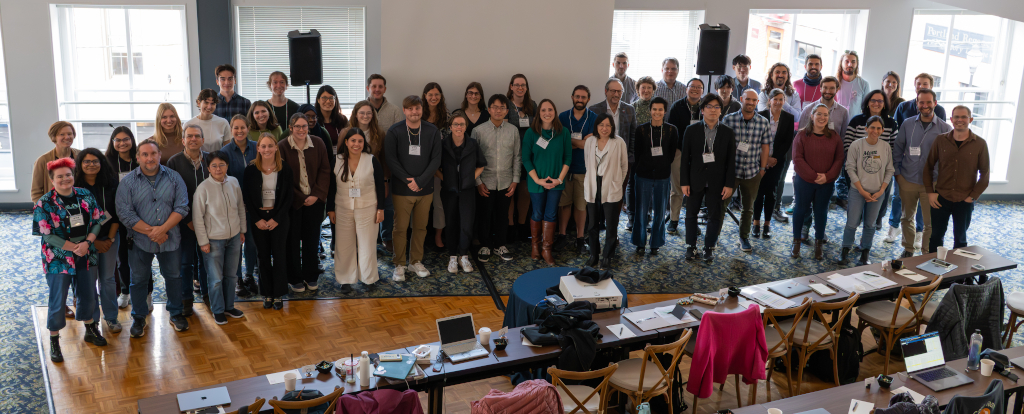

ngVLA and ALMA WSU were discussed in Portland, Maine by leaders in the field at the Astrochemistry in the Broadband Era conference in October.
The astrochemical science that can currently be accomplished with radio facilities is fundamentally limited by narrow spectral bandwidths, but we are about to enter a new era of broadband radio astronomy. ALMA (following the Wideband Sensitivity Upgrade, WSU) and the next-generation Very Large Array (ngVLA) will both deliver unprecedented spectral bandwidths while maintaining exquisite spectral resolution and sensitivity. This data quality will transform the field of astrochemistry, but will also require entirely new approaches to data analysis. This workshop surveyed the current state of astrochemistry in this specific context, identified high-priority science that can be achieved in the Broadband Era, and developed a community roadmap for approaching these new data challenges.

The program included:
- "Primer" talks on specific topics given by ngVLA/WSU personnel and/or SOC members.
- Invited outlook talks addressing key opportunities and challenges.
- Focused science talks contributed from a small number of attendees.
- A number of hour-long, moderated and guided group discussion sections on big-picture topics.
Photos courtesy of Lisa Jordan (US NSF / AUI / NSF NRAO). Group photo courtesy of Brett McGuire (MIT).
Recent Science Media Releases
 |
NSF National Radio Astronomy Observatory and Mexican Institutions Sign Historic Agreements to Advance ngVLA Collaboration |
 |
Astronomers Discover a Superheated Star Factory in the Early Universe |
 |
Astronomers Share Largest Molecular Survey To-date: GOTHAM Legacy Data Goes Public |
 |
Astronomers Map Mysterious "Dark" Gas in the Milky Way |
 |
Astronomers Spot Magnetically-Guided Streamer Funneling Star-Building Material into Newborn System in Perseus |
 |
Astronomers Discover Fastest-Evolving Radio Signals Ever Observed from Black Hole Tearing Apart Star |
 |
First-ever Detection of "Heavy Water" in a Planet-forming Disk |
 |
Astronomers Detect Lowest Mass Dark Object Yet in Distant Universe
|
 |
Cosmic Tug-of-War: Gravity Reshapes Magnetic Fields in Star Clusters
|
|
Contact the NRAO press office to share your new and exciting science results. |
From the Archives
Ellen Bouton

About this month's photograph - In November 1994, the National Science Board approved a project development plan for the Millimeter Array and endorsed further planning. By the time of the formal NSB approval, however, NRAO had been looking for several years at potential sites in Arizona and New Mexico - and in Chile as well. In May 1994, a group explored areas around Ascotan, Ollague, Escondita, Salar de Imillac, and San Pedro de Atacama. In this photo, taken near Imillac by Riccardo Giovanelli, Hernan Quintana, Paul Vanden Bout, Bob Brown, and Angel Otalora are either pleased with what they see or pleased to be out of the truck. Seven years later, in November 2001, Congress appropriated initial construction funds for what had by then evolved from NRAO's MMA to the multi-national ALMA.
From the Archives is an ongoing series illustrating NRAO and U.S. radio astronomy history via images selected from our collections of individuals' and institutional papers. If readers have images they believe would be of interest to the Archives, please contact Ellen Bouton.