
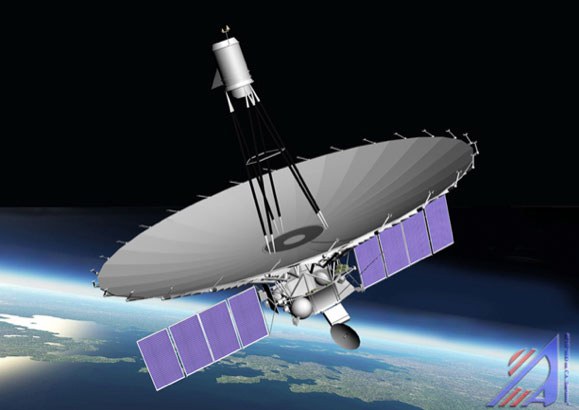
RadioAstron Operational
After more than three decades of planning and development, the RadioAstron space VLBI satellite was launched from the Baikonour Cosmodrome on 18 July 2011, and placed in a highly elliptical orbit extending some 350,000 km from the Earth. Starting in November 2011, following a period of in orbit check-out and calibration of the 10-m antenna and associated instrumentation, fringes have been detected in all four P, L, C, and K bands, including fringes between the space radio telescope and the Green Bank Telescope (GBT) at L and C bands. In response to proposals, an early science program covering AGN, masers, and pulsars that began in February 2012 has been awarded time on the GBT, Arecibo, the European VLBI Network, as well as a number of other antennas in Russia, Ukraine, Japan, and Australia. Correlation is being done primarily at the Astro Space Center in Moscow, but also at the Max Planck Institut für Radioastronomie in Bonn on a modified DiFX correlator. So far fringes have been detected on seven AGN. The longest projected baseline to show AGN fringes was about 90,000 km at 6 cm on OJ 287 suggesting an angular size not more than about 30 micro-arcseconds. An even longer baseline of 220,000 km showed fringes on the pulsar B0950+08 at 92 cm.
The 1.3 cm receiver on RadioAstron includes two low noise preamplifiers provided by the NRAO Coordinated Development Lab that were modeled after similar devices built for the Wilkinson Microwave Anisotropy Probe. Using NRAO amplifiers, fringes have been detected on the quasar 2013+370, as well as on a water maser source in W51 over a projected baseline just over one Earth diameter, making it the highest resolution spectral line observation ever made.
At its recent meeting in Moscow, the RadioAstron International Science Council (RISC) supported the plans to issue a call for proposals for an Open Skies phase of RadioAstron built around a limited number of key science programs including AGN, masers, pulsars, the ISM, gravity, and astrometry. Discussions are underway between NRAO and the RadioAstron mission to implement a tracking station in Green Bank using the 140-ft antenna to receive the RadioAstron downlink data stream. It is hoped that the Green Bank tracking station will be in operation by the beginning of 2013, as needed to support the Open Skies programs, and in particular will greatly improve the opportunity for co-observing with the GBT.
More information about the status of RadioAstron can be found on the mission web site.



Connect with NRAO