NRAO Newsletter
Volume Vol#, Issue Iss#
Day# Month# Year#
NRAO Newsletter
Volume Vol#, Issue Iss# • Day# Month# Year#
 The NSF Karl G. Jansky Very Large Array (VLA) in New Mexico, in the most compact D configuration. Photo by Henry Newton (U.S. NSF / AUI / NSF NRAO).
Upcoming Science Events

AAS 247
January 4-8, 2026 | Phoenix, Arizona

The End of Star Formation
March 2-6, 2026 | University of Illinois, Urbana-Champaign

21st Synthesis Imaging Workshop
May 19-27, 2026 | Socorro, NM
NSF NRAO at the 247th Winter AAS in Phoenix, Arizona

The NSF National Radio Astronomy Observatory, NSF Green Bank Observatory, Central Development Laboratory, and Associated Universities, Inc. will be playing a major part in the January 2026 247th meeting of the American Astronomical Society. Join the NSF NRAO leadership, staff, users, and students for a week sharing outstanding science results, press conferences, and technology developments.
Visit the NRAO in the exhibit hall, starting with the opening reception on Sunday evening. Learn about the ALMA Wideband Sensitivity Upgrade, the ngVLA prototype antenna, new opportunities with the Green Bank Telescope and dysh, and capabilities for observing with the VLA and VLBA from New Mexico Operations. The exhibit will feature instrumentation pieces from the Central Development Laboratory. Join the NRAO leadership for the NRAO Town Hall evening reception on Tuesday, January 6th to learn about the latest research and development initiatives.
Pre-register for the Synthesis Imaging Workshop in May 2026, and sign up for the 2026 Virtual GBT Observer Training Workshop.
During the conference, follow these social media outlets:
- NRAO (Facebook, Twitter(X), Instagram, LinkedIn, and BlueSky)
- GBO (Facebook, Twitter(X),and Instagram)
- AUI (Facebook, LinkedIn, and Instagram)
See the NRAO meeting website for conference details. The block schedule is available on the AAS Website.
| Session | Date | Time (Local) | Location |
|---|---|---|---|
| Grad School and REU Fair | Sunday, January 4 | 5:30pm to 7:00pm | 301 C |
| Opening Reception | Sunday, January 4 | 7:00pm to 9:00pm | Exhibit Hall B/C/D |
| Advancing AI Infrastructure for Large Astronomy Datasets (CosmicAI partners) | Tuesday, January 6 | 2:00pm-3:30pm | 232 A |
| NRAO Town Hall | Tuesday, January 6 | 6:30pm to 8:30pm | 301 C |
| The Highest Angular Resolution Frontier (Splinter) | Wednesday, January 7 | 10:00am-11:30am | 126 C |
| Monitoring the transient sky: the role of ALMA in the WSU era | Wednesday, January 7 | 10:00am-12:00pm | 225 B |
| Closing Reception | Thursday, January 8 | 6:00pm-7:30pm | 301 C |
Engineering Spotlight: Developing Technology for Radio Astronomy Instrumentation

Figure 1: (a) Room temperature measurement set up of the metal 3D printed OMT, (b) transmission response with VLA machine OMT, (c) cryogenic measurements set up.
At the NSF NRAO Central Development Laboratory (NRAO CDL) Dr. Priyanka Mondal performs research to evaluate and develop advanced technologies for future radio astronomy instrumentation. Her projects and research are designed to combat the obsolescence of legacy equipment on existing NRAO telescopes and on developing new capabilities and devices.
Priyanka has been performing rigorous performance characterization of a Ka-band metallic 3D printed orthomode transducer (OMT) that is a joint project between NRAO and the Optisys Corporation. An OMT is a device that separates the two polarizations of incoming sky radiation into its constituent parts so a receiver can process them independently. OMTs are used on virtually all radio telescope receiver sections. There is interest in the unique structures that are possible with metallic 3-D printing, with the hope that one day such devices could outperform existing devices made through traditional machining techniques. Priyanka's work includes room temperature and cryogenic temperature measurements of the OMT and comparing its performance to existing OMTs in use on NRAO instruments. Figure 1(a) shows the room temperature measurement setup and its transmission response is shown in Figure 1(b) along with the VLA machined OMT. Figure 1(c) shows the cryogenic measurement setup which is being developed.

Figure 2: Micro-assembly of the power amplifier (PA) in the split block.
Priyanka has also been investigating emerging power amplifier (PA) technologies. A PA provides critical power boosts to signals in the local oscillator (LO) chain in a radio telescope, conditioning the LO optimally for its role in down converting the sky signal to frequencies where it can be more easily processed (deficiency of LO power leads to non-compliant receiver noise temperature. So PA performance is important.). One such PA technology is the Gallium Nitride (GaN) high electron mobility transistor (HEMT) monolithic microwave integrated circuit (MMIC), which has the capability to provide significant output power at high frequencies like the kind used in ALMA receivers. Priyanka has extensively tested MMICs (120 nm GaN-on-SiC process) from HRL Laboratories at W-band frequencies to evaluate their performance for use in the warm cartridge assembly of ALMA local oscillator (LO) chain. The micro assembly of such a PA is shown in Figure 2. The resulting experimental results, including the critical metric of long-term output power degradation are reported in a memo authored by Priyanka.
Priyanka is also actively involved in several projects with the ngVLA frontend, integrated receiver development, and antenna time and frequency groups. Learn more about research and development with the NSF NRAO CDL.
Would you like your science or engineering projects featured in the NRAO Science Newsletter? Email the editor Brian Kent with your recent science publications!
NRAO and GBO: What's New in 26B?

NRAO and GBO Users' Policy. The NRAO and GBO Users' Policies have been updated and include the following:
Updates to Proposal Requirements (Section 3.3.1):- The Scientific Justification must not include embedded or clickable hyperlinks within the text. Plain text URLs are permitted.
- References must be included within the page limit of the Scientific Justification. While no specific citation format is required, reference entries must contain sufficient information to identify the work, consistent with standard professional practices.
GBT Large Proposals. Starting in 26B, GBT Large proposals will be offered every semester.
GBT Cyclic Spectroscopy Backend. The GBT cyclic spectroscopy backend may be included in the 26B call for proposals.
GBT Ultra-wideband Receiver (UWBR). The GBT ultra-wideband receiver may be included in the 26B call for proposals.
Reminders:
- Constraints on Opportunities (Section 3.2.4): Starting with the 26A semester there will be the following constraints for VLA proposals with a PI from a non-US institution.
- Only scheduling priorities A and B will be allocated time; no filler time.
- The priority A and B time will be further restricted by applying a country cap of 10% and a total foreign cap of 30%
- Proprietary Period (Section 5.5.4): Beginning with the 26A semester the proprietary period will be increased from one to two years for all PIs.
- Use of AI (Section 3.3.2): Starting in 26A, proposers that use AI tools during proposal preparation should select the checkbox under the "AI Usage" section on the proposal's "General" page in the Proposal Submission Tool.
- Joint Proposals (Section 3.2.3): To submit a joint proposal requires that both facilities are necessary to do the science. See the memorandum of understandings (MOUs) on the Joint Proposal Opportunities page. Joint Proposals with ALMA or JWST need to be submitted to the facility requesting the larger amount of observing time.
- Dissertation Plans. The Dissertation Plan requirements (Section 7.2) were revised to specify that the plan must be written by the student. Students that have dissertation plans as part of their NRAO profile will be REQUIRED to update their plans following a strict thesis template. The LaTex and Word formats are available online.
- PST Proposal Template. The NRAO offers an optional Latex template for proposals. Proposers are strongly encouraged to use this template for all proposal types - Regular, Large and DDTs and to follow the appropriate guidelines for font size, page margins and references.
See the NRAO and GBO Users' Policy page for more details.
Photos courtesy of Jeff Hellerman, Bettymaya Foott, and Brian R. Kent (US NSF / AUI / NSF NRAO).
25B-26A GBT Special Proposal Call Report

Figure 1: The LST pressure of the accepted Special Call proposals. The x-axis is the LST hour while the y-axis is the number of hours accepted as part of the special call. The special call proposals will be considered for scheduling in the 25B and 26A semesters.
A total of 35 proposals were submitted for the 25B-26A GBT Special Proposal Call. The proposals were reviewed with an expedited process to allow accepted submissions the opportunity to be considered for scheduling on the GBT as soon as possible. Proposals which did not follow the criteria outlined in the proposal call and the NRAO and GBO Users' Policies were marked for rejection and were not reviewed. The remaining proposals were reviewed by the GBT scientific staff during a one-week period. A technical review check was performed by the GBT data analysts. Each science reviewer provided a ranked order list of the proposals. No review comments were provided by the reviewers as this would have required a substantial extension of the review process. The proposals were then sorted by their average rank from all reviewers. Proposals with a very low average rank were rejected. All other proposals were accepted.
In total 20 proposals were accepted to be observed as filler time on the GBT during the 25B and 26A semesters.
Dr. Anthony Remijan Appointed Director of Green Bank Observatory

Dr. Anthony (Tony) Remijan has been appointed as the NRAO Assistant Director for Green Bank/Director of Green Bank Observatory.
Dr. Remijan is a distinguished astrophysicist and scientific leader at NRAO, and recently has been serving as the Interim Director of the Green Bank Observatory. Over the course of more than two decades with the NRAO and the Atacama Large Millimeter/submillimeter Array (ALMA), Tony has played a central role in shaping the way we explore the chemistry of the interstellar medium. His work bridges astronomy, chemistry, and planetary science - probing how complex molecules form and evolve in space, and what they can tell us about the origins of life's building blocks. He also currently serves as Assistant Director for Science Support and Research at NRAO, and in the recent past contributed to the commissioning and optimization of ALMA's scientific capabilities. Beyond his scientific achievements, Dr. Remijan is known for his commitment to collaboration, mentorship, and scientific communication. His leadership exemplifies how coordinated international efforts and cutting-edge instrumentation can open new windows on the molecular universe.

The science productivity of GBT remains outstanding, and new projects like the UWBR, dysh, and ngRADAR are opening up new scientific capabilities for the instrument. With additional funding from the NSF, great strides are being made in upgrading and refreshing the site infrastructure in Green Bank. Dr. Remijan replaces Dr. Jim Jackson, who retired earlier this year after a successful term as GBO Director from 2021 to 2025.
Read the Green Bank news release.
ALMA News

ALMA Observing Status
Summer Solstice is here! The array is currently in configuration C-5 (baselines up to 1.5 km) and will continue to rapidly contract over the Southern Summer. Photo by Bettymaya Foott (US NSF / AUI / NSF NRAO / ALMA).
The Most Luminous Known Fast Blue Optical Transient
By combining X-ray and radio data monitoring, including from ALMA observations, Nayana A. J. (UC Berkeley, ALMA Cycle 12 Ambassador) is investigating the mysterious nature of the latest class of astronomical transient sources: fast blue optical transients (FBOTs). This AAS NOVA blog post explores the technique and the various progenitor hypotheses.
New Targets for Science Verification: Band 2
With more than 20 receivers already installed on ALMA antennas, Band 2 (67-116 GHz) commissioning is starting. The list of targets which could be used for Band 2 science verification observations is now public. The data are planned to be taken with about 25 antennas and will be released for public use; the release of any Science Verification data will be announced on the ALMA portal and NRAO Newsletter.
ALMA Primer Video Series - New Releases

The ALMA Primer Instructional Video series, which can be found on the Science Portal, is designed to provide a basic introduction to radio interferometry, calibration, imaging, and other topics in short (5-10 minute), easy-to-digest segments. Recently a new video has been released with a brief introduction to calibrating polarization data. Another recently released video includes an Introduction to Primary Beams and Field-of-View.
Subscribe to the ALMA Primer Video Series YouTube channel to be alerted to new videos as they are released.
We are always looking for ideas for new videos, and especially looking for people who would like to help with script generation, animation, and narration. If you have an idea or would like to join the Primer Video Working Group (at any level of effort), please contact Gerald Schieven.
ALMA and the NAASC at the 247th AAS Meeting, January 2026, Phoenix, AZ
ALMA science will be well-represented at the AAS 247th meeting on January 4-8 in Phoenix, AZ. The NAASC will host a special session on Wednesday January 7th (10-11:30 am): Monitoring the transient sky: the role of ALMA in the WSU era, with 5 invited talks by Jennifer Donovan Meyer (NRAO), Abygail Waggoner (Wisconsin), Kate Alexander (Arizona), Tarraneh Eftekhari (Northwestern), and Boris Georgiev (Arizona). Also note the regular session "Planet-Forming Disks with JWST and ALMA: Mass, Chemistry, and Dynamics" on Wednesday January 7th (2-3:30 pm). Please come and visit the ALMA table at the NRAO exhibit to meet NAASC staff, inquire about opportunities, and pick up our latest documentation and swag.
ALMA Wideband Sensitivity Upgrade (WSU) News

The test facility (IDTF) for the new Advanced Technology ALMA Correlator (ATAC), located at the NRAO Central Development Laboratory in Charlottesville, hhas received a total of four Bittware Terabox Servers (TBSs), three air-cooled and the first liquid-cooled, pictured at left (Terabox processing unit is on top, with the desktop liquid cooling heat exchanger on the bottom). The TBS is the primary processing platform of ATAC, containing both the FPGAs performing the first and second stages of correlator processing (coarse channelizer and frequency slice processor), as well as the CPUs that perform the final Correlator Data Processing stage. The current complement of TBSs will be joined by 4 more liquid-cooled units next year. The IDTF TBSs will be used for ATAC integration testing of the firmware and software prior to deployment of ATAC to the ALMA site. The current ATAC design calls for 128 liquid-cooled servers. Liquid-cooling of the FPGAs and CPUs will significantly lower the long-term HVAC costs at 2,900m altitude.
ngVLA Project News

The Highest Angular Resolution Frontier at AAS 247
The NSF NRAO and the ngVLA project are pleased to invite all AAS 247 attendees to a Splinter Session titled The Highest Angular Resolution Frontier on January 7, 2026 in Phoenix, Arizona, USA. This session will highlight recent science breakthroughs enabled with milli- and micro-arcsecond angular resolutions. It will also discuss future science possibilities that demand joint improvements in angular resolution and sensitivity. Invited oral presentations include Neutrino-Emitting Blazars, Resolving Jets from Gamma-ray Bursts, Peering into the Formation of New Worlds with the ngVLA, Multimessenger Astronomy with the Celestial Reference Frame, and ngVLA Status and Update. To broaden information sharing, the presentations will eventually be posted and advertised world wide.
Advancing ngVLA Collaboration in Mexico
The NSF NRAO and Mexican institutions announced in November the signing of historic agreements to advance their ngVLA collaboration. This represents a significant step in strengthening international collaboration for one of the world's most ambitious next-generation observatories.
ngVLA Science - Polarimetry of a Radio Relic in a Galaxy Cluster

Figure: Left: The relic's total intensity at 10 GHz and a zoom showing region R1's polarization intensity and magnetic field direction. Right: Stokes QU-fitting assuming one external Faraday screen for region R1. At 10 GHz the fractional polarization p is systematically lower than predicted by the model. Credit: Pasetto et al. (2025)
Radio relics are Mpc-size structures emitting nonthermal radiation, typically at the peripheries of merging galaxy clusters. They are believed to result from the (re)-acceleration of electrons by shock fronts propagating through the intracluster medium (ICM). It is still debated whether the relics' cosmic ray electrons are accelerated thermal electrons from the ICM, or are re-accelerated "fossil" electrons left behind by a long-dead galaxy jet (e.g., Bonafede et al. 2014, van Weeren et al. 2017). Understanding the magnetic-field structure through polarization diagnostics, such as fractional polarization and rotation measures, is essential for constraining these scenarios.
Using new JVLA observations of the massive merging cluster MACS J0717.5+3745 at 10 GHz, we (Pasetto et al. 2025) detect, for the first time, high-frequency total and polarized emission from the relic region R1 (see figure). Employing a spectropolarimetric analysis based on Stokes QU-fitting (Pasetto 2021), we studied the depolarization properties of region R1 by combining these new data with previous data at 3 and 6 GHz (Rajpurohit et al. 2022).
These measurements reveal changes in the depolarization mechanism, offering the clearest signs yet that the relic’s interior is far more complex than previously thought. The Stokes QU-fitting shows a change in the magneto-ionic properties of R1 relative to the low-frequency observations. In particular, the high-frequency emission shows a decrease in fractional polarization p and likely traces a different, more compact, synchrotron-emitting region. There, the polarization properties, such as the intrinsic magnetic field structure and local plasma density fluctuations, could play a more significant role.
This finding suggests that the structure and properties of the magnetic field within the relic may be more complex than can be inferred from low-frequency observations alone. Moreover, these results highlight the importance of conducting high-frequency observations, as they can effectively trace the shock fronts and the properties of the cosmic ray electrons. In turn, this enables a better characterization of the intrinsic magneto-ionic structure and improved constraints on the true nature of the cosmic rays, whether they are accelerated thermal electrons or re-accelerated "fossil" electrons.
With its unprecedented combination of sensitivity and angular resolution, the ngVLA will enable imaging of the fine substructures associated with shocks in the radio relics of MACS J0717.5+3745 and other galaxy clusters.
Since 2015 the acronym ngVLA has appeared in 1440+ publications indexed in the SAO/NASA Astrophysics Data System. This article continues a regular feature intended to showcase some of those publications. We are especially interested in showcasing work done by early-career researchers. The collection of showcase articles can be viewed online. Anyone wishing to volunteer to author a feature should contact Joan Wrobel.
26A NRAO Proposals

The NRAO has completed the Semester 2026A proposal review and time allocation process for the Very Large Array (VLA), Very Long Baseline Array (VLBA), and the Green Bank Telescope (GBT).
For the VLA the A and D-configurations will be available in the 26A semester and 295 new proposals were received by the 30 July 2025 submission deadline, including thirty-five time critical (triggered) proposals. The oversubscription rate (by proposal number) was 2.1 and the proposal pressure (hours requested over hours available) was 2.2, both of which are similar to recent semesters.
For the VLBA 67 new proposals were submitted. The oversubscription rate was 2.4 and the proposal pressure was 4.4, slightly higher than past semesters.
For the GBT 48 proposals were received for the 26A Semester. The oversubscription rate was 1.5 and the proposal pressure was 1.5, slightly lower than past semesters.
There were thirty-five joint proposals submitted that requested time with our partner observatories: ALMA, JWST, HST, Swift, Chandra, XMM-Newton, and NICER.
The proposals were reviewed for scientific merit by ten Science Review Panels (SRPs) and for technical feasibility by NRAO staff. These reviews were completed in August - September 2025 and then considered by the Time Allocation Committee (TAC) during a face-to-face meeting on 14-15 October 2025. The TAC - comprising the 10 SRP chairs - was charged with recommending a science program for Semester 2026A to the Observatory Director. The recommended program was reviewed and approved on 4 November 2025.
A disposition letter was sent to the Principal Investigator and Co-Investigators of each proposal on 12 November 2025 and a TAC report containing information for proposers and observers, including statistics and telescope pressure plots, was released the same day. The approved science program for the VLA, VLBA, and GBT has been posted to the NRAO science website. The authors, title, abstract, and scheduled hours for each approved proposal can be accessed from the Proposal Finder Tool. The NRAO welcomes community feedback on the proposal review and time allocation process. Please provide such feedback via the Proposal Review department of the NRAO Helpdesk.
41st Annual New Mexico Symposium

The 41st Annual New Mexico Symposium was held on November 21, 2025 at the Domenici Science Operations Center in Socorro, NM, followed by the Jansky Lecture. More than 90 participants were registered for the event. The symposium featured 17 talks and 19 posters presented by students, postdocs, and faculties from UNM, TTU, LANL, ASU, NMT, and NSF NRAO. After the symposium, the 2025 Jansky Lecture was delivered by Dr. Jean L. Turner (UCLA) on the New Mexico Tech campus, titled "Exploring the Dusty Origins of Star Clusters." Over 200 people attended this popular annual event.
Aurora over the NSF Robert C. Byrd Green Bank Telescope

Skywatchers were treated to an amazing night time display, captured by Thomas Chamberlin. Click the image at left to view his aurora timelapse video in Green Bank, West Virginia on November 11, 2025.
Recent Science Media Releases
 |
NSF VLA and ALMA Reveal Time-Stamps of Star Birth in Dazzling Cosmic Jet
|
 |
ALMA Helps Unmask Monster Black Hole Behind Record-Breaking Cosmic Burst |
 |
Astronomers Make First Radio Detection of Rare Supernova Type, Revealing Secrets of Stellar Death |
 |
NSF National Radio Astronomy Observatory and Mexican Institutions Sign Historic Agreements to Advance ngVLA Collaboration |
|
Contact the NRAO press office to share your new and exciting science results. |
From the Archives
Ellen Bouton
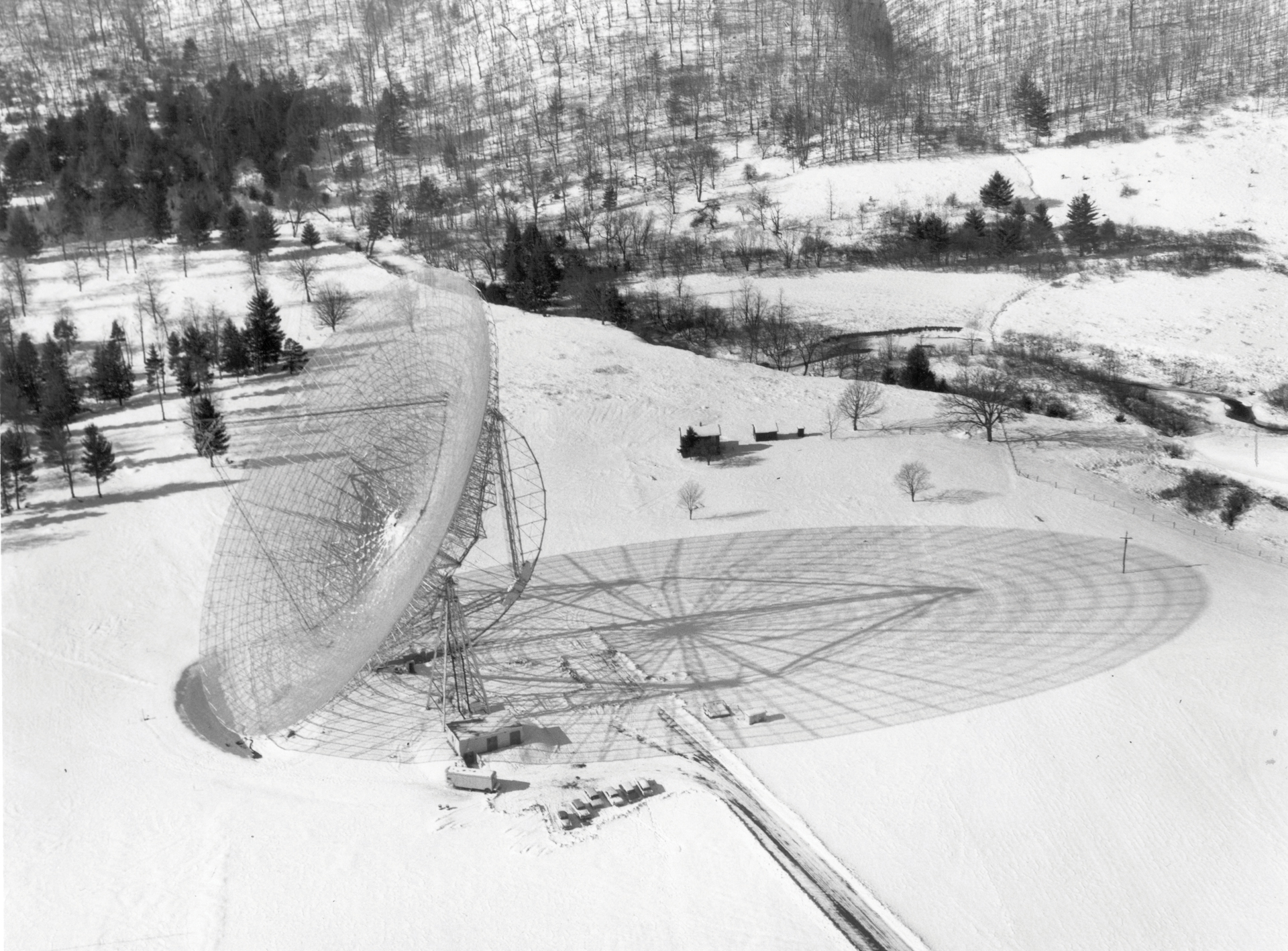
About this month's photograph - Snowy shadows in Green Bank. This aerial photo shows a magnificent shadow cast by the former 300-foot radio telescope in Green Bank, West Virginia. This radio telescope contributed to many projects before its collapse in 1988, including the Green Bank All Sky Survey. Read more about this incredible telescope and its history, as well as the amazing science being conducted by its successor - the Robert C. Byrd Green Bank Telescope.
From the Archives is an ongoing series illustrating NRAO and U.S. radio astronomy history via images selected from our collections of individuals' and institutional papers. If readers have images they believe would be of interest to the Archives, please contact Ellen Bouton.