NRAO ALMA/NAASC
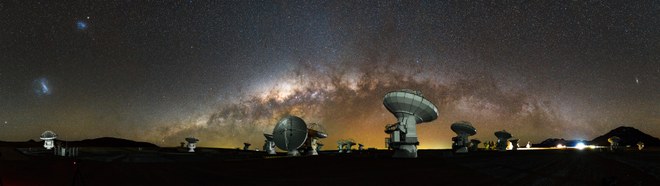

Credit: ALMA (ESO/NAOJ/NRAO)
ALMA Status:
- Weather conditions at AOS
- Recent observations (QA0 Pass)
- Public observations
- Publications
- ALMA Configuration schedule
ALMA Ambassadors Program for Cycle 14 is open
The NAASC is accepting applications for the ALMA Ambassadors Program, with a deadline of October 2, 2026. The program provides training and up to a $10,000 USD research grant (other forms of payment are available, see the ALMA Ambassadors website) to postdoctoral researchers, senior graduate students, and early career researchers interested in expanding their ALMA/radio interferometry expertise and sharing that knowledge with their home (or other) institutions. For Cycle 14, ALMA Ambassadors can choose to support the community by organizing and hosting (1) ALMA Cycle 14 proposal preparation support workshops (Spring 2027), and/or (2) ALMA-focused data processing and analysis workshops (Fall 2027). Applications seeking to host both proposal preparation and data processing workshops will be favored.
Some radio or submillimeter interferometry experience is preferred but not required. Applicants must be based at a North American institution. If you do not meet these requirements but are interested in learning more about the training we are offering, please contact Arielle Moullet to discuss opportunities. We will consider both individual and coordinated applications from users in the same institution or region. For more information, please visit the ALMA Ambassadors website
ALMA at 15 years: Science, Synergies, and the Road Ahead. February 22-27, 2027, Taipei, Taiwan
Abstract submission is now open for the conference ALMA at 15 Years: Science, Synergies, and the Road Ahead , which will be in person from February 22 to 26, 2027, at Academia Sinica's Nangang campus in Taipei, Taiwan. The abstract submission deadline is September 15, 2026. The conference will highlight ALMA's latest results, especially since the last Pan-ALMA conference held in 2023, and identify exciting directions for future ALMA research. The program will feature invited and contributed science presentations, along with updates on the Wideband Sensitivity Upgrade (WSU), tutorial sessions on the archival and CARTA systems, and discussions of future ALMA prospects. Talks and posters presenting scientific work using ALMA and/or its synergies with other facilities across all areas of astronomy are welcome.
The NAASC can provide travel support for early career attendees (students and postdocs) who are based at North American institutions (US and Canada). To apply for financial support, please contact Arielle Moullet (amoullet@nrao.edu) after submitting your abstract and no later than the deadline for abstract submission (September 15, 2026). Announcement of travel support awards will be made at the time of abstract acceptance.
Important Dates:
Abstract Submission Opens: June 15, 2026
Abstract Submission Deadline: September 15, 2026
Early-Bird Online-registration Opens: September 30, 2026
Notification of Abstract Acceptance: Late Oct./Early Nov., 2026
Early Bird Online-registration Deadline: November 27, 2026
Online Registration Deadline: January 20, 2027
ALMA Data Processing and Analysis Workshops for Cycle 13
This Fall, the NAASC and the Cycle 13 ALMA Ambassadors will host a series of workshops on the processing and analysis of ALMA data, at several locations in the US, Canada and Chile. All local students and researchers are encouraged to attend these events, and no previous ALMA experience is required or necessary. The goal of these events is to train users on basic data processing and analysis techniques that they may need to use ALMA for scientific discovery. Early registration is encouraged, to facilitate tailoring workshop presentations to the interests of the attendees. Lunches will be provided at all these events.
| Ambassador | Workshop Location | Date |
|---|---|---|
| Woorak Choi | McMaster University | October 16, 2026 |
| Nickolas Pingel | Indiana University | October 21, 2026 |
| Maria Galloway-Sprietsma and Nazar Budaiev | University of Florida | October 21, 2026 |
| Carla Cornil-Baïotto | University of Concepción | October 22 and 23, 2026 |
| Teresa Paneque-Carreno | University of Michigan | October 23, 2026 |
| Nazar Budaiev | Columbia University | October 30, 2026 |
Meetings and Conference support
The NAASC invites members of the North American scientific community to apply for funding in support of conferences and workshops that are ALMA focused or have a synergy with ALMA, and which encourage the participation of students, postdocs, and early career researchers. PI-ed events (e.g. collaboration workshops) held in the US and Canada or conferences organized at any geographical location (national or international) are eligible to apply. Events must be scheduled between Oct 1, 2026 and December 31, 2027 to be eligible.
For awarded events, the NAASC can provide monetary funding (up to $5,000 per event). As needed, the NAASC can also provide logistical support (e.g., webinar platform) materials and content if requested in the application or proposed by the NAASC at the time of the award.
For instructions on how to apply, eligibility criteria and other details on this program, please look at the program webpage.
Visits to the NAASC: data reduction support and more
If you need any help in reducing your data, or just a quiet week away to finish writing up your next ALMA paper, consider coming for a face-to-face visit to work closely with our data analysts and scientific staff. For more information and to request a visit, please see https://science.nrao.edu/facilities/alma/facilities/alma/visitors-shortterm and submit a ticket to the face-to-face visits department of the ALMA Helpdesk. Come visit us!
Update as of May 2026: Investigators from U.S. institutions who are requesting an in-person f2f data reduction visit to NAASC Headquarters can apply to the NAASC for assistance with travel expenses for up to two members of their team.
Reach out to the NAASC
Feedback on ALMA data analysis tools is greatly appreciated. Please communicate any obstacles encountered in the path from data delivery to publication by submitting a Helpdesk ticket. In particular, has a lack of computing resources, software for analysis, visualization, plotting, or other "tools" proven to be a difficulty? NRAO thanks you in advance for your feedback.
You can also consult with our EPO team (jmalusky@nrao.edu) to see if your results would have broader public interest and to explore outreach opportunities.
Contact Us :
More information about ways to contact us.


Connect with NRAO