
RCT 2.0 manual
Beta-tester's Instructions and help for RCT 2.0
(Living document started October 12, 2022)
Introduction
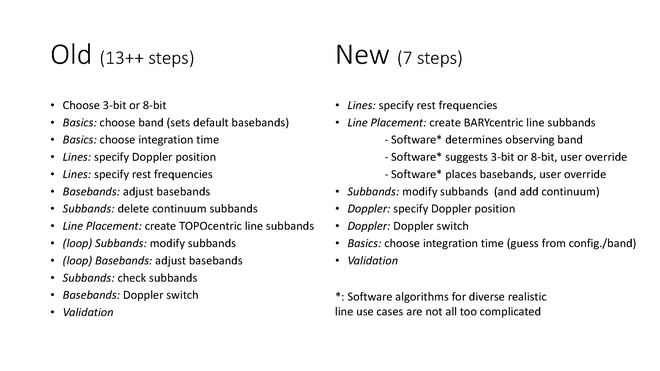
This RCT2.0 was created after a staff presentation in early 2017 where Lorant summarized the current (old) way of generating a line resource in the OPT/RCT using the implemented telescope hardware point of view requiring at least 13 steps, depending on how good the initial guess for setting the baseband center was. This was compared to a desired (new) way with only 7 steps and without any required guess work. Here the telescope hardware iterative back-and-forth fine-tuning, causing potential undesired shifting of frequency coverage (and missing the targeted line) could be replaced by a science point of view without the observer having to worry about the hardware specific limitations from the start. The final summarizing slide is reproduced below to indicate the general changes in RCT2.0 (with minor modifications) presented here:
First steps on using RCT2.0
The new prototype RCT (aka RCT 2.0) has been made available through,
http://webtest.aoc.nrao.edu/rct
Use the same OPT user credentials (also used for the PST at my.nrao.edu), to login.
Once logged in, the initial RCT 2.0 view should mostly resemble the original RCT view with an important difference that isn't immediately obvious. To start testing, [we anticipate this won't be necessary later] please create a new catalog (File → Create New → Catalog) for your new testing resource setup. Then create a new instrument configuration and note that the drop-down menu to create a resource has a single option: create a new instrument configuration.
This pops up a window where one can specify what kind of resource should be created; in reverse order of appearance:
- manual: this resembles the classic way of setting up any resource where the user specifies exactly what they want, step by step.
- continuum: this resembles the classic way of setting up a continuum resource with the original resource wizard (assuming this feature was known to you) which would more or less reproduce the NRAO Default resources that then can be edited, e.g., for baseband center frequency. The caveat is that this -- like any of the other options here -- disables the commensal 'realfast' observing obtained with any of the resources in the NRAO Defaults catalog.
- spectral scan: this option is for those that want to observe all or most of a 1GHz or 2GHz baseband in a contiguous chunk of frequency with higher spectral resolution (better than 2 MHz and typically in dual polarization) than the NRAO Default setups or the continuum option above will do. Other basebands can either be interleaved to get a homogeneous sensitivity over the entire frequency range (without subband-edge sensitivity loss effects) or be put on different frequency ranges in the band.
- spectral line: is the option to make full use of recirculation and stacking of baselineboard pairs to obtain the highest spectral resolution on narrow chunks of frequency centered on specific rest frequencies and which are corrected for Doppler effects on the time and date of the actual observation. Placing the spectral windows between the forbidden regions might be complicated, especially when covering many spectral features, and an attempt is made to solve this for you. As this is not a one hundred percent solvable problem, the user is given some options, including manually editing of the suggested solution. Note that changing the solution may require to start from scratch if manual edits are unsatisfactory. We anticipate that some users will ask the helpdesk for alternatives when they get stuck.
From this point it may be helpful to us if you could keep a list/record of actions taken, buttons clicked and baseband/subband adjustments - but also server interruptions - in chronological order. Previous exchanges show that it otherwise is very difficult to remember exactly what was done in case we need to trace back steps to resolve or understand possible problems encountered. However we understand that this may be too much of an effort to ask.
When a line setup is created, again the view should mostly resemble the view of the current RCT, but note that the tab order and tab names have been revised, with some other minor differences (mainly, the resource name and integration time are always visible and editable in the basics table — it is not a tab anymore - and that no a-priori selection of the receiver is requested).
The first tab is the "Lines" tab, where the lines are specified as before. Here the lines specified with their main Doppler shift (with respect to the Solar System barycenter and displayed below the rest frequency entered) will determine the receiver band. For the observing-day specific fine-tuning, specifying the Doppler position is moved further down in the process. For complicated setups or setups with many lines, we strongly suggest to make a line definition file and import that instead of hand editing each line, but we wouldn't mind if you also try hand editing and provide feedback on that as well. Instructions to make a line definition (txt) file can be found in the OPT manual.
Note that the line definitions can be selected or de-selected, depending on whether this line should be used in the automated setup. For example, one could define an artificial average line frequency to be used for Doppler setting only, or one would exclude lines that are less important for the science but create difficulties for or undesired behavior of the automated setup, e.g., providing a 3-bit setup as the only possible solution to catch most desired lines whereas an 8-bit setup could be more efficient but only captures the essential lines (plus maybe a few but not all desired lines).
The next step is to select the "Basebands" tab and click the "Start Automated Setup" button (*see known issues below). This is the major difference between the current RCT and this new prototype RCT 2.0. It uses an algorithm to replace the guess-work on setting the baseband centers that were the cause of a lot of frustration and unnoticed subband shifts when using the "Generate Lines" tab (see the extensive OPT manual). The algorithm also places the line subbands in the (anticipated) most optimum sections of the baseband or complain when it cannot find a solution without comprimizing the science (suggesting solutions like removing a line or reducing a velocity coverage). This should make sure that the requested velocity coverage is always observed in the subband with the caveat that individual subbands may not be centered on the line.
The algorithm by default will use the more sensitive 8-bit samplers, unless the lines are spread over more than two chunks of ~1 GHz (the 8-it baseband width); then the 3-bit samplers (~2 GHz baseband widths) are used. You, as the user can switch between them and also shift the baseband centers by (integer steps of) 128 MHz without compromising the setup (until a line is not covered by the baseband anymore). Note that the old setup selections are still available under the "Show Manual Settings", but we anticipate that these are not necessary to be used anymore.
The unused basebands (if there are any) at this point probably aren't placed in the most optimal way to capture any continuum. We are working this out but it should also be possible to manually set their centers at their desired frequencies here and add continuum (128MHz) subbands in the next tab.
The next tab, "Subbands", allows the user to make changes to individual subbands and add more (continuum or line) subbands with the restrictions as before. We further trust that the remaining tabs are logical and self-explanatory. Please let us know if you need further help and where we can improve the tool and/or these brief instructions.
Future expansions
This initial implementation of the RCT does not feature all possible smarts (yet). Future expansions we are actively investigating include, in no particular order (see also below):
- optional merging of overlapping subbands (although keeping the channel separation unchanged is not always possible)
- prioritizing lines covered (in a sequence) other than plain distinguishing essential versus optional lines
- smarter choices on where to center initially unused basebands that can be filled with continuum subbands and a single button to do this filling
- currently the algorithm offers a choice based on the largest 'gap' modulo 128MHz to minimize the lines to be off-centered in a subband, but alternative gaps may offer other personal preferences for the baseband centering.
A proper manual for this version is being worked on as a living document as well.
Known Issues
Please be aware of the following:
- We are currently working on the actual on-the-sky part and that comparing frequencies to programs like Dopset or the current OPT may not compare favorably at this point.
- After using the "Start Automated Setup" button, any adjustments made to your setup will disable the ability to change Baseband Options. However, the developer has not had time to include this for all adjustments. We ask that you do not change baseband options after manually adjusting your setup.
- When rest frequencies are closely separated and velocity coverage is wide, i.e. where individual line subbands overlap, it does not suggest to merge the subbands in a single one centered on the average of the lines. Merging subbands is a scientific choice and at this time best left to the observer, either to be edited afterwards in the subbands tab or by defining an average rest frequency with the appropriate frequency coverage in the lines tab beforehand.
- Some cases where lines may be placed in overlapping basebands, the algorithm currently will place them in a single baseband. If this is not possible (i.e., the velocity coverages are too wide), it will not suggest to place one of them in the other baseband to resolve the problem. This currently would be done manually in such cases.
- It is possible that a person's request to cover lines does not match with the current capabilities of the instrument. The Automated Setup tries to present different options that can be selected with a single mouse click, but it may not come to a final resolution. The solution might be to reduce the velocity coverage or to increase channel separation or perhaps even to de-select some of the optional lines in the lines tab and redo the Automated Setup.
At this stage we are mostly interested in the GUI and look-and-feel feedback on this new way of defining the setup, and
we thank you for your time and effort!



Connect with NRAO