
Advanced Spectrum Monitor (ASM)
The objective of the ASM device is the creation of a self-contained, autonomous, and wideband spectrum monitoring station with direction finding capabilities. The ASM-1 prototype development finished in 2023, and let to design changes now being implemented in ASM-2. Key design features for the ASM-2 include: (1) complete frequency coverage from 1-50 GHz separated into 4 overlapping bands: 1-20, 18-30, 28-40, 38-50 GHz, (2) full hemispherical coverage with 4 cardinal directions, (3) tightly integrated antennas and receivers/low-noise block downconverters with mostly COTS components/technology, (4) a fixed frequency local oscillator (LO) generator with harmonic generator, (5) electrically/solid-state switching of active antenna and receiver signal path for Amplitude of Arrival (AoA) direction finding, and (6) a simple network interface over fiber ethernet.
ASM-1 (2021-2023)
Since 2021, NRAO has been engaged in the design and deployment of an Advanced Spectrum Monitor (ASM) device. The goals for this device were to cover a large range of frequencies (initially planned to be 1-120 GHz) and to provide direction-fining information useful in identifying the source of RFI at a particular frequency. The initial "proof of concept" device was tested in May 2023 at both the Central Development Laboratory (CDL) in Charlottesville and the Green Bank Observatory (GBO).
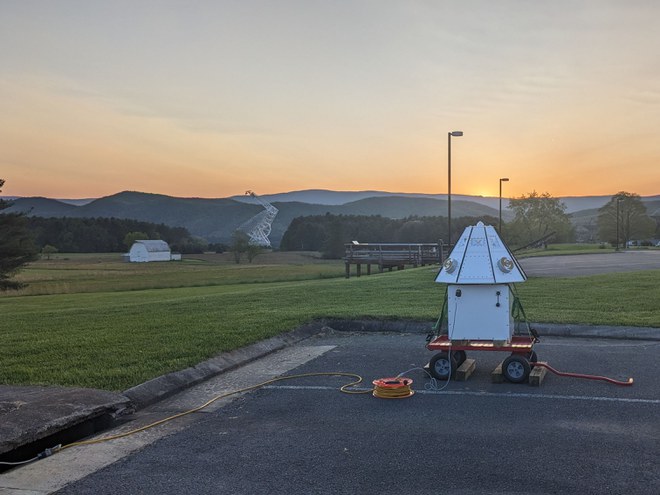
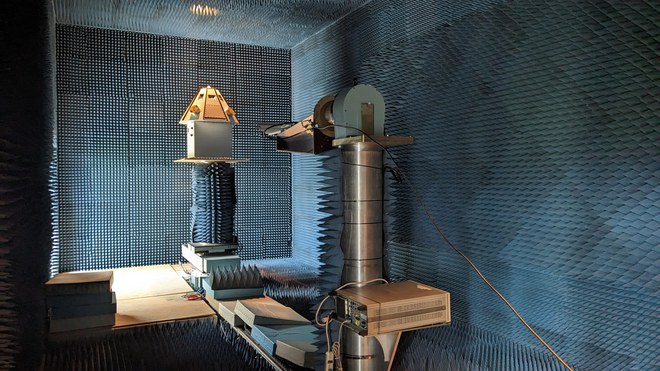
The first "proof of concept" device (above) was capable of receiving, determining vectors to, and categorizing signals from frequencies between 1 and 20 GHz. Hemispherical coverage is required as potential interferers can be terrestrial or space borne. Frequency, Signal strength, Polarization and Spectral Occupancy was measured and logged by the device. ASM-1 (Proof of Concept Device) during on site RFI (anechoic chamber, below) and field testing at the Green Bank Observatory in May 2023.
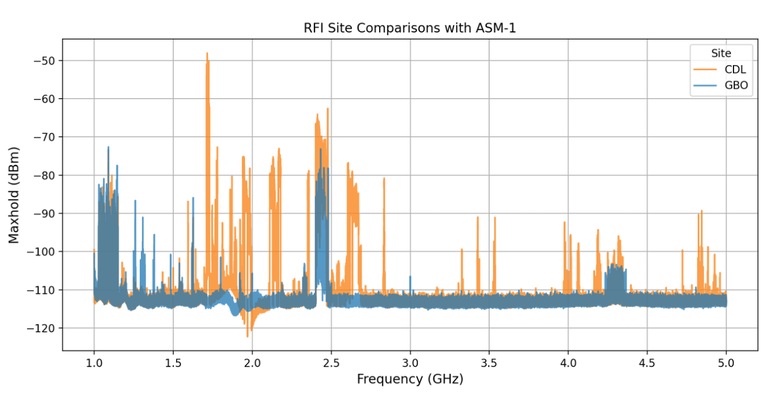
Sample spectra from 1-5 GHz taken with the ASM-1 device at CDL (orange) and GBO (blue). While the RFI environment is clearly better at the GBO, the National Radio Quiet Zone (NRQZ) is not completely quiet. Signals near 2.4 GHz are from WIFI networks.
ASM-2 (2023-2026)
The ASM-1 and ASM-2 are both designed in the form of a pyramid with multiple antennas built into the perimeter of the outer shell. This configuration has allowed for the device to determine azimuth and elevation of emitters. Each antenna is sampled individually, allowing for the amplitude measurements to be entered into an algorithm that will determine a two-dimensional vector (azimuth, elevation) to the radiating source.
The ASM-2, currently being tested and assembled at the CDL will expand frequency coverage from 1-50 GHz, covering the same range of frequencies observed by the Jansky Very Large Array (VLA) in New Mexico.
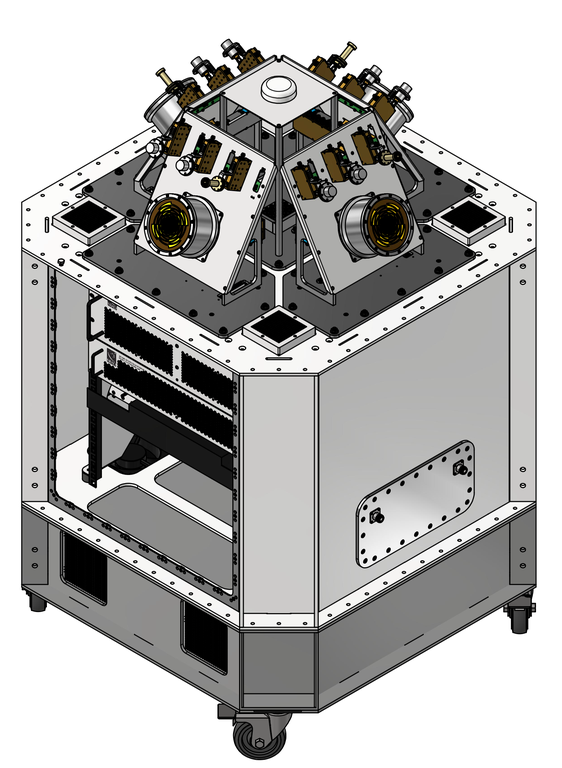
Current (March 2026) mechanical drawing of the ASM-2 enclosure.Device will be able to be secured and operated in an outdoor environment.
ASM-2: Sinuous Antenna: The ASM-2 Sinuous Antenna (1-20 GHz) has been redesigned and the first redesigned sinuous antennas (shown below) Has been integrated into a working 1-50 GHz "face". One of these antennas will be on each face of the new ASM-2, giving direction finding capability to the spectrum monitoring device.
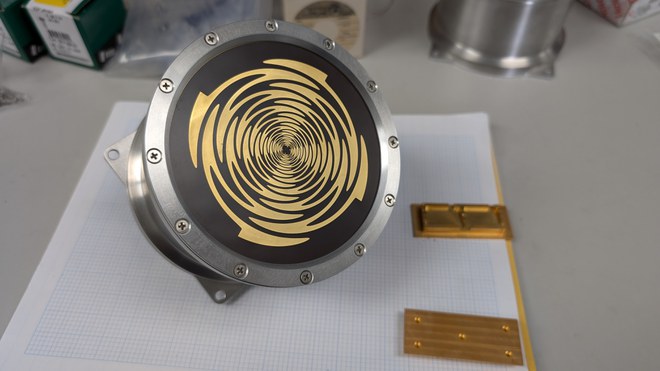
The first redesigned ASM-2 Sinuous Antenna on the bench at the Central Development Lab (CDL) in Charlottesville, VA.



Connect with NRAO