
New Mexico Radio Coordination Zone
Background
The New Mexico Radio Coordination Zone (NMRCZ) consists of the region in the Plains of San Agustin, New Mexico around the Karl G. Jansky Very Large Array (VLA) and Very Long Baseline Array (VLBA) Pie Town site. Although not a formally protected zone, it was created by the NRAO to establish awareness and criteria for coordination and operation that can provide RFI protection for the VLA and VLBA. The NMRCZ is applicable to terrestrial, airborne, and satellite-based RF emitters.
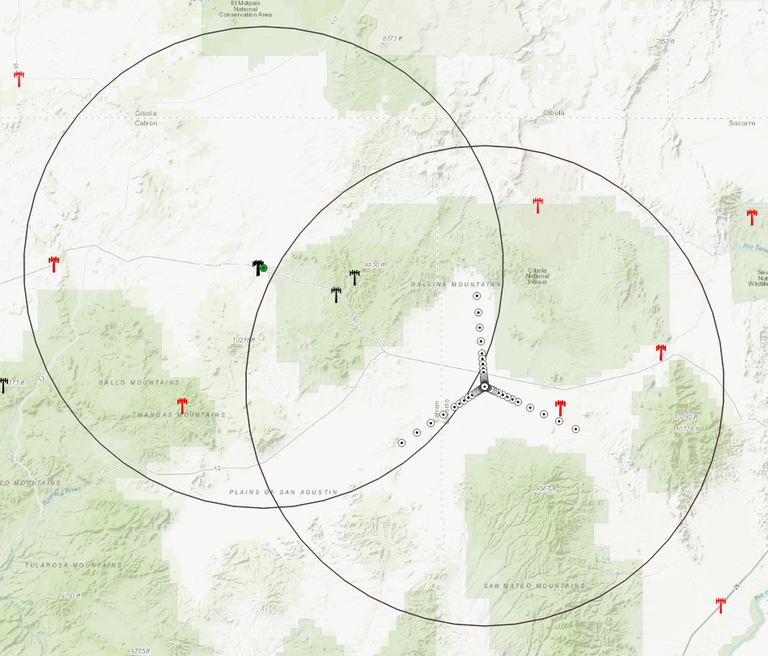
The VLA is a 27–element interferometric array, arranged along the arms of an upside-down Y, which produces images of the radio sky at a wide range of frequencies and resolutions. There are four basic antenna arrangements, called configurations, whose scales vary by the ratios 1 : 3.28 : 10.8 : 35.5 from smallest to largest. These configurations are denoted D, C, B, and A, respectively. For details about antenna positions in the various configurations we refer to the stations position file (pdf version). All VLA antennas are outfitted with eight receivers providing continuous frequency coverage from 1 to 50 GHz. These receivers cover the frequency ranges of 1–2 GHz (L-band), 2–4 GHz (S-band), 4–8 GHz (C-band), 8–12 GHz (X-band), 12–18 GHz (Ku-band), 18–26.5 GHz (K-band), 26.5–40 GHz (Ka-band), and 40–50 GHz (Q-band). Additionally, all antennas of the VLA have receivers for lower frequencies, enabling observations at P-band (200–500 MHz) and 4-band (54–86 MHz).
The RF environment of the VLA site can be viewed in the public data produced by the on-site electromagnetic spectrum monitor (ESM-VLA). The ESM-VLA utilizes a horizon sensitive omni-directional antenna to monitor signals from ~10 MHz – 10 GHz. The NRAO SMD and New Mexico Interference Protection Group (NMIPG) regularly reviews these data to identify and mitigate impactful RFI. It is noted that radio astronomy telescopes are orders of magnitude more sensitive than the ESM-VLA. For more information about the RF environment around the NMRCZ, please visit here.
In addition, under the purview of NRAO New Mexico, the NMRCZ also manages coordination with other VLBA sites across the United States.
Existing Protections of Radio Astronomy
The NMRCZ and VLBA sites benefit from spectrum set aside for the protection of passive observations through the international and FCC table of allocations (footnotes US246, US342), where radio astronomy is listed with a primary status. We pay specific attention to the protected bands or primary bands falling into: 73-74.6, 406.1-410, 1400-1427, 1610.6-1613.8, 1660-1670, 2690-2700, and 4990-5000 MHz, as well as 10.68-10.7, 15.35-15.4, 22.21-22.5, 23.6-24, 31.3-31.8, 42.5-43.5, 76-100 GHz. For these bands protection at the level of Recommendation ITU-R RA.769-2 applies.
Furthermore, FCC Table of Allocations Footnotes US13 (162.0375-173.2, 406.1-420 MHz), US113 (4825-4835 MHz, 14.47-14.5 GHz), US117 (406.1-410 MHz), US131 (10.7-11.7 GHz), US161 (81-86, 84-86, 92-94, 94.1-95 GHz), US385 (1350-1400, 1718.8-1722.2, 2655-2690, 4950-4990 MHz) expects coordination with NMRCZ managed facilities.
For all other bands NRAO Spectrum Management Department greatly appreciates voluntary coordination for all transmitting radio frequency sources around the New Mexico Radio Coordination Zone and VLBA sites across the United States.
NRAO ZRS and NMIPG will work with the coordinating parties to help resolve the expected interference. To coordinate with the NRAO ZRS Office and NMIPG, please use the linked contact form and we will get back to you.
Related Links:



Connect with NRAO