Operational Data Sharing (ODS)
As part of the NSF’s Spectrum Innovation Initiative: National Radio Dynamic Zones (SII-NRDZ) and Spectrum and Wireless Innovation enabled by Future Technologies - Satellite-Terrestrial Coexistence (SWIFT-SAT), NRAO has led the development of coordination techniques in conjunction with SpaceX and other non-geostationary (NGSO) satellite operators to achieve dynamic spectrum sharing and spectrum coexistence. Meanwhile, these efforts can help to achieve the requirements set by the FCC Rule Part US131.
To mitigate radio frequency interference (RFI) from satellites’ broadband internet and cellular downlink services, particularly from the Low-Earth Orbit (LEO), by radio telescopes on Earth, two primary schemes have been implemented between satellite operators and radio astronomy (RA) observatories are: Zone Avoidance (ZA) and Telescope Boresight Avoidance (TBA).
The ZA provides the basic protection approach to have satellite constellations avoid directly illuminating the RA sites (Figure 1, left). This partial solution requires no communication between telescopes and satellite operators, but simply a database of the observatory locations.
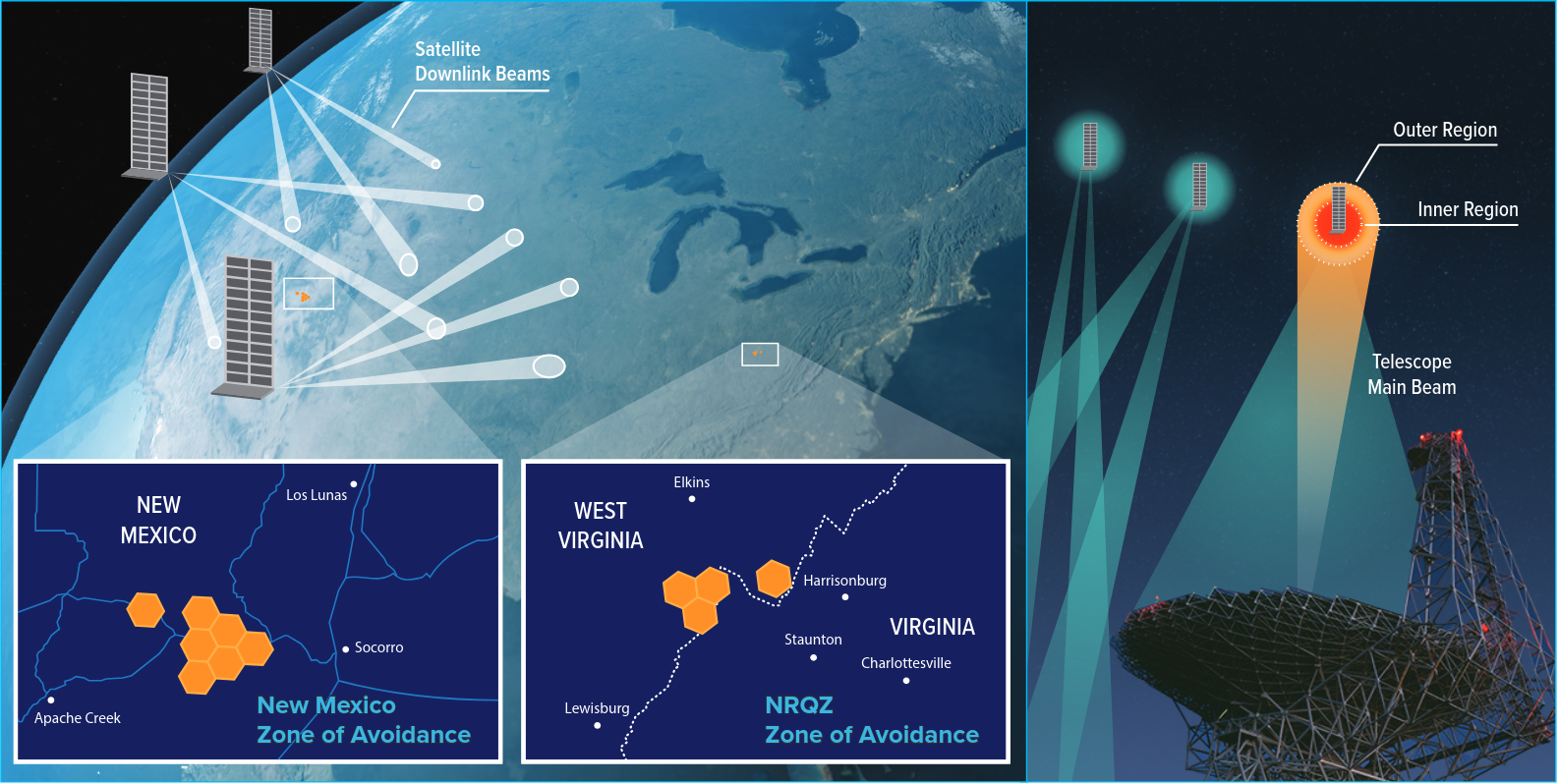
Figure 1 - A simplified illustration of the two approaches enabling spectrum coexistence between radio telescopes and satellite operators. (Left) Zone avoidance (ZA) provides the basic protection with satellites placing DL beams far away from radio telescopes residing within their 10.7-12.7 GHz internet service cells, highlighted by orange hexagonal hierarchical geospatial indexing regions in the lower insets, as reproduced from the Starlink Availability Map online in February 2025. (Right) Telescope boresight avoidance (TBA) provides an advanced protection when a satellite is passing close to the telescope main farfield beam (or boresight). The TBA consists of two modes: the inner boresight region (white dashed circle) where the satellite would briefly turn off the formation of phased array beams; and the outer boresight region (orange dashed annulus) within which the satellite places its DL beams far from the telescope site. (Credit: NRAO/SMD/Paul Vosteen).
To help inform satellite operators of the current telescope status, the Operational Data Sharing (ODS) system was developed to provide information about current and near future observations of participating radio telescopes, including where their antennas are pointing and at what frequencies they are observing. Satellite operators can dynamically query for this information to reconfigure any satellites that may interfere with the RA observations by either activating the TBA technique or other means of reducing the downlink RFI. Note that this technique is not meant to address the unintentional electromagnetic radiation (UEMR) from onboard electronics.
For more details about ODS, see the ODS documentation here.


Connect with NRAO