
The Impact of real-time RFI Blanking on HI 21 cm Observations
Introduction
To evaluate the impact of the Real-Time RFI Excision on HI 21 cm science with the VLA, two sets of high spectral resolution (15.625 kHz per channel) observations were acquired spanning the frequency range 951 – 1431 MHz. This range includes the frequencies of the HI 21 cm transition (νrest=1420.405752 MHz) from within our Galaxy and associated high-velocity clouds to extragalactic sources up to a redshift of z = 0.4936. This frequency range also corresponds to the OH 18 cm mainline transitions at νrest=1665.4018 MHz and νrest=1667.359 MHz for z = 0.1638 – 0.7512 and z = 0.1652– 0.7533, respectively.
Even though it is possible to tune the L-band receivers of the VLA down to 935 MHz, as noted in EVLA memo 204, a significant loss in sensitivity is seen below 950 MHz, hence the low end value for the covered frequency range in these observations.
The two observing sessions were carried out in June 2024, separated by three days, and spanned the same LST range to provide (almost) comparable RFI environments, especially from pulsed RFI (e.g., civilian DME and military TACAN systems).
Each observing session was 2 hr long. The calibrator source 3C286 (J1331+3030) and a field devoid of strong continuum sources (hereafter “blank field”) were observed in each session. The WIDAR correlator was configured to deliver 15 x 32 MHz subbands, each with 2048 spectral channels. The first observing session did not utilize the real-time RFI blanking mode, while the second one did with a blanking threshold of 5σ and a blanking duration of 10μs. The VLA was in the B-configuration with a maximum baseline of 11.1 km.
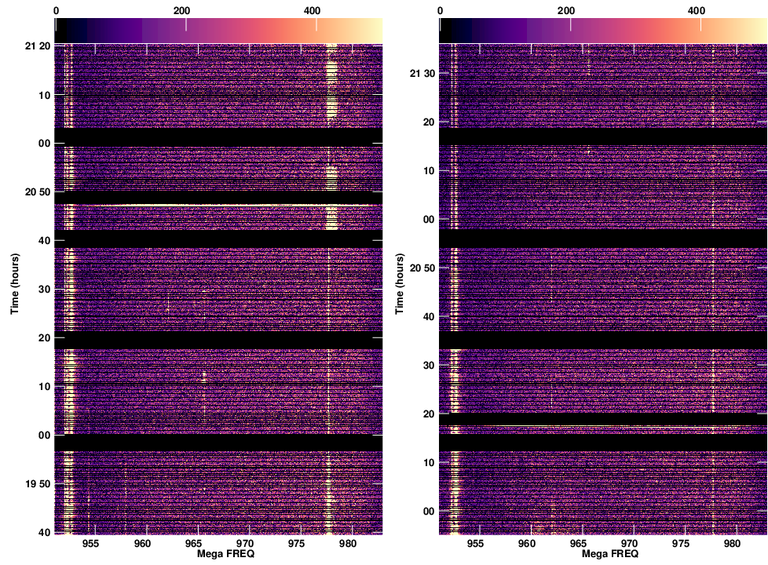
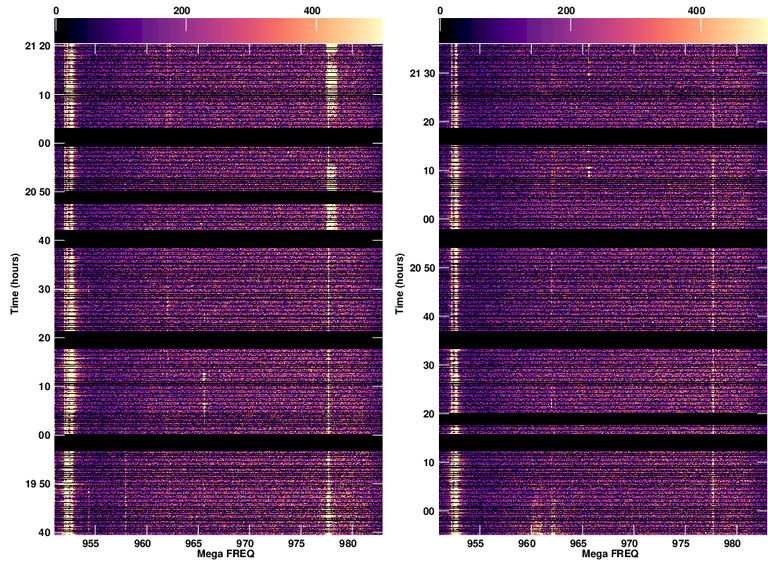
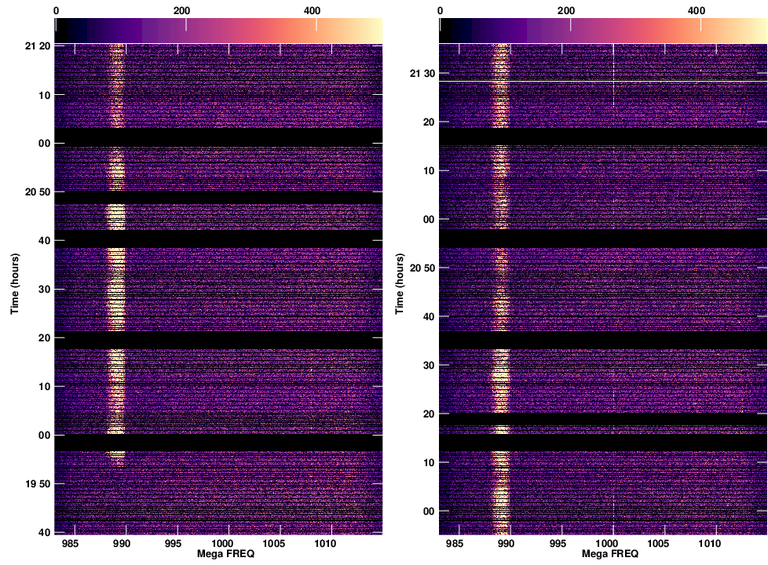
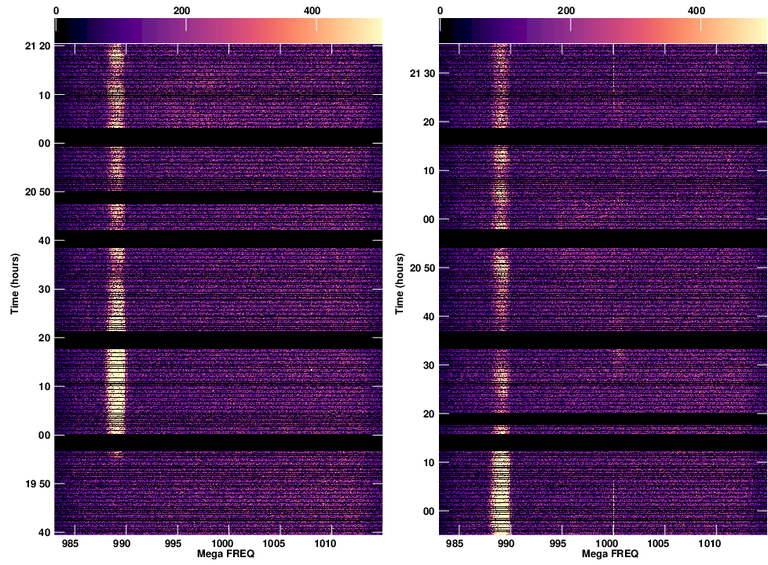
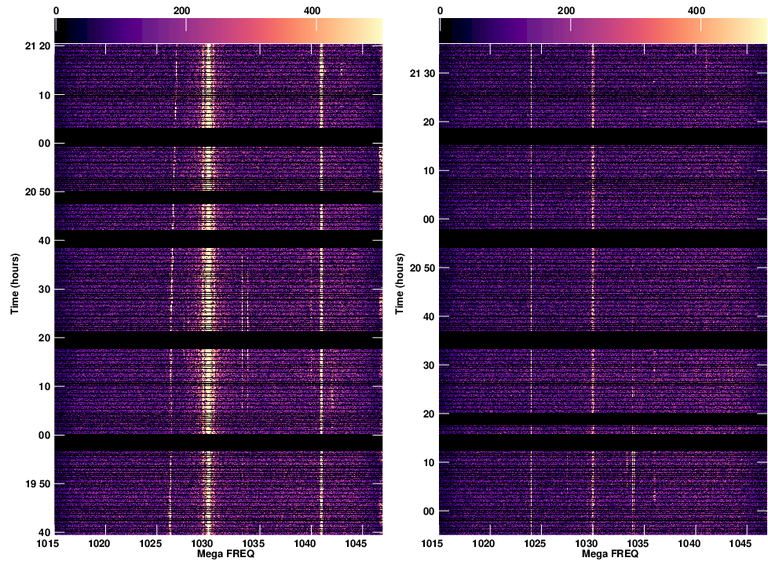
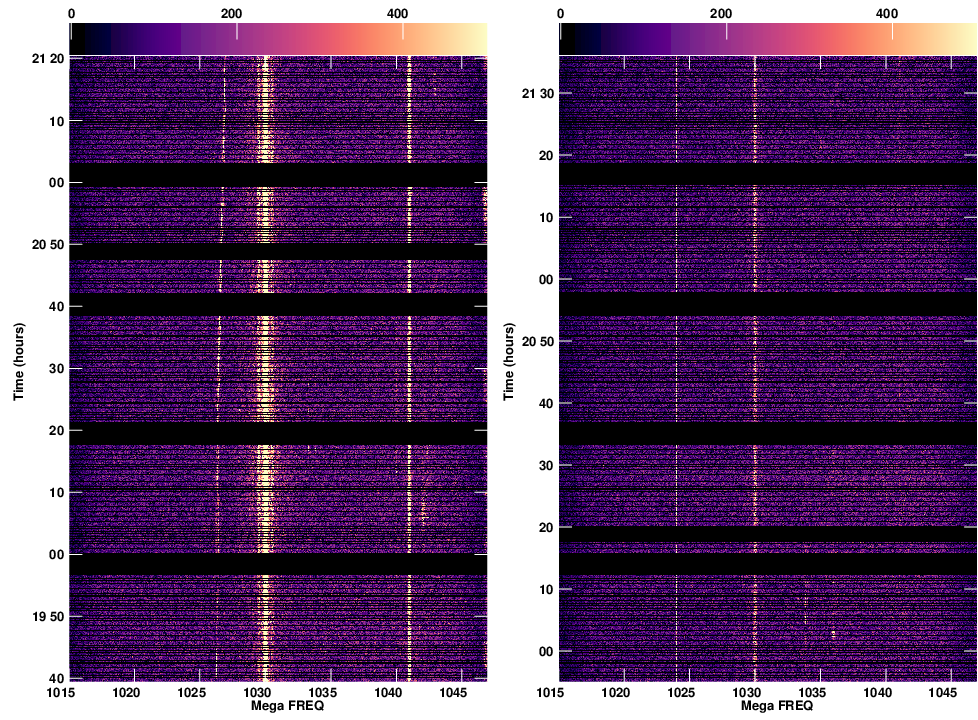
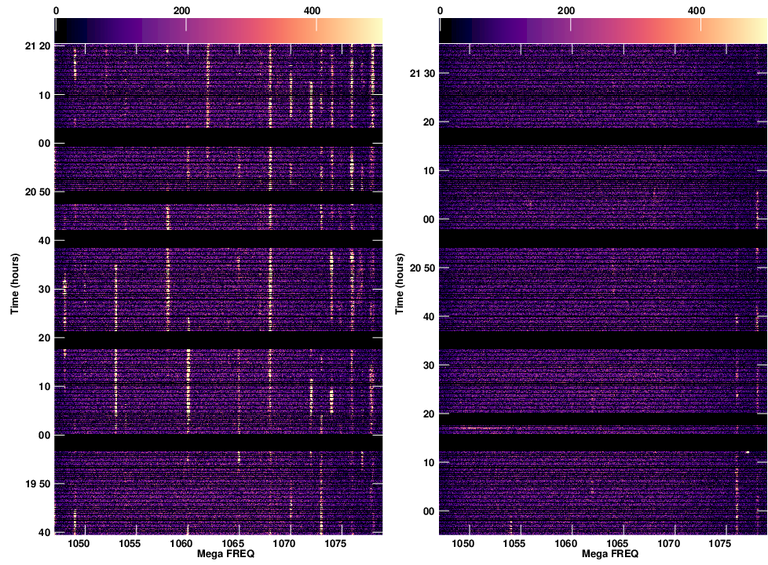
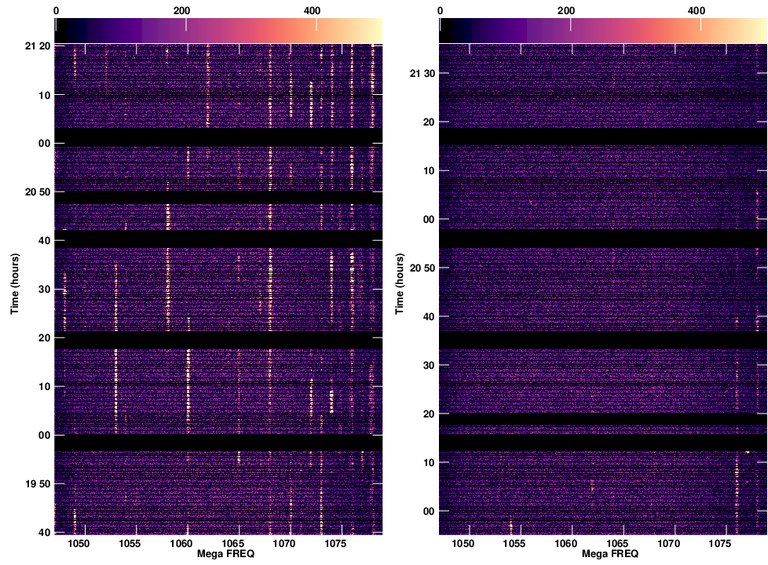
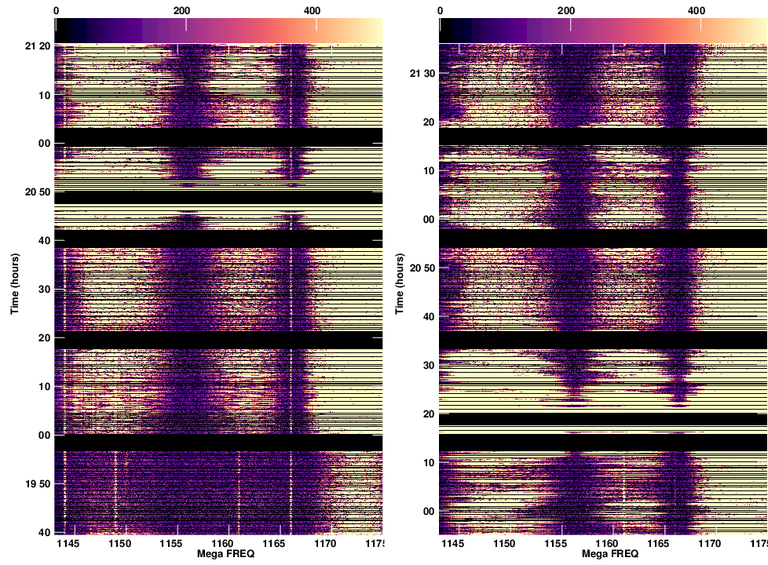
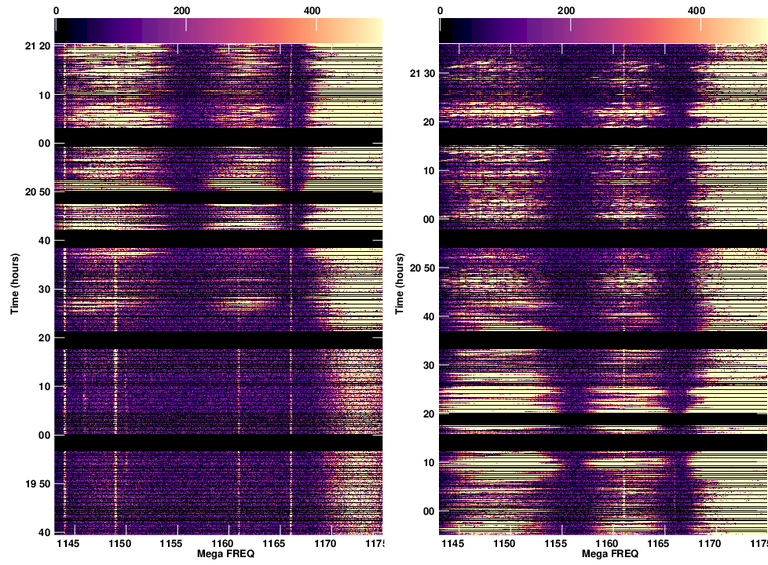
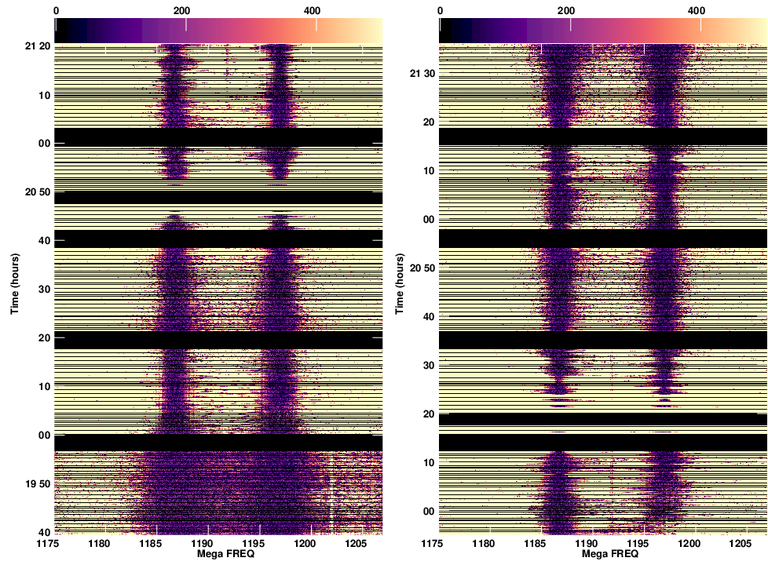
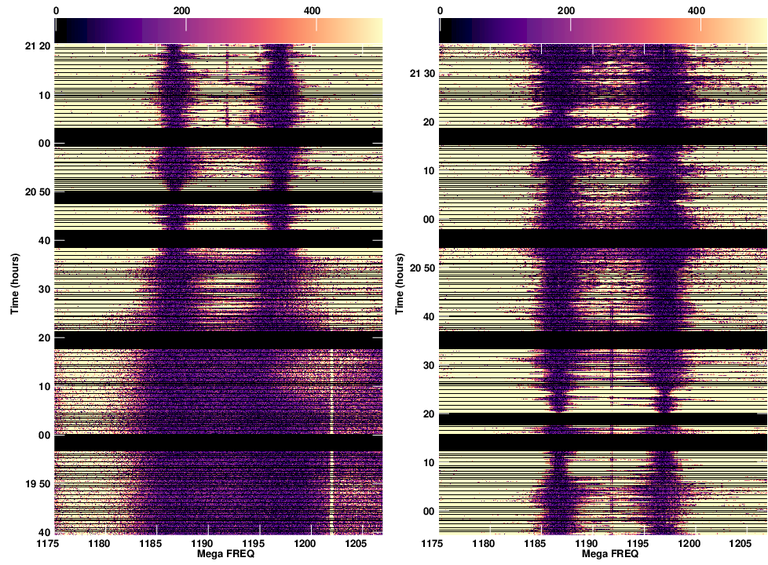
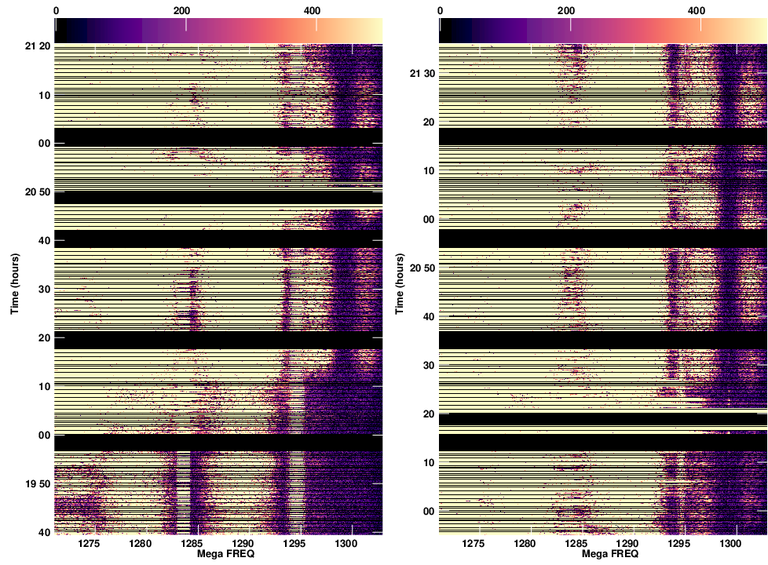
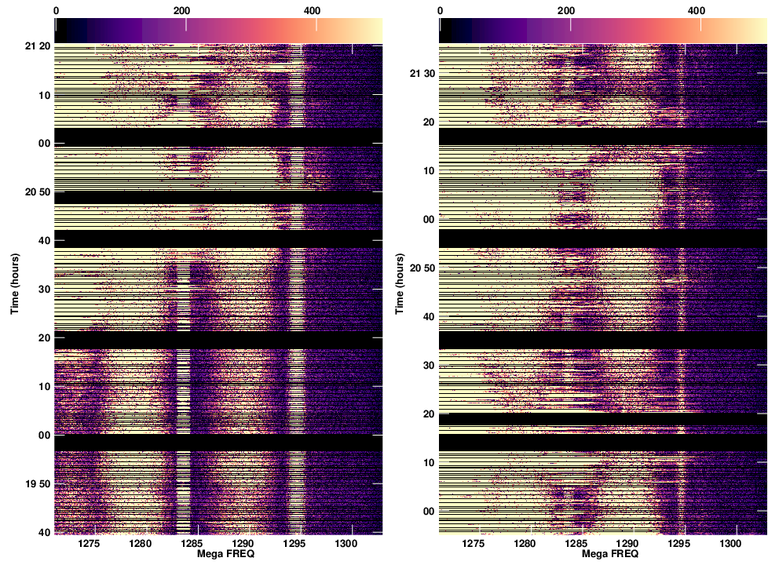
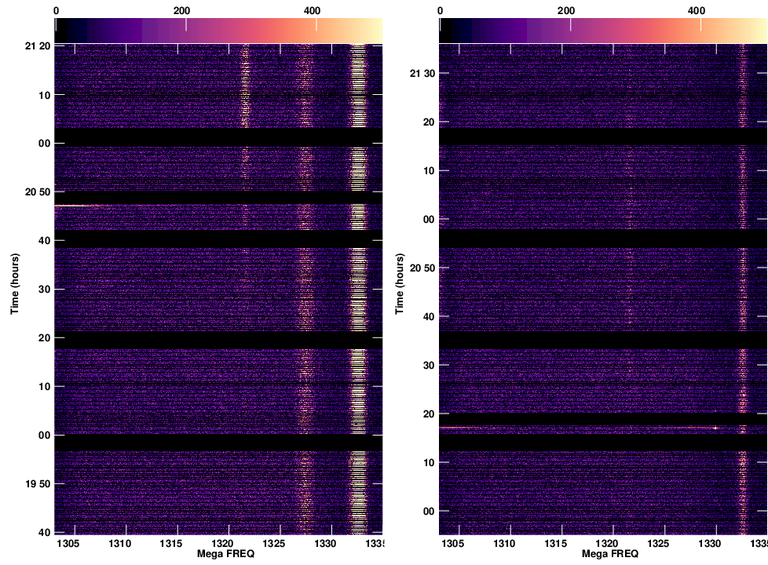
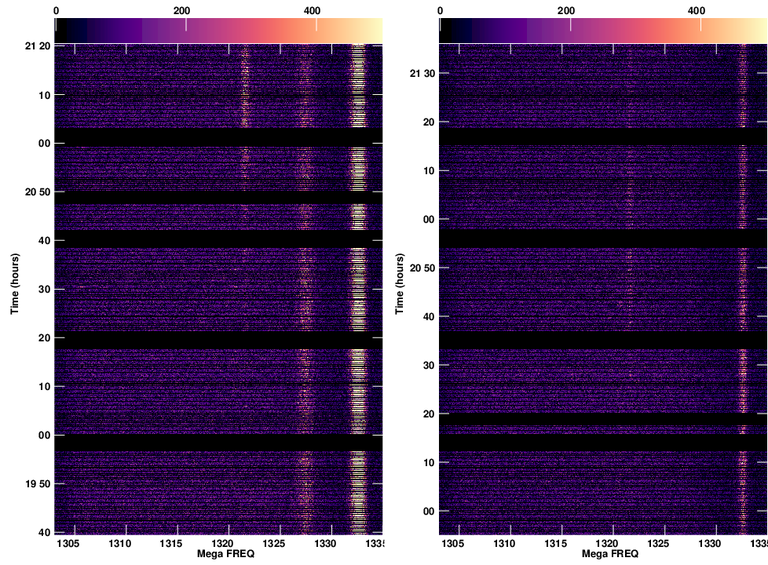
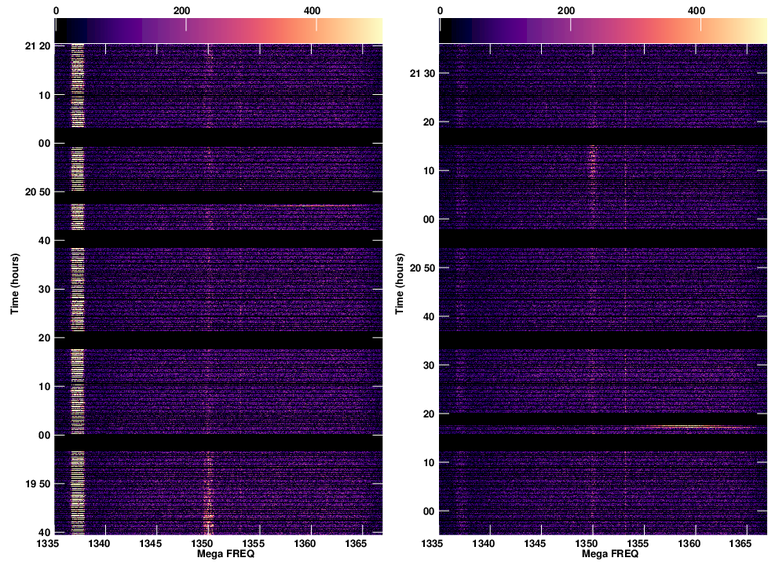
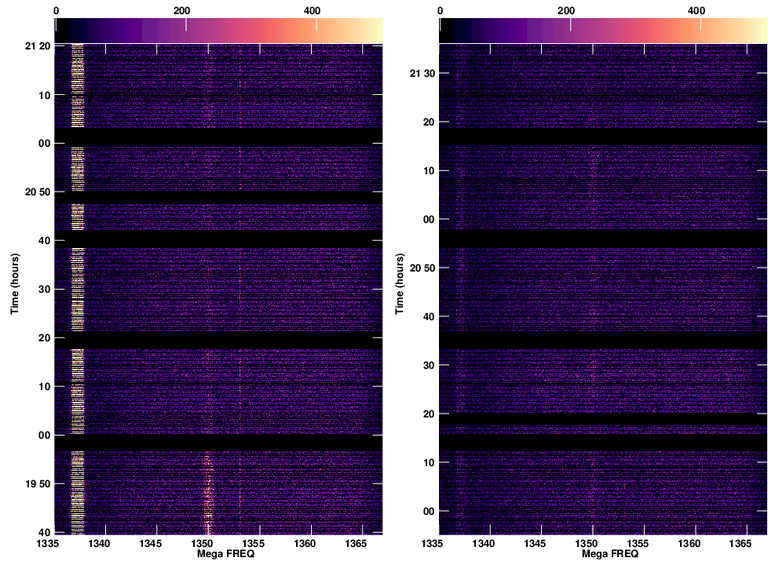
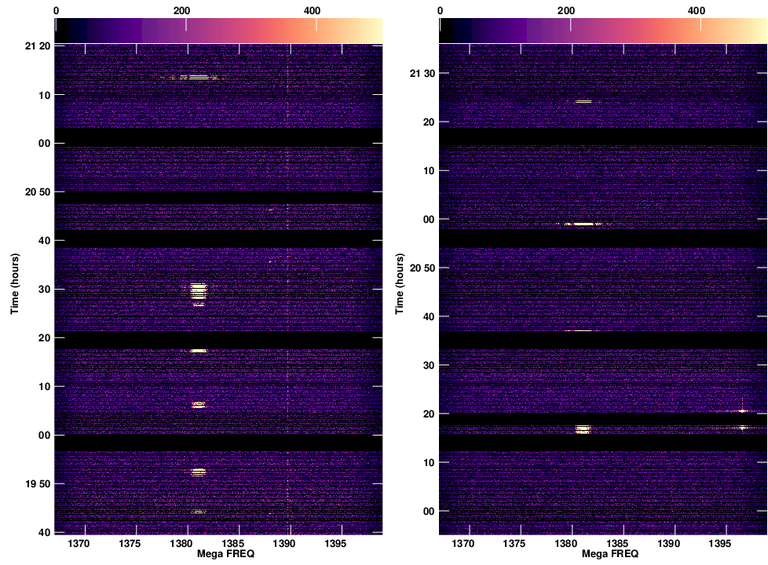
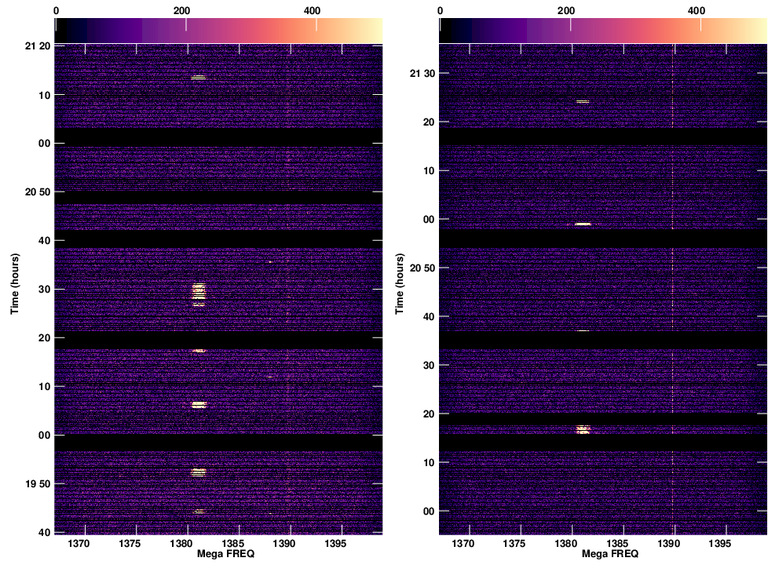
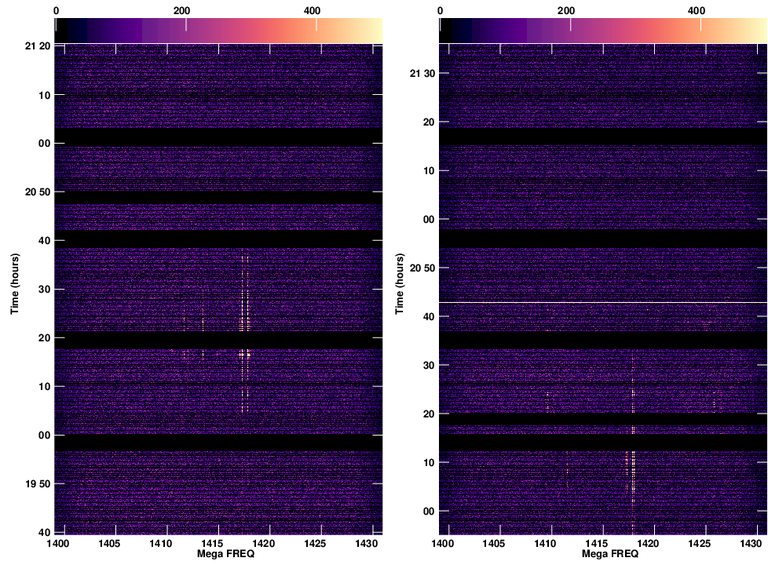
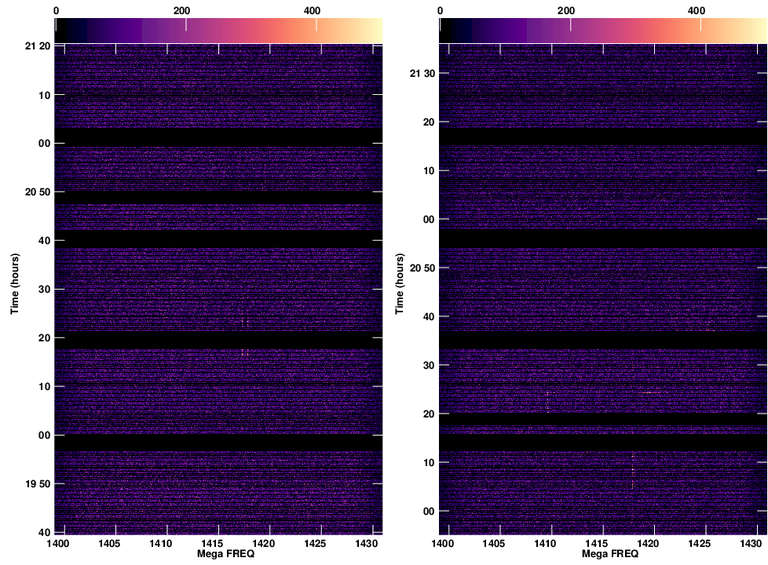
The flux density scale of the data was set using the Baars et al. 1977 coefficients for 3C286. Below, waterfall plots are presented for each 32 MHz subband in RR and in LL cross correlations using the data of the "blank field". All the baselines in the array are averaged while generating these plots. The left panels in these plots are of data without real-time RFI blanking, while the right panels are with real-time RFI blanking applied. All the plots use the same amplitude scale (0 – 500 mJy). Clicking on each figure opens a PDF version of the file. Note the improvement in the RFI environment especially in the frequency ranges 1025–1143 MHz and 1303–1365 MHz.
To address any differences due to observing on two days, such as wide-band satellite transmissions that may have a different impact from one day to another as seen below, but which cannot be removed by the RFI blanking technique, an observing session that includes both RFI blanked and non-blanked subbands spanning the same frequency ranges will be carried out, albeit with a lower spectral resolution.
Real-time RFI blanking, as utilized in these observations, is implemented in the default NRAO resources for L, S, C, X, and Ku-bands, and can be activated by the observer in custom resources (being for spectral line or otherwise) in the Resource Catalog Tool (RCT). For more details, see the RFI blanking page in the RCT manual. It is worth noting that the overall flagged data when real-time RFI blanking is utilized is expected to be less than 1% in a given observation.
951–983 MHz RR
(Left: No blanking, Right: With blanking)
951–983 MHz LL
(Left: No blanking, Right: With blanking)
983–1015 MHz RR
(Left: No blanking, Right: With blanking)
983–1015 MHz LL
(Left: No blanking, Right: With blanking)
1015–1047 MHz RR
(Left: No blanking, Right: With blanking)
1015–1047 MHz LL
(Left: No blanking, Right: With blanking)
1047–1079 MHz RR
(Left: No blanking, Right: With blanking)
1047–1079 MHz LL
(Left: No blanking, Right: With blanking)
1079–1111 MHz RR
(Left: No blanking, Right: With blanking)
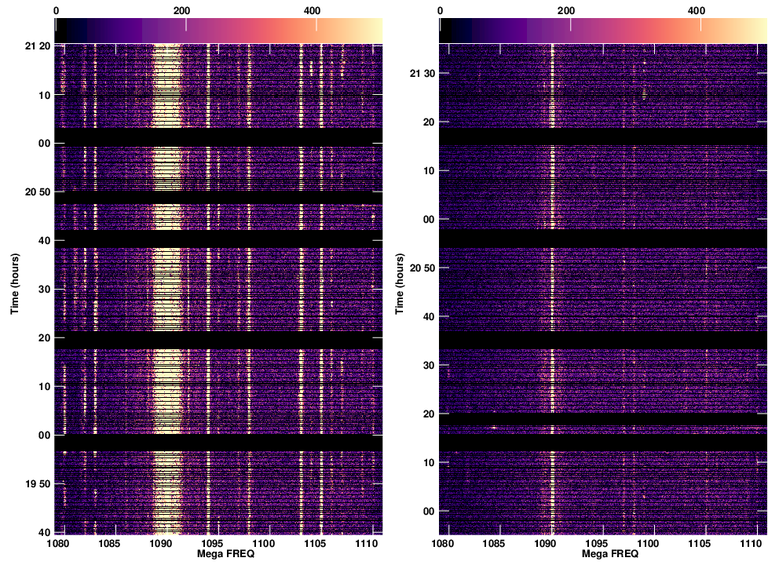
1079–1111 MHz LL
(Left: No blanking, Right: With blanking)
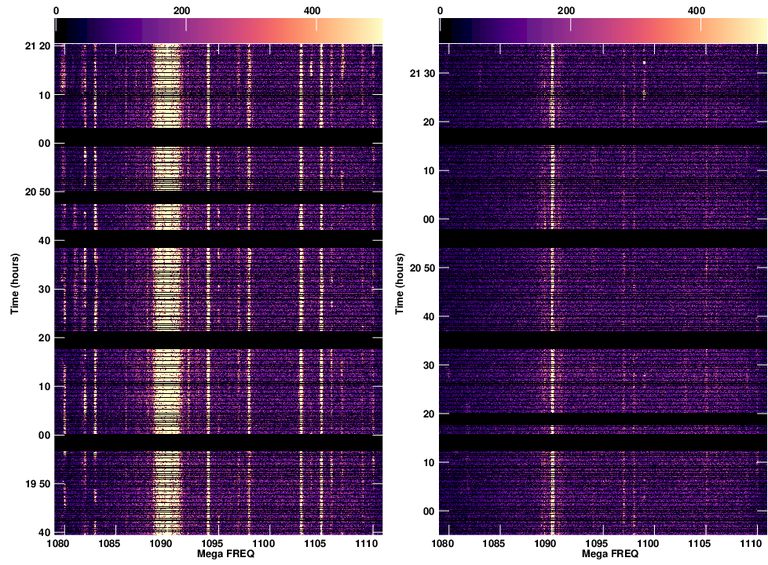
1111–1143 MHz RR
(Left: No blanking, Right: With blanking)
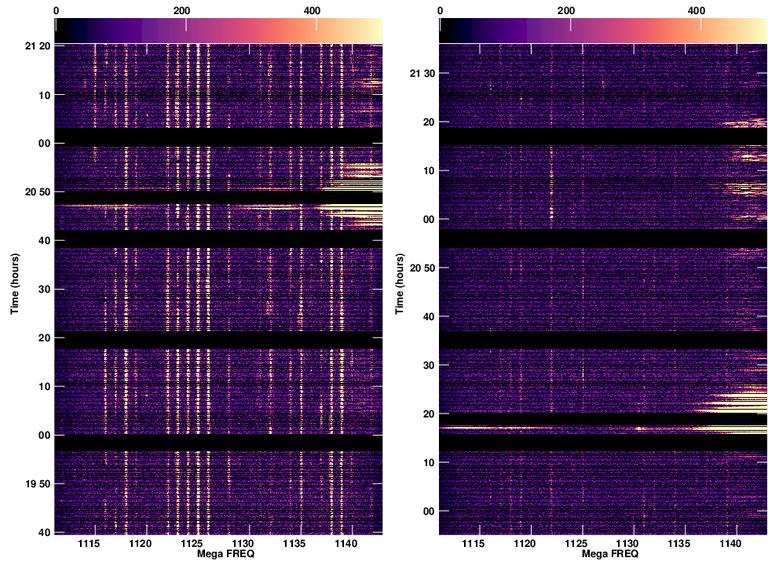
1111–1143 MHz LL
(Left: No blanking, Right: With blanking)
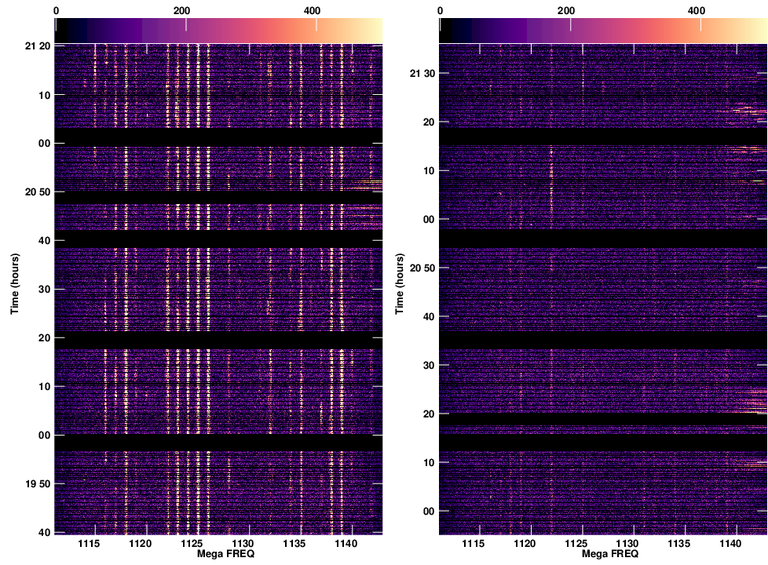
1143–1175 MHz RR
(Left: No blanking, Right: With blanking)
1143–1175 MHz LL
(Left: No blanking, Right: With blanking)
1175–1207 MHz RR
(Left: No blanking, Right: With blanking)
1175–1207 MHz LL
(Left: No blanking, Right: With blanking)
1207–1239 MHz RR
(Left: No blanking, Right: With blanking)
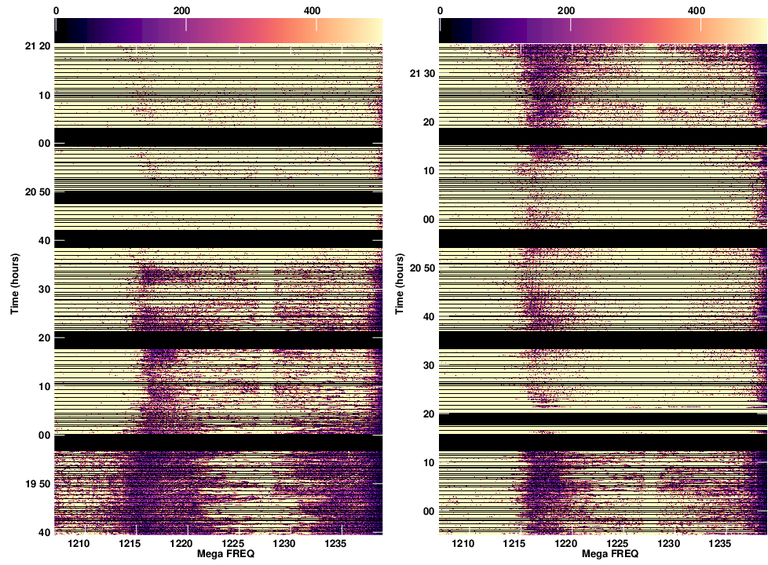
1207–1239 MHz LL
(Left: No blanking, Right: With blanking)
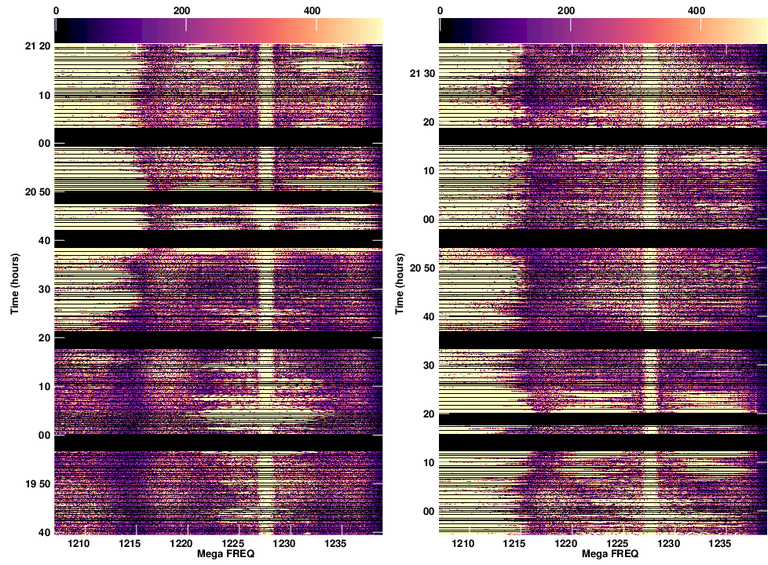
1239–1271 MHz RR
(Left: No blanking, Right: With blanking)
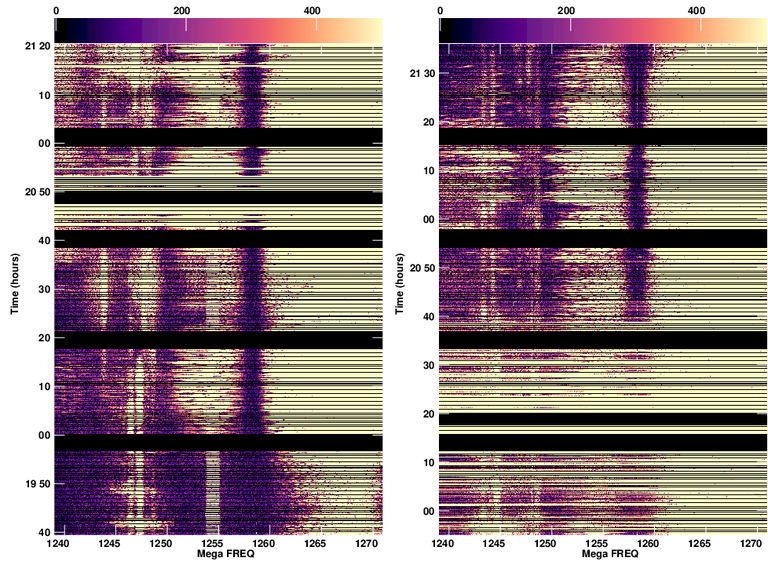
1239–1271 MHz LL
(Left: No blanking, Right: With blanking)
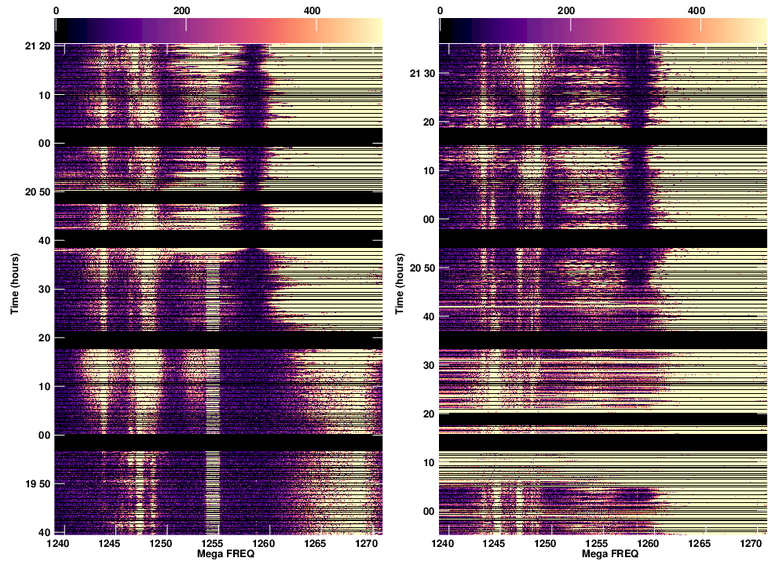
1271–1303 MHz RR
(Left: No blanking, Right: With blanking)
1271–1303 MHz LL
(Left: No blanking, Right: With blanking)
1303–1335 MHz RR
(Left: No blanking, Right: With blanking)
1303–1335 MHz LL
(Left: No blanking, Right: With blanking)
1335–1367 MHz RR
(Left: No blanking, Right: With blanking)
1335–1367 MHz LL
(Left: No blanking, Right: With blanking)
1367–1399 MHz RR
(Left: No blanking, Right: With blanking)
1367–1399 MHz LL
(Left: No blanking, Right: With blanking)
1399–1431 MHz RR
(Left: No blanking, Right: With blanking)
1399–1431 MHz LL
(Left: No blanking, Right: With blanking)



Connect with NRAO