
GBT Proposal Guide
The GBT 27A semester will run from February 1, 2027 through July 31, 2027.
Low Frequency Science Opportunities
Low frequency (below 8 GHz) projects, especially those that may require significant amounts of observing time per source or field, are strongly encouraged. Observations up to 200 hours per source or field at low frequencies is not unreasonable for the less subscribed LST ranges. Please see the LST pressure plots in the Proposal Results for previous semesters located here.
Scheduling Increments
Please note that the GBT is scheduled in 15 minute (0.25 hour) increments and that all proposals should request time appropriately for each session. Time requests for individual sessions will be rounded down to the nearest 0.25 hour increment.
Expected GBT available time
The GBT is expected to be shut down from May-September during the summer of 2027. During this shutdown, repairs to the GBT infrastructure will be performed. This includes azimuth wheel replacement, painting, track, and other work.
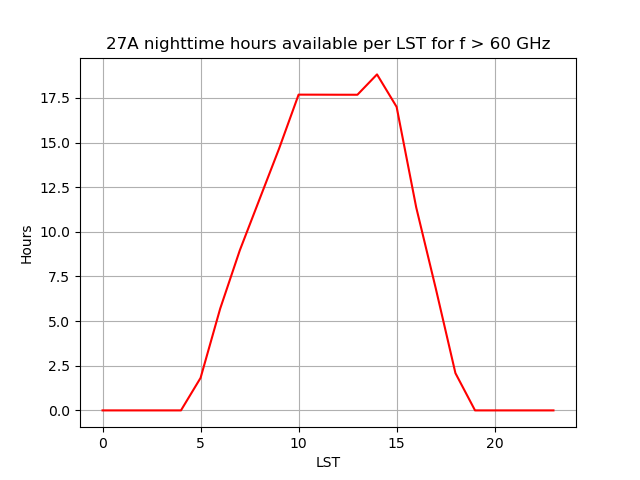
It is expected that there will be around 2000 hours available for astronomy in the 27A semester with 170 hours available for high frequency observations requiring nighttime conditions (MUSTANG-2, ARGUS and non-VLBI W-band).
We cannot guarantee that monitoring projects can be scheduled due to the planned infrastructure work. All monitoring requests are required to discuss how the infrastructure work (5 months of no observations) will impact their science goals.
Receiver Availability
Receivers available
Proposal requesting the 342 MHz, 800 MHz, L, S, UWB, C, X, Ku, KFPA, Ka, Q, W, MUSTANG-2, and Argus receivers will be considered for review as part of the 27A proposal call. The accepted proposals will determine which receivers are made available during the 27A semester. Note that the S and Ka-band receivers will only be considered to be made available if the proposal is ranked very highly (top 5-10%).
Receiver Restrictions
Proposals requesting the Ku-band receiver will be restricted to using only a single beam for the 27A proposal call.
Prime Focus Pressure and Expected Availability
There will be five receivers using the single prime focus receiver slot during the 27A semester. This will limit the availability of these receivers. The PF/800 MHz and UWB receivers will be available for one week per month following a regular cadence - only monthly monitoring will be considered. The PF/342 MHz receiver will be available monthly but on an irregular cadence that would not support regular monitoring observations. Two private receivers will also be deployed regularly during the semester. Requests for monitoring cadences that do not match the above restrictions will be rejected.
The PF/800 MHz receiver will only be available for monthly monitoring observations during the 27A semester. This receiver will be available on an irregular cadence beginning with the 27B semester.
GBT Capabilities
The GBO encourages proposals that take advantage of the GBT’s unique capabilities across 0.29 to 116 GHz frequency range. (Coverage is not available for 15.8-18.0 GHz, and 50.5-67.0 GHz).
Key science areas include, but are not limited to:
- low column density HI (NHI ≈1017 cm-2 galactic and extragalactic)
- star formation
- fast radio bursts
- galaxy and cluster evolution
- pulsars (searches and timing)
- cosmology
- radio recombination lines
- astrochemistry
- solar system science
Details of all GBT observing modes are in The Proposer's Guide for the Green Bank Telescope. Proposers should also consult the more general document The Performance of the GBT: A Guide for Planning Observations.
The GBT Large Proposal definitions
The definitions of Regular and Large proposals for the GBT are as follows:
- 0-8 GHz (Any weather)
- Regular: < 400 hours and lasting ≤ 1 year
- Large: ≥ 400 hours or lasting >1 year
- 8-18 and 27.5-50 GHz (Good weather)
- Regular: < 200 hours and lasting ≤ 1 year
- Large: ≥ 200 hours or lasting >1 year
- 18-27.5 and > 50 GHz (Excellent weather)
- Regular: < 100 hours and lasting ≤ 1.5 year
- Large: ≥ 100 hours or lasting >1.5 year
- Fixed and Monitoring proposals
- Regular: < 200 hours and lasting ≤ 1 year
- Large: ≥ 200 hours or lasting >1 year
Instrumentation
The GBT receivers, backends, and observing modes that are available for Semester 2027A proposals are listed in Tables 1 and 2 below.
|
Receiver |
Frequency Range |
Notes |
|---|---|---|
|
Prime Focus 1 (PF/342) |
290-395 MHz |
Available irregularly |
|
Prime Focus 1 (PF/800) |
680-920 MHz |
Available monthly in 27A and irregularly thereafter. Monitoring observations must have a monthly cadence and will only be for the 27A semester. |
|
Prime Focus 1 (PF/450 and PF/600) |
385-520 MHz and 510-690 MHz |
Not available |
|
Prime Focus 2 |
910-1230 MHz |
Not available |
|
Ultrawideband Receiver |
700-4000 MHz |
Available monthly. Monitoring observations must have a monthly cadence. |
|
L-band |
1.15-1.73 GHz |
|
|
S-band |
1.73-2.60 GHz |
Only to be considered for highly ranked proposals. |
|
C-band (linear polarization only – see below) |
3.95-7.8 GHz |
|
|
X-band |
7.8-12.0 GHz |
|
|
Ku-band |
12.0-15.4 GHz |
Limited to a single beam. |
|
K-band Focal Plane Array (7 pixels) |
18.0-27.5 GHz |
|
|
Ka-band |
26.0-39.5 GHz |
Only to be considered for highly ranked proposals. |
|
Q-band |
39.2-50.5 GHz |
|
|
W-band |
67-93 GHz |
|
|
ARGUS |
74-116 GHz |
See The ARGUS Observer's Web Page for further information |
|
MUSTANG-2 (shared-risk – see below) |
90 GHz, Shared Risk |
Private instrument – proposals must include instrumentation team (see below). |
Table 1
|
Backend |
Observing Modes |
|---|---|
|
Versatile Green Bank Astronomical Spectrometer (VEGAS) |
Continuum (see below), spectral line, pulsar |
|
Digital Continuum Receiver (DCR) |
Continuum |
|
Cyclic Spectroscopy |
Pulsar |
|
Caltech Continuum Backend (CCB) |
Continuum (Ka receiver only). |
|
Mark6 Very Long Baseline Array Disk Recorder |
Very Long Baseline Interferometry |
|
JPL Radar backend |
Private PI Instrument - Open for Public Use |
|
Breakthrough Listen |
Private PI Instrument, Shared Risk Need permission of BTL and GBO director (or scheduler) to submit proposal. |
Table 2
Permission required for instruments not listed as being available
Anyone requesting a receiver or instrument not listed as being available in the proposal call must have prior permission from the site director or the GBT schedulers before the proposal is submitted. Proposals that did not request permission will be rejected without consideration.
C-band Polarization
Proposals wishing to use the GBT C-band receiver should only use linear polarization outputs or perform full Stokes observations with calibration. The receiver is not optimally designed for circular polarization.
VLBI including the HSA and GMVA
Proposers should clearly justify the need for the GBT in the text of the proposal. All Very Long Baseline Interferometry (VLBI) proposals requesting the GBT should include any needed setup and overhead time in the time request of their proposals.
Proposals requesting the GBT as part of High Sensitivity Array (HSA), and Global 3mm VLBI Array (GMVA) should be submitted through the Very Long Baseline Array's call (available here).
C-band VLBI on the GBT
Observations using the GBT 6-cm (C band) receiver must be taken, correlated, and calibrated in full Stokes mode.
MUSTANG-2
The GBO will accept proposals for shared risk observations using the MUSTANG-2 instrument at the proposal deadline. More information on MUSTANG-2 can be found here. All MUSTANG-2 proposals must have permission from the instrument development team – contact Emily Moravec, Simon Dicker or Brian Mason.
Breakthrough Listen (BTL) backend
Proposers must seek permission from BTL and the GBO director (or scheduler) before submitting a 27A proposal to use the BTL backend.
The Breakthrough Listen project is making its backend available for shared-risk observations during the 2027A semester. The instrument consists of a cluster of 64 Titan X and 1080 GPU-based servers capturing 8-bit baseband voltages over up to 12 GHz of instantaneous bandwidth. Data rates are typically tens of TB/hr but a pipeline is available to generate spectra with adjustable frequency (> 3 Hz) and time (> 350 μs) resolutions, with possible science applications including fast radio transients, pulsar observations, stellar flares, SETI, etc. Before submitting a proposal, proposers must obtain permission from the Breakthrough Listen team. The team will consult on proposal preparation and data analysis. Any data acquired using the backend will be proprietary to the proposer per the standard policies.
More information including a technical description of the backend and team contact details can be found here.
Continuum Observations
Proposers wishing to perform continuum observations should consult with a GBO scientist.
RFI
The most recent RFI monitoring scans for the GBT can be found here. This tool allows you to explore scans that provide information on the frequencies that may encounter RFI. Note that a Green Bank computing account is required to be able to view this information.
If you do not have a Green Bank computing account please look here for pre-made RFI plots.You will not be able to manipulate these plots to obtain more detailed information.
If you wish to obtain more information on RFI near your desired frequencies, please contact the helpdesk to request the desired plots. This should be done well before the proposal deadline as we cannot guarantee rapid responses on the proposal deadline date.
Observing and Scheduling Constraints
The GBT is scheduled by the Dynamic Scheduling System (DSS). The DSS system is fully described in the GBT Proposer's Guide and the GBT Observer's Guide.
Mapping
If you are considering mapping with the GBT such that there are major turns or moves (end of rows in raster map, petals in daisy maps, changes in position for pointed maps, etc.) that occur with a cadence faster than every 30 seconds, you will need to consult with a GBT support scientist to ensure that the GBT can safely withstand the stresses induced by the mapping motions.
GBT Proposal Preparation
All proposals should state why the GBT is necessary for the requested observations in both the abstract and science justification.
Proposers who need assistance with their proposal should submit a helpdesk ticket via https://help.nrao.edu/. Proposers needing significant help should submit their requests to the helpdesk well before the deadline.
Proposers are encouraged to look at past proposal call results, especially the LST pressure plots, which can be found in the TAC proposal result reports located here.
All proposers, including pulsar proposers, should use the GBT Sensitivity Calculator. The Sensitivity Calculator results can be cut and pasted into the Technical Justification section of the proposal. This will streamline the creation of your Technical Justification and will lessen the chances for error.
If you are planning on making maps with the GBT, you should use the GBT Mapping Calculator tool.
The GBT observing policies describe the telescope's remote observing restrictions.
Proposers requesting GBT participation in High Sensitivity Array (HSA), Very Long Baseline Array (VLBA), or Global Millimeter Very Long Baseline Interferometry (GMVA) observations should consult the VLBA, HSA, and GMVA Proposal Call.



Connect with NRAO