
VLBA, HSA, and GMVA Proposal Guide
Proposal submission information for the following three combinations of telescopes are detailed in individual sections below:
- Very Long Baseline Array (VLBA) and High Sensitivity Array (HSA) proposals requesting time in Semester 2027A (2027 February 01 – 2027 July 31) or multi-semester proposals.
- Global mm VLBI Array (GMVA) proposals for 2027 Session I (2027 April 22 – 27), or later sessions.
VLBA Proposals
It is anticipated that there will be around 965 hours available for new Open Skies proposals on the VLBA in observing semester 2027A. In addition to Regular proposals, Large proposals (those which request 200 hours or more) are welcome on the VLBA. Such proposals should follow the instructions for Large proposals in the NRAO & GBO Users' Policy. It is anticipated that there will be around 390 hours available for new Large proposals on the VLBA in observing semester 2027A; users should see the note below on time availability and GST restrictions. Large proposals which require multi-semester observations are often supported. Filler proposals are also encouraged – these are scientifically useful programs, preferably utilizing the lower frequency bands of the VLBA, that can be scheduled over a large range of GST, require fewer than eight VLBA stations, and use short (2 – 6 hours) scheduling blocks. Such projects can help to fill gaps in the dynamic observing schedule.
Filler proposals can be submitted as Regular proposals or even Large proposals (the Users' Policy instructions for Large proposals still apply); either Large or Regular filler proposals can be multi-semester proposals if scientifically justified. Filler proposals should be explicitly identified as such and will normally only be considered for filler time (i.e., priority C) regardless of their ranking. See the instructions for Filler Programs in the NRAO & GBO Users' Policy for further information.
Overall information about the VLBA is available in the VLBA Observational Status Summary (OSS); specific sections relevant to various proposal types are linked below.
VLBA proposals must be prepared and submitted using the NRAO Proposal Submission Tool (PST), accessible via NRAO Interactive Services. Use of the PST requires registration by all proposers, including co-investigators, in the NRAO User Database.
Science Time Available
The availability of science time varies with GST, with less time available during daytime periods due to maintenance and at other GSTs due to multi-semester proposals approved at earlier calls that are continuing in 2027A. Plots below detail the anticipated time that is available to be allocated for different observing priorities in 2027A.
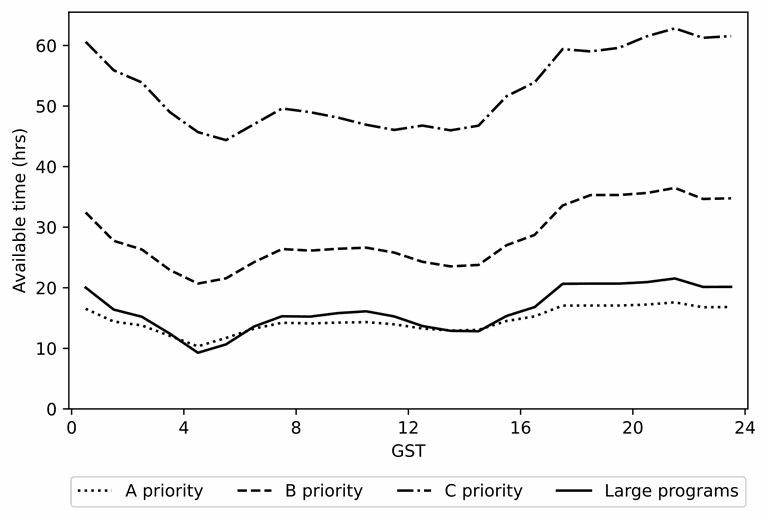
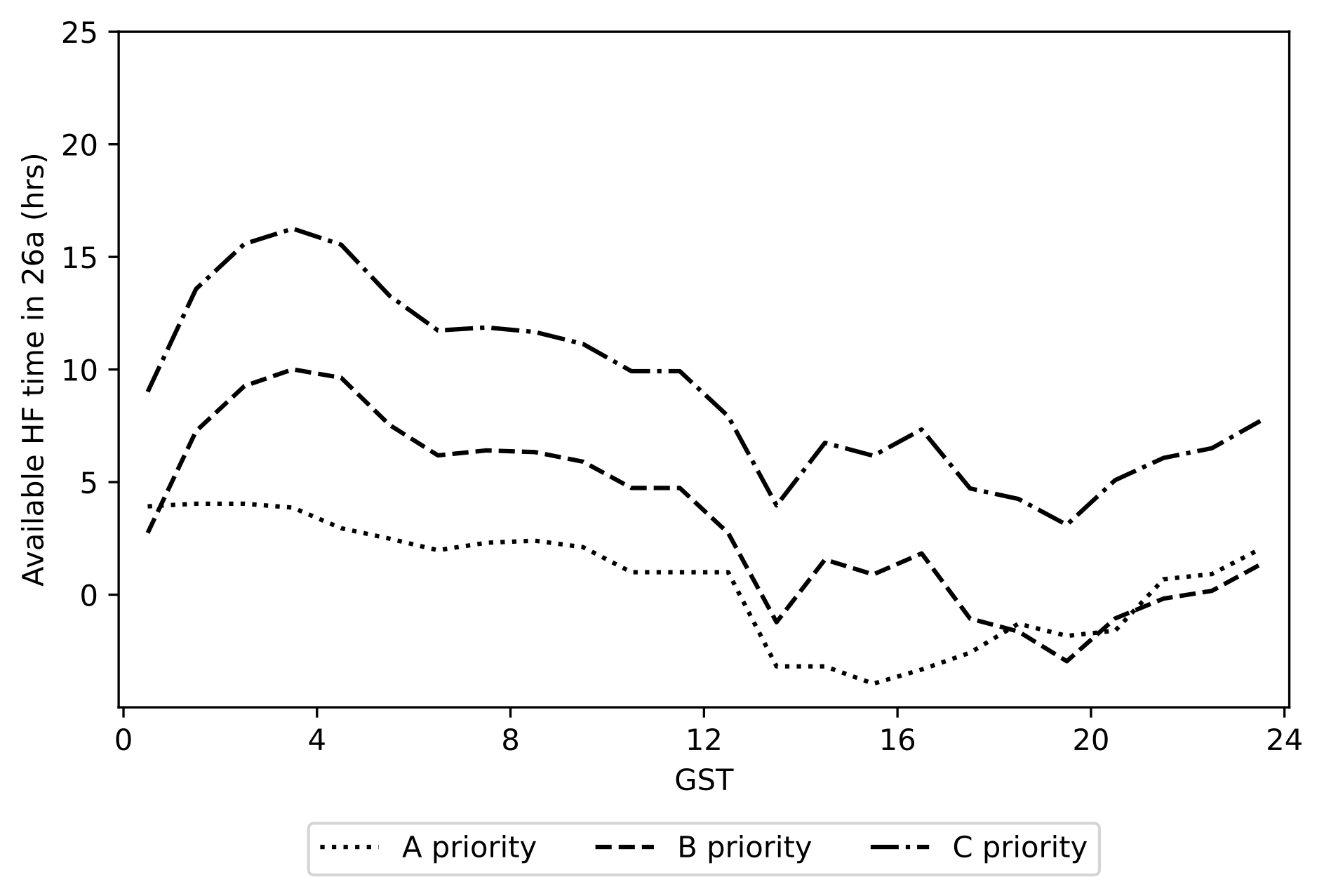
The upper plot shows the total estimated availability across all frequencies, while the lower plot shows the estimated availability for high frequency (> 12 GHz) observing. The upper plot also shows the estimated time available by GST hour for large proposals. The limit on large proposal time has been increased from 50% to 70% of the open skies time at any given GST, including time already allocated to large proposals from previous calls.
Large proposals: As can be seen from the above plots, there are no GSTs that are predicted to have limited availability of time for Large proposals in 2027A.
High frequency proposals: As can be seen from the lower plot, there are no GSTs that are predicted to have limited availability of time for HF proposals in 2027A. Note that filler time (C priority) is not awarded for observations in the 3mm (86 GHz) band. A limit on large proposal HF time has been introduced at 85% of open skies HF time at any given GST, including HF time already allocated to large proposals from previous calls.
Proposal pressure is a function of both availability and demand. In recent semesters, there has been lower demand in the approximate GST range 05:00 – 15:00 (± about an hour at each end) than in the GST range 15:00 – 05:00 (around the Galactic center), leading to lower proposal pressure in the 05:00 – 15:00 range. We expect this trend to continue.
Heightened pressure for VLBA time has increased the importance of setting the GST ranges of sessions accurately in the PST and, if possible, avoiding the regions of highest pressure (normally 15:00 - 05:00 GST ± about an hour at each end, as mentioned above) that can be seen in the pressure plot in the historical TAC reports.
As detailed in the PST Manual, the sessions defined in the PST are used by the TAC in their assignment of scheduling priorities, thus sessions that include the times of high pressure are likely to receive a lower scheduling priority than sessions with the same linear-rank science score in times of lower pressure. In particular, sessions with a 24-hour GST range (00:00 – 24:00) are guaranteed to pass through high pressure times and should be avoided if not essential (e.g., for actual 24 hour observations). Observations wanting a 24-hour GST range and triggered observations for which the GST range is not known a priori should explicitly set the GST range to 00:00 – 24:00 as this is no longer the default.
The "Guidelines for Creating VLA Sessions" in the PST Manual contain advice that is also useful in creating VLBA sessions; in particular, proposals with a small number of sources should put each target source into a separate session and proposals with a large number of sources should be broken into smaller sessions, grouping nearby sources by GST range.
Users are advised to use Sched or Planobs to manually define their GST range as detailed in the Guide to Proposing. The Calculate Min/Max GST button in the PST has been removed as the results could be misleading.
Most approved VLBA observations are performed dynamically; for those dynamic observations, users must either submit their observing (.key) files (to vlbiobs@nrao.edu) before the beginning of the semester (February 01 or August 01 for A and B semesters, respectively), or contact the VLBA Scheduler (schedsoc@nrao.edu) before those dates to avoid a reduction in scheduling priority. Observing files for HSA observations should also be submitted by the start of the semester to ensure that scheduling opportunities on the HSA can be taken when they arise. Early submission of schedules maximizes the opportunity of dynamic observing and assists in the efficient scheduling of the VLBA.
Observing Capabilities for 2027A
For the 2027A semester the General Observing (GO) capabilities are given in the Offered VLBA Capabilities during the Next Semester section of the Observational Status Summary (OSS) and are summarized in the following table. Several additional capabilities are available to proposers through the Shared Risk Observing (SRO) and Resident Shared Risk Observing (RSRO) programs, as described below.
The GO capabilities being offered are:
| Capability | Description |
|---|---|
| Receivers offered |
The VLBA has receivers covering the 90cm (P), 50cm (610), 21/18cm (L), 13cm* (S), 6cm (C), 4cm (X), 2cm (Ku), 1cm (K), 7mm (Q) and 3mm (W) VLBI bands * See the Frequency Bands and Performance section of the OSS for details of performance and notes on use |
| 4096 Mbps recording (requires DDC data system) |
|
| S/X Simultaneous Observations |
Up to 4096 Mbps recording rate total across both bands (but with reduced sensitivity). Note that VLA antennas do not have this capability, so S/X cannot be used with VLBA + Y1. See the Frequency Bands and Performance section of the OSS for details of performance and notes on use. |
| VLBA + Y1 | Adds a single VLA antenna (Y1) to the VLBA to provide a short (~50 km) baseline to the VLBA Pt station |
| Multiple Phase Centers | Up to 300 (or 150) phase centers at 4096 Mbps with a single correlator pass for dual polarization (or full polarization) products |
| Flexible Frequency Setup with the DDC data system |
|
| Flexible Spectral Resolution |
|
| Spectral Zooming |
During correlation, allows the selection of a narrower frequency window to have a large number of spectral channels
|
| Pulsar Modes |
Binary gating, matched-filter gating, and pulsar binning correlation modes for pulsar observations
|
The VLBA operates two data systems, a Polyphase Filterbank (PFB), and a Digital Downconverter (DDC). These are described in detail in the Roach Digital Backend (RDBE) section of the VLBA OSS, which also includes suggestions for selecting the optimal observing system for various scientific goals. For the best continuum sensitivity (i.e. 4096 Mbps) at most receiver bands, or for the most flexible observing setups, the DDC is the better choice. For continuum observations using the 20cm or 13cm receiver bands, the PFB provides a setup using 2048 Mbps that can reduce the impact of prevalent radio-frequency interference (RFI). It is worth noting that while the DDC mode provides wider bandwidth (4096 Mbps recording) and tuning flexibility, the PFB mode (2048 Mbps recording) provides more accurate amplitude calibration and should be used if <10% flux density accuracy is required.
Proposals to use the VLBA as part of an ad-hoc VLBI array including non-VLBA stations must state the other VLBI stations planned to be used in the 'Ad Hoc' box on the resources tab of the PST and as part of the technical justification. It is likely that any award of VLBA time will be conditional on time being awarded to use the other stations. If the VLBA correlator is to be used to correlate this observation, the correlator section of the technical justification should include a full description of this; proposals to correlate observations using a different correlator should note the limitations on baseband data copy in the VLBA Shared Risk Observing section (below). It will be the responsibility of the PI to coordinate the scheduling of ad-hoc VLBI stations and the transfer of data from those stations to the VLBA correlator. The inclusion of non-NRAO facilities is at the risk of the proposer and no guarantee is made that observations that fail due to problems with non-NRAO facilities will be rescheduled.
Correlator capabilities are discussed in the DiFX Correlator section of the OSS. Proposals requiring significant additional correlator resources beyond that required for standard observing, such as multiple phase centers per field or multiple pulsar phase bins, should consider mechanisms to support the correlation without adversely affecting the throughput of other projects. These should be entered in the technical justification section of the proposal. A scientific justification for requests for large correlator resources should be given in the scientific justification section of the proposal.
VLBA Shared Risk Observing
The VLBA Shared Risk Observing (SRO) program allows observers access to capabilities that are essentially commissioned, but are not well tested. The following capabilities are offered under the SRO program during the 2027A semester:
- Baseband Data Copy: Limited amounts of raw data recorded at each station can be copied to user-supplied media or transferred via e-transfer (if a compatible e-transfer system is available at the user's site), for correlation at a different location. See the VLBA OSS SRO section for more details.
- Real-time Correlation: Limited amounts of raw data can be correlated in real time, with limitations. See the VLBA OSS SRO section for details.
- Y3+VLBA: Observing with the VLBA plus the outer three antennas of the VLA in A configuration. This is only available for semesters with VLA A configuration. See the Y3+VLBA page for additional details.
Proposers should be aware that SRO projects will not be carried over to future semesters if they cannot be scheduled or observations fail for reasons associated with the shared risk component(s) of the observations, even if awarded scheduling priority A.
VLBA Resident Shared Risk Observing
The VLBA Resident Shared Risk Observing (RSRO) program provides users with early access to new capabilities in exchange for a period of residency in Socorro to help commission those capabilities. For example, the phased-VLA system was developed through RSRO programs. Users are encouraged to conceive and propose innovative ideas for new VLBA capabilities. Some staff suggestions, such as Y3 Reference Pointing Mode Observing, can be found at the VLBA RSRO program section of the VLBA OSS. For details about participating in the RSRO program, see the RSRO Considerations section of the Submission Guidelines page in the Guide to Proposing for the VLBA
Users wishing to propose a RSRO program should select the VLBA RSRO observing mode in the resources section of the PST in order to submit their proposal as a RSRO program.
Proposers should be aware that RSRO projects are generally not approved at scheduling priority A, owing to the level of risk associated with these observations. Also, RSRO proposals will not be carried over to future semesters if they cannot be scheduled, similar to SRO proposals.
High Sensitivity Array (HSA) Proposals
The HSA comprises the VLBA, phased VLA, GBT, and Effelsberg telescopes. Similar to the VLBA, all of the HSA stations can observe at 4096 Mbps (General Observing) at 6 cm and shorter wavelength bands. Details on the HSA telescopes are documented in the HSA section of the VLBA OSS, and special considerations on proposing and observing are listed in the HSA page of the Guide to Proposing for the VLBA.
VLBI observations combining the VLBA with any one or more of the other three HSA stations can be requested in a single HSA proposal. HSA proposals requesting only VLBI use of HSA telescopes should not be identified as Joint proposals. However, separate proposals must be submitted for any non-VLBI use of any requested telescopes.
HSA proposals must be prepared and submitted using the NRAO Proposal Submission Tool (PST), accessible via NRAO Interactive Services. Use of the PST requires registration by all proposers, including co-investigators, in the NRAO User Database. The inclusion of HSA stations should be quantitatively justified in the proposal.
Observing files for HSA observations should be submitted by the start of the semester to ensure that scheduling opportunities on the HSA can be taken when they arise.
HSA Station Notes
• The phased Very Large Array (Y27) will be available for HSA observing during Semester 2027A in the B (2027 March 03 to June 14) and A (2027 June 26 to October 25) configurations, and during reconfigurations. Please note that high frequencies (at receiver bands 22 GHz and above) have better phasing in the more compact configurations (C and D), and also that high frequency phasing in the summer can be quite difficult, particularly in the extended configurations. For more details, see VLBI at the VLA.
Wide-band correlation of VLA-only data in parallel with the VLBI recording is offered for 27A as General Observing (GO). This supports standard VLA 8-bit continuum modes with a 2-GHz bandwidth. If your science requires these wide-band correlations, you should explain this and justify your need for wide-band correlations in the top box of the Technical Justification of your proposal in the PST. Proposals for recording wide-band correlation of VLA-only data using modes other than standard VLA 8-bit continuum with 2-GHz bandwidth can be submitted as Resident Shared Risk Observing (RSRO) proposals; see the VLBA RSRO section of the OSS for details of the RSRO program.
• The Green Bank Telescope (Gb): Proposers should clearly justify the need for the GBT in the text of the proposal. All proposers requesting the GBT should include any needed setup and overhead time in the total time request for their proposals.
Observations using the GBT 6-cm (C band) receiver as part of the HSA must be taken, correlated, and calibrated in full Stokes mode.
Please see the GBT Proposal Guide for receiver availability, time availability, and other relevant factors regarding the GBT's participation in HSA observations.
Due to infrastructure work on the GBT, the GBT will not be available to participate in VLBI observations from the beginning of May until mid-October in 2027. This is expected to be the situation over the next several years.
HSA Monitoring proposals requesting the GBT are required to discuss the impacts of summer shutdowns or else risk the proposal being fully rejected on technical grounds. See the "Expected GBT available time" section in the GBT Proposal Guide under the full proposal call.
• The Effelsberg (Eb) 100-m telescope supports both the PFB and DDC observing systems available on the VLBA. Consult this web page for more detailed information about the Eb HSA station.
Global mm VLBI Array (GMVA) Proposals
GMVA proposals submitted for the semester 2027A deadline will be considered for scheduling in 2027 Session I (2027 April 22 – 27), or later sessions.
Complete information on the GMVA is available at the GMVA website. Ongoing special considerations are documented in the GMVA section of the VLBA OSS; new features and/or special cases are cited here.
GMVA proposals must be prepared and submitted using the NRAO Proposal Submission Tool (PST), accessible via NRAO Interactive Services. Use of the PST requires registration by all proposers, including co-investigators, in the NRAO User Database.
Please note that the formatting requirements for the scientific justification given in the NRAO & GBO Users' Policy Manual, in particular the requirement for 1" (2.54 cm) margins, apply to GMVA proposals.
Sensitivity:
Proposers should use the EVN Observation Planner tool or the old EVN Sensitivity Calculator to estimate their sensitivity. See http://go.nrao.edu/vlba-expcalc for detailed instructions.
NOTE: The 3mm noise estimates provided by both the Observation Planner and the old EVN Sensitivity Calculator use SEFD values determined during reasonably good weather and while the antennas were performing well. Because real-world conditions are often less than ideal, the actual noise levels obtained during observations may be significantly worse. This is especially true for GMVA observations, which are observed on fixed dates and cannot be rescheduled due to poor weather. When planning for GMVA observations, users are encouraged to assume the actual noise will be roughly 3 times higher than the tool’s estimate.
The GMVA will record at the highest bit rate which instrumentation and resources permit. Currently all telescopes will record at 4096 Mbps.
Station notes:
The KVN, or the Greenland Telescope (GLT) must be specified by entering "KVN" or "GLT" as "Other" entries in the PST. If the Hancock (HN) or Saint Croix (SC) VLBA antennas (which are not normally included in the GMVA) are requested at 7mm, these should be specified by entering "HN" or "SC" as "Other" entries in the PST.
Apex should now be specified by selecting "Ax" under 'Members' in the PST. The codes for NOEMA and Yebes have also been updated to "Nn" and "Ys".
Proposals requesting the GBT should clearly justify the need for the GBT in the text of the proposal. All proposers requesting the GBT should include any needed setup and overhead time in the total time request for their proposals.
Observations at 7mm with the VLBA antennas can be scheduled as part of a GMVA program during what would otherwise be gaps in observing while other antennas are making pointing or calibration observations. Such observations can be included in GMVA proposals.
New GMVA proposals requesting phased ALMA should not be submitted at the semester 2027A deadline. Only proposals which were re-proposed at the Cycle 13 ALMA deadline – those that were approved for GMVA Session 2026/I but failed at ALMA – will be considered.
Documentation and Assistance
Detailed information about the VLBA instrument, its capabilities, observing strategies, proposal preparation and submission, and observation preparation, can be found in the VLBA Observational Status Summary, at the Guide to Proposing for the VLBA, and at the Observing with the VLBA web pages. Questions should be directed to the NRAO Helpdesk.



Connect with NRAO