
test collection
Proposal Process and Opportunities
NRAO Telescope Time Allocation Process
Proposals to the National Radio Astronomy Observatory (NRAO) for the scientific use of its telescopes are evaluated on the basis of scientific merit and technical feasibility using a panel-based proposal review system.
Joint Observing Program
Observations that require combinations of the GBT, VLBA, and/or the VLA should submit a proposal for each of the requested telescopes. The same Scientific Justification should be submitted with each proposal, and it should contain a clear justification for each telescope requested. VLBI proposals which request the GBT or VLA as elements of the VLBI array do not need separate proposals. For more details see the Joint Proposal page.
Access to joint observations with external facilities will continue for the VLA, VLBA and GBT for semester 26B. This includes joint observations with ALMA, the James Webb Space Telescope (JWST), the Hubble Space Telescope (HST), the Swift Gamma-Ray Burst MIssion, the Chandra X-ray Observatory, the XMM-Newton Project, the Imaging X-ray Polarimetry Explorer (IXPE), and the Fermi Gamma-ray Space Telescope. For more details see the Joint Proposal page.
Director's Discretionary Time Including Education and Public Outreach
Proposals for Director's Discretionary Time (DDT) may be submitted at any time. They must be submitted through the PST. DDT proposals are intended to address targets of opportunity, high-risk/high-return exploratory time, or other science opportunities deemed sufficiently urgent to justify prompt action.
DDT proposals may also be submitted for the purpose of education and public outreach---for example, to image an iconic source or to support an educational opportunity for students. Such proposals should clearly justify the requirements for the requested time allocation and observing mode on any given instrument, and should describe the anticipated impact of the observation.
While there is not an a priori limit to time that can be requested via DDT, it is expected that no more than 5% of the available science time on each telescope will be allocated for this purpose.
Technical Proposals
Proposals that are primarily focused on technical issues are allowed. But the authors must include in the Scientific Justification how the results from the proposed observations will enable Science in the future. For example, a proposal to develop a new strategy to improve phase calibration at high frequencies is acceptable, whereas a proposal to find good high frequency calibrators is the responsibility of the observatory (e.g., test time).
Other Proposal Opportunities
The NRAO would like to make users aware that there are additional proposal opportunities as follows:
- High Risk Proposals: As a means of maximizing its scientific impact through cutting-edge observations, the Observatory encourages the submission of high-risk/high-reward proposals.
- Commensal Observing: Commensal observations can be an effective way to maximize observing hours on NRAO telescopes, by allowing multiple experiments or systems to run simultaneously, when resources allow. The Observatory may support two kinds of commensal observing: commensal observing projects, and commensal systems. For more information see the Commensal Observing with NRAO Telescopes page.
- Filler Programs: Some programs are not time critical, not strongly dependent on array configuration, or do not require highly subscribed LST ranges. Such programs may be able to take advantage of "filler" time. The proposal should make clear in the abstract and early in the science justification that "filler" time is being requested. If “filler” time is requested, the proposal will be ineligible for scheduling priority A or B.
- ANY Configuration Proposals: We encourage VLA proposals that can utilize time in the move configurations to be submitted as using 'ANY' configuration. During the antenna move periods, the observing pressure can be much lower compared to in the standard configurations, providing increased probability for flexible configuration scheduling blocks to be observed.
Further information about each of these programs can be found on the Proposal Opportunities page.
VLA Proposal Guide
VLA Configuration Plans and Science Time Available
The February 4th, 2026 proposal deadline covers the observing period October 29, 2026 through February 8, 2027 (Semester 2026B), corresponding to the C configuration of the VLA. Multi-configuration proposals that include this configuration may also be submitted. Additionally, proposals requesting only configurations that will fall in semester 2026B (or later) may be submitted if the Principal Investigator is a graduate student. NRAO offers this service to provide scientific and technical feedback for students, and to provide them with an opportunity to re-submit their proposals for their principal semester with this information in hand. Students should ensure that their status is up to date and correct in the NRAO User Database. Please refer to the VLA Configuration Plans for details and availability of upcoming configurations.
A plot of estimated available observing hours as a function of LST for C configuration in semester 2026B are shown below. In this plot, engineering, maintenance, and testing cause the solid (upper) line to be less than the total number of LST days in this configuration; such activities occur predominantly during daytime.
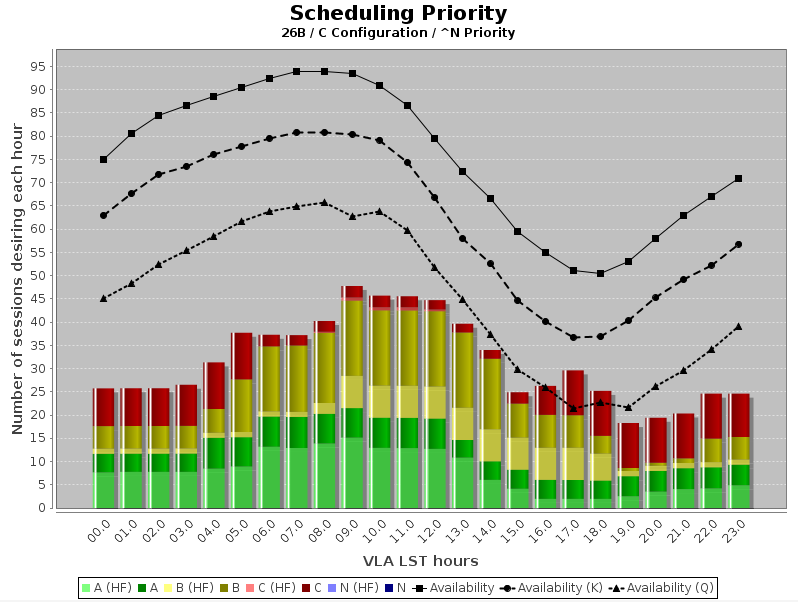
Estimated science time available per LST hour is shown by the solid (upper) black line for all frequencies, the dashed (middle) line for K-band conditions, and dotted (lower) line for Q-band conditions. The colored bars show pre-committed time where green represents priority A, yellow priority B, and red priority C and D. The lighter green, yellow, and red represent high frequency (HF; K through Q bands) priority A, B, and C, respectively. For the net available time in this configuration per LST hour subtract the bars of the pre-committed time from the black curve. The pre-committed time in this plot consists of A-priority not completed in previous configurations and proposals from previous semesters that requested future configurations.
By the start of the 2026B semester, VLASS observing will be complete with no further needs for VLASS carve-out time. As a result the C configuration will be on average 2-3 weeks longer compared to the last 8 years, adding to the open-skies availability.
In total, we expect about 1200 hours to be available for open skies observing in the 2026B semester for the C configuration.
VLA Proposal Types
In addition to Regular Proposals, Large proposals (those which request 200 hours or more) are particularly encouraged and welcome on the VLA. Such proposals should follow the instructions for Large proposals in the NRAO & GBO Users' Policy. Large proposals which require multi-semester observations are often supported. Filler proposals are also encouraged – these are scientifically useful programs, preferably utilizing the lower frequency bands of the VLA, that can be scheduled over a large range of LST using short (2 hours or less) scheduling blocks. Such projects can help to fill gaps in the dynamic observing schedule. Programs requesting time at lower frequencies (C-, S-, and L-bands) are particularly encouraged.
Filler proposals can be submitted as Regular proposals or Large proposals (the Users' Policy instructions for Large proposals still apply); either Large or Regular filler proposals can be multi-semester proposals if scientifically justified. Filler proposals should be explicitly identified as such and will normally only be considered for filler time (i.e., priority C) regardless of their ranking. See the instructions for Filler Programs in the NRAO & GBO Users' Policy for further information.
Observing Capabilities for Semester 2026B
For the 2026B semester the General Observing (GO) capabilities are given in the Offered VLA Capabilities during the Next Semester section of the Observational Status Summary (OSS) and are summarized in the following table. Several additional capabilities are available to proposers through the Shared Risk Observing (SRO) and Resident Shared Risk Observing (RSRO) programs, as described below.
Important Update: Starting with the 24B Call for Proposals, the VLA General Observing Setup Tool (GOST) has been made obsolete. The NRAO requires the use of a proposing-specific version of the Resource Catalog Tool (RCT) for proposers requesting spectral-line or non-default VLA WIDAR resources. For more details and to access the new proposal specific version of the tool, please visit https://go.nrao.edu/pst-rct.
| Capability | Description |
|---|---|
|
8-bit samplers |
Standard full polarization default setups for:
Flexible setups for spectroscopy, using two, independently tunable, 1 GHz baseband pairs, each of which can be split into up to 32 flexibly tunable subbands. Single, dual, and full polarization products for non-default setups. *Note: 4-band and dual 4/P-band observations are offered for Stokes I continuum only using standard full polarization default setups. Spectral line and/or polarization science carried out in these bands, or the use of non-standard setups, should be submitted as a RSRO proposal. |
|
3-bit samplers |
Standard full polarization default setups for:
Flexible setups for spectroscopy, using four, independently tunable, 2 GHz baseband pairs, each of which can be split into up to 16 flexibly tunable subbands. Single, dual, and full polarization products for non-default setups. |
|
Mixed 3-bit and 8-bit samplers |
Allows more flexibility for simultaneous continuum and high-resolution spectral line observing. |
|
Subarrays |
Up to 3 independent subbarrays using standard 3-bit continuum setups, or a mix of standard 3-bit and standard 8-bit continuum setups, and up to 3 independent subarrays with changing standard continuum setups in a given subarray (e.g., to perform reference pointing at X-band for high frequency observations). |
|
Y27 or Y1 for VLBI |
VLA Phased Array (Y27) or single VLA antenna (Y1) for VLBI. See the VLBA Call for Proposals for more details. |
|
Solar observing |
All solar observing except the L-band reverse-coupled system. |
|
On-The-Fly Mosaicing (OTF) |
P-, L-, S-, C- and X-bands only, using linear interpolations in Equatorial Coordinates; no subarrays. |
|
Pulsar |
Phase-binned and coherent-dedispersion (YUPPI) pulsar observing, except 4-band YUPPI. |
Both single pointing and mosaics with discrete, multiple field centers are supported. Data rates up to 60 MB/s (216 GB/hour) are considered GO. Correlator integration time limits per band and per array configuration also apply as described in the OSS. The data rate and total data volume required by a proposal will be a consideration in its technical evaluation.
There are some limitations on frequency settings and tuning ranges, especially at Ka-band; please consult the OSS for further details. Additionally, the Exposure Calculator is available to estimate sensitivities, while other special tools are available to assist users with the development of correlator setups for the proposal deadline (see VLA Proposal Submission Guidelines). All antennas employ electronics and receiver systems that provide continuous frequency coverage from 1–50 GHz in the following observing bands: 1–2 GHz (L-band); 2–4 GHz (S-band); 4–8 GHz (C-band); 8–12 GHz (X-band); 12–18 GHz (Ku-band); 18–26.5 GHz (K-band); 26.5–40 GHz (Ka-band); and 40–50 GHz (Q-band). In addition to these, all VLA antennas are equipped with 200-500 MHz (P-band) and 54-84 MHz (4-band) receivers near the prime focus.
We continue to offer shared risk programs to our user community for those who would like to push the capabilities of the VLA beyond those offered for general use.
VLA Shared Risk Observing
The VLA Shared Risk Observing (SRO) program allows users access to capabilities that can be set up via the Observation Preparation Tool (OPT) and run through the dynamic scheduler without intervention, but are not as well tested as GO capabilities. Data rates higher than 60 MB/s (216 GB/hour) and up to 100 MB/s (360 GB/hour) are considered SRO. In addition, the following capabilities are offered under the SRO program during this semester:
- On-the-Fly (OTF) mosaicing for Ku-, K-, Ka-, and Q-bands (used when each pointing on the sky is no more than a few seconds), but not using subarrays.
- OTF observing using interpolation in Galactic coordinates: OTF observing is usually executed as linear interpolations in Equatorial Coordinates (i.e., RA/Dec). This can now be expanded to allow using stripes linear in Galactic coordinates (l,b). Note that these must still adhere to the restrictions of the OTF mode under General Observing, i.e., using the full array below 8 GHz (up to C-band), and no subarrays.
- Wideband VLA for VLBI: Enables recording of VLA WIDAR continuum-mode correlations during VLA phased array (Y27) VLBI observations. Currently, this only supports standard VLA 8-bit continuum modes with a 2-GHz bandwidth. See the VLBA Call for Proposals for more details.
- eLWA: Joint LWA and VLA 4-band observations using a single 8 MHz subband centered at 76 MHz, and 4-bit VDIF output.
Note: During semester 2026B, the LWA is expected to be undergoing infrastructure upgrades and availability of the telescopes (LWA1 and LWA-SV) may be limited. Those interested in using this mode should contact Greg Taylor at gbtaylor@unm.edu for more details.
Proposers should be aware that SRO projects will not be carried over to future semesters if they cannot be scheduled for reasons associated with the shared risk component(s) of the observations, even if awarded scheduling priority A.
See the VLA Proposal Submission Guidelines for information about tools and other advice on proposing for Shared Risk observing capabilities.
VLA Resident Shared Risk Observing
The VLA Resident Shared Risk Observing (RSRO) program provides access to extended capabilities of the VLA that require additional testing and might require lower-level access to the software system (hand-crafted observing scripts, for instance). This access is provided in exchange for a period of residence to help commission those capabilities. Users are encouraged to conceive and propose innovative ideas for new VLA capabilities. Some staff suggestions can be found at the VLA RSRO program section of the VLA OSS.
Proposers should be aware that RSRO projects are generally not approved at scheduling priority A, owing to the level of risk associated with these observations. Also, RSRO proposals will not be carried over to future semesters if they cannot be scheduled, similar to SRO proposals.
A detailed description of the VLA RSRO program is available at the VLA Proposal Submission Guidelines web page.
Commensal Observing Systems at the VLA
There are currently three commensal systems in operation on the VLA that may take data at the same time as your proposed observation. The first is the VLITE system, which will take data at P-band during regular observations that use bands other than P-band. Hence, VLITE is turned off by default during P-band or dual 4/P-band observations. The VLITE system is deployed on up to eighteen VLA antennas. Observers wishing to gain access to the commensal VLITE data taken during their VLA observations should follow the instructions on the VLITE web page for doing so. The collection of VLITE data during observation can be disabled in the OPT if desired. The second is the realfast system, which takes data at very fast dump rates in an effort to detect Fast Radio Bursts (FRBs). This system is fully commissioned for observing at L- through X-bands, in parallel with standard continuum correlator configurations. The collection of realfast data can similarly be disabled if desired, by selecting a resource that is not enabled for realfast observing. The third is COSMIC SETI, which enables the search for extraterrestrial intelligence (SETI) using the VLA, and collects data during unconflicted PI science observations. Similar to VLITE, collection of COSMIC SETI data can be disabled in the OPT when setting up observations. For information about commensal observing see the Commensal Observing with NRAO Telescopes page.
Proposal and Observation Preparation
Proposal preparation and submission are via the Proposal Submission Tool (PST) at NRAO Interactive Services. Use of the PST requires registration in the NRAO User Database. There are various tools and documentation to help users in this process. Descriptions of all updated documentation and tools, along with an outline of the steps required to write a proposal, are available at the Guide to Proposing for the VLA web page.
When constructing sessions in the PST, proposers should be cognizant of their use by the Telescope Time Allocation Committee (TAC). Specifically taking into account the time available as a function of LST, software will assign an initial scheduling priority to each session in each proposal, which can be modified by the TAC if they desire. The assigned scheduling priority will depend on the linear-rank score of the proposal from its scientific review, the LSTs involved in the session (daytime is harder to accommodate than nighttime, for instance), the predicted atmospheric conditions for observing over that LST range at the time of year of the configuration, the total time requested in the session, and the competition from other proposals requesting time at similar LSTs. Please see this description for guidance on how to set up sessions in the PST, and this document for a complete description of the VLA Prioritizer (the software that generates the initial scheduling priorities for all sessions that are subsequently used by the TAC to derive the final priorities).
All approved VLA observations are set up using the Observation Preparation Tool (OPT). Most projects will be observed dynamically; users granted dynamic, non-triggered time, must either submit their scheduling blocks before the start of the configuration or contact the VLA Scheduler (schedsoc@nrao.edu) before that date to avoid a reduction in scheduling priority. Early submission maximizes the opportunity of them being observed and helps us to schedule the VLA most efficiently. Advice on the optimal length of scheduling blocks and other useful information may be found at the Observing FAQ web page.
Information about VLA capabilities, proposal preparation and submission, observing strategies, and calibration overhead can be found in the VLA Observational Status Summary, at the Guide to Proposing for the VLA, and at the Guide to Observing with the VLA. Answers to Frequently Asked Questions are contained in these proposing and observing guides. Questions may also be directed to the NRAO Helpdesk.
VLBA, HSA, and GMVA Proposal Guide
Proposal submission information for the following three combinations of telescopes are detailed in individual sections below:
- Very Long Baseline Array (VLBA) and High Sensitivity Array (HSA) proposals requesting time in Semester 2026B (2026 August 01 – 2027 January 31) or multi-semester proposals.
- Global mm VLBI Array (GMVA) proposals for 2026 Session I (2026 September 24 – 29), or later sessions.
VLBA Proposals
It is anticipated that there will be around 755 hours available for new Open Skies proposals on the VLBA in observing semester 2026B. In addition to Regular proposals, Large proposals (those which request 200 hours or more) are welcome on the VLBA. Such proposals should follow the instructions for Large proposals in the NRAO & GBO Users' Policy. It is anticipated that there will be around 200 hours available for new Large proposals on the VLBA in observing semester 2026B; users should see the note below on time availability and GST restrictions. Large proposals which require multi-semester observations are often supported. Filler proposals are also encouraged – these are scientifically useful programs, preferably utilizing the lower frequency bands of the VLBA, that can be scheduled over a large range of GST, require fewer than eight VLBA stations, and use short (2 – 6 hours) scheduling blocks. Such projects can help to fill gaps in the dynamic observing schedule.
Filler proposals can be submitted as Regular proposals or even Large proposals (the Users' Policy instructions for Large proposals still apply); either Large or Regular filler proposals can be multi-semester proposals if scientifically justified. Filler proposals should be explicitly identified as such and will normally only be considered for filler time (i.e., priority C) regardless of their ranking. See the instructions for Filler Programs in the NRAO & GBO Users' Policy for further information.
Overall information about the VLBA is available in the VLBA Observational Status Summary (OSS); specific sections relevant to various proposal types are linked below.
VLBA proposals must be prepared and submitted using the NRAO Proposal Submission Tool (PST), accessible via NRAO Interactive Services. Use of the PST requires registration by all proposers, including co-investigators, in the NRAO User Database.
Science Time Available
The availability of science time varies with GST, with less time available during daytime periods due to maintenance and at other GSTs due to multi-semester proposals approved at earlier calls that are continuing in 26B. Plots below detail the anticipated time that is available to be allocated for different observing priorities in 26B.
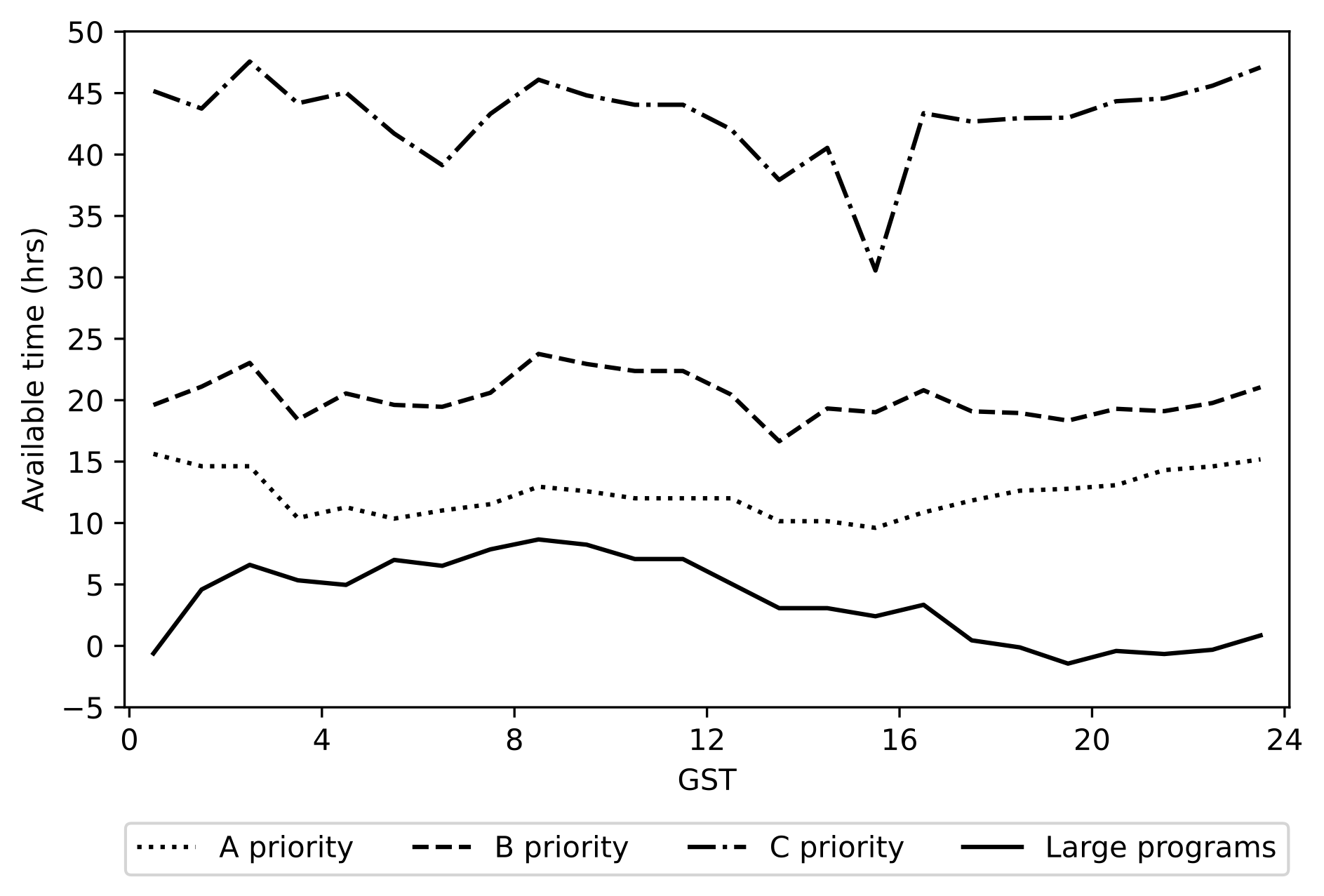
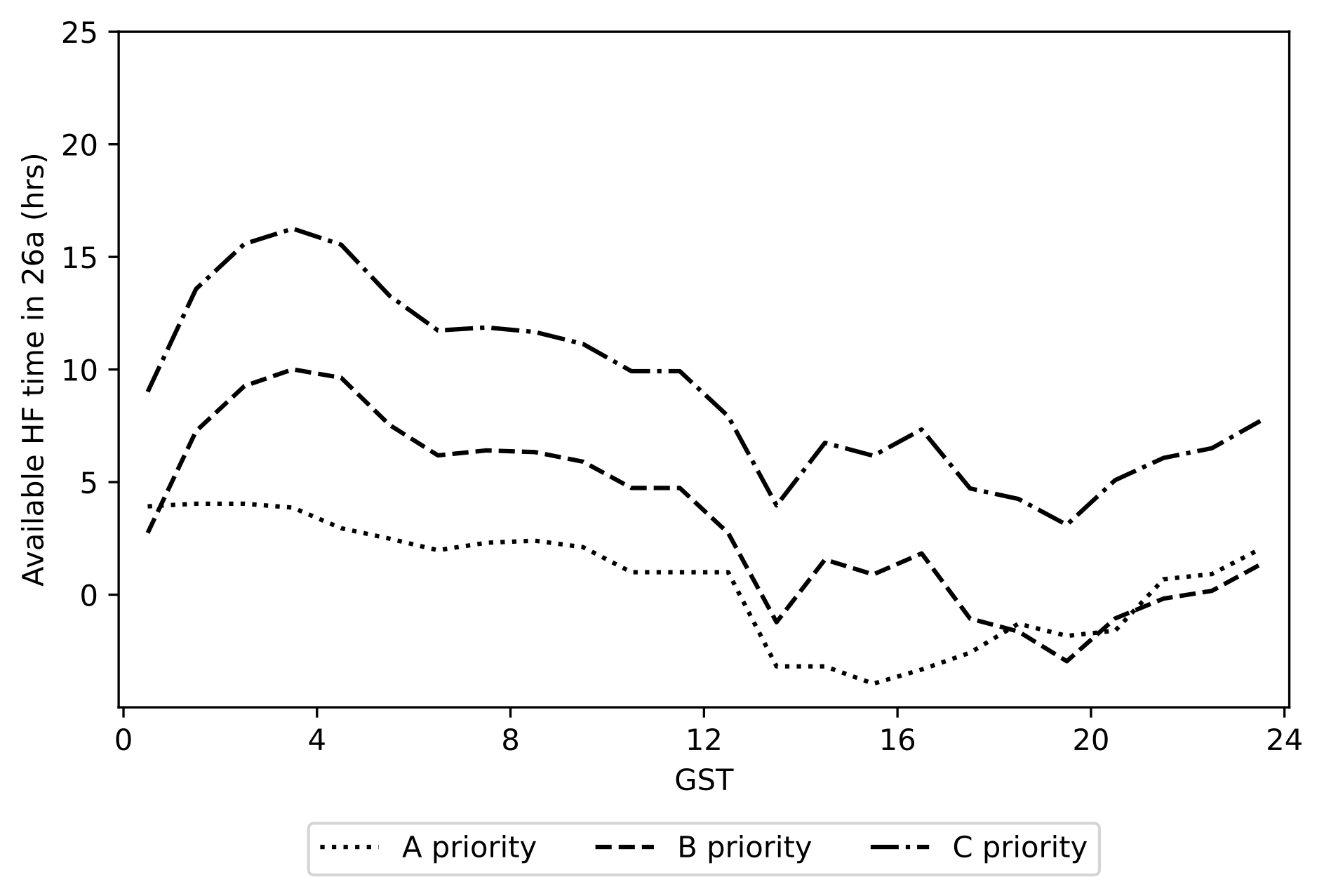
The upper plot shows the total estimated availability across all frequencies, while the lower plot shows the estimated availability for high frequency (> 12 GHz) observing. The upper plot also shows the estimated time available by GST hour for large proposals. This is determined by the limitation of time allocated to large proposals to 50% of the open skies time at any given GST and the time already allocated to large proposals from previous calls.
Large proposals: As can be seen from the upper plot, there is predicted to be limited availability of time (< 5h/GST hour) in the 18–03 GST range and effectively no availability of time (< 1h/GST hour) in the 19–21 GST range.
High frequency proposals: As can be seen from the lower plot, there is predicted to be limited availability for HF proposals to be accepted except as filler (C priority) in the 19–24 GST range. Note that filler time (C priority) is not awarded for observations in the 3mm (86 GHz) band.
Proposal pressure is a function of both availability and demand. In recent semesters, there has been lower demand in the approximate GST range 05:00 – 15:00 (± about an hour at each end) than in the GST range 15:00 – 05:00 (around the Galactic center), leading to lower proposal pressure in the 05:00 – 15:00 range. We expect this trend to continue.
Heightened pressure for VLBA time has increased the importance of setting the GST ranges of sessions accurately in the PST and, if possible, avoiding the regions of highest pressure (normally 15:00 - 05:00 GST ± about an hour at each end, as mentioned above) that can be seen in the pressure plot in the historical TAC reports.
As detailed in the PST Manual, the sessions defined in the PST are used by the TAC in their assignment of scheduling priorities, thus sessions that include the times of high pressure are likely to receive a lower scheduling priority than sessions with the same linear-rank science score in times of lower pressure. In particular, sessions with a 24-hour GST range (00:00 – 24:00) are guaranteed to pass through high pressure times and should be avoided if not essential (e.g., for actual 24 hour observations). Observations wanting a 24-hour GST range and triggered observations for which the GST range is not known a priori should explicitly set the GST range to 00:00 – 24:00 as this is no longer the default.
The "Guidelines for Creating VLA Sessions" in the PST Manual contain advice that is also useful in creating VLBA sessions; in particular, proposals with a small number of sources should put each target source into a separate session and proposals with a large number of sources should be broken into smaller sessions, grouping nearby sources by GST range.
Users are advised to use Sched or Planobs to manually define their GST range as detailed in the Guide to Proposing. The Calculate Min/Max GST button in the PST has been removed as the results could be misleading.
Most approved VLBA observations are performed dynamically; for those dynamic observations, users must either submit their observing (.key) files (to vlbiobs@nrao.edu) before the beginning of the semester (February 01 or August 01 for A and B semesters, respectively), or contact the VLBA Scheduler (schedsoc@nrao.edu) before those dates to avoid a reduction in scheduling priority. It is strongly advised that observing files for HSA observations also be submitted by the start of the semester to ensure that scheduling opportunities on the HSA can be taken when they arise. Early submission of schedules maximizes the opportunity of dynamic observing and assists in the efficient scheduling of the VLBA.
Observing Capabilities for 2026B
For the 2026B semester the General Observing (GO) capabilities are given in the Offered VLBA Capabilities during the Next Semester section of the Observational Status Summary (OSS) and are summarized in the following table. Several additional capabilities are available to proposers through the Shared Risk Observing (SRO) and Resident Shared Risk Observing (RSRO) programs, as described below.
New and Recently Updated:
- Y3+VLBA was added as an shared risk observing (SRO) mode in semester 2026A. See the Y3+VLBA page for additional details.
- Real-time correlation was added as an SRO mode for semester 25B. See the VLBA OSS SRO section for details.
The GO capabilities being offered are:
| Capability | Description |
|---|---|
| Receivers offered |
The VLBA has receivers covering the 90cm (P), 50cm (610), 21/18cm (L), 13cm* (S), 6cm (C), 4cm (X), 2cm (Ku), 1cm (K), 7mm (Q) and 3mm (W) VLBI bands * See the Frequency Bands and Performance section of the OSS for details of performance and notes on use |
| 4096 Mbps recording (requires DDC data system) |
|
| S/X Simultaneous Observations |
Up to 4096 Mbps recording rate total across both bands (but with reduced sensitivity). Note that VLA antennas do not have this capability, so S/X cannot be used with VLBA + Y1. See the Frequency Bands and Performance section of the OSS for details of performance and notes on use. |
| VLBA + Y1 | Adds a single VLA antenna (Y1) to the VLBA to provide a short (~50 km) baseline to the VLBA Pt station |
| Multiple Phase Centers | Up to 300 (or 150) phase centers at 4096 Mbps with a single correlator pass for dual polarization (or full polarization) products |
| Flexible Frequency Setup with the DDC data system |
|
| Flexible Spectral Resolution |
|
| Spectral Zooming |
During correlation, allows the selection of a narrower frequency window to have a large number of spectral channels
|
| Pulsar Modes |
Binary gating, matched-filter gating, and pulsar binning correlation modes for pulsar observations
|
The VLBA operates two data systems, a Polyphase Filterbank (PFB), and a Digital Downconverter (DDC). These are described in detail in the Roach Digital Backend (RDBE) section of the VLBA OSS, which also includes suggestions for selecting the optimal observing system for various scientific goals. For the best continuum sensitivity (i.e. 4096 Mbps) at most receiver bands, or for the most flexible observing setups, the DDC is the better choice. For continuum observations using the 20cm or 13cm receiver bands, the PFB provides a setup using 2048 Mbps that can reduce the impact of prevalent radio-frequency interference (RFI). It is worth noting that while the DDC mode provides wider bandwidth (4096 Mbps recording) and tuning flexibility, the PFB mode (2048 Mbps recording) provides more accurate amplitude calibration and should be used if <10% flux density accuracy is required.
Proposals to use the VLBA as part of an ad-hoc VLBI array including non-VLBA stations must state the other VLBI stations planned to be used as part of the technical justification. It is likely that any award of VLBA time will be conditional on time being awarded to use the other stations. If the VLBA correlator is to be used to correlate this observation, the correlator section of the technical justification should include a full description of this; proposals to correlate observations using a different correlator should note the limitations on baseband data copy in the VLBA Shared Risk Observing section (below). It will be the responsibility of the PI to coordinate the scheduling of ad-hoc VLBI stations and the transfer of data from those stations to the VLBA correlator. The inclusion of non-NRAO facilities is at the risk of the proposer and no guarantee is made that observations that fail due to problems with non-NRAO facilities will be rescheduled.
Correlator capabilities are discussed in the DiFX Correlator section of the OSS. Proposals requiring significant additional correlator resources beyond that required for standard observing, such as multiple phase centers per field or multiple pulsar phase bins, should consider mechanisms to support the correlation without adversely affecting the throughput of other projects. These should be entered in the technical justification section of the proposal. A scientific justification for requests for large correlator resources should be given in the scientific justification section of the proposal.
VLBA Shared Risk Observing
The VLBA Shared Risk Observing (SRO) program allows observers access to capabilities that are essentially commissioned, but are not well tested. The following capabilities are offered under the SRO program during the 2026B semester:
- Baseband Data Copy: Limited amounts of raw data recorded at each station can be copied to user-supplied media or transferred via e-transfer (if a compatible e-transfer system is available at the user's site), for correlation at a different location. See the VLBA OSS SRO section for more details.
- Real-time Correlation: Limited amounts of raw data can be correlated in real time, with limitations. See the VLBA OSS SRO section for details.
- Y3+VLBA: Observing with the VLBA plus the outer three antennas of the VLA in A configuration. See the Y3+VLBA page for additional details.
and for HSA observations only:
- Wideband VLA for VLBI: Enables recording of VLA WIDAR continuum-mode correlations at full 2-GHz BW during VLA phased array (Y27) VLBI observations. See the HSA Station Notes for more details.
Proposers should be aware that SRO projects will not be carried over to future semesters if they cannot be scheduled or observations fail for reasons associated with the shared risk component(s) of the observations, even if awarded scheduling priority A.
VLBA Resident Shared Risk Observing
The VLBA Resident Shared Risk Observing (RSRO) program provides users with early access to new capabilities in exchange for a period of residency in Socorro to help commission those capabilities. For example, the phased-VLA system was developed through RSRO programs. Users are encouraged to conceive and propose innovative ideas for new VLBA capabilities. Some staff suggestions, such as Y3 Reference Pointing Mode Observing, can be found at the VLBA RSRO program section of the VLBA OSS. For details about participating in the RSRO program, see the RSRO Considerations section of the Submission Guidelines page in the Guide to Proposing for the VLBA
Users wishing to propose a RSRO program should select the VLBA RSRO observing mode in the resources section of the PST in order to submit their proposal as a RSRO program.
Proposers should be aware that RSRO projects are generally not approved at scheduling priority A, owing to the level of risk associated with these observations. Also, RSRO proposals will not be carried over to future semesters if they cannot be scheduled, similar to SRO proposals.
High Sensitivity Array (HSA) Proposals
The HSA comprises the VLBA, phased VLA, GBT, and Effelsberg telescopes. Similar to the VLBA, all of the HSA stations can observe at 4096 Mbps (General Observing) at 6 cm and shorter wavelength bands. Details on the HSA telescopes are documented in the HSA section of the VLBA OSS, and special considerations on proposing and observing are listed in the HSA page of the Guide to Proposing for the VLBA.
VLBI observations combining the VLBA with any one or more of the other three HSA stations can be requested in a single HSA proposal. HSA proposals requesting only VLBI use of HSA telescopes should not be identified as Joint proposals. However, separate proposals must be submitted for any non-VLBI use of any requested telescopes.
HSA proposals must be prepared and submitted using the NRAO Proposal Submission Tool (PST), accessible via NRAO Interactive Services. Use of the PST requires registration by all proposers, including co-investigators, in the NRAO User Database. The inclusion of HSA stations should be quantitatively justified in the proposal.
It is strongly advised that observing files for HSA observations also be submitted by the start of the semester to ensure that scheduling opportunities on the HSA can be taken when they arise.
HSA Station Notes
• The phased Very Large Array (Y27) will be available for HSA observing during Semester 2026B in the D (to 2026 October 19; considered semester 2026A for the VLA) and C (2026 October 29 to 2027 February 08) configurations, and during reconfigurations. Please note that high frequencies (at receiver bands 22 GHz and above) have better phasing in the more compact configurations (C and D), and also that high frequency phasing in the summer can be quite difficult, particularly in the extended configurations. For more details, see VLBI at the VLA.
Wide-band correlation of VLA-only data in parallel with the VLBI recording is offered as Shared Risk Observing (SRO). This supports standard VLA 8-bit continuum modes with a 2-GHz bandwidth. If your science requires these wide-band correlations, you should explain this and justify your need for wide-band correlations in the top box of the Technical Justification of your proposal in the PST. Proposals for recording wide-band correlation of VLA-only data using modes other than standard VLA 8-bit continuum with 2-GHz bandwidth can be submitted as Resident Shared Risk Observing (RSRO) proposals; see the VLBA RSRO section of the OSS for details of the RSRO program.
• The Green Bank Telescope (Gb): Proposers should clearly justify the need for the GBT in the text of the proposal. All proposers requesting the GBT should include any needed setup and overhead time in the total time request for their proposals.
Observations using the GBT 6-cm (C band) receiver as part of the HSA must be taken, correlated, and calibrated in full Stokes mode.
Please see the GBT Proposal Guide for receiver availability, time availability, and other relevant factors regarding the GBT's participation in HSA observations.
Due to infrastructure work on the GBT, the GBT will not be available to participate in VLBI observations from the beginning of May until mid-October in 2026. This is expected to be the situation over the next several years.
• The Effelsberg (Eb) 100-m telescope supports both the PFB and DDC observing systems available on the VLBA. Consult this web page for more detailed information about the Eb HSA station.
Global mm VLBI Array (GMVA) Proposals
GMVA proposals submitted for the semester 2026B deadline will be considered for scheduling in 2026 Session II (2026 September 24–29), or later sessions.
Complete information on the GMVA is available at the GMVA website. Ongoing special considerations are documented in the GMVA section of the VLBA OSS; new features and/or special cases are cited here.
GMVA proposals must be prepared and submitted using the NRAO Proposal Submission Tool (PST), accessible via NRAO Interactive Services. Use of the PST requires registration by all proposers, including co-investigators, in the NRAO User Database.
Sensitivity:
Proposers should use the EVN Observation Planner tool or the old EVN Sensitivity Calculator to estimate their sensitivity. See http://go.nrao.edu/vlba-expcalc for detailed instructions.
NOTE: The 3mm noise estimates provided by both the Observation Planner and the old EVN Sensitivity Calculator use SEFD values determined during reasonably good weather and while the antennas were performing well. Because real-world conditions are often less than ideal, the actual noise levels obtained during observations may be significantly worse. This is especially true for GMVA observations, which are observed on fixed dates and cannot be rescheduled due to poor weather. When planning for GMVA observations, users are encouraged to assume the actual noise will be roughly 3 times higher than the tool’s estimate.
The GMVA will record at the highest bit rate which instrumentation and resources permit. Currently all telescopes will record at 4096 Mbps.
Station notes:
The KVN, or the Greenland Telescope (GLT) must be specified by entering "KVN" or "GLT" as "Other" entries in the PST. If the Hancock (HN) or Saint Croix (SC) VLBA antennas (which are not normally included in the GMVA) are requested at 7mm, these should be specified by entering "HN" or "SC" as "Other" entries in the PST.
Apex should now be specified by selecting "Ax" under 'Members' in the PST. Note that the codes for NOEMA and Yebes have also been updated to "Nn" and "Ys".
[Proposals requesting the GBT should clearly justify the need for the GBT in the text of the proposal. All proposers requesting the GBT should include any needed setup and overhead time in the total time request for their proposals.] - delete if GBT not participating
The GBT will not be available for 2026 Session II.
Observations at 7mm with the VLBA antennas can be scheduled as part of a GMVA program during what would otherwise be gaps in observing while other antennas are making pointing or calibration observations. Such observations can be included in GMVA proposals.
An opportunity to propose VLBI observations using the phased ALMA telescope in conjunction with the GMVA is available at this Call for Proposals:
It is expected that phased ALMA will participate in some GMVA observations during ALMA Cycle 13 (~Oct 2026 - Sept 2027; it is anticipated that the ALMA Cycle 13 Call for Proposals will open in April 2026). GMVA session I in 2027 (expected to be in April 2027) should provide an opportunity for GMVA + ALMA observing. In ALMA Cycle 13, ALMA expects to support 3mm and 7mm VLBI observations. Spectral line VLBI is supported at both wavelengths, so GMVA + ALMA spectral line observations can be proposed.
Proposers should:
- specify "ALMA" in the Other Stations text field in the PST
- select the default GMVA 3mm or 7mm observing mode of 4096 Mbps, dual polarization
- specify the amount of time and GST range(s) needed for ALMA separately, either in Session Constraints or Comments, or in the Technical Justification.
A separate proposal to ALMA must also be submitted at the deadline for ALMA Cycle 13 proposals. For this, all proposers (PI and Co-Is) must be registered ALMA users (see the ALMA science website).
Restrictions on GMVA+ALMA proposals in Cycle 13:
- GMVA observations with ALMA will be limited to a fixed recording mode, which currently provides 4096 Mbps on all baselines.
- Direct phasing of the ALMA array is limited to targets with a correlated flux density > 180 mJy at 3mm or > 130 mJy at 7mm, contained within an unresolved core on ALMA baselines up to 1 km. Direct phasing on the science target ("active" phasing) thus puts a lower limit on the brightness of the science target.
- For weaker sources, ALMA offers the option of "passive" phasing. In this mode, the ALMA is phased on a bright phasing calibrator close in angular distance to the science target. (This mode has been in use for VLBI at the VLA for many years). The phasing calibrator has to be brighter than 180 mJy at 3mm (> 130 mJy at 7mm) and be located within 6 degrees from the science target (<10 deg at 7mm). Proposers must specify the phasing calibrator in their proposal; consult the ALMA calibrator catalog.
- In order to make a clean linear-to-circular polarization transformation of ALMA recordings, any target source must be observed at each frequency for a duration of at least 3 hours (breaks for calibrators permitted) to sample a range of parallactic angles.
- Large ALMA Programs (>50 hours of observing time) are not permitted because phased ALMA is a non-standard mode.
- No long-term programs may be proposed, and no proposals will be carried over into the next cycle.
- As time for ALMA observations with the GMVA will be scarce, proposals should include a quantitative justification as to why ALMA is essential for the goals of the project.
Documentation and Assistance
Detailed information about the VLBA instrument, its capabilities, observing strategies, proposal preparation and submission, and observation preparation, can be found in the VLBA Observational Status Summary, at the Guide to Proposing for the VLBA, and at the Observing with the VLBA web pages. Questions should be directed to the NRAO Helpdesk.
GBT Proposal Guide
Low Frequency Science Opportunities
Low frequency (below 8 GHz) projects, especially those that may require significant amounts of observing time per source or field, are strongly encouraged. Observations up to 200 hours per source or field at low frequencies is not unreasonable for the less subscribed LST ranges. Please see the LST pressure plots in the Proposal Results for previous semesters located here.
Scheduling Increments
Please note that the GBT is scheduled in 15 minute (0.25 hour) increments and that all proposals should request time appropriately for each session. Time requests for individual sessions will be rounded down to the nearest 0.25 hour increment.
Expected GBT available time
The GBT is expected to be shut down from May-September during the summer of 2026. During this shutdown, repairs to the GBT infrastructure will be performed. This includes azimuth wheel replacement, painting, and track, foundation and grout work.
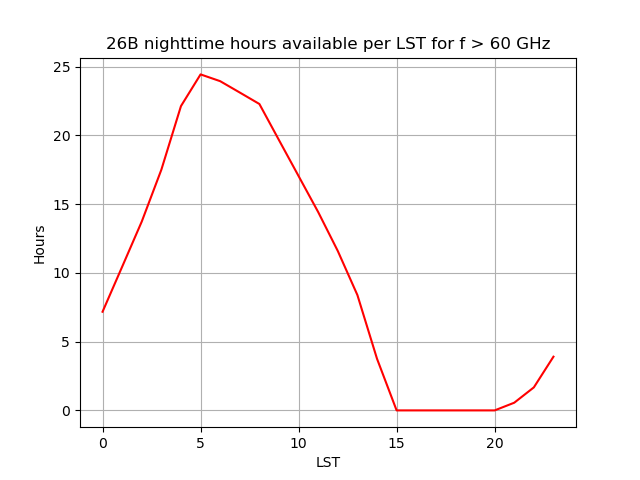
It is expected that there will be around 2600 hours available for astronomy in the 26B semester with 245 hours available for high frequency observations requiring nighttime conditions (MUSTANG-2, ARGUS and non-VLBI W-band).
We cannot guarantee that monitoring projects can be scheduled due to the planned infrastructure work. All monitoring requests are required to discuss how the infrastructure work will impact their science goals.
Receiver Availability
Receivers available
Proposal requesting the 342 MHz, 800 MHz, L, S, UWB, C, X, Ku, KFPA, Ka, Q, W, MUSTANG-2, and Argus receivers will be considered for review as part of the 26B proposal call. The accepted proposals will determine which receivers are made available during the 26B semester.
Prime Focus Pressure and Expected Availability
There will be five receivers using the single prime focus receiver slot during the 26B semester. This will limit the availability of these receivers. The PF/800 MHz and UWB receivers will be available for one week per month following a regular cadence. The PF/342 MHz receiver will be available monthly but on an irregular cadence that would not support regular monitoring observations. Two private receivers will also be deployed regularly during the semester.
UWBR
GBO is pleased to accept proposals for use of the ultrawideband receiver (UWBR). The receiver instantaneously covers a frequency range of 0.7-4 GHz. It can be used with any VEGAS mode, including coherent dedispersion pulsar modes over the full available bandwidth. For more information on UWBR please see the GBT Proposer's Guide.
GBT Capabilities
The GBO encourages proposals that take advantage of the GBT’s unique capabilities across 0.29 to 116 GHz frequency range. (Coverage is not available for 15.8-18.0 GHz, and 50.5-67.0 GHz).
Key science areas include, but are not limited to:
- low column density HI (NHI ≈1017 cm-2 galactic and extragalactic)
- star formation
- fast radio bursts
- galaxy and cluster evolution
- pulsars (searches and timing)
- cosmology
- radio recombination lines
- astrochemistry
- solar system science
Details of all GBT observing modes are in The Proposer's Guide for the Green Bank Telescope. Proposers should also consult the more general document The Performance of the GBT: A Guide for Planning Observations.
The GBT will accept Large Proposals
Beginning with the 26B semester call, the GBT will consider large proposals at all regular deadlines.
However, the GBT will not consider any large proposals for the 26B semester with observations above 60 GHz.
The definitions of Regular and Large proposals for the GBT are as follows:
- 0-8 GHz (Any weather)
- Regular: < 400 hours and lasting ≤ 1 year
- Large: ≥ 400 hours or lasting >1 year
- 8-18 and 27.5-50 GHz (Good weather)
- Regular: < 200 hours and lasting ≤ 1 year
- Large: ≥ 200 hours or lasting >1 year
- 18-27.5 and > 50 GHz (Excellent weather)
- Regular: < 100 hours and lasting ≤ 1.5 year
- Large: ≥ 100 hours or lasting >1.5 year
- Fixed and Monitoring proposals
- Regular: < 200 hours and lasting ≤ 1 year
- Large: ≥ 200 hours or lasting >1 year
Instrumentation
The GBT receivers, backends, and observing modes that are available for Semester 2026B proposals are listed in Tables 1 and 2 below.
|
Receiver |
Frequency Range |
Notes |
|---|---|---|
|
Prime Focus 1 |
290-395 MHz |
|
|
Prime Focus 1 |
680-920 MHz |
|
|
Prime Focus 1 |
385-520 MHz and 510-690 MHz |
Not available |
|
Prime Focus 2 |
910-1230 MHz |
Not available |
|
Ultrawideband Receiver |
700-4000 MHz |
|
|
L-band |
1.15-1.73 GHz |
|
|
S-band |
1.73-2.60 GHz |
|
|
C-band (linear polarization only – see below) |
3.95-7.8 GHz |
|
|
X-band |
7.8-12.0 GHz |
|
|
Ku-band |
12.0-15.4 GHz |
|
|
K-band Focal Plane Array (7 pixels) |
18.0-27.5 GHz |
|
|
Ka-band |
26.0-39.5 GHz |
|
|
Q-band |
39.2-50.5 GHz |
|
|
W-band |
67-93 GHz |
|
|
ARGUS |
74-116 GHz |
See The ARGUS Observer's Web Page for further information |
|
MUSTANG-2 (shared-risk – see below) |
90 GHz, Shared Risk |
Private instrument – proposals must include instrumentation team (see below). |
Table 1
|
Backend |
Observing Modes |
|---|---|
|
Versatile Green Bank Astronomical Spectrometer (VEGAS) |
Continuum (see below), spectral line, pulsar |
|
Digital Continuum Receiver (DCR) |
Continuum |
|
Cyclic Spectroscopy |
Pulsar |
|
Caltech Continuum Backend (CCB) |
Continuum (Ka receiver only). |
|
Mark6 Very Long Baseline Array Disk Recorder |
Very Long Baseline Interferometry |
|
JPL Radar backend |
Private PI Instrument - Open for Public Use |
|
Breakthrough Listen |
Private PI Instrument, Shared Risk |
Table 2
Cyclic Spectroscopy
GBO is pleased to accept proposals for use of the cyclic spectroscopy backend. This backend is used to obtain high-resolution cyclic spectra of pulsars, and can be used with any existing GBT receiver, including UWBR (the lone exception is MUSTANG-2). The cyclic spectroscopy backend can process up to 3750 MHz of usable instantaneous bandwidth. Details, including special instructions for the 26B semester on how to request the cyclic spectroscopy backend in the NRAO Proposal Submission Tool, can be found in the GBT Proposer's Guide.
Permission required for instruments not listed as being available
Anyone requesting a receiver or instrument not listed as being available in the proposal call must have prior permission from the site director or the GBT schedulers before the proposal is submitted. Proposals that did not request permission will be rejected without consideration.
C-band Polarization
Proposals wishing to use the GBT C-band receiver should only use linear polarization outputs or perform full Stokes observations with calibration. The receiver is not optimally designed for circular polarization.
VLBI including the HSA and GMVA
Proposers should clearly justify the need for the GBT in the text of the proposal. All Very Long Baseline Interferometry (VLBI) proposals requesting the GBT should include any needed setup and overhead time in the time request of their proposals.
Proposals requesting the GBT as part of High Sensitivity Array (HSA), and Global 3mm VLBI Array (GMVA) should be submitted through the Very Long Baseline Array's call (available here).
C-band VLBI on the GBT
Observations using the GBT 6-cm (C band) receiver must be taken, correlated, and calibrated in full Stokes mode.
MUSTANG-2
The GBO will accept proposals for shared risk observations using the MUSTANG-2 instrument at the proposal deadline. More information on MUSTANG-2 can be found here. All MUSTANG-2 proposals must have permission from the instrument development team – contact Emily Moravec, Simon Dicker or Brian Mason.
Breakthrough Listen backend
The Breakthrough Listen project is making its backend available for shared-risk observations during the 2026B semester. The instrument consists of a cluster of 64 Titan X and 1080 GPU-based servers capturing 8-bit baseband voltages over up to 12 GHz of instantaneous bandwidth. Data rates are typically tens of TB/hr but a pipeline is available to generate spectra with adjustable frequency (> 3 Hz) and time (> 350 μs) resolutions, with possible science applications including fast radio transients, pulsar observations, stellar flares, SETI, etc. Before submitting a proposal, proposers must obtain permission from the Breakthrough Listen team. The team will consult on proposal preparation and data analysis. Any data acquired using the backend will be proprietary to the proposer per the standard policies.
More information including a technical description of the backend and team contact details can be found here.
Continuum Observations
Proposers wishing to perform continuum observations should consult with a GBO scientist.
RFI
The most recent RFI monitoring scans for the GBT can be found here. This tool allows you to explore scans that provide information on the frequencies that may encounter RFI. Note that a Green Bank computing account is required to be able to view this information.
If you do not have a Green Bank computing account please look here for pre-made RFI plots.You will not be able to manipulate these plots to obtain more detailed information.
If you wish to obtain more information on RFI near your desired frequencies, please contact the helpdesk to request the desired plots. This should be done well before the proposal deadline as we cannot guarantee rapid responses on the proposal deadline date.
Observing and Scheduling Constraints
The GBT is scheduled by the Dynamic Scheduling System (DSS). The DSS system is fully described in the GBT Proposer's Guide and the GBT Observer's Guide.
Mapping
If you are considering mapping with the GBT such that there are major turns or moves (end of rows in raster map, petals in daisy maps, changes in position for pointed maps, etc.) that occur with a cadence faster than every 30 seconds, you will need to consult with a GBT support scientist to ensure that the GBT can safely withstand the stresses induced by the mapping motions.
GBT Proposal Preparation
All proposals should state why the GBT is necessary for the requested observations in both the abstract and science justification.
Proposers who need assistance with their proposal should submit a helpdesk ticket via https://help.nrao.edu/. Proposers needing significant help should submit their requests to the helpdesk well before the deadline.
Proposers are encouraged to look at past proposal call results, especially the LST pressure plots, which can be found in the TAC proposal result reports located here.
All proposers, including pulsar proposers, should use the GBT Sensitivity Calculator. The Sensitivity Calculator results can be cut and pasted into the Technical Justification section of the proposal. This will streamline the creation of your Technical Justification and will lessen the chances for error.
If you are planning on making maps with the GBT, you should use the GBT Mapping Calculator tool.
The GBT observing policies describe the telescope's remote observing restrictions.
Proposers requesting GBT participation in High Sensitivity Array (HSA), Very Long Baseline Array (VLBA), or Global Millimeter Very Long Baseline Interferometry (GMVA) observations should consult the VLBA, HSA, and GMVA Proposal Call.
Joint Proposals
Joint Proposals Between the VLA, GBT, and VLBA
Observing programs that require combinations of the GBT, VLBA, and/or the VLA should submit a proposal for each of the requested telescopes. The same Scientific Justification should be submitted with each proposal, and it should contain a clear justification for each telescope requested. The proposals will be reviewed and considered jointly by the Telescope Time Allocation Committee. VLBI proposals which request the GBT or VLA (or any other HSA telescope) as elements of the VLBI array do not need separate proposals---those telescopes can be selected as separate VLBI stations from a VLBA/HSA proposal.
Joint Proposals with External Facilities
Here we list opportunities for joint proposals with several external (non-AUI) facilities. Agreements for Joint Observations with external facilities were made at different times across the boundaries when the NRAO was split into multiple observatories (NRAO, GBO, and LBO) in 2017, when the LBO was reintegrated back into the NRAO in 2019, and when the GBO was reintegrated back into the NRAO in 2024. Therefore, the agreements below will sometimes mention various combinations of the NRAO, GBO, and LBO. Regardless, access to the Joint Observing program will continue for the VLA, VLBA, and GBT for semester 26A.
Joint Observations with ALMA
By agreement between the NRAO and the Joint ALMA Observatory (JAO), detailed in a Memorandum of Understanding, the NRAO can award up to 50 hours on the ALMA 12-m array, 50 hours on the 7-m array, and 50 hours on the Total Power array per cycle. (Only 13.7 hours remain in semester 26B.) In return, the JAO can award up to 5% of the available time on the VLA per year. Proposals for joint NRAO and ALMA observations must be submitted to the observatory where more observing time is being requested. Here, the ALMA time is defined by the hours requested for only the 12-m array. If the 7-m array is being used as standalone, however, then the ALMA time is defined by the hours requested for only the 7-m array. N.B., specific technical information must be supplied for the Partner Observatory. See the Joint Observations with ALMA page for details, including the available array configurations.
Joint Observations with JWST
By agreement between the NRAO and the Space Telescope Science Institute (STScl), detailed in a Memorandum of Understanding, the NRAO can award up to 50 hours of JWST observing time per year. (The 50 hours corresponds to 26B and 27A.) In return, STScI can award up to 5% of the NRAO scientific observing time on the VLA, VLBA, and GBT. Proposals for joint NRAO and JWST observations must be submitted to the observatory where more observing time is being requested. N.B., specific technical information must be supplied for the Partner Observatory. See the Joint Observations with JWST page for details.
Joint Observations with the Hubble Space Telescope (HST)
By agreement between the NRAO and the Space Telescope Science Institute, STScI can award up to 3% of the available time on NRAO's North American facilities to highly ranked proposals that request time on both HST and NRAO telescopes. In return, STScI has offered 30 orbits of HST time for allocation by the NRAO TAC per year. N.B., HST "Snapshot" observations are not supported under the HST-NRAO Joint program since there is no guarantee that Snapshot targets will be completed. See the Joint Observations with HST page for details.
Joint Observations with Swift Gamma-Ray Burst Mission
To foster correlative observations, a joint Swift/NRAO observing program has been established, detailed in a Memorandum of Understanding. By this agreement, the Swift Program permits NRAO to award up to 300 kiloseconds of Swift observing time per year. Similarly, NRAO permits the Swift Guest Investigator (GI) Program to award no more than 5% of the NRAO scientific observing time on the VLA, GBT and VLBA, or up to 200-300 hours per year on each telescope. See the Joint Observations with Swift page for details.
Joint Observations with Chandra X-ray Observatory
The community has the opportunity to propose for observing time on NRAO facilities through a joint program with the Chandra X-ray Observatory. Proposers to the NRAO have the opportunity to request time on Chandra, to be awarded on the recommendation of the NRAO Telescope Time Allocation Committee (TAC) and approved by the NRAO Director. Up to 120 ksec will be made available to NRAO proposers annually. The NRAO has allocated up to 3% of the open skies observing time on the VLA, the VLBA, and the GBT for Chandra joint proposals.
Due to Chandra's increasingly challenging thermal constraints, the amount of Chandra exposure time available for High Ecliptic Latitude (HEL) targets with |bGal| > 55deg is extremely limited. If you request joint time on Chandra, please avoid long exposures on such targets if at all possible. You must note explicitly the requested amount of Chandra HEL time in the body of your science justification. N.B., Chandra ToO proposals are not supported under the Chandra-NRAO joint program. See the Joint Observations with Chandra page for details.
Joint Observations with XMM-Newton Project
By agreement with the NRAO and GBO Observatories, detailed in a Memorandum of Understanding, the XMM-Newton Project may award up to 3% of NRAO/GBO open skies observing time. Similarly the NRAO/GBO Time Allocation Committee may award up to 150 ks of XMM-Newton time per year. See the Joint Observations with XMM-Newton page for details.
Joint Observations with IXPE
By agreement between the NRAO and IXPE, detailed in a Memorandum of Understanding, the NRAO can award up to 300 ksec of IXPE observing time per year. In return, IXPE can award up to 5% of the NRAO scientific observing time on the VLA, VLBA, and GBT or up to 200-300 hours per year on each telescope. See the Joint Observations with IPXE page for details.
Joint Observations with Fermi Gamma-ray Space Telescope
It is possible to propose for observing time on NRAO facilities through the Fermi Gamma-ray Space Telescope Joint Proposal Opportunity or the Cooperative Proposal Opportunity. A maximum of 5% of the NRAO open skies observing time is made available on the VLA, the VLBA and the GBT, or up to 200-325 hours per year on each telescope. See the Joint Observations with Fermi page for details.
Tips for Proposers
Scientific Justification
The NRAO proposal evaluation and time allocation process is panel based. That is, members of the scientific community are responsible for reviewing proposals based on their scientific merit through the Science Review Panels. As a means of broadening the scientific perspective of its reviewers, and of increasing the participation of the wider astronomy and astrophysics community in the science program of NRAO facilities, SRP membership is deliberately selected to include some colleagues that are not necessarily experts in radio observational techniques. This being the case, we encourage proposers to consider the following when preparing their proposals:
- Avoid the use of radio astronomy jargon.
- Do not assume the reader is familiar with a particular observing technique - explain it briefly.
- Do not assume the reader is familiar with an earlier rationale for a developing line of research - provide adequate historical context and connect the dots as necessary.
- Describe previous observations and publications relevant to the proposed observations.
- If a particular point source or brightness temperature sensitivity is required, justify it.
Source Lists
The Observatory requires proposers to specify their source lists in full. This enables the Observatory to identify potential conflicts between observing programs and to better understand scheduling pressure on the instruments it operates. It may be the case that the final target list has not been selected at the time a proposal is submitted. In such cases, all potential targets and fields should be listed. The only exceptions to this requirement are for Triggered proposals to observe targets that are unknown a priori. Proposal source lists are not made public by the Observatory.
Dissertation Plans
The Plan of Dissertation is important in the proposal review process and should be well written; it is not a placeholder and should not be a replica of the proposal. The plan must be compliant with specific requirements, which includes following a Plan of Dissertation Research template. See Section 7.2 of the NRAO Users' Policy guide for details.
Useful Resources & Tools
Note: you must be a registered NRAO user to access some of these resources. Please go to NRAO Interactive Services. If you are already a registered user, you are encouraged to update your profile.
Proposal Submission Tool
The Proposal Submission Tool and associated documentation is accessed through NRAO Interactive Services.
Proposal Finder Tool
The Proposal Finder Tool (PFT) may be used to search cover sheets of proposals approved for time on NRAO telescopes. The PFT returns the proposal's authors, title, abstract, and, if available, approved hours.
Very Large Array (VLA)
- Guide to Proposing for the VLA
- Guide to Observing with the VLA
- VLA Configuration Plans and Science Time Available
- VLA Exposure Calculator
Very Long Baseline Array (VLBA)
- VLBA Observational Status Summary
- Guide to Proposing for the VLBA
- High Sensitivity Array
- VLBA/HSA Sensitivity (via EVN Sensitivity Calculator)
- Observing
Green Bank Telescope (GBT)
- GBT Users Portal
- GBT Performance
- GBT Proposing Resources and GBT Proposer's Guide
- GBT Observing Resources and GBT Observer's Guide
- GBT Sensitivity Calculator
- GBT Mapping Calculator
- GBT Archival Data available upon request from the NRAO Helpdesk.
NRAO Helpdesk
For help on any aspect of proposing or observing not found in our documentation, please file a ticket with the NRAO helpdesk.
Continuing Opportunity: Joint Observations with Chandra X-ray Observatory
In previous semesters, the community has had the opportunity to propose for observing time on NRAO facilities through a joint program with the Chandra X-ray Observatory. For Chandra, proposals must be for observations that require both Chandra pointings and NRAO observations to carry out a scientific investigation. The NRAO has allocated up to 3% of the open skies observing time on the VLA, the VLBA, and the GBT for Chandra joint proposals. The Chandra Cycle 27 deadline was 19 March 2025 and will cover January 2026 to January 2027. See the Chandra Call for Proposals for details.
Starting with semester 2016A, proposals to the NRAO can request time on Chandra, to be awarded on the recommendation of the NRAO TAC and approved by the NRAO Director. Up to 120 ksec will be made available to NRAO proposers annually.
Chandra as Primary Observatory: NRAO observing time awarded through the Chandra Cycle 27 review will be implemented during the 2026A and 2026B observing semesters. The award of time on NRAO facilities will be subject to approval by the NRAO Director, after technical review and a nominal review by the NRAO TAC to avoid duplication of programs. The important additional criterion for the award of NRAO time is that both the Chandra and the radio data are required to meet the science goals of the project. Proposed NRAO and Chandra observations are not required to be coordinated or simultaneous. Under this agreement, NRAO time will only be awarded in conjunction with new Chandra observations (and should not be proposed for in conjunction with an Archival Research or Theory Proposal).
NRAO as Primary Observatory: Chandra time awarded through the NRAO TAC will be implemented during the course of Chandra Cycle 27. Proposals submitted to the NRAO requesting Chandra time must indicate that the proposal is joint with Chandra. Furthermore, the proposal must briefly justify for each target the number of kiloseconds, and the Chandra instrument and observing mode requested. The important additional criterion for the award of Chandra time is that both Chandra X-ray and radio data are required to meet the science goals of the project. Proposed NRAO and Chandra observations are not required to be coordinated or simultaneous. Programs requesting Chandra time will be subject to basic technical review prior to the NRAO TAC meeting. No Chandra TOOs can be awarded through this program.
The PIs of successful programs with Chandra as the primary observatory will be contacted by NRAO science operations. Successful PIs of programs with NRAO as the primary observatory will be contacted by Chandra science operations. Successful proposers will submit Chandra Cost proposals at the standard deadline. Funding will be available to US investigators to support Chandra data reduction.
Continuing Opportunity: Joint Observations with Fermi Gamma-ray Space Telescope
We remind the community that it is possible to propose for observing time on NRAO facilities through the Fermi Gamma-ray Space Telescope Joint Proposal Opportunity or the Cooperative Proposal Opportunity. For Fermi, which is primarily in sky-survey mode, potential observers may propose for NRAO observations that make use of the Fermi survey data even without re-pointing of the Fermi satellite. The actual amount of NRAO observing time allocated via the Joint Fermi Process depends on the amount of proposal pressure and the scientific quality of the proposals. A maximum of 5% of the NRAO open skies observing time is made available on the VLA, the VLBA and the GBT, or up to 200-325 hours per year on each telescope. Details about joint observations with Fermi and the VLA, the VLBA or the GBT may be found here.
Continuing Opportunity: Joint Observations with the Hubble Space Telescope (HST)
By agreement between the NRAO and the Space Telescope Science Institute, STScI will be able to award time on NRAO facilities to highly ranked proposals that request time on both HST and NRAO telescopes. NRAO has offered up to 3% of the available open skies time on its North American facilities, namely the Green Bank Telescope (GBT), the Very Large Array (VLA), and the Very Long Baseline Array (VLBA), for allocation by the HST Time Allocation Committee (TAC), subject to a maximum of 5% of the available time in any given VLA configuration.
In return, STScI has offered 30 orbits of HST time per year for allocation by the NRAO TAC. Joint HST/NRAO proposals should be submitted to the observatory that represents the primary science facility, not to both observatories.
HST as Primary Observatory: NRAO observing time awarded through the HST Cycle 34 review will be implemented during the 2026B and 2027A observing semesters. The award of time on NRAO facilities will be subject to approval by the NRAO Director, after nominal review by the NRAO TAC to avoid duplication of programs. The important additional criterion for the award of NRAO time is that both the HST and the radio data are required to meet the science goals of the project. It is not essential that the project requires simultaneous NRAO and HST observations. Under this agreement, NRAO time will only be awarded in conjunction with new HST observations (and should not be proposed for in conjunction with an Archival Research or Theory Proposal).
NRAO as Primary Observatory: HST time awarded through the NRAO TAC will be implemented during the course of HST Cycle 34. Proposals submitted to the NRAO requesting HST orbits must indicate that the proposal is joint with HST and must specify the number of orbits requested. The important additional criterion for the award of HST orbits is that both the HST and radio data are required to meet the science goals of the project. It is not essential that the project requires simultaneous NRAO and HST observations.
Successful proposers will submit Phase II HST proposals at the standard Phase II deadline. Funding will be available to US investigators to support HST data reduction; budgets should be submitted at the standard deadline
Proposers must always check whether appropriate archival data exist, and provide clear scientific and technical justification for any new observations of previously observed targets. Observations awarded time that duplicate observations already approved by HST or NRAO for the same time period may be canceled, or data sharing and cooperation among different groups may be necessary, as determined by the two observatories. This includes triggered proposals with similar trigger criteria, with or without previously known coordinates.
Be aware that some HST targets might not require new NRAO observations because the joint science goals can be met using:
- non-proprietary archival data from the VLA or VLBA that are online
- VLA continuum images from sky surveys at a wavelength of 20cm and at a FWHM resolution of 45 arcseconds or 5 arcseconds.
All scientific data from NRAO telescopes have a proprietary period during which the data are reserved for the exclusive use of the observing team. The NRAO data archive policy and proprietary periods are online, and apply to data taken through the joint HST-NRAO program.


25A VLBA Availability
 unallocatedtime_future_25a_postTAC.pdf
— 14.7 KB
unallocatedtime_future_25a_postTAC.pdf
— 14.7 KB


unallocatedtime_future_25a_postTAC.pdf
unallocatedtime_future_25a_postTAC.pdf
— 14.7 KB





Connect with NRAO