
NRAO ALMA/NAASC Website
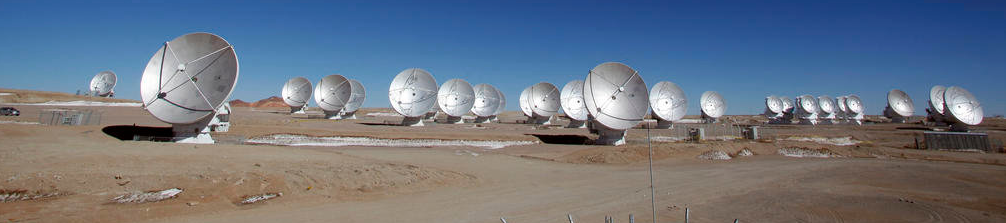

Credit: ALMA (ESO/NAOJ/NRAO)
ALMA Status:
- Weather conditions at AOS
- Recent observations (QA0 Pass)
- Public observations
- Publications
- ALMA Configuration schedule
Support for Conferences and Workshops
The North American ALMA Science Center (NAASC) invites members of the North American (US and Canada) scientific community to apply for funding in support of inclusive conferences and workshops in fiscal year 2024. We prioritize events which encourage the participation of students, postdocs, and early career researchers. PI-led events based in the US or other national or international conferences may be considered. We will accept applications for funding below $10K at any time while funds for fiscal year 2024 last. More information: https://science.nrao.edu/facilities/alma/facilities/alma/support-for-naasc-conferences-and-workshops
Events supported in FY24 include:
- The Physics and Impact of Astrophysical Dust (PI D. Naranayan) Aspen CO, March 2024
- Debris Disks in the Sonoran Desert (PI K. Su) Tuscon AZ, March 2024
- Spatio-spectral Modeling of Interferometric Data: Preparing for the Wideband Era (PI E. Koch) Charlottesville, May 2024
- Cool Stars (PI C. Thiessen), San Diego CA, June 2024
- The FUor/EXor-Planet formation connection (PI A. Hales), Santiago, September 2024
Data Reduction Support
The North American ALMA Science Center (NAASC) provides travel and lodging support during your visit to NRAO headquarters in Charlottesville, VA from investigators of successful ALMA programs or archival researchers. If you need any help in reducing your data, or just a quiet week away in Central Virginia to finish writing up your next ALMA paper, consider coming for a face-to-face visit to work closely with our data analysts and scientific staff. For more information and to request a visit, please see https://science.nrao.edu/facilities/alma/visits and submit a ticket to the face-to-face visits department of the ALMA Helpdesk. Come visit us!
Reach out to the NAASC
You can also consult with our EPO team to see if your results would have broader public interest and to explore outreach opportunities.
Feedback on ALMA data analysis tools is greatly appreciated. Please communicate any obstacles encountered in the path from data delivery to publication by submitting a Helpdesk ticket. In particular, has a lack of computing resources, software for analysis, visualization, plotting, or other "tools" proven to be a difficulty? NRAO thanks you in advance for your feedback.
Contact Us :
More information about ways to contact us.


