test collection
 low.pdf
 ant_positions.ps
VLA Observational Status Summary 2026A
There are currently no items in this folder.
NRAO at AAS 247 in Phoenix, Arizona
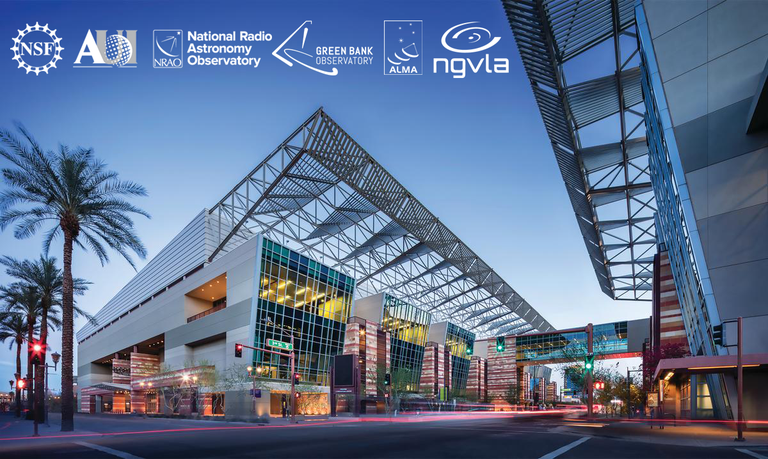
The NSF National Radio Astronomy Observatory, NSF Green Bank Observatory, Central Development Laboratory, and Associated Universities, Inc. will be playing a major part in the January 2026 247th meeting of the American Astronomical Society. Join the NSF NRAO leadership, staff, users, and students for a week sharing outstanding science results, press conferences, and technology developments.
Visit the NRAO in the exhibit hall, starting with the opening reception on Sunday evening. Learn about the ALMA Wideband Sensitivity Upgrade, the ngVLA prototype antenna, new opportunities with the Green Bank Telescope and dysh, and capabilities for observing with the VLA, VLBA, and VLA Sky Survey (VLASS) from New Mexico Operations. The exhibit will feature instrumentation pieces from the Central Development Laboratory. Join the NRAO leadership for the NRAO Town Hall evening reception on Tuesday, January 6th to learn about the latest research and development initiatives.
Stop by the NRAO exhibit on Monday/Wednesday (5:30pm), and Tuesday/Thursday (9:00am) to learn about the new GBT reduction package, dysh.
Pre-register for the Synthesis Imaging Workshop, May 2026.
Sign up for the 2026 Virtual GBT Observer Training Workshop.
Subscribe to the NRAO Science Newsletter. Follow the NRAO (Facebook, Twitter(X), Instagram, LinkedIn, and BlueSky); GBO (Facebook, Twitter(X), and Instagram); and AUI (Facebook, LinkedIn, and Instagram) on the various social media outlets.
See the meeting website for conference details. The block schedule is available on the AAS Website with any location changes.
| Session |
Date | Time (Local) | Location |
| Grad School and REU Fair | Sunday, January 4 | 5:30pm to 7:00pm | 301 C |
| Opening Reception | Sunday, January 4 | 7:00pm to 9:00pm | Exhibit Hall B/C/D |
| Advancing AI Infrastructure for Large Astronomy Datasets (CosmicAI partners) | Tuesday, January 6 | 2:00pm-3:30pm | 232 A |
| NRAO Town Hall | Tuesday, January 6 | 6:30pm to 8:30pm | 301 C |
| The Highest Angular Resolution Frontier (Splinter) | Wednesday, January 7 | 10:00am-11:30am | 126 C |
| Monitoring the transient sky: the role of ALMA in the WSU era | Wednesday, January 7 | 10:00am-12:00pm | 225 B |
| Closing Reception | Thursday, January 8 | 6:00pm-7:30pm | 301 C |


June 2025 C-configuration
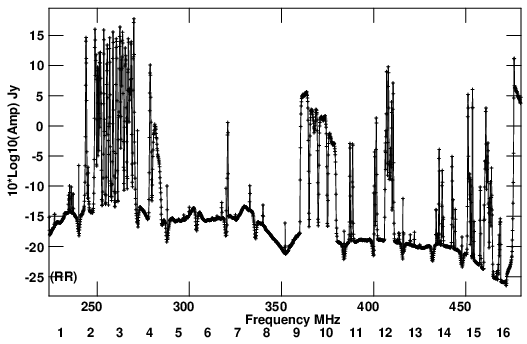
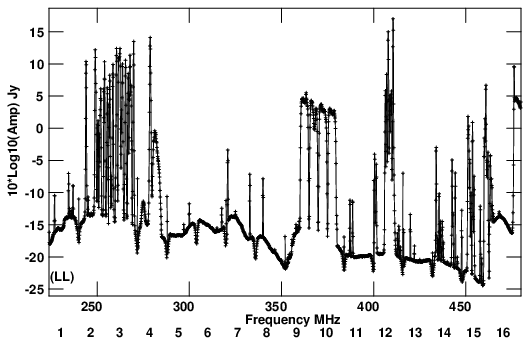
Each link in the list below presents scalar-averaged cross correlation spectra using several baselines in the C-configuration for each respective receiver band obtained in 2025's C-configuration. The channel separation is 125 kHz. The antennas are pointed to the north celestial pole and away from known RFI sources. Hanning smoothing has been applied to minimize Gibbs ringing. The scale is logarithmic, in dB, with arbitrary offset. The scale can be roughly calibrated by noting that the mean power level is roughly equal to the antenna SEFD in Jy. There is no bandpass calibration, so the downturns at the edges are due to the analog and/or digital filters.
In addition, each link contains .CSV files. These files contain the values needed to plot Amplitude vs Frequency for the RR and LL correlations. Similar to the above, the values are scalar-averaged cross correlations, Hanning smoothing has been applied, and no bandpass calibration has been performed. The amplitudes are in Janskys calibrated using the system temperature of the antennas. Due to the gain compression effect the reported values are better thought of as lower limits than absolute fluxes of the RFI.
P-Band Spectra (224-480 MHz) 2025 June C-config
A listing of the various RFI in this frequency band is available here.
Also available are spectra per 16 MHz subband.
CSV files for RR and LL - 05/27
CSV files for RR and LL - 05/29
CSV files for RR and LL - 06/09
CSV files for RR and LL - 06/09
CSV files for RR and LL - 06/26
CSV files for RR and LL - 06/26
CSV files for RR and LL - 07/24
CSV files for RR and LL - 07/24
CSV files for RR and LL - 08/04
CSV files for RR and LL - 08/04


ALMA Community Day Event at Berkeley
Date: Tuesday March 25, 2025
Time: 9:30am to 4:45pm
Location: Bloomberg Center, Department of Physics and Astronomy, Room 462, Zoom (link to be provided at a later date to registered participants)
The National Radio Astronomy Observatory (NRAO) and ALMA Ambassadors cordially invite you to an ALMA Proposal Workshop at Johns Hopkins. This event is designed for all astronomers, with a particular goal to reach those that do not yet regularly utilize radio/millimeter data in their research. This one-day workshop will provide a primer on millimeter/radio interferometry and the basics of ALMA, a review of how to design and prepare successful ALMA proposals, and an overview of how best to take advantage of the latest resources developed by NRAO/ALMA (such as pipeline processing and simulating interferometric observations). An interactive session in the afternoon will offer a tutorial for preparing and submitting proposals with the ALMA Observing Tool, where attendees can start to build a foundation for their own Cycle 12 proposals (deadline April 24). Throughout the day, we will feature some of the latest science results from ALMA, including work from members of the JHU community, and offer a preview of the exciting new capabilities of ALMA coming in the next few years.
A free catered lunch will be provided on-site for registered participants. While attendance for the full day is not required, we hope you will join us for as much of the day as you can. Registration is completely free, but please complete the registration form by March 18 (sooner is better!) so that we can plan for lunch and ensure that the workshop is best tailored to your interests. Please note that in-person participation is limited to 30 people.
I look forward to welcoming you at Johns Hopkins University!
- Pallavi Patil (ALMA Ambassador)
Program
09:15 – 09:30 Welcome and Coffee
09:30 – 09:35 Overview of the Workshop
09:35 – 10:00 ALMA Basics
10:00 – 10:45 Introduction to Interferometry and New Cycle 12 Capabilities
10:45 – 11:00 Coffee Break
11:00 – 11:30 ALMA Proposal Preparation Process
11:30 – 12:15 Science Talks by Justin Otter and Jay Chittidi
12:15 – 13:30 Lunch
13:30 – 14:00 Wideband Sensitivity Upgrade + ALMA Archival Data Products
14:00 – 14:40 OT Demo
14:40 – 15:00 Break
15:00 – 16:30 OT Demo Continued, Practice, and Co-work
16:30 – 16:45 Wrap up and Final Questions
Logistics
Before the event, please download and install the Cycle 12 ALMA Observing Tool (OT). Note that the Cycle 12 OT will not be available until the Call for Proposals is released on March 20: https://almascience.nrao.edu/proposing/observing-tool
Travel/Local Information
Traveling to and from Charlottesville
- Information about traveling to Charlottesville by car, plane and train can be found here.
- Link to Charlottesville regional airport (CHO)
Maps of Charlottesville
- Route to NRAO-CV (Far view) (gif)
- Route to NRAO-CV (Closer view) (pdf)
- Route from NRAO-NTC to NRAO-ER
- NRAO-CV area, with major street names and hotels:
- NRAO-CV area, with many street names
- University of Virginia and McCormick Road area
- Google Map of the area: View Map in new Window/Tab
Hotels in Charlottesville
Lodging/Hotel
We have made reservations for you and you will be getting confirmation numbers for your reservations soon.
Introduction
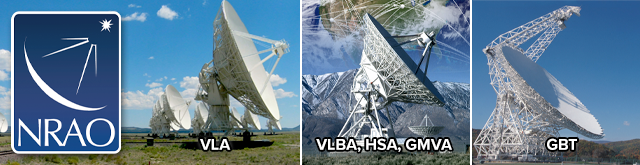
The National Radio Astronomy Observatory (NRAO) invites scientists to participate in the Semester 2026B Call for Proposals for the Karl G. Jansky Very Large Array (VLA), the Robert C. Byrd Green Bank Telescope (GBT), and the Very Long Baseline Array (VLBA), High Sensitivity Array (HSA), and Global mm VLBI Array (GMVA).
The submission deadline for Semester 2026B proposals is Wednesday, 4 February 2026, at 17:00 EST (22:00 UTC).
Starting in 26B Large proposals can be submitted to the GBT every semester (see What's New in 26B).
For the VLA, the C-configuration will be available. It is anticipated there will be around 1200 hours on the VLA, 2600 hours on the GBT, and 755 hours on the VLBA available for science observing. Opportunities for Joint proposals will be available for ALMA, JWST, HST, Swift, Chandra, XMM-Newton, and IXPE. Joint Proposals with ALMA or JWST need to be submitted to the facility requesting the larger amount of observing time.
The array configurations available for joint ALMA/VLA will be: ALMA C-1 to C-8 and VLA C-configuration.
The NRAO 2026B Call for Proposals is for observations with the VLA, GBT, and VLBA/HSA/GMVA.
A detailed timeline for the 26B Proposal Call is available here and summarized in the table below:
| Date | Action |
|---|---|
| 07 January 2026 | NRAO Call for Proposals |
| 04 February 2026 | NRAO Proposal Deadline @ 17:00 EST |
| 05 March 2026 | Individual Science Reviews Completed |
| 20 March 2026 | Science Review Panel (SRP) Meetings Completed |
| 16-17 April 2026 | Telescope time allocation committee (TAC) meeting |
| 15 May 2026 | Disposition Letters Sent |



Connect with NRAO