
test collection
Snapshots
The two-dimensional geometry of the VLA allows a snapshot mode whereby short observations can be used to image relatively bright, unconfused sources. This mode is ideal for survey work where the sensitivity requirements are modest.
Single snapshots with good phase stability of strong sources should give dynamic ranges of a few hundred. Note that because the snapshot synthesized beam contains high sidelobes, the effects of background confusing sources are much worse than for full syntheses, especially at 20 cm and longer wavelengths in the D configuration. For instance, at 20 cm, a single snapshot will give a limiting noise of about 0.2 mJy. This level can be reduced by taking multiple snapshots separated by at least one hour. The deconvolution of the data is necessary to remove the effects of background sources. Before considering snapshot observations at 20 cm, users should first determine if the goals desired can be achieved with the existing Faint Images of the Radio Sky at Twenty-centimeters survey (FIRST, http://sundog.stsci.edu/top.html) (B configuration) or the NRAO VLA Sky Survey (NVSS, http://www.cv.nrao.edu/nvss/) (D configuration, all-sky).
Shadowing and Cross-Talk
Observations at low elevation in the C and D configurations will commonly be affected by shadowing. It is strongly recommended that all data from a shadowed antenna be discarded. This will automatically be done during filling when using the default inputs with CASA tasks importasdm and importevla. AIPS task UVFLG can be used to flag VLA data based on shadowing, although it will only flag based on antennas in the dataset, and is ignorant of antennas in other subarrays. The CASA task flagdata can also be used to flag data based on shadowing. For more information on shadowing, please see the Antenna Shadowing section in the Guide to Observing with the VLA.
Cross-talk is an effect in which signals from one antenna are picked up by an adjacent antenna, causing an erroneous correlation. This effect is important at low frequencies in compact configurations. Careful examination of the visibilities is necessary to identify and remove this form of interference. The affected data would show time-variable high-amplitude points.
Combining Configurations and Mosaicking
Any single VLA configuration will allow accurate imaging of a range of spatial scales determined by the shortest and longest baselines. For extended and structured objects, it may be required to obtain observations in multiple array configurations. It is advisable that the frequencies used be the same for all configurations to be combined. The ideal combination of arrays results in a uv-plane with all cells equally filled by uv-points. To first order, this can be achieved by using the beam sizes of the individual arrays to inversely scale the on-source integration time. This approach is equivalent to achieving the same surface brightness sensitivity for all arrays on all scales. For the VLA, observations in the different configurations generate beam sizes that decrease by factors of three, i.e., C configuration generates a three times smaller beam than D configuration, B three times smaller than C, and A three times smaller than B. Thus, on-source integrations would increase by about an order of magnitude between each array. Such a drastic increase is very expensive and, in fact, not necessary since some spatial scales are common to more than a single array, which is equivalent to some uv-cells being filled more than others. The best way to fill the uv-plane depends on many factors such as declination of the source, LST time of the observation, and bandwidth.
Experience shows for the VLA that a factor of about three in on-source integration time for the different array configurations works well for most experiments. For example, a 20min on-source time in D, 1hr in C, 3hrs in B, and 9hrs in A should produce a decent map. Using large bandwidths and multi-frequency synthesis will broaden all uv tracks radially and one may need even fewer array configurations or shorter integration times between the different arrays.
Objects larger than the primary antenna pattern may be mapped through the technique of interferometric mosaicking. The VLA has no limit on the number of pointings for each mosaic. Typically hexagonal, rectangular, or individual pointing patterns are used and the overlap regions will result in an improved rms over each individual pointing. Given the many, potentially short observations, it is important to obey the data rate limits outlined in the Time Resolution and Data Rates Section. In addition to discrete or pointed mosaics, on-the-fly (OTF) mosaics (i.e. dumping the data while moving the telescopes across the source) are also available.
Time-variable structures, such as the nuclei of radio galaxies and quasars, cause special, but manageable, problems. See the article by Mark Holdaway in Reference 2 of the Documentation for more information.
Guidelines for mosaicking with the VLA are given in the Guide to Observing with the VLA.
Pulsar Observing
The VLA can be used for several kinds of pulsar observing: phase-binning using the WIDAR correlator, using the phased-array for single-beam pulsar processing in either search or fold modes, or simply standard imaging mode with fast integrations. Both phase-binning and phased-array (YUPPI) modes are available under General Observing (GO). The only exception is the 4-band YUPPI which is a Resident Shared Risk Observing (RSRO) capability. For any questions not addressed here regarding the capabilities of these observing modes, please contact the NRAO Helpdesk.
Phased-array pulsar processing
The "Y" Ultimate Pulsar Processing Instrument (YUPPI) is a software suite that runs in the correlator backend (CBE) computer cluster and can process a single-beam phased/summed-array data stream for pulsar observations in real time, into either folded profiles or search mode (filterbank) output. Coherent dedispersion can be optionally applied in either mode.
In the phased-array pulsar processing mode, the voltage data streams from each antenna are divided into a number of frequency subbands within the correlator, then summed and requantized before being output to the cluster for pulsar processing. The limitation on bandwidth comes primarily from the available network connections between the correlator and cluster. In all cases, a maximum of 64 subbands total can be processed. Depending on the number of bits chosen, this results in the following total bandwidth constraints:
|
Subband bandwidth |
Subband quantization |
Max total bandwidth |
Samplers |
|---|---|---|---|
| 32 MHz | 8 bits | 2048 MHz | 8-bit |
| 64 MHz | 4 bits | 4096 MHz | 3-bit |
| 128 MHz | 2 bits | 8192 MHz | 3-bit |
| <32 MHz | 8 bits | 64*BWsub | 8-bit |
As described in the VLA Frequency Bands and Tunability section, the 8-bit samplers provide two independently tunable 1 GHz IFs, while the 3-bit samplers provide four tunable 2 GHz IFs.
The pulsar-specific processing is done in real time using the DSPSR software package and, in principle, any processing option supported by DSPSR can be used; this will be constrained by the real-time computing power available in the cluster. In general, each subband can be divided into an arbitrary (2n) number of channels; 1 (summed), 2 or 4 detected polarization products can be output; and coherent dedispersion can be enabled or not.
Fold mode
In fold mode, the data are averaged modulo a known pulsar ephemeris (provided via a standard TEMPO/TEMPO2 "par file") into pulse profiles. The data can also be folded at a constant topocentric period, for example at 10 Hz to detect the injected noise cal signal. Fold integration times as short as 1 second have been tested. Up to 16384 profile bins can be used. The data are recorded in PSRFITS format using the standard 16-bit data encoding. This means the final output data rate is given by:
Data rate = 2 bytes × Nsubband × Nchannel × Nbin × Npoln / Tint
If the desired data rate exceeds ~25 MB/s, additional testing ahead of time may be required.
Search mode
In search mode, the data are simply detected and averaged over a specified amount of time before being output to disk, resulting in a filterbank data array (power vs time and frequency). Coherent dedispersion at a known DM can optionally be enabled for this. Data can be recorded using 2, 4, 8, 16 or 32 bits, resulting in a final data rate of:
Data rate = (Nbit/8) bytes × Nsubband × Nchannel × Npoln / Tint
The maximum sustained output rate in this mode should be kept less than ~400 MB/s.
Subarrays
It is possible to use any of the phased-array pulsar modes listed here in a subarray observation, following the guidelines described in the Subarrays section. In addition, the above constraints on the pulsar processing apply to the total of all simultaneously-used subarrays, rather than each subarray separately. For example, the total number of subbands in use across all subarrays must not be greater than 64; the total (not per-subarray) data rate must meet the above constraints, etc. It is possible to use different parameters such as subband bandwidth, number of bits, or processing mode (fold versus seach) in the different subarrays.
VLBI
It is possible to use phased-array pulsar processing as part of a VLBI experiment; see the VLBI Observations section, and links therein, for additional information about VLBI at the VLA. The main constraint on this type of observation is that a subband that is being recorded for VLBI can not be sent to the pulsar processing system. However, since VLBI recording typically only requires a small number of subbands (2 through 8), any additional subbands produced by WIDAR can be sent to the pulsar system, following the constraints above. This provides a high time resolution data stream covering wider bandwidth than the VLBI data. One typical use case is to detect a pulsar using the VLA data stream and determine a short-term timing ephemeris covering the observation. This can then be used to gate the VLBI correlation, reducing uncertainties associated with extrapolating existing timing solutions or obtaining time on other telescopes for these purposes.
Gated or binned visibilities
The WIDAR correlator has the capability to internally integrate (fold) visibilities into 1 or more pulse phase bins, following a standard TEMPO-compatible pulsar ephemeris. This mode can be used to image the emission from a pulsar of known period anywhere in the telescope field of view. This provides both higher signal-to-noise ratio on the pulsar than a standard image, and allows the pulsed emission to be separated from continuous emission from other sources in the field.
The following constraints apply to binning-mode observations:
- Binning is limited to the case where the pulse period is divided evenly into bins covering the full pulse period. "Gating" style observations (common in VLBI) where a single on-pulse bin is used are not supported.
- The maximum number of pulse phase bins is 1000.
- There is a tradeoff between the total bandwidth and the minimum bin width (pulse period divided by number of bins):
- With 4 subbands (up to 512 MHz total), the minimum allowed bin width is 12.5 μs.
- With 16 subbands (up to 2048 MHz total), the minimum allowed bin width is 50 μs.
- With 64 subbands (up to 8192 MHz total), the minimum allowed bin width is 200 μs.
- The number of channels per subband is currently limited to 128 maximum. Combining recirculation and binning is not allowed.
- Integration (dump) time must be an integer number of pulse periods.
- The data rate produced in this mode is the standard VLA data rate (see the Data Rate section) multiplied by the number of bins. The data rate must be kept less than 60 MB/s.
It should also be noted that there is currently very limited support for binned observations in standard data processing software (e.g., CASA). Development of data analysis procedures is ongoing and users of this mode should be aware that this will likely involve some advanced/low-level manipulation of raw VLA data sets.
Fast-dump visibilities
While not specifically a pulsar mode, standard visibility data can be dumped as fast as 5 ms, which may be sufficient for imaging of slow pulsars. See the Time Resolution and Data Rates section for more details.
Solar Observing
Observations of the Sun can currently be performed in five frequency bands: 1-2 GHz (L band), 2-4 GHz (S band), 4-8 GHz (C band), 8-12 GHz (X band), and 12-18 GHz (Ku band). To observe the Sun, any 8-bit resource using these bands can be used in Solar mode (see below). As the Sun is moving across the sky, the source position should be defined in the source catalog.
If the center of the solar disk needs to be tracked, select the Sun using the drop-down for "Solar System Body with Internal Ephemeris". Otherwise, to allow for specifying the location of interest on or near the solar disk and the differential rotation model to be used for tracking the source, solar observations require selection of a source position type of "Solar System Body with Uploaded Ephemeris". An ephemeris file can be generated using the guidelines given in the Moving Object section or, for example, by using the ALMA Solar Ephemeris Generator.
The user must select the “Solar” scan mode when specifying scan details under Observation Preparation in the OPT. This scan mode ensures that the necessary attenuators are switched into the signal path when observing the Sun and that special noise cal sources are employed in the switched power system; this allows users to flux calibrate their data. Two observing modes are currently supported:
- For quiet Sun observations, when no strong active regions or flares expected, users should select a scan mode of “Solar Attenuators with Low Noise Internal Cal”.
- If the science objective involves observing a strong active region and/or flare activity, users should select a scan mode of “Solar Attenuators with High Noise Internal Cal”.
These selections ensure that cal noise levels of these scans are of order a few percent of the anticipated system temperature. (A third scan mode, “Noise Reverse Coupler Setup (L Band only)”, is not yet supported.)
Solar observations rely on the switched power system to flux calibrate the data. This, in turn, requires the use of 8-bit sampling modes in the frequency bands that support solar observing. Solar observing is such that input power levels may change from scan to scan, particularly for active Sun targets. This being the case each source scan requires a setup scan to trigger the system to reset the requantizer gain.
Considerations for the calibration of solar observations are otherwise quite similar to standard gain calibration. Phase calibration proceeds in the same manner for solar observations as it does for general observing. However, it is important to be aware of two factors: First, when observing a calibrator source, the attenuation used when observing the Sun is removed from the signal path; the RFI that is suppressed, to a large degree, when observing the Sun is fully present in observations of calibrators. Second, when the attenuators are removed, solar radiation may be present in the sidelobes of the primary beam if the phase calibrator is too close to the Sun, particularly if the Sun is in an active phase. Therefore, it is advisable to observe phase calibrators that are further in angular distance from the source than would normally be used.
VLA+LWA (eLWA) Observing
The VLA can be used to record individual antenna signals (voltages) to VLBI Data Interchange Format (VDIF) files. Similar to Very Long Baseline Interformetry, using the phased-VLA or individual antennas, this specifically allows for joint correlation of VLA antennas with the Long Wavelength Array (LWA) stations in New Mexico in the overlapping 4m-band range. Joint correlation is performed offline using the LWA software correlator, which is located inside the VLA control building and produces FITS-IDI compatible data output.
For shared risk observing, this mode is available for a single subband with a center frequency of 76 MHz, a bandwidth of 8 MHz, and 4-bit VDIF output. Other possible modes or center frequencies (limited by the VLA MJP-dipole response) are available through resident-shared risk observing. Use of any RSRO modes should also be brought to the attention of the LWA Director in order to verify that correlation is possible.
eLWA proposals that are granted VLA time are automatically granted time for the LWA stations, for more information on how to select the eLWA resource for your proposal, refer to the PST manual. Observations are prepared and scheduled like any other VLA observations through the OPT and the LWA stations are automatically triggered to follow the VLA pointing. Specific instructions for eLWA instrument setups are provided in the OPT manual.
The two LWA stations currently available in this mode are: LWA1 (close to the center of the VLA) and LWA-Sevilleta (on Sevilleta National Wildlife Refuge, ~80 km North-East of the VLA).
Current limitations
- VLA+LWA (eLWA) observing cannot be mixed with other observing modes in a single scheduling block/observing script. This limitation is due to the disabling of the array geometric delay model.
- Data quality is highly susceptible to the low-frequency interference environment. Known sources of interference can be the active sun, powerline arcing, or self-generated interference from AC power components or digital electronics. The environment is regularly monitored and mitigation measures are taken, which in rare cases can significantly delay or prevent execution of observations.
- Correlated data products are available through the LWA archive only and will eventually also be available through the regular NRAO archive. The PI of a proposal will be notified when correlated products are available.
- Data calibration is recommended to be performed using AIPS.
WIDAR Correlator
Introduction
The correlator configurations offered for general observing may be divided into three basic modes: wideband, spectral line, and subarrays. The possible setups are also subject to the integration time and data rate restrictions outlined in the section on Time Resolution and Data Rates. The possibilities and restrictions are embodied in the Resource Catalog Tool for proposing (RCT-proposing) and in the Resources section of the Proposal Submission Tool (PST), which must be used to define the correlator configuration for General Observing (GO) and Shared Risk Observing (SRO) proposals.
Additionally, phased-array configurations are possible. These are allowed for VLBI experiments (see the section on VLBI Observations) and for phased-array pulsar observations.
Wideband and spectral line observing modes with the WIDAR correlator are described below. For the subarray mode, we refer to the Subarrays section of the OSS, and for pulsar observing modes, we refer to the Pulsar Observing section of the OSS.
For technical details about the WIDAR correlator, refer to References 14 in Documentation.
WIDAR Correlator: Wideband Observing
The wideband observing setups provide the widest possible bandwidth for a given observing band, with channel spacing depending on the number of polarization products as listed in the following table 4.1.1:
| Polarization products | Channel spacing |
|---|---|
| Full (RR, RL, LR, LL) | 2 MHz |
| Dual (RR and LL) | 1 MHz |
| Single (RR or LL) | 0.5 MHz |
8-bit wideband setups are available for all observing bands, providing a total of 2 GHz of bandwidth per polarization (1 GHz per polarization at L-band, and 256 MHz per polarization at P-band). 3-bit setups are available for all bands above S-band, providing total bandwidths per polarization of 4 GHz (C/X-bands), 6 GHz (Ku-band), or 8 GHz (K/Ka/Q-bands). In all cases, except for P and L-band, each of the subbands is 128 MHz wide. At L-band the default is 64 MHz/subband, yielding channels twice as narrow as those listed in the table above, while at P-band the default is 16 MHz/subband, resulting in 125 kHz channel spacing.
In many frequency bands, the total processed bandwidth is less than that delivered by the front-end. In those cases, the observer may independently tune two 1 GHz baseband pairs when using the 8-bit samplers, or four 2 GHz baseband pairs when using the 3-bit samplers, or choose to have a mix 8-bit and 3-bit samplers. The tuning restrictions are described in the section on VLA Frequency Bands and Tunability, and the 8-bit and 3-bit samplers are described in the section on VLA Samplers.
WIDAR Correlator: Spectral Line Observing
Basebands and Subbands
Observers have access to very flexible correlator configurations using up to 64 subbands in up to 4 basebands sampled with the 8-bit and/or the 3-bit samplers. These capabilities may be summarized as follows:
- Two 1 GHz baseband pairs using the 8-bit samplers, or four 2 GHz baseband pairs using the 3-bit samplers, independently tunable within the limits outlined in the section on VLA Frequency Bands and Tunability. The 8-bit baseband pairs are referred to as A0/C0 and B0/D0, while the 3-bit samplers are A1/C1, A2/C2, B1/D1, and B2/D2. The AC/BD nomenclature corresponds to that of the IF pairs in the pre-expansion VLA.
- Up to 16 subband pairs (spectral windows) in each 3-bit baseband pair, and up to 32 subbands in each 8-bit baseband pair, for a total of up to 64 subbands in any correlator configuration:
- Tuning, bandwidth, number of polarization products, and number of channels can be selected independently for each subband;
- All subbands must share the same integration time;
- No part of a subband can cross a 128 MHz boundary;
- Subband bandwidths can be 128, 64, 32, …, 0.03125 MHz (128 / 2n, n=0, 1, …, 12).
- The sum over subbands of channels times polarization products is limited to 16384 (without recirculation):
- These may be spread flexibly over subbands and polarization products, in multiples of 64: 64, 128, 192, 256, 384, …, 16384 cross-correlation products;
- Recirculation may be used to increase the number of channels per subband for subbands narrower than 128 MHz. Baseline Board stacking may be used to increase the number of channels per subband for setups requiring less than 64 subbands;
- Assigning many channels to a given subband may reduce the total bandwidth and/or the total number of subbands available.
The remainder of this section discusses the various limitations in more detail, including some examples to show how they come up in practice.
Subband Tuning Restrictions
Each subband may be placed anywhere within a baseband, with the caveat that no subband may cross a 128 MHz boundary. Mathematically:
| νBB0 + n×128 MHz <= νsbLow <= νsbHigh <= νBB0 + (n+1)×128 MHz |
where:
| νBB0 | the lower frequency edge of the baseband; | |
| n= 0, 1, …, 7 (, …, 15) | (any integer between 0 and 7 for 8-bit, between 0 and 15 for 3-bit); | |
| νsbLow |
the lower edge of the subband (the subband center frequency minus half the subband bandwidth); |
|
| νsbHigh |
the upper edge of the subband (the subband center frequency plus half the subband bandwidth). |
For example, if the baseband were tuned to cover 10000–11024 MHz, one could place a 64 MHz subband to cover 10570–10634 MHz, but not to cover 10600–10664 MHz because that would cross the 128 MHz boundary at 10640 MHz. Note in particular that the center of a baseband is a boundary and no line should be observed at the baseband center.
The figure below illustrates these restrictions:
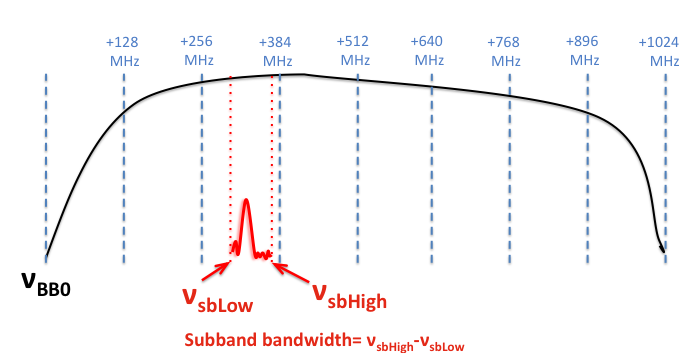
The black curve shows the analog filter response for an 8-bit baseband covering 1024 MHz, starting at νBB0. The dashed blue vertical lines show the 128 MHz boundaries; no subband can cross those boundaries and 128 MHz subbands are thus constrained to cover a region between two of those boundaries, with no finer tuning being possible. Narrower subbands, like the 64 MHz subband shown here in red, can be shifted around arbitrarily within one of the 128 MHz slots, but cannot cross any of these boundaries. (The dotted vertical red lines show the boundaries of the 64 MHz subband, while the solid curve shows an illustrative line within the subband.)
The analog filter shape defining the baseband rolls off severely at one edge of the baseband, so the 128 MHz slot at that edge has reduced sensitivity. The baseband edge is at the lowest sky frequency in the baseband when using the upper sideband, and at the highest sky frequency in the baseband when using the lower sideband.
Subband Bandwidths and the Digital Filter Response
The bandwidth for each subband may be selected independently, and can be any of 128/2n MHz, for n= 0, 1, …, 12: 128, 64, 32, 16, 8, 4, 2, or 1 MHz, or 500, 250, 125, 62.5, or 31.25 kHz.
The usable portion of the subband is set by three effects. First, as discussed above, the analog filters which define the baseband are not perfect, leading to lower sensitivity in the 128 MHz near the baseband edge for the 8-bit samplers.
Second, because the digital filters are not infinitely sharp, the rejected sideband leaks in at both edges of the subband. This leads to additional (aliased) noise, with a factor ~2 increase in the noise at the subband edges, dropping to a few percent within a few percent of the subband edge. The precise filter shape and noise increase is a complex but predictable function of the subband bandwidth (sbBW) and the subband tuning.
The third effect stems from the offset frequencies used for sideband rejection in the WIDAR correlator. The local oscillators at the individual antennas are tuned to slightly different frequencies, with those offsets taken out in the correlator. This means that each antenna observes a slightly different sky frequency, and thus some baselines will not give an interesting correlation near one edge of the subband. The maximum frequency shift is currently set to 32×f0, with the fundamental f0 being set to f0 = max(25.6 kHz×sbBW/128 MHz, 100 Hz). Here sbBW is the smallest subband bandwidth within the baseband. For the wider subband bandwidths the maximum frequency shift corresponds to <1% of that bandwidth, but for narrower subbands the effect can be severe. For instance, a 31.25 kHz subband has f0 = 100 Hz, and a maximum frequency shift of 3.2 kHz—10% of the subband may be lost on some baselines.
Spectral Channels and Polarization Products
Each subband, without recirculation enabled, can have a different number of channels and polarization products, subject to two limitations:
- For the ithsubband, the number of spectral channels can be:
- 64 nBlBP,i with full polarization products (RR,RL,LR,LL)
- 128 nBlBP,i with dual polarization products (RR and LL)
- 256 nBlBP,i with a single polarization product (RR or LL)
- The sum over all subbands of nBlBP,i must be less than or equal to 64, the number of Baseline Board pairs in the correlator. Equivalently, the sum over all subbands of spectral channels times polarization products is limited to 64 × 256 = 16,384 (without recirculation).
Baseline Boards are the boards in the WIDAR correlator where the actual cross-multiplications are done. There are 128 Baseline Boards arranged as 64 Baseline Board pairs (BlBPs). The limitations given here correspond to the capabilities of the individual boards and the finite number of boards the correlator has. Use of more than one pair per subband (i.e., nBlBP>1) is known as Baseline Board stacking; see additional details about this below.
Limitation #1 corresponds to table 4.2.1 of the options for subband bandwidth and spectral resolution when using nBlBP Baseline Board pairs for a subband:
| Table 4.2.1: Subband Bandwidth and Spectral Resolution Options (without recirculation) |
|||||||
|---|---|---|---|---|---|---|---|
| Subband bandwidth & total velocity coverage |
Full polarization products (RR, RL, LR, LL) 64nBlBP spectral channels Channel spacing: |
Dual polarization products (RR and LL) 128nBlBP spectral channels Channel spacing: |
Single polarization product (RR or LL) 256nBlBP spectral channels Channel spacing: |
||||
| 128 MHz | 38400/νGHz km/s | 2000/nBlBP kHz | 600/nBlBP/νGHz km/s | 1000/nBlBP kHz | 300/nBlBP/νGHz km/s | 500/nBlBP kHz | 150/nBlBP/νGHz km/s |
| 64 | 19200 | 1000 / nBlBP | 300 / nBlBP | 500 / nBlBP | 150 / nBlBP | 250 / nBlBP | 75 / nBlBP |
| 32 | 9600 | 500 / nBlBP | 150 / nBlBP | 250 / nBlBP | 75 / nBlBP | 125 / nBlBP | 37.5 / nBlBP |
| 16 | 4800 | 250 / nBlBP | 75 / nBlBP | 125 / nBlBP | 37.5 / nBlBP | 62.5 / nBlBP | 18.75 / nBlBP |
| 8 | 2400 | 125 / nBlBP | 37.5 / nBlBP | 62.5 / nBlBP | 18.75 / nBlBP | 31.25 / nBlBP | 9.375 / nBlBP |
| 4 | 1200 | 62.5 / nBlBP | 18.75 / nBlBP | 31.25 / nBlBP | 9.375 / nBlBP | 15.625/nBlBP | 4.687 /n BlBP |
| 2 | 600 | 31.25 / nBlBP | 9.375 / nBlBP | 15.625/nBlBP | 4.687 / nBlBP | 7.8125 / nBlBP | 2.344 / nBlBP |
| 1 | 300 | 15.625/nBlBP | 4.687 / nBlBP | 7.8125 / nBlBP | 2.344 / nBlBP | 3.906 / nBlBP | 1.172 / nBlBP |
| 0.5 | 150 | 7.8125 / nBlBP | 2.344 / nBlBP | 3.906 / nBlBP | 1.172 / nBlBP | 1.953 / nBlBP | 0.586 / nBlBP |
| 0.25 | 75 | 3.906 / nBlBP | 1.172 / nBlBP | 1.953 / nBlBP | 0.586 / nBlBP | 0.977 / nBlBP | 0.293 / nBlBP |
| 0.125 | 37.5 | 1.953 / nBlBP | 0.586 / nBlBP | 0.977 / nBlBP | 0.293 / nBlBP | 0.488 / nBlBP | 0.146 / nBlBP |
| 0.0625 | 18.75 | 0.977 / nBlBP | 0.293 / nBlBP | 0.488 / nBlBP | 0.146 / nBlBP | 0.244 / nBlBP | 0.073 / nBlBP |
| 0.0325 | 9.375 | 0.488 / nBlBP | 0.146 / nBlBP | 0.244 / nBlBP | 0.073 / nBlBP | 0.122 / nBlBP | 0.037 / nBlBP |
|
Subband bandwidth and spectral resolution options. Note that the table entries refer to the spacing between spectral channels—that spacing is before any frequency smoothing, so these channels are not independent.
|
|||||||
Here are four examples of allowed general observing setups which use all 64 BlBPs to produce the maximum number of channels times polarization products:
| Baseband | Subband |
Pol'n |
Spectral |
nBlBP | |
| Example 1 | A0/C0 | sb0 | RR | 16384 | 64 |
| Example 2 | A0/C0 | sb0 | RR | 8192 | 32 |
| A0/C0 | sb1 | RR, LL | 1024 | 8 | |
| A0/C0 | sb2 | RR, LL | 512 | 4 | |
| B0/D0 | sb0 | RR, LL | 2048 | 16 | |
| B0/D0 | sb1 | RR,RL,LR,LL | 256 | 4 | |
| Example 3 | A0/C0 | sb0 | RR | 8192 | 32 |
| A0/C0 | sb1 | LL | 1024 | 4 | |
| A0/C0 | sb2 | RR, LL | 1024 | 8 | |
| A0/C0 | sb3 | RR,RL,LR,LL | 1024 | 16 | |
| A0/C0 | sb4 | RR,RL,LR,LL | 256 | 4 | |
| Example 4 | A0/C0 | sb0-5 | RR,RL,LR,LL | 64 | 6 x 1 |
| A0/C0 | sb6 | RR, LL | 3840 | 1 x 30 | |
| A0/C0 | sb7 | RR | 768 | 1 x 3 |
|
| A0/C0 | sb8 | RR,RL,LR,LL | 192 | 1 x 3 | |
| B0/D0 | sb0-2 | RR,RL,LR,LL | 64 | 3 x 1 | |
| B0/D0 | sb3 | LL | 768 | 1 x 3 |
|
| B0/D0 | sb4 | RR, LL | 2048 | 1 x 16 |
Recirculation
When the subband bandwidth is less than the maximum 128 MHz, the spare clock cycles that become available in the correlator hardware can be re-purposed to compute additional lags using a single baseline board. This increases the spectral resolution within the subband, and is known as recirculation. Each factor of two reduction in subband bandwidth results in an additional factor of two maximum lags; therefore for subbands of 128 MHz / N the possible spectral resolution (in units of frequency) can be increased by a factor of N2.
Recirculation vs. Baseline Board Stacking
When faced with the choice between recirculation and Baseline Board stacking to increase the number of channels in a subband, we recommend recirculation for subbands narrower than 128 MHz; this is supported in observatory software (RCT-proposing, OPT). Using recirculation rather than stacking frees up more Baseline Boards for other uses; alternatively the experiment becomes less dependent on all Baseline Board pairs being available/working at the time of observation. For subbands of 128 MHz, recirculation is not possible, and Baseline Board stacking must be utilized to increase the number of channels.
The present implementation of recirculation is that, for each halving of the subband bandwidth, the number of channels in the subband may be doubled without having to use additional correlator hardware. The maximum recirculation factor for a subband is 128/(subband bandwidth in MHz) and, of course, subject to other configuration restrictions such as data rate.
Baseline Board Stacking
As opposed to recirculation, which increases the number of channels in a subband by exploiting otherwise unused CPU resources, Baseline Board stacking adds more channels to a subband by adding correlator hardware resources, i.e., using up more Baseline Board pairs. Using Baseline Board stacking may therefore limit the number of subbands available in one or more of the basebands. Understanding how this works requires understanding some of the details of the correlator hardware. That understanding is built into the RCT-proposing, and observers may simply use that tool to find out whether their particular setup will, in fact, work. But the results can be confusing without some understanding of the hardware constraints from which they arise. These hardware constraints are complex, and most observers will not need to understand these details. The following section is for those who are attempting complex line experiments and who find the RCT-proposing restricting the number of subbands and/or channels they can use in unexpected ways. Most observers can skip the following section.
Baseline Board Stacking and Correlator Use
First let us consider how the correlator hardware is organized. The cross-multiplications in the WIDAR correlator are spread across 64 Baseline Board pairs (BlBP), arranged into 4 quadrants of 16 BlBP each. Each baseband is connected directly to one of those quadrants. In the simplest mode, each of the 16 BlBP of a quadrant handles the correlations for one of the 16 subbands of the corresponding baseband. Four basebands and four quadrants are required to handle the full 8 GHz of bandwidth per polarization provided by the 3-bit (wideband) samplers: 8 GHz is split into four basebands of 2 GHz each, with each baseband fed into a different BlBP quadrant. Each BlBP in that quadrant handles a subband of maximum bandwidth 128 MHz, so 16 BlBP handles 16 subbands for a total of 16×128 MHz = 2048 MHz.
A single BlBP produces 256 cross-correlations per baseline for a single subband, which can be used for a single polarization product (e.g., RR or LL with 256 spectral channels), or two (RR and LL with 128 spectral channels each), or four (RR, RL, LR, and LL with 64 spectral channels each).
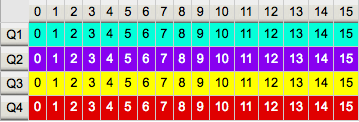 |
Baseline Board pair (BlBP) usage for a simple 4 x 2 GHz (3-bit sampler) experiment. The different colors correspond to different baseband pairs (Q1=cyan, Q2=purple, Q3=yellow, Q4=red). The BlBP quadrants are indicated along the left-hand side, while the numbers across the top represent the BlBPs within those quadrants. Numerals within the colored boxes label the subbands within the basebands. In this setup each subband is correlated using a single BlBP, using all of the 64 available BlBPs. |
When using the 8-bit samplers, the total bandwidth is only 2 GHz per polarization, split into two basebands of 1 GHz each. The simplest continuum setup uses only two quadrants, since there are only two basebands; and only 8 subbands are required to span the 8×128 MHz = 1024 MHz of each baseband. Three-quarters of the correlator BlBP hardware remain unused.
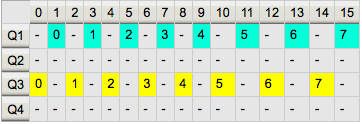 |
Baseline Board pair (BlBP) usage for a simple 2 x 1 GHz (8-bit sampler) experiment. The cyan boxes (shaded when printed out in black and white) correspond to the first baseband pair (IF A0/C0), fed directly into Q1; the yellow boxes to the second (IF B0/D0), fed directly into Q3. The BlBP quadrants are indicated along the left-hand side, while the numbers across the top represent the BlBPs within those quadrants. Numerals within the colored boxes label the subbands within the basebands. In this setup each subband is correlated using a single BlBP, using only 16 of the 64 available BlBPs. |
The spectral line mode allows access to these extra correlator resources through Baseline Board stacking: using multiple BlBPs to process the same subband and produce more cross-correlations for that subband. This is done using crossbar switches which make the data for a single subband available to several BlBPs. Those BlBPs can then be used to produce more spectral channels for that subband, with n BlBPs producing 256×n cross-correlations per baseline. The limit on the total number of cross-correlations (16384) stems from the total number of BlBPs (64): 64×256 = 16384.
Unfortunately, completely flexible crossbar switches are expensive and could not be implemented in the VLA's correlator. This means that one cannot route a given subband to a randomly-chosen BlBP. The routings which are possible, are as follows:
- A subband in a baseband can be routed to any BlBP within the corresponding quadrant.
- Data coming into a given BlBP in one quadrant, can be routed to the corresponding BlBP in any other quadrant.
Routing option #1 means that one could use all the BlBPs within a quadrant to correlate a single subband, yielding 16×256 = 4096 cross-correlations for that subband:
 |
Baseline Board pair (BlBP) usage when assigning all BlBPs within a quadrant to a single subband within the corresponding baseband. The cyan boxes (shaded when printed out in black and white) correspond to the first baseband pair (IF A0/C0), fed directly into Q1; the yellow boxes to the second (IF B0/D0), fed directly into Q3. The BlBP quadrants are indicated along the left-hand side, while the numbers across the top represent the BlBPs within those quadrants. Numerals within the colored boxes label the subbands within the basebands. In this setup each subband is correlated using 16 BlBPs, yielding 16×256 = 4096 cross-correlations for those subbands, and using 32 of the 64 available BlBPs. |
Routing option #2 means that one could use the BlBPs in all 4 quadrants to correlate a single subband. One simple case would use 4 BlBPs to correlate each of the 16 subbands in a single baseband, yielding 4×256 = 1024 cross-correlations for each of those subbands. Note that in this case, no BlBPs are left to correlate any data from the second baseband.
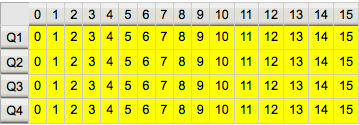 |
Baseline Board pair (BlBP) usage when assigning the BlBPs in all 4 quadrants to correlate the corresponding subbands in a single baseband. The BlBP quadrants are indicated along the left-hand side, while the numbers across the top represent the BlBPs within those quadrants. Numerals within the colored boxes label the subbands within the baseband. In this setup each subband is correlated using 4 BlBPs, yielding 4×256 = 1024 cross-correlations for those subbands, and using all of the 64 available BlBPs. |
Using routing option #2 does come with a subtle cost: assigning a BlBP in quadrant X to correlate a subband corresponding to quadrant Y removes that BlBP from use in the baseband corresponding to quadrant X…and therefore also removes the corresponding subband in that baseband. So, getting more channels for a subband in one baseband may prevent the use of a subband in a different baseband. To take a simple example, consider an experiment where one wishes to observe a single line in dual polarization with 512 channels (requiring 4 BlBPs), plus as much continuum bandwidth as possible. Naively, one would say there are 16 subbands in each baseband; one is used for the spectral line, so that leaves 16+15 = 31 subbands, and with the widest subband bandwidth (128 MHz) the total available continuum should be 31×128 MHz = 3968 MHz per polarization. Actually, however, there are only 15+15 subbands available, or 30×128 MHz = 3840 MHz per polarization, because the spectral line subband has eaten one BlBP corresponding to the other baseband:
 |
Baseline Board pair (BlBP) usage for a continuum plus single line experiment. The cyan boxes (shaded when printed out in black and white) correspond to the first baseband pair (IF A0/C0), fed directly into Q1; the yellow boxes to the second (IF B0/D0), fed directly into Q3. The BlBP quadrants are indicated along the left-hand side, while the numbers across the top represent the BlBPs within those quadrants. Numerals within the colored boxes label the subbands within the basebands. In this setup subband #15 of A0/C0 is correlated using 4 BlBPs, yielding 4×256 = 1024 cross-correlations for that subband, while the other 15 subbands in each baseband are correlated using a single BlBP each. The use of 4 BlBPs for a subband in baseband A0/C0 has eliminated the corresponding subband of the other baseband (B0/D0). Note that only 30+4 = 34 of the 64 available BlBPs have been used—there is plenty of correlator hardware available, but the signal for the spectral line subband cannot be routed to them. |
If the same spectral line required twice as many channels, this will result in the loss of two subbands in both of the basebands:
 |
Baseline Board pair (BlBP) usage for a continuum plus single line experiment. The cyan boxes (shaded when printed out in black and white) correspond to the first baseband pair (IF A0/C0), fed directly into Q1; the yellow boxes to the second (IF B0/D0), fed directly into Q3. The BlBP quadrants are indicated along the left-hand side, while the numbers across the top represent the BlBPs within those quadrants. Numerals within the colored boxes label the subbands within the basebands. In this setup subband #14 of A0/C0 is correlated using 8 BlBPs, yielding 8×256 = 2048 cross-correlations for that subband, while the other 14 subbands in each baseband are correlated using a single BlBP each. The use of 8 BlBPs for a subband in baseband A0/C0 has eliminated one additional subband in baseband A0/C0, and two subbands in B0/D0. Note that only 28+8 = 36 of the 64 available BlBPs have been used—there is no way to route the signals from the missing subbands to that hardware. |
In some cases one may want to use a different routing to use up subbands in one baseband in preference to another. For instance, the same spectral line setup (2048 cross-correlations for a single spectral line subband, plus as much continuum as possible) could be set up to allow 13 continuum subbands in the A0/C0 baseband, and the full 16 continuum subbands in B0/D0:
 |
Baseline Board pair (BlBP) usage for a continuum plus single line experiment. The cyan boxes (shaded when printed out in black and white) correspond to the first baseband pair (IF A0/C0), fed directly into Q1; the yellow boxes to the second (IF B0/D0), fed directly into Q3. The BlBP quadrants are indicated along the left-hand side, while the numbers across the top represent the BlBPs within those quadrants. Numerals within the colored boxes label the subbands within the basebands. In this setup subband #13 of A0/C0 is correlated using 8 BlBPs, yielding 8×256 = 2048 cross-correlations for that subband, while the other 13 subbands in A0/C0 and 16 subbands in B0/D0 are correlated using a single BlBP each. In this setup the use of 8 BlBPs for a subband in baseband A0/C0 has eliminated two additional subbands in baseband A0/C0, while retaining all 16 subbands in B0/D0. Note that only 29+8 = 37 of the 64 available BlBPs have been used. Shared risk observations can assign a number of BlBPs which is not a power of two, and hence could assign one additional BlBP (Q4-BlBP 15) to the spectral line subband. |
Understanding these confusing constraints can help observers set up the VLA more effectively to achieve their scientific goals. For instance, in a mixed line+continuum experiment, it works best to use the resource tools to set up the baseband tunings and subband channelization for the most important lines first, then add the desired continuum, and then see what correlator resources remain for any lines of secondary interest.
The above examples all use BlBP pair stacking in powers of 2, but this is not required. To give some idea of more complex possibilities, the following tables (4.2.3 and 4.2.4) give two examples of other possible configurations. The RCT display shows how the Baseline Boards are used to process the individual subbands. The cyan boxes (shaded when printed out in black and white) show the Baseline Boards used to process data from baseband A0/C0, while the yellow boxes show Baseline Boards used to process data from baseband B0/D0.
| Baseband | Subband | Pol'n products | Spectral channels | nBlBP |
|---|---|---|---|---|
| A0/C0 | sb0 | RR | 10240 | 40 |
| A0/C0 | sb1 | LL | 768 | 3 |
| A0/C0 | sb2 | RR,LL | 2176 | 17 |
| B0/D0 | sb0 | RR | 256 | 1 |
| B0/D0 | sb1 | RR,LL | 384 | 3 |
| RCT display: |  |
|||
| Baseband | Subband | Pol'n products | Spectral channels | nBlBP |
|---|---|---|---|---|
| A0/C0 | sb0 | RR | 4352 | 17 |
| A0/C0 | sb1 | RR, LL | 1152 | 9 |
| B0/D0 | sb0 | RR,RL,LR,LL | 192 | 3 |
| B0/D0 | sb1 | RR, LL | 4480 | 35 |
| RCT display: |  |
|||
The individual subbands can have different bandwidths, and those bandwidths may be chosen completely independently of the number of spectral channels in each subband. So, for instance, a subband with a bandwidth of 2 MHz and 1152 spectral channels would have a channel separation of 2 MHz/1152 = 1.736 kHz; but the observer could equally well choose a bandwidth of 64 MHz for that subband, leading to a channel separation of 64 MHz/1152 = 55.56 kHz.
Use of the 3-bit samplers further extends the possibilities. Here is one example:
| Baseband | Subband | Pol'n products | Spectral channels | nBlBP | Quadrant(s): Column(s) |
|---|---|---|---|---|---|
| A1/C1 | sb0-8 | RR, LL, RL, LR | 9 x 64 | 9 x 1 | Q1: 0–8 |
| A1/C1 | sb9 | RR, LL | 1 x 1152 | 1 x 9 | Q1 & Q3: 9–11, 14 / Q4: 9 |
| A1/C1 | sb10 | RR | 1 x 1792 | 1 x 7 | Q1 & Q3 & Q4 : 12,13 / Q2: 13 |
| A1/C1 | sb11 | RR, LL | 1 x 384 | 1 x 3 | Q1 & Q2 & Q3: 15 |
| A2/C2 | sb0-11 | RR, LL, RL, LR | 12 x 64 | 12 x 1 | Q2: 0–11 |
| A2/C2 | sb12 | LL | 1 x 768 | 1 x 3 | Q2: 12, 14 / Q4: 14 |
| B1/D1 | sb0-3 | RR, LL, RL, LR | 4 x 64 | 4 x 1 | Q3: 0–3 |
| B1/D1 | sb4 | RR, LL, RL, LR | 1 x 320 | 1 x 5 | Q3: 4–8 |
| B2/D2 | sb0-6 | RR, LL, RL, LR | 7 x 64 | 7 x 1 | Q4: 0–6 |
| B2/D2 | sb7 | RR, LL | 1 x 640 | 1 x 5 | Q4: 7, 8, 10, 11, 15 |
| RCT display: | 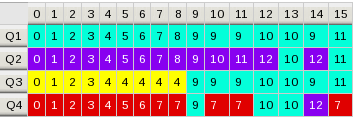 |
||||
Once again, the RCT-proposing implements all of these constraints.
Documentation
Documentation
Documentation for VLA data reduction, image making, observing preparation, etc., can be found in various manuals. Current manuals are available on-line. Those manuals marked by an asterisk (*) can be mailed out upon request, or are available for downloading from the NRAO website. Direct your requests for mailed hardcopy to Lori Appel. Many other documents of interest to the VLA user, not listed here, are available from our website.
- PROCEEDINGS FROM THE 1988 SYNTHESIS IMAGING WORKSHOP: Synthesis theory, technical information and observing strategies can be found in: "Synthesis Imaging in Radio Astronomy." This collection of lectures given in Socorro in June 1988 has been published by the Astronomical Society of the Pacific as Volume 6 of their Conference Series. The lectures of the 2014 workshop are available at the 14th Synthesis Imaging Workshop web site.
- PROCEEDINGS FROM THE 1998 SYNTHESIS IMAGING WORKSHOP: This is an updated and expanded version of Reference 1, taken from the 1998 Synthesis Imaging Summer School, held in Socorro in June, 1998. These proceedings are published as Volume 180 of the ASP Conference Series.
- GUIDE TO OBSERVING WITH THE VLA: Describes details of how to observe with the VLA once you have been allocated time on the VLA (https://science.nrao.edu/facilities/vla/docs/manuals/obsguide). Including special observing modes such as:
- CALIBRATION (https://science.nrao.edu/facilities/vla/docs/manuals/obsguide/calibration)
- OBSERVING WITH THE 8-BIT (up to 2 GHz bandwidth) & 3-BIT (up to 8 GHz bandwidth) SAMPLER SYSTEMS (https://science.nrao.edu/facilities/vla/docs/manuals/obsguide/modes/set-up);
- SPECTRAL LINE OBSERVING (https://science.nrao.edu/facilities/vla/docs/manuals/obsguide/modes/line);
- HIGH FREQUENCY OBSERVING (https://science.nrao.edu/facilities/vla/docs/manuals/obsguide/topical-guides/hifreq);
- LOW FREQUENCY OBSERVING (https://science.nrao.edu/facilities/vla/docs/manuals/obsguide/topical-guides/lofreq);
- VERY LOW FREQUENCY OBSERVING (< 500 MHz) (https://science.nrao.edu/facilities/vla/docs/manuals/obsguide/topical-guides/vlofreq);
- POLARIMETRY (https://science.nrao.edu/facilities/vla/docs/manuals/obsguide/modes/pol);
- MOSAICKING (https://science.nrao.edu/facilities/vla/docs/manuals/obsguide/modes/mosaicking);
- RADIO FREQUENCY INTERFERENCE (https://science.nrao.edu/facilities/vla/docs/manuals/obsguide/rfi);
- MOVING OBJECTS (https://science.nrao.edu/facilities/vla/docs/manuals/obsguide/modes/moving);
- VLBI AT THE VLA (https://science.nrao.edu/facilities/vla/docs/manuals/obsguide/modes/vlbi).
- *CASA COOKBOOK (deprecated with last updates for CASA 4.7.2): The CASA Cookbook for use of the package for data reduction of VLA (& ALMA) data is available, along with other documentation, from the CASA home page (http://casa.nrao.edu). See (http://casa.nrao.edu/docs/cookbook/)
- CASA Online Documentation: https://casadocs.readthedocs.io/en/stable/
- VLA CASA Guides: Tutorials and data reduction examples of VLA data in CASA (https://casaguides.nrao.edu/index.php/Karl_G._Jansky_VLA_Tutorials)
- *AIPS COOKBOOK: The Astronomical Image Processing System (AIPS) software is able to fully calibrate VLA data and do most imaging operations. The exception is the wide-band (bandwidth synthesis) deconvolution which is being developed in CASA only. ALMA data may also be reduced in AIPS although the package is not fully qualified to calibrate data from the ALMA linearly-polarized feeds. The Cookbook description for calibration and imaging under the AIPS system can be found near all public workstations in the SOC. The latest version has expanded descriptions of data calibration imaging, cleaning, self-calibration, spectral line reduction, and VLBI reductions. See (http://www.aips.nrao.edu/cook.html)
- *GOING AIPS: This is a two-volume programmers manual for those wishing to write programs under AIPS. It is now somewhat out of date. See (http://www.aips.nrao.edu/goaips.html)
- *VLA CALIBRATOR LIST: This page contains the list of VLA Calibrators in both 1950 and J2000 epoch. See (https://science.nrao.edu/facilities/vla/observing/callist)
- *The Very Large Array: Design and Performance of a Modern Synthesis Radio Telescope, Napier, Thompson, and Ekers, Proc. of IEEE, 71, 295, 1983.
- *HISTORICAL VLA MEMO SERIES: archive memo series from the early days of the VLA. See (http://library.nrao.edu/vlam.shtml)
- *RECENT VLA MEMO SERIES: the memo series relating to the expanded capabilities of the VLA. See (http://library.nrao.edu/evla.shtml)
- *The VLA Expansion Project: Construction Project Book. The Expanded VLA Project Books contains the technical details of the VLA Expansion construction project. It is available online at http://www.aoc.nrao.edu/evla/pbook.shtml.
- INTRODUCTION TO THE NRAO VERY LARGE ARRAY (Green Book): This manual has general introductory information on the VLA. Topics include theory of interferometry, hardware descriptions, observing preparation, data reduction, image making and display. Major sections of this 1983 manual are now out of date, but it nevertheless remains a useful source of information on much of the VLA. There are a few hard copies at the VLA and in the DSOC. Much of this document is now available for download (https://science.nrao.edu/facilities/vla/obsolete/green-book). Note: it does not include any information about the hardware and software specific to the expanded Karl G. Jansky VLA.
- WIDAR: The DRAO design and development documents of the WIDAR correlator of the VLA are available at http://www.aoc.nrao.edu/widar/docs/.
Online Tools & Important Links
The NRAO User Portal. (https://my.nrao.edu) This is a gateway to the NRAO interactive services that include the Proposal Submission Tool (PST).
The NRAO Proposal Submission Tool (PST) online manual. (https://science.nrao.edu/facilities/vla/docs/manuals/proposal-guide/pst)
The VLA Exposure Calculator Tool (ECT) online manual. (https://science.nrao.edu/facilities/vla/docs/manuals/propvla/determining)
The VLA Exposure Calculator Tool (ECT). (https://obs.vla.nrao.edu/ect/)
The Resource Catalog Tool for proposers. (https://rctp.vla.nrao.edu/rct/)
Acknowledgements
Many thanks to all the VLA staff and our RSRO participants who have worked long and hard to commission these capabilities and who have helped to create this extensively updated set of documentation.
NRAO is grateful to Professor Rob Ivison for supporting the upgrade of some of the 3-bit samplers on the VLA via a grant from the European Research Council. For observations using the 3-bit samplers between May 2015 and March 2018 we encourage users to include the following text in the Acknowledgments section of their publications:
"We acknowledge funding towards the 3-bit samplers used in this work from ERC Advanced Grant 321302, COSMICISM."
Contact Information
Please go to the People page for information on key personnel at NRAO-Socorro.
Please direct queries to the NRAO Helpdesk; you can expect a response within one to two business days.
Editor's Notes
This Observational Status Summary for the Karl G. Jansky (expanded) VLA is based substantially on its predecessor, the VLA Observational Status Summary. Over the VLA history of over 40 years, many individuals contributed to that document by writing sections, editing previous versions, commenting on draft material, and implementing the capabilities described herein. We thank all these contributors for their efforts. For questions on the content, or suggestions that would enhance the clarity of this guide, we recommend contacting the NRAO Helpdesk.





Connect with NRAO