
VLA Observational Status Summary 2025A
VLA capabilities October 2024 - May 2025
VLA Observational Status Summary 2025A
- Introduction
- Offered VLA Capabilities during the Next Semester
- Performance of the VLA during the Next Semester
- Resolution
- Sensitivity
- VLA Frequency Bands and Tunability
- VLA Samplers
- Field of View
- Time Resolution and Data Rates
- Radio Frequency Interference
- Subarrays
- Positional Accuracy & Astrometry
- Limitations on Imaging Performance
- Calibrating the Flux Density Scale
- Complex Gain Calibration
- Polarization
- VLBI Observations
- Snapshots
- Shadowing and Cross-Talk
- Combining Configurations and Mosaicking
- Pulsar Observing
- Solar Observing
- VLA+LWA (eLWA) Observing
- WIDAR Correlator
- Documentation
- Contact Information
- Editor's Notes
All content on one page (useful for printing, presentation mode etc.)
Offered VLA Capabilities during the Next Semester
The Call for Proposals
The most recent Call for Proposals summarizes the General Observing (GO) capabilities being offered for the Karl G. Jansky Very Large Array (VLA).
In addition to these general capabilities, NRAO continues to offer shared risk observing options for those who would like to push the capabilities of the VLA beyond those offered for general use. These are the Shared Risk Observing (SRO) and Resident Shared Risk Observing (RSRO) programs.
Details about what is being offered for each program are given below. If you have any questions or problems with any link or tool, please submit a ticket through the NRAO Helpdesk.
Considering the lack of hybrid configurations after semester 2016A, guidelines on how to substitute such configurations with the use of principal array configurations are presented in the Array Configurations section of the Guide to Proposing for the VLA.
General Observing (GO) and Shared-Risk Observing (SRO)
Summary of Capabilities
As described in the Call for Proposals, the VLA offers continuous frequency coverage from 1–50 GHz in the following observing bands: 1–2 GHz (L-band); 2–4 GHz (S-band); 4–8 GHz (C-band); 8–12 GHz (X-band); 12–18 GHz (Ku-band); 18–26.5 GHz (K-band); 26.5–40 GHz (Ka-band); and 40–50 GHz (Q-band). Both single pointing and mosaics with discrete, multiple field centers will be supported under General Observing (GO). In addition to these, all VLA antennas are equipped with 224–480 MHz (P-band) and 54–86 MHz (4-band) receivers near the prime focus. Data rates of up to 60 MB/s (216 GB/hour) will be available to all users as GO, combined with correlator integration time limits per band and per configuration, as described in the Time Resolution and Data Rates section. Limitations on frequency settings and tuning ranges are described in the Frequency Bands and Tunability section.
The GO capabilities being offered are:
| Capability | Description |
| 8-bit samplers |
*Note: 4-band and dual 4/P-band observations are offered for Stokes I continuum only using standard full polarization default setups. Polarization, spectral-line, or the use of non-standard setups, should be submitted as a RSRO proposal. |
| 3-bit samplers |
|
| Mixed 3-bit and 8-bit samplers |
|
|
Subarrays |
|
| Y27 or Y1 for VLBI |
|
|
Solar observing |
|
|
On-The-Fly Mosaicking (OTF)‡ |
|
|
Pulsar |
|
*Note: The VLA L-band (1-2 GHz) has a special signal path (the "reverse coupler" path) that allows coherent radio bursts to be observed without saturating the system, as the brightest of these solar bursts can exceed 105 solar flux units, or 109 Jy. This signal path has not yet been fully commissioned and is therefore not yet available under GO.
SRO capabilities can be set up via the Observing Preparation Tool (OPT) and run through the dynamic scheduler without intervention, but are not as well tested as GO capabilities. Data rates higher than 60 MB/s (216 GB/hour) and up to 100 MB/s (360 GB/hour) are considered SRO. A summary of the SRO capabilities being offered are:
- On-the-Fly (OTF) mosaicking for X-, Ku-, K-, Ka-, and Q-bands (used when each pointing on the sky is on the order of several seconds or less), but not using subarrays.
- Wideband VLA for VLBI: Enables recording of VLA WIDAR continuum-mode correlations during VLA phased array (Y27) VLBI observations. Currently, this only supports standard VLA 8-bit continuum modes with a 2-GHz bandwidth. See the VLBA Call for Proposals for more details.
- eLWA: Joint LWA and VLA 4-band observations using a single 8 MHz subband centered at 76 MHz, and 4-bit VDIF output. Note: During semester 2025A, the LWA is expected to be undergoing infrastructure upgrades and availability of the telescopes (LWA1 and LWA-SV) may be limited. Those interested in using this mode should contact Greg Taylor at gbtaylor@unm.edu for more details.
We expect that most SRO programs will have no or only minor problems that can be corrected quickly. If an SRO program fails, however, and it becomes clear that detailed testing with additional expertise is needed, then the project must make an experienced member from their team available to help troubleshoot the problem. In some cases, this may require the presence of that experienced member in Socorro. If adequate support from the project is not given, then the time on the telescope will be forfeited. The additional effort is to be determined based on discussions with the NRAO staff and management and the project team.
The guidelines for General and Shared Risk observing proposals, along with information about tools and other advice, can be found in the VLA Proposal Submission Guidelines.
Resident Shared Risk Observing (RSRO)
Summary of Capabilities
The VLBA Resident Shared Risk Observing (RSRO) program provides users with early access to new capabilities in exchange for a period of residency in Socorro to help commission those capabilities.
RSRO proposals should be submitted using the NRAO Proposal Submission Tool in response to a regular proposal call. The proposal should include a scientific justification, as for normal proposals, which will be peer reviewed as part of NRAO's time allocation process. Selecting "VLA RSRO" from the "Observing Mode" menu on the Resources page makes an "RSRO Comments" text-entry facility available for describing the technical resources required. A description of the personnel who will be involved in the effort along with their expertise and availability should also be included in the technical justification.
We emphasize the "shared risk" nature of the RSRO program. Since observers will be attempting to use capabilities under development and in the process of being commissioned, NRAO can make no guarantee of the success of any observations made under this program, and no additional commitment is made beyond granting the hours actually assigned by the peer review process.
Proposals for any area of user interest bit offered under GO or SRO are welcome. Here, we provide some examples of capabilities that are being utilized in recent RSRO proposals.
- Correlator dump times shorter than 50 msec, including integration times as short as 5 msec for transient detection, or data rates above 100 MB/s. In order to reduce the data rate, frequency averaging in the correlator may be utilized in RSRO proposals;
- YUPPI pulsar mode combined with VLBI recording;
- Subarray observations with setups other than the default continuum setups, or observations with more than 3 subarrays;
- Currently, OTF observing is implemented as linear interpolations in Equatorial Coordinates (i.e., RA/Dec). This can be expanded to allow using stripes linear in Galactic coordinates (l,b), as well as more complex patterns other than linear in RA and Dec, such as Rosetta or Spiral patterns. Note that these must still adhere to the restrictions of the OTF mode under General Observing, i.e., using the full array below 8 GHz (up to C-band), and no subarrays.
The guidelines for Resident Shared Risk Observing proposing, along with requirements and considerations, can be found in the VLA Proposal Submission Guidelines.
Commensal Observing Systems at the VLA
There are three commensal systems on the VLA that may take data at the same time as your proposed observation. The first is the VLITE system, which will take data at P-band during regular observations that use bands other than P-band. Hence, VLITE is turned off by default during P-band or dual 4/P-band observations. The VLITE system is deployed on up to eighteen VLA antennas. Observers wishing to gain access to the commensal VLITE data taken during their VLA observations should follow the instructions on the VLITE web page for doing so. The second is the realfast system, which takes data at very fast dump rates in an effort to detect Fast Radio Bursts (FRBs). This system is fully commissioned for observing at L- through X-bands, in parallel with standard continuum correlator configurations. The third commensal system, COSMIC SETI, enables the search for extraterrestrial intelligence (SETI) using the VLA, and collects data during unconflicted PI science observations. For information about commensal observing see the Commensal Observing with NRAO Telescopes page.
To report errors or problems encountered in any link or while using any NRAO tool listed here, please submit a ticket through the NRAO Helpdesk.
Performance of the VLA during the Next Semester
Resolution
Resolution
The VLA's resolution is generally diffraction-limited, and thus is set by the array configuration and the observing frequency. Like all synthesis arrays, the VLA is sensitive only to structures on a range of angular scales between the diffraction limit (the smallest angular scale detectable) and a "Largest Angular Scale" (which depends on the fringe spacing formed by the shortest baselines in the configuration). For emission structures smaller than the diffraction limit (θ ∼ λ/Bmax), the VLA acts like a single-dish instrument—the resulting image is smoothed to the resolution of the array. For emission structures larger than the detectable range, the VLA is simply blind to the emission; this is a limitation unique to interferometers. No subsequent processing can fully recover the missing information from these large scales. It can only be obtained by observing in a more compact VLA array configuration or with data from an instrument that is sensitive to the missing angular scales, such as a large single dish or a compact array of smaller antennas.
Table 3.1.1 displays the VLA's resolution and the scale at which severe attenuation of large-scale structure occurs. This table shows the maximum and minimum antenna separations, the approximate synthesized beam size (full width at half-power; the resolution element) for the central frequency for each band, and the largest angular scale of detectable emission.
| Configuration | A | B | C | D |
|---|---|---|---|---|
| Bmax (km1) | 36.4 | 11.1 | 3.4 | 1.03 |
| Bmin (km1) | 0.68 | 0.21 | 0.0355 | 0.035 |
| Band | Synthesized Beamwidth θHPBW(arcsec)1,2,3 | |||
| 74 MHz (4) | 24 | 80 | 260 | 850 |
| 350 MHz (P) | 5.6 | 18.5 | 60 | 200 |
| 1.5 GHz (L) | 1.3 | 4.3 | 14 | 46 |
| 3.0 GHz (S) | 0.65 | 2.1 | 7.0 | 23 |
| 6.0 GHz (C) | 0.33 | 1.0 | 3.5 | 12 |
| 10 GHz (X) | 0.20 | 0.60 | 2.1 | 7.2 |
| 15 GHz (Ku) | 0.13 | 0.42 | 1.4 | 4.6 |
| 22 GHz (K) | 0.089 | 0.28 | 0.95 | 3.1 |
| 33 GHz (Ka) | 0.059 | 0.19 | 0.63 | 2.1 |
| 45 GHz (Q) | 0.043 | 0.14 | 0.47 | 1.5 |
| Band | Largest Angular Scale θLAS(arcsec)1,4 | |||
| 74 MHz (4) | 800 | 2200 | 20000 | 20000 |
| 350 MHz (P) | 155 | 515 | 4150 | 4150 |
| 1.5 GHz (L) | 36 | 120 | 970 | 970 |
| 3.0 GHz (S) | 18 | 58 | 490 | 490 |
| 6.0 GHz (C) | 8.9 | 29 | 240 | 240 |
| 10 GHz (X) | 5.3 | 17 | 145 | 145 |
| 15 GHz (Ku) | 3.6 | 12 | 97 | 97 |
| 22 GHz (K) | 2.4 | 7.9 | 66 | 66 |
| 33 GHz (Ka) | 1.6 | 5.3 | 44 | 44 |
| 45 GHz (Q) | 1.2 | 3.9 | 32 | 32 |
- These estimates of the synthesized beamwidth are for a uniformly weighted, untapered map produced from a full 12 hour synthesis observation of a source which passes near the zenith.
- Notes:
- 1. Bmax is the maximum antenna separation, Bmin is the minimum antenna separation, θHPBW is the synthesized beam width (FWHM), and θLAS is the largest angular scale structure visible to the array.
- 2. The listed resolutions are appropriate for sources with declinations between −15 and +75 degrees.
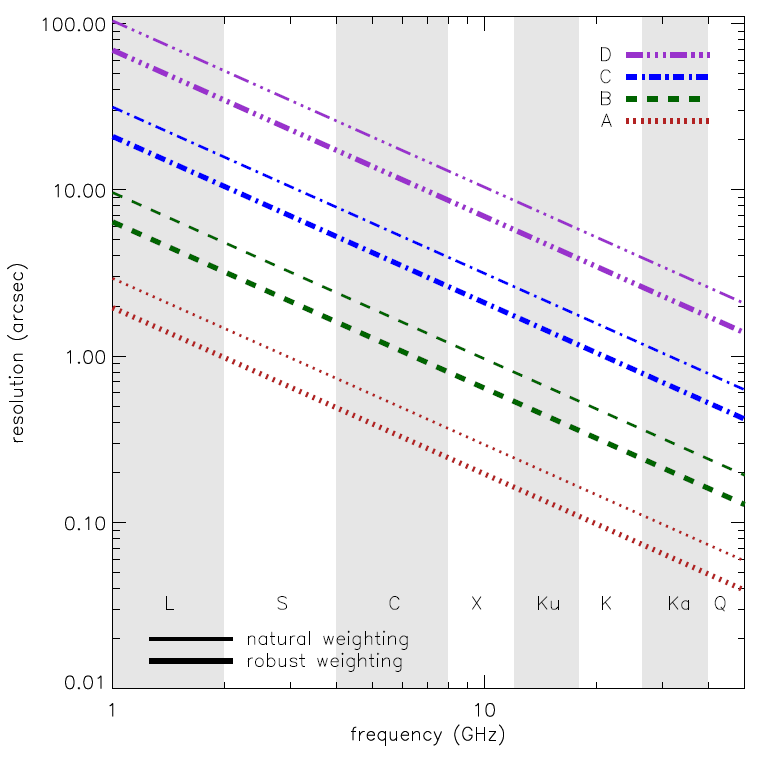
- 3. The approximate resolution for a naturally weighted map is about 1.5 times the numbers listed for θHPBW. The values for snapshots are about 1.3 times the listed values.
- 4. The largest angular scale structure is that which can be imaged reasonably well in full synthesis observations. For single snapshot observations, the quoted numbers should be divided by two.
- 5. For the C configuration, an antenna from the middle of the north arm is moved to the central pad N1. This results in improved imaging for extended objects, but may slightly degrade snapshot performance. Note that although the minimum spacing is the same as in D configuration, the surface brightness sensitivity and image fidelity to extended structure is considerably inferior to that of the D configuration.
The following figure is a graphical representation of the synthesized beamwidths for natural and robust weighting for the four main array configurations between 1 and 50 GHz. Also available are synthesized beamwidth figures for the low frequency (1–12 GHz) and the high frequency (12–50 GHz) receiver bands.
(click image to enlarge)
Sensitivity
Sensitivity
The theoretical thermal noise expected for an image using natural weighting of the visibility data is given by:
| \[\Delta I_m = \frac{SEFD}{\eta_{\rm c}\sqrt{n_{\rm pol}N(N-1)t_{\rm int}\Delta\nu}}\] | (eq. 1) |
where:
- - SEFD is the system equivalent flux density (Jy), defined as the flux density of a radio source that doubles the system temperature. Lower values of the SEFD indicate more sensitive performance. For the VLA's 25–meter paraboloids, the SEFD is given by the equation SEFD = 5.62Tsys/ηA, where Tsys is the total system temperature (receiver plus antenna plus sky), and ηA is the antenna aperture efficiency in the given band.
- - ηc is the correlator efficiency (~0.93 with the use of the 8-bit samplers).
- - npol is the number of polarization products included in the image; npol = 2 for images in Stokes I, Q, U, or V, and npol = 1 for images in RCP or LCP.
- - N is the number of antennas.
- - tint is the total on-source integration time in seconds.
- - Δν is the bandwidth in Hz.
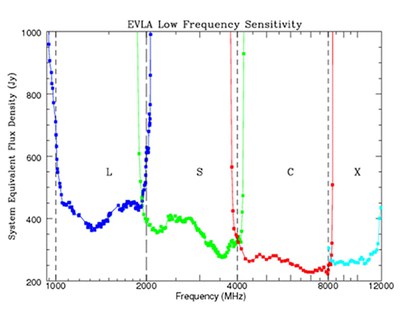
Figure 3.2.1 shows the SEFDs as a function of frequency used in the VLA exposure calculator for those Cassegrain bands currently installed on VLA antennas, and include the contribution to Tsys from atmospheric emission at the zenith. Figure 3.2.2 shows the SEFDs as a function of frequency for the P-band; these measurements are based on imaging of a field far from the galactic plane. Table 3.2.1 gives the SEFD at some fiducial VLA frequencies.
 |
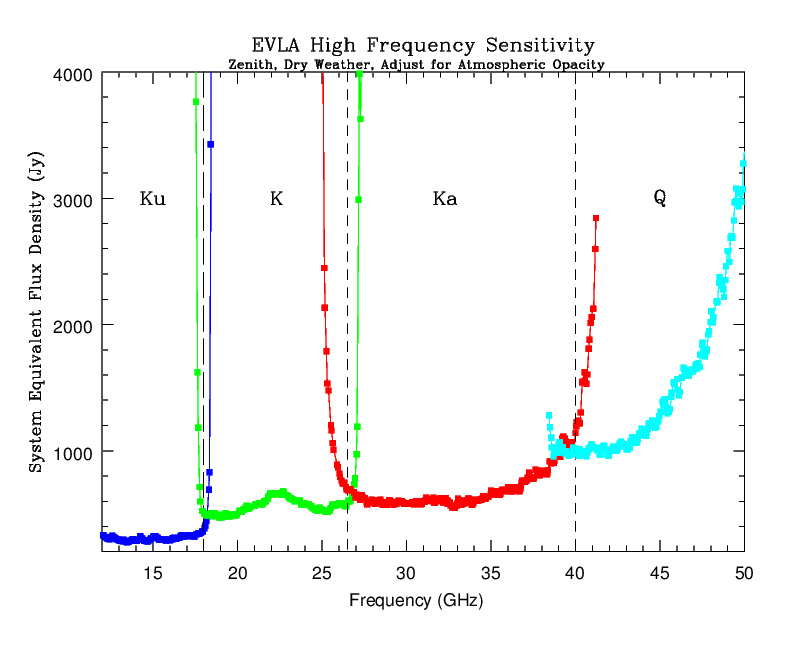 |
Figure 3.2.1: SEFD used in the Exposure Calculator for the VLA. Left: The system equivalent flux density as a function of frequency for the L, S, C and X-band receivers. Right: The system equivalent flux density as a function of frequency for the Ku, K, Ka, and Q-band receivers. SEFDs at Ku, K, Ka, and Q bands include contributions from Earth's atmosphere and were determined under good conditions.
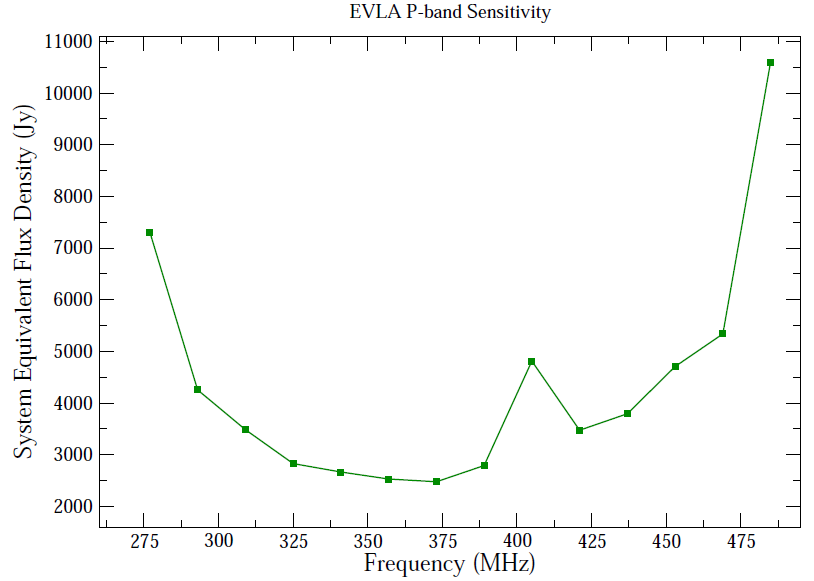
Figure 3.2.2: The SEFD used in the VLA Exposure Calculator as a function of frequency for the P-band receiver
Note that the theoretical rms noise calculated using equation 1 is the best limit possible. There are several factors that will tend to increase the noise compared with theoretical:
- For the more commonly used robust weighting scheme, intermediate between pure natural and pure uniform weightings (available in the AIPS task IMAGR and CASA task clean), typical parameters will result in the sensitivity being a factor of about 1.2 worse than the listed values.
- Confusion. There are two types of confusion: (i) that due to confusing sources within the synthesized beam, which affects low resolution observations the most. Table 3.2.1 shows the confusion noise in D configuration assuming robust weighting (see Condon et al. 2012, ApJ, 758), which should be added in quadrature to the thermal noise in estimating expected sensitivities. The confusion limits in C configuration are approximately a factor of 10 less than those in Table 3.2.1; (ii) confusion from the sidelobes of uncleaned sources lying outside the image, often from sources in the sidelobes of the primary beam. This confusion primarily affects low frequency observations.
- Weather. The sky and ground temperature contributions to the total system temperature increase with decreasing elevation. This effect is very strong at high frequencies, but is relatively unimportant at the other bands. The extra noise comes directly from atmospheric emission: primarily from water vapor at K-band, and from water vapor and the broad wings of the strong 60 GHz O2 transitions at Q-band.
- Losses from the 3-bit samplers. The VLA's 3-bit samplers incur an additional 10–15% loss in sensitivity above that expected—i.e., the efficiency factor ηc = 0.78 to 0.83.
| Frequency | SEFD (Jy) |
RMS confusion level |
||
|---|---|---|---|---|
| 0.39 GHz (P) | 2790 | 5330 | ||
| 1.5 GHz (L) | 420 | 74 | ||
| 3.0 GHz (S) | 370 | 12 | ||
| 6.0 GHz (C) | 310 | 2 | ||
| 10.0 GHz (X) | 250 | negligible | ||
| 15 GHz (Ku) | 320 | negligible | ||
| 20 GHz (K) | 500 | negligible | ||
| 33 GHz (Ka) | 600 | negligible | ||
| 45 GHz (Q) | 1300 | negligible |
In general, the zenith atmospheric opacity to microwave radiation is very low: typically less than 0.01 at L, C, and X-bands; 0.05 to 0.2 at K-band; and 0.05 to 0.1 at the lower half of Q-band, rising to 0.3 by 49 GHz. The opacity at K-band displays strong variations with time of day and season, primarily due to the 22 GHz water vapor line. Observing conditions are best at night and in the winter. Q-band opacity, dominated by atmospheric O2, is considerably less variable.
Observers should remember that clouds, especially clouds with large water droplets (thunderstorms), can add appreciable noise to the system temperature. Significant increases in system temperature can, in the worst conditions, be seen at frequencies as low as 5 GHz.
Tipping scans—which are currently unavailable but will be implemented at some time in the future—can be used for deriving the zenith opacity during an observation. In general, tipping scans should only be needed if the calibrator used to set the flux density scale is observed at a significantly different elevation than the range of elevations over which the complex gain calibrator (amplitude and phase) and target source are observed.
When the flux density calibrator observations are within the elevation range spanned by the science observing, elevation dependent effects (including both atmospheric opacity and antenna gain dependencies) can be accounted for by fitting an elevation-dependent gain term. See the following items:
- Antenna elevation-dependent gains. The antenna figure degrades at low elevations, leading to diminished forward gain at the shorter wavelengths. The gain-elevation effect is negligible at frequencies below 8 GHz. The antenna gains can be determined by direct measurement of the relative system gain using the AIPS task ELINT on data from a strong calibrator which has been observed over a wide range of elevation. If this is not possible, care should be taken to observe a primary flux calibrator at the same elevation as the target.
Both CASA and AIPS allow the application of elevation-dependent gains and an estimated opacity generated from ground-based weather through the CASA tasks gencal and plotweather, and AIPS task INDXR.
- Pointing. The SEFD quoted above assumes good pointing. Under calm, nighttime conditions, the antenna blind pointing is about 10 arcsec rms. The pointing accuracy in daytime can be much worse—occasionally exceeding 1 arcminte due to the effects of solar heating of the antenna structures. Moderate winds have a very strong effect on both pointing and antenna figure. The maximum wind speed recommended for high frequency observing is 11 mph (5 m/s). Wind speeds near the stow limit 45 mph (20 m/s) will have a similar negative effect at 8 and 15 GHz.
To achieve increased pointing accuracy, referenced pointing is recommended where a nearby calibrator is observed in interferometric pointing mode every hour or so. The local pointing corrections measured can then be applied to subsequent target observations. This reduces rms pointing errors to as little as 2–3 arcseconds (but more typically 5–7 arcseconds) if the reference source is within about 15 degrees in azimuth and elevation of the target source and the source elevation is less than 70 degrees. At source elevations greater than 80 degrees (zenith angle < 10 degrees), source tracking becomes difficult; it is recommended to avoid such source elevations during the observation preparation setup.
Use of referenced pointing is highly recommended for all Ku, K, Ka, and Q-band observations, and for lower frequency observations of objects whose total extent is a significant fraction of the antenna primary beam. It is usually recommended that the referenced pointing measurement be made at 8 GHz (X-band), regardless of what band your target observing is at, since X-band is the most sensitive and the closest calibrator is likely to be weak. Proximity of the reference calibrator to the target source is of paramount importance; ideally the pointing sources should precede the target by 20 or 30 minutes in Right Ascension (RA). The calibrator should have at least 0.3 Jy flux density at X-band and be unresolved on all baselines to ensure an accurate solution.
To aid VLA proposers there is an online guide to the exposure calculator; the exposure calculator provides a graphical user interface to these equations.
Special caveats apply for P-band (230–470 MHz) observing. The SEFD's in Figure 3.2.2 or that listed in table 3.1.2 are from an observation taken far from the Galactic plane, where the sky brightness is about 30K. At P-band, Galactic synchrotron emission is very bright in directions near the Galactic plane. The system temperature increase due to Galactic emission will degrade sensitivity by factors of two to three for observations in the plane, and by a factor of five or more at or near the Galactic center. Additionally, the antenna efficiency (currently about 0.31 for 300 MHz) will decline with both increasing and decreasing frequencies from the center of P-band.
The beam-averaged brightness temperature measured by a given array depends on the synthesized beam, and is related to the flux density per beam by:
| \[T_{\rm b} = \frac{S \lambda^2}{2k\Omega} = F \cdot S\] | (eq. 2) |
where Tb is the brightness temperature (Kelvins) and Ω is the beam solid angle. For natural weighting (where the angular size of the approximately Gaussian beam is ∼1.5λ/Bmax), and S in mJy per beam, the parameter F depends on the synthesized beam, therefore on the array configuration, and has the approximate value of F = 190, 18, 1.7, 0.16 for A, B, C, and D configurations, respectively. The brightness temperature sensitivity can be obtained by substituting the rms noise, ΔIm, for S. Note that Equation 2 is a beam-averaged surface brightness; if a source size can be measured, then the source size and integrated flux density should be used in Equation 2 and the appropriate value of F calculated. In general, the surface brightness sensitivity is also a function of the source structure and how much emission may be filtered out due to the sampling of the interferometer. A more detailed description of the relation between flux density and surface brightness is given in Chapter 6 of Reference 1, listed in Documentation.
For observers interested in HI in galaxies, a number of interest is the sensitivity of the observation to the HI mass. This is given by van Gorkom et al. (1986; AJ, 91, 791):
| \[M_{\rm HI} = 2.36 \times 10^5 D^2 \sum S \Delta V ~~~~M_\odot\] | (eq. 3) |
where D is the distance to the galaxy in Mpc, and SΔV is the HI line area in units of Jy km/s.
VLA Frequency Bands and Tunability
-
- 1. Listed here are the nominal band edges. For all bands, the receivers can be tuned to frequencies outside this range, but at the cost of diminished performance. Contact the NRAO Helpdesk for further information.
- 2. The 4-band system is currently under development. The default frequency range maximizes sensitivity of the system and provides a nominal bandwidth of 12 MHz and a channel resolution of 64 kHz.
- 3. The default setup for P-band will provide 16 subbands from the A0/C0 IF pair, each 16 MHz wide, to cover the frequency range 224–480 MHz. The channel resolution is 125 kHz.
- 4. The default frequency setup for L-band comprises two 512 MHz IF pairs (each comprising 8 contiguous subbands of 64 MHz) to cover the entire 1–2 GHz of the L-band receiver.
Tuning Restrictions
In general, for all frequency bands except Ka, if the total span of the two independent IF pairs of the 8-bit system (defined as the frequency difference between the lower edge of one IF pair and the upper edge of the other) is less than 8.0 GHz, there are no restrictions on the frequency placements of the two IF pairs. For K, Ka, and Q-bands—the only bands where a span greater than 8 GHz is possible—there are special rules:
- At Ka-band, the low frequency edge of the A0/C0 IF pair must be greater than 32.0 GHz. There is no restriction on the B0/D0 frequency, unless the B0/D0 band overlaps the A0/C0 band when the latter is tuned at or near the 32.0 GHz limit. In this case, the Observation Preparation Tool (OPT) may not allow the requested frequency setups. Users wanting to use such a frequency setup are encouraged to contact the NRAO Helpdesk for possible tuning options.
- At K and Q-bands, if the frequency span is greater than 8.0 GHz, the B0/D0 frequency must be lower than the A0/C0 frequency.
For the 3-bit system, the maximum frequency span permitted for the A1/C1 and A2/C2 IF pairs is about 5000 MHz. The same restriction applies to B1/D1 and B2/D2. The tuning restrictions given above for the separation and location of the 8-bit pairs A0/C0 and B0/D0 also apply to the 3-bit pairs, with A0/C0 replaced by A1/C1 and A2/C2, and B0/D0 replaced by B1/D1 and B2/D2.
VLA Samplers
The VLA is equipped with two different types of samplers, 8-bit with 1GHz bandwidth, and 3-bit with 2GHz bandwidth. The choice depends on your science goals and on technicalities described below.
The 8-bit Set consists of four 8-bit samplers running at 2.048 GSamp/sec. The four samplers are arranged in two pairs, each pair providing 1024 MHz bandwidth in both polarizations. The two pairs are denoted A0/C0 and B0/D0. Taken together, the four samplers offer a maximum of 2048 MHz coverage with full polarization. The frequency spans sampled by the two pairs need not be adjacent. Some restrictions apply, depending on band, as described in the section on Frequency Bands and Tunability.
The 3-bit Set consists of eight 3-bit samplers running at 4.096 GSamp/sec. The eight samplers are arranged as four pairs, each pair providing 2048 MHz bandwidth in both polarizations. Two of these pairs, denoted A1/C1 and A2/C2 cannot span more than 5000 MHz (lower edge of one to the higher edge of the other). The same limitation applies to the second pair, denoted B1/D1 and B2/D2. The tuning restrictions are described in the section on Frequency Bands and Tunability. Taken together, the eight 3-bit samplers offer a maximum of 8192 MHz coverage with full polarization.
Which set to use?
- S, L, and 4/P-band observations, whether line or continuum, should use the 8-bit sampler set.
- C and X-band continuum observations should use 3-bit samplers in order to exploit the full 4 GHz bandwidth: in spite of the 15% reduction in sensitivity that comes with 3-bit (at equal bandwidth to the 8-bit samplers—see below for details) and the reduced effective bandwidth after removing RFI, this still provides superior overall sensitivity. For more details we refer to EVLA memo 166.
- Note: C-band is impacted by strong RFI caused by microwave links near 6 GHz in the A and B configurations. As a result, 3-bit data obtained with the standard setup are corrupted. We advise observers to use mixed 3-bit and 8-bit samplers. For more details, refer to the VLA Observing Guide.
- Ku, K, Ka, and Q-band continuum observations should use the 3-bit samplers for maximum bandwidth.
- Wide-band spectral line searches requiring more than 2 GHz span should use the 3-bit samplers.
- Spectral-line observations which fit within two, possibly disjoint, 1 GHz bands should use the 8-bit set.
- Simultaneous continuum and high resolution spectral line observation can use mixed 3-bit and 8-bit samplers. The 3-bit samplers in this case will be set up to deliver the continuum data, while the 8-bit samplers will be for the spectral line data. This mix mode can be used in C-band and higher.
Major Characteristics of each Set
The 8-bit samplers are warranted for observations at 4/P, L, and S-bands. The full analog bandwidth from the receivers fits within the 2048 MHz span covered by the samplers.
For the 3-bit samplers, users need to be aware of the following issues:
- Sensitivity: compared to the 8-bit system, the sensitivity of the 3-bit samplers is worse by ~15% (at equal bandwidth). Alternatively, a given continuum noise level requiring on-source integration time T with the 8-bit (two bands of 1GHz), requires 0.33T with the 3-bit (4 bands of 2GHz, assuming the bandwidth is available from the front end).
- Resonances: each of the eight 3-bit samplers on an antenna has a resonance about 3 MHz wide. Each resonance is independent of all others, so there is no correlated signal between antennas. The resonance degrades the spectrum in its narrow frequency range, but has little effect on continuum observing. Bandpass solutions will be affected, but can be interpolated over. Spectral-line calibration and images at the affected frequencies will show significant loss in sensitivity. The resonances are easily seen in autocorrelation spectra, and it is recommended that users, especially spectral-line users, utilize these to locate the compromised frequencies.
- Amplitude Calibration: The traditional method for both 8- and 3-bit systems is to observe a flux-density calibrator, use self-cal to determine the antenna amplitude calibration factors (gains), and transfer the gains to the phase calibrator and target. For 3-bit samplers this procedure gives results good to 5% between elevations of 20–70 degrees. (Expect worse at the upper edge of Q-band and/or during bad weather.) The switched power data can be used to correct for system gain variations and works well for the 8-bit samplers. For 3-bit samplers, the Pdif depends on the Psum, i.e., Pdif is non-linear and its application will bias the resulting visibilities by 5–10%. The origin of this effect is understood, but we have not yet determined how best to compensate for it. Because of this, we do not recommend use of the Psum and Pdif data to calibrate visibilities from the 3-bit samplers. We do, however, recommend that the requantizer gains in the switched power data be applied to remove gain changes. For more information about the switched power, Psum, and Pdif, see EVLA memo 145.
Setting up the 8-bit or 3-bit Samplers
Either set requires an initial scan for each individual LO (frequency) tuning, during which power levels are optimized.
For the 8-bit system, a dummy scan of 1 minute duration is sufficient for each tuning. This is usually done while the antennas are slewing at the start of an observing file, as the pointing direction of the antennas is not critical.
For the 3-bit system, the requirements are more demanding, see the section on 3-bit setup within the Guide to Observing with the VLA. The minimum setup time is 1 minute for each tuning to adjust the power levels and bandpass slopes across the 2GHz samplers. These values are retained and applied if the tuning is re-encountered in the same observation. Additionally, every time the LO setup is changed—whether or not it is new (e.g., changing from 8-bit X-band reference pointing back to target)—a scan of 30 seconds is needed to reset the subband gains (requantizers) in the correlator. For better amplitude calibration at high frequencies, the 3-bit initial setup should be near the elevation of the target, so do it after the first 8-bit setup described above. For 3-bit observing without 8-bit (e.g., C or X-band without reference pointing), the power variation with elevation is small, so the 3-bit setup can be done at any elevation.
For settings that use a mix of 3-bit and 8-bit samplers, the guidelines to set up the 3-bit samplers should be followed.
Other issues
The overhead for setup of 3-bit samplers can eat into observing time, especially for projects with many different LO settings, and/or sources all over the sky accompanied by band change, reference pointing, and requantizer reset for each direction. The impact is most severe for short scheduling blocks.
Polarization testing conducted so far indicates no degradation of performance by using the 3-bit samplers.
Time Resolution and Data Rates
The default integration times for the various array configurations and frequency bands are as follows:
| Configurations | Observing Bands |
Default integration time |
|---|---|---|
| A, B, C, D | 4 P | 2 seconds |
| A | L S C X Ku K Ka Q | 2 seconds |
| B | L S C X Ku K Ka Q | 3 seconds |
| C, D | X Ku K Ka Q | 3 seconds |
| C, D | L S C | 5 seconds |
Observations with the 3-bit (wideband) samplers, when applicable, should use these integration times. Observations with the 8-bit samplers may use shorter integration times, but these must be requested and justified explicitly in the proposal, and obey the following restrictions:
| Proposal type |
Minimum integration time |
Maximum data rate |
|---|---|---|
| General Observing (GO) | 50 msec | up to 60 MB/s (216 GB/hr) |
| Shared Risk Observing (SRO) | 50 msec | > 60 MB/s (216 GB/hour) and up to 100 MB/s (360 GB/hour) |
| Resident Shared Risk Observing (RSRO) | < 50 msec | > 100 MB/s (360 GB/hr) |
Note that integration times as short as 5 msec and data rates as high as 300 MB/s can be supported for some observing, though any such observing is considered Resident Shared Risk Observing. For these short integration times and high data rates there will be limits on bandwidth and/or number of antennas involved in the observation. Those desiring to utilize such short integration times and high data rates should consult with NRAO staff.
The maximum recommended integration time for any VLA observing is 10 seconds.
Observers should bear in mind the data rate of the VLA when planning their observations. For Nant antennas and integration time Δt, the data rate† is:
| Data rate | ~ 45 MB/sec × (Nchpol/16384) × Nant × (Nant − 1)/(27×26) / (Δt/1 sec) |
| ~ 160 GB/hr × (Nchpol/16384) x Nant × (Nant − 1)/(27×26) / (Δt/1 sec) | |
| ~ 3.7 TB/day × (Nchpol/16384) × Nant × (Nant − 1)/(27×26) / (Δt/1 sec) |
Here Nchpol is the sum over all subbands of spectral channels times polarization products:
| Nchpol = Σi Nchan,i × Npolprod,i |
where Nchan,i is the number of spectral channels in subband i, and Npolprod,i is the number of polarization products for subband i (1 for single polarization [RR or LL], 2 for dual polarization [RR and LL], 4 for full polarization products [RR, RL, LR, LL]). This formula, combined with the maximum data rates given above, imply that observations using the maximum number of channels currently available (16384) will be limited to minimum integration times of ~2 seconds for standard observations, and 0.8 seconds for shared risk observations.
We note that frequency averaging in the correlator will reduce the total number of channels. Therefore, the data rate and the data volume will be reduced by the same channel averaging factor. See the Chromatic Aberration section for more details on the frequency averaging in the correlator and to assess its impact on your science.
These data rates are challenging for transfer and analysis. Data may either be downloaded via ftp over the Internet, or shipped on hard drives for large data sets or for those with slow Internet connections (please review the data shipping policy). For users whose science permits, the Archive Access Tool allows some level of frequency averaging in order to decrease data set sizes before ftp; note that the full spectral resolution will be retained in the NRAO archive for all observations.
†Note: The data rate formula given above does not account for the auto-correlations delivered by WIDAR. Precise data rate values can be obtained through the use of the Resource Catalog Tool for proposing (RCT-proposing).
Radio Frequency Interference
The very wide bandwidths of the VLA mean that radio frequency interference (RFI) will be present in a far larger fraction of current observations than in observations made with the old systems. Considerable effort has gone into making the VLA's electronics as linear as possible, so that the effects of any RFI will remain limited to the actual frequencies at which the RFI exists. Non-linear effects, such as receiver saturation, should occur only for those very unlikely, and usually very brief, times when the emitter is within the antenna primary beam.
RFI is primarily a problem within the low frequency (C, S, L, and the low-band system) bands, and is most serious in the D configuration. With increasing frequency and increasing resolution comes an increasing fringe rate, which is often very effective in reducing interference to tolerable levels.
The bands within the tuning range of the VLA which are protected for radio astronomy are: 73.0-74.6 MHz, 322.0-328.6 MHz, 1400–1427 MHz, 1660.6–1670.0 MHz, 2690–2700 MHz, 4990–5000 MHz, 10.68–10.7 GHz, 15.35–15.4 GHz, 22.21–22.5 GHz, 23.6–24.0 GHz, 31.3–31.8 GHz, and 42.5–43.5 GHz. No significant external interference should occur within these bands.
VLA staff periodically observes the entire radio spectrum with the VLA, from 1.0 through 50.0 GHz with 125 kHz channel resolution, to monitor the ever-changing RFI spectrum. Users concerned about the precise frequencies of strong RFI, and the likelihood of being affected, are encouraged to peruse these plots. To access these plots, or for more information on RFI, including the impact of satellite transmissions, please see the RFI section in the Guide to Observing with the VLA.
Subarrays
The continuum subarray option offers two 1 GHz baseband pairs with the 8-bit samplers in up to 3 subarrays or four 2 GHz baseband pairs with the 3-bit samplers, with the same spectral channel and polarization product options as are available for wideband observing. The setup for each subarray is completely independent in terms of observing frequency, polarization products, and integration times.
When using three subarrays, there are some restrictions on the number of antennas in each subarray. The Baseline Board in the correlator treats each set of 4 antennas independently, using a separate column of correlator chips. With 7 such columns, the correlator can handle up to 7×4 = 28 antennas. The correlator configuration software requires that a given column not be split across subarrays. For instance, one cannot observe with 9 antennas in each of 3 subarrays, because 9 antennas requires three columns (two with 4 antennas each, and one with 1 antenna); three subarrays of 9 antennas each would require 3×3 = 9 columns, two more than are actually available. Splitting the array into 11, 8, and 8 antennas is allowed.
For more information on subarrays, please see the Subarrays section in the Guide to Observing with the VLA.
Positional Accuracy & Astrometry
The position of a target can be determined to a small fraction of the synthesized beam, limited by atmospheric phase stability, the proximity of an astrometric calibrator, the calibrator-source cycle time, and the SNR on target.
In preparation for observing, the a priori position must be known to within the antenna primary beam, except perhaps for mosaicking observations. In the special case of using the phased VLA as a VLBI element, the a priori position must be accurate to within the synthesized beam of the array.
In post-processing, target positions are typically determined from an image made after phase calibration, i.e., correcting the antenna and atmospheric phases as determined on the reference source. The accuracy of the calibration determines the accuracy of the positions in the image. Note that phase self-calibration imposes the assumed position of the model, i.e., makes the position indeterminate. Therefore, an absolute position cannot be determined after self-calibration, but relative positions between features within a self-calibrated image are valid.
It may help to think of astrometry as two methods, narrow-field and wide-field.
Narrow-field astrometry
In narrow-field astrometry, the target is close to the phase tracking center and the antennas nod every few minutes between the target and a calibrator. If no special calibration provisions are taken, under typical conditions, an astrometric accuracy of ~10% of the synthesized beam FWHM can often be obtained. For example, an observation in Ka-band (~33 GHz) in A-configuration might reach an astrometric accuracy of ~10 milliarcseconds (mas). When care is taken (special calibrations and ideal observing conditions), the accuracy can approach 1–2% of the synthesized beam, with a floor of ~2 mas. If such accuracies are needed, we strongly recommend obtaining advice from VLA staff in setting up the observations.
Astrometric calibrators are marked J2000 A in the VLA calibrator list, and have a positional accuracy of ~2 mas. Other catalogs from the USNO and the VLBA are also useful, but offsets may exist between the VLA and VLBA centroids arising from extended structure in the particular source and the different resolutions of the arrays.
For studies of proper motion and parallax, the absolute accuracy of a calibrator may be less important than its stability over time. Close, or in-beam calibrators with poor a priori positions, can be used and tied to the ICRF reference frame in the same or separate observations.
Phase stability can be assessed in real time from the Atmospheric Phase Interferometer (API) at the VLA site, which uses observations of a geostationary satellite at ~12 GHz. Dynamic scheduling uses the API data to run a project under suitable conditions specified by the user. VLBI projects using the phased VLA will typically be fixed date and not dynamically scheduled.
Wide-field astrometry
Wide-field astrometry is used to determine the positions of targets within the primary beam, referenced to a calibrator within the beam or close by. In addition to the previous effects, there are distortions as a function of position in the field, from small errors in the Earth Orientation Parameters (EOP) used at correlation time, differential aberration, and phase gradients across the primary beam. With no special effort, the errors build up to roughly one synthesized beam at a separation of ~104 beams from the phase tracking center. Not all these errors are fully understood, and accurate recovery of positions over the full primary beam in the wide-band, wide-field case is a research area. These effects are handled somewhat differently in the post-processing packages. Check with VLA staff for more details via the NRAO Helpdesk.
Calibrating the Flux Density Scale
Normal calibration of the flux density scale for VLA observations is effected by including a scan on a source of presumed known flux density in each Scheduling Block (SB). Using that known flux density source, the flux density of the complex gain calibrator(s) can be determined and then transferred to your target source(s). Historically, 3C48 and 3C286 have been the standard sources for which NRAO has assumed flux densities are known as a function of frequency, and which have been recommended as flux density scale calibrator sources for the VLA. Restrictions on baseline length as a function of VLA configuration and observing band were supplied which, if followed, allowed relatively accurate flux density scale calibration. We have recently improved the ability to calibrate the flux density scale by providing sky brightness models for these sources in CASA and AIPS, which loosens the restrictions on configurations and bands. We have also added the sources 3C138** and 3C147 to the list of calibrators that have models. However, 3C48*, 3C138**, and 3C147 have spectral flux densities that vary with time (3C286, along with 3C295 and 3C196, are constant), so some care should be taken if the most accurate flux density scale calibration is desired.
Note: While accurate models are available in both AIPS and CASA for various frequency bands for the calibrators 3C286, 3C48*, 3C147, and 3C138**, neither 3C295 nor 3C196 has such models in CASA. Therefore, the VLA CASA calibration pipeline will fail if these two calibrators are used. Furthermore, 3C295 and 3C196 may not be suitable for all VLA configurations and frequencies even if one chooses to not use the pipeline.
A single observation of a few minutes of one of the above-mentioned flux density scale calibrators will suffice for most observers. If possible, the flux density scale calibrator should be observed at a time when it is nearly at the same elevation as the complex gain calibrator, especially for the highest four bands (Ku-, K-, Ka-, and Q-band). This is not always possible because of timing and geometry of sources, and that it is not typically known when an SB will be executed (so elevations versus time are uncertain). Flux density scale calibration accuracy in this case should be of order 10% at 4- and P-bands, 5% at L- through Ku-bands, and 10-15% for the three higher bands. If more accuracy is needed, a more careful strategy should be adopted, potentially using multiple flux density scale calibrators. The fundamental accuracy of the scale is ~5% at 4- and P-bands, 3% at L- through Ku-bands, increasing to 5% at Q-band. See Perley and Butler (2017) for more details on how the spectral flux densities of 3C48*, 3C138**, 3C147, and 3C286 (and many other sources) have been determined across the frequency range from 50 MHz to 50 GHz and how they vary versus time, along with information on the fundamental accuracy of the flux density scale when using these sources.
If less accuracy is needed in the flux density scale calibration, an observation of one of these standard sources need not necessarily be included in an SB. As an example, for a short triggered observation where a simple detection is desired, the time spent slewing back and forth to the flux density scale calibrator can make the SB significantly longer than it could otherwise be. In this scenario, the switched power measurement can be used to calibrate the flux density scale; see EVLA Memo 120 for some background. This technique, which should only be used with the 8-bit samplers, is not a standard path of calibration, but it is possible. The flux density scale accuracy in this case is ~10% for L- through Ku-bands, increasing to ~20% at Q-band; not nearly as good as using the "standard" method of flux density scale calibration, but it may be sufficient for some observers.
For reference, the polynomial expression for the spectral flux density for 3C286 determined in Perley and Butler (2017) is: \[\log(S) = 1.2481 - 0.4507 \log(f) - 0.1798 \log^2(f) + 0.0357 \log^3(f)\] where S is the flux density in Jy, and f is the frequency in GHz.
The tables below show flux densities determined using the polynomial coefficients for a few sources at a single frequency within each of the VLA bands.
| Source | 75 MHz | 350 MHz | 1500 MHz | 3000 MHz | 6000 MHz | 10000 MHz | 15000 MHz | 22000 MHz | 33000 MHz | 45000 MHz |
|---|---|---|---|---|---|---|---|---|---|---|
| 3C48* = J0137+3309 | 72.8 | 42.2 | 15.4 | 8.44 | 4.42 | 2.68 | 1.79 | 1.22 | 0.815 | 0.601 |
| 3C138** = J0521+1638 | 26.5 | 16.1 | 8.25 | 5.44 | 3.39 | 2.33 | 1.72 | 1.28 | 0.949 | 0.761 |
| 3C147 = J0542+4951 | 58.0 | 52.3 | 21.0 | 12.0 | 6.45 | 3.99 | 2.73 | 1.93 | 1.39 | 1.13 |
| 3C196 = J0813+4813 | 129 | 44.4 | 13.6 | 6.98 | 3.38 | 1.91 | 1.20 | 0.763 | 0.473 | 0.329 |
| 3C286 = J1331+3030 | 30.0 | 25.9 | 14.6 | 9.91 | 6.39 | 4.50 | 3.37 | 2.54 | 1.88 | 1.49 |
| 3C295 = J1411+5212 | 124 | 58.4 | 21.2 | 11.0 | 5.06 | 2.70 | 1.60 | 0.970 | 0.571 | 0.385 |
| Source | 328 MHz | 1465 MHz | 2565 MHz | 4885 MHz | 6680 MHz | 11320 MHz | 16564 MHz | 25564 MHz | 32064 MHz | 48064 MHz |
|---|---|---|---|---|---|---|---|---|---|---|
| 3C48* = J0137+3309 | 43.9 | 15.6 | 9.82 | 5.48 | 4.12 | 2.56 | 1.86 | 1.33 | 1.11 | 0.816 |
| 3C138** = J0521+1638 | 15.9 | 8.26 | 6.00 | 4.00 | 3.23 | 2.24 | 1.69 | 1.25 | 1.06 | 0.821 |
| 3C147 = J0542+4951 | 53.9 | 21.4 | 13.8 | 7.88 | 5.91 | 3.67 | 2.61 | 1.82 | 1.53 | 1.14 |
| 3C196 = J0813+4813 | 46.5 | 13.8 | 8.14 | 4.22 | 3.00 | 1.67 | 1.08 | 0.656 | 0.508 | 0.313 |
| 3C286 = J1331+3030 | 25.8 | 14.6 | 10.9 | 7.33 | 5.97 | 4.12 | 3.15 | 2.30 | 1.92 | 1.44 |
| 3C295 = J1411+5212 | 61.1 | 21.6 | 12.8 | 6.42 | 4.45 | 2.33 | 1.43 | 0.819 | 0.596 | 0.405 |
We refer the reader to the VLA Observing Guide for the practical considerations (e.g., observing frequency and array configuration, as well as post processing) regarding the choice of the flux density scale calibrator in their scheduling blocks.
* The flux density scale calibrator 3C48 has been undergoing a flare since January 2018 or so. While we have not fully characterized this with the VLA, other instruments have measured it at some frequencies. At Ku-band the magnitude of the flare is of order 10%. The effect will be smaller at lower frequencies (of order 5% at L-band), and might be larger at higher frequencies (of order 20% at Q-band). If you care about the flux density scale of your observations at that level, you may want to re-calibrate your data once new time-variable values have been put into CASA and AIPS.
** The flux density scale calibrator 3C138 is currently undergoing a flare. From VLA calibration pipeline results, we have noticed that 3C138 is deviating from the model. The amount of this deviation is still being investigated by NRAO staff, but does seem to effect frequencies of 10 GHz and higher. At K and Ka-bands the magnitude of the flare is currently of order 40-50% compared to Perley-Butler 2017 flux scale. If you care about the flux density scale of your observations above 10 GHz, monitoring datasets are publicly available in the archive under project code TCAL0009, from which you may find an updated flux density ratio to use for your data.
Complex Gain Calibration
General Guidelines for Complex Gain Calibration
Adequate complex gain calibration (tracking amplitude and phase fluctuations as a function of time) is a complicated function of source-calibrator separation, frequency, array scale (configuration), and weather. Since what defines adequate for some experiments is completely inadequate for others, it is difficult to define simple guidelines to ensure adequate phase calibration. However, some general statements remain valid most of the time. These are given below.
- Under decent conditions with no thunderstorms or ionospheric storms, tropospheric effects dominate at frequencies higher than about 4 GHz; ionospheric effects dominate at frequencies lower than about 4 GHz.
- Atmospheric (troposphere and ionosphere) effects are nearly always unimportant in the C and D configurations at L and S-bands, and in the D configuration at X and C-bands. For these cases, calibration need only be done to track instrumental changes—three or four times per hour is usually sufficient for tracking the system gains.
- If your target object has sufficient flux density to permit phase self-calibration, there is no need to calibrate more than a couple of times per hour at low frequencies or 15 minutes at high frequencies in order to track pointing or other effects that might influence the amplitude scale. The enhanced sensitivity of the VLA guarantees, for full-band continuum observations, that every field will have enough background sources to enable phase self-calibration at L and S-bands. At higher frequencies, the background sky is not sufficient, and only the flux of the target source itself will be available.
- In principle, the smaller the source-calibrator angular separation, the better (even if the closer calibrator is weaker). However, the final choice will depend on the observing frequency. If deciding between a nearby calibrator with an S code in the calibrator database, and a more distant calibrator with a P code, for low frequencies (L-band and below) the nearby calibrator is usually the better choice (low frequency strategy). For higher frequencies it is advisable to use the further away but higher quality P-code calibrator (high frequency strategy). A detailed description of calibrator codes is available in the calibrator list.
- Phase stability often deteriorates dramatically after about 10AM due to small-scale convective cells set up by solar heating, even in clear and calm conditions, especially in the summer. Observers should consider a more rapid calibration cycle for observations between this time and a couple of hours after sundown.
- At high frequencies, and longer configurations, rapid switching between the source and nearby calibrator is needed to track tropospheric phase fluctuations if the target cannot be self-calibrated. See Rapid Phase Calibration and the Atmospheric Phase Interferometer (API) (below).
Rapid Phase Calibration and the Atmospheric Phase Interferometer
Polarization
For projects requiring imaging in Stokes Q and U, the instrumental polarization should be determined through observations of a bright calibrator source spread over a range in parallactic angle or a single observation of an unpolarized source. The complex gain calibrator chosen for the observations can also double as a polarization calibrator, provided it is at a declination where it moves through enough parallactic angle during the observation (roughly Dec 15–50 degrees during a several hour track).
The minimum condition that will enable accurate polarization calibration from a polarized source, in particular with unknown polarization, is three observations of a bright source spanning at least 60 degrees in parallactic angle (schedule four scans, if possible, in case one is lost); if at all possible, it is strongly recommended that five or more observations covering 100 degrees (or more) of parallactic angle in roughly uniform steps be run. If a bright, unpolarized, unresolved source is available, and known to have very low polarization, then a single scan will suffice to determine the leakage terms. The accuracy of polarization calibration is generally better than 0.5% for small objects as compared to the antenna beam size. At least one observation of 3C286 or 3C138 is required to fix the absolute position angle of polarized emission; 3C48 can be used at frequencies of ~3 GHz and higher, or 3C147 at frequencies over ~10 GHz. Note that 3C48 and 3C138 are variable—the polarization properties are known to be changing significantly over time, most notably at the higher frequencies (for details see Perley and Butler (2013b)).
More information on polarization calibration strategy can be found in the Polarimetry section in the Guide to Observing with the VLA.
VLBI Observations
The VLA can participate in VLBI observations with the VLBA. This is possible by either using the VLA as a phased array (Y27) or using one of its dishes (single dish: Y1). We note that currently P-band cannot be phased. For more details see the VLBI at the VLA documentation. In phased array mode, the program TelCal derives the antenna-based delay and phase corrections needed for antenna phasing in real time. This correction is applied to the antenna signals before they are summed, requantized to 2-bits, and recorded in VDIF format on the Mark5C disk at the VLA site. The disk(s) are then transported to Socorro, NM and correlated on the DiFX correlator with other VLBI stations which participated in the observation.
Standard VLA data, i.e., correlations between VLA antennas, are also archived in the NRAO science data archive. By default, a maximum of 512 MHz dual polarization is phased/recorded and sent to the archive. This leaves a large portion of the possible VLA bandwidth unused (up to 2 or 8 GHz total depending on sampler choice). Increasing the bandwidth to the maximum that the VLA can provide has obvious benefits for most continuum observations. Pulsar gating can be performed commensally with the phased VLA, avoiding the need for extra single dish observations. Line VLBI observations that run through the WIDAR correlator currently produce each requested VLBI subband bandwidth divided into full polarization products with 64 frequency channels, regardless of the requested spectral resolution obtained in the VLBI correlation. By adding unused baseline boards to the VLBI-specified line subbands, a closer match in spectral resolution can be offered for the standalone VLA data. If you think your science could benefit from these capabilities, please review our documentation on VLBI at the VLA or contact the helpdesk for further guidance.
Snapshots
The two-dimensional geometry of the VLA allows a snapshot mode whereby short observations can be used to image relatively bright, unconfused sources. This mode is ideal for survey work where the sensitivity requirements are modest.
Single snapshots with good phase stability of strong sources should give dynamic ranges of a few hundred. Note that because the snapshot synthesized beam contains high sidelobes, the effects of background confusing sources are much worse than for full syntheses, especially at 20 cm and longer wavelengths in the D configuration. For instance, at 20 cm, a single snapshot will give a limiting noise of about 0.2 mJy. This level can be reduced by taking multiple snapshots separated by at least one hour. The deconvolution of the data is necessary to remove the effects of background sources. Before considering snapshot observations at 20 cm, users should first determine if the goals desired can be achieved with the existing Faint Images of the Radio Sky at Twenty-centimeters survey (FIRST, http://sundog.stsci.edu/top.html) (B configuration) or the NRAO VLA Sky Survey (NVSS, http://www.cv.nrao.edu/nvss/) (D configuration, all-sky).
Shadowing and Cross-Talk
Observations at low elevation in the C and D configurations will commonly be affected by shadowing. It is strongly recommended that all data from a shadowed antenna be discarded. This will automatically be done during filling when using the default inputs with CASA tasks importasdm and importevla. AIPS task UVFLG can be used to flag VLA data based on shadowing, although it will only flag based on antennas in the dataset, and is ignorant of antennas in other subarrays. The CASA task flagdata can also be used to flag data based on shadowing. For more information on shadowing, please see the Antenna Shadowing section in the Guide to Observing with the VLA.
Cross-talk is an effect in which signals from one antenna are picked up by an adjacent antenna, causing an erroneous correlation. This effect is important at low frequencies in compact configurations. Careful examination of the visibilities is necessary to identify and remove this form of interference. The affected data would show time-variable high-amplitude points.
Combining Configurations and Mosaicking
Any single VLA configuration will allow accurate imaging of a range of spatial scales determined by the shortest and longest baselines. For extended and structured objects, it may be required to obtain observations in multiple array configurations. It is advisable that the frequencies used be the same for all configurations to be combined. The ideal combination of arrays results in a uv-plane with all cells equally filled by uv-points. To first order, this can be achieved by using the beam sizes of the individual arrays to inversely scale the on-source integration time. This approach is equivalent to achieving the same surface brightness sensitivity for all arrays on all scales. For the VLA, observations in the different configurations generate beam sizes that decrease by factors of three, i.e., C configuration generates a three times smaller beam than D configuration, B three times smaller than C, and A three times smaller than B. Thus, on-source integrations would increase by about an order of magnitude between each array. Such a drastic increase is very expensive and, in fact, not necessary since some spatial scales are common to more than a single array, which is equivalent to some uv-cells being filled more than others. The best way to fill the uv-plane depends on many factors such as declination of the source, LST time of the observation, and bandwidth.
Experience shows for the VLA that a factor of about three in on-source integration time for the different array configurations works well for most experiments. For example, a 20min on-source time in D, 1hr in C, 3hrs in B, and 9hrs in A should produce a decent map. Using large bandwidths and multi-frequency synthesis will broaden all uv tracks radially and one may need even fewer array configurations or shorter integration times between the different arrays.
Objects larger than the primary antenna pattern may be mapped through the technique of interferometric mosaicking. The VLA has no limit on the number of pointings for each mosaic. Typically hexagonal, rectangular, or individual pointing patterns are used and the overlap regions will result in an improved rms over each individual pointing. Given the many, potentially short observations, it is important to obey the data rate limits outlined in the Time Resolution and Data Rates Section. In addition to discrete or pointed mosaics, on-the-fly (OTF) mosaics (i.e. dumping the data while moving the telescopes across the source) are also available.
Time-variable structures, such as the nuclei of radio galaxies and quasars, cause special, but manageable, problems. See the article by Mark Holdaway in Reference 2 of the Documentation for more information.
Guidelines for mosaicking with the VLA are given in the Guide to Observing with the VLA.
Pulsar Observing
The VLA can be used for several kinds of pulsar observing: phase-binning using the WIDAR correlator, using the phased-array for single-beam pulsar processing in either search or fold modes, or simply standard imaging mode with fast integrations. Both phase-binning and phased-array (YUPPI) modes are available under General Observing (GO). The only exception is the 4-band YUPPI which is a Resident Shared Risk Observing (RSRO) capability. For any questions not addressed here regarding the capabilities of these observing modes, please contact the NRAO Helpdesk.
Phased-array pulsar processing
The "Y" Ultimate Pulsar Processing Instrument (YUPPI) is a software suite that runs in the correlator backend (CBE) computer cluster and can process a single-beam phased/summed-array data stream for pulsar observations in real time, into either folded profiles or search mode (filterbank) output. Coherent dedispersion can be optionally applied in either mode.
In the phased-array pulsar processing mode, the voltage data streams from each antenna are divided into a number of frequency subbands within the correlator, then summed and requantized before being output to the cluster for pulsar processing. The limitation on bandwidth comes primarily from the available network connections between the correlator and cluster. In all cases, a maximum of 64 subbands total can be processed. Depending on the number of bits chosen, this results in the following total bandwidth constraints:
|
Subband bandwidth |
Subband quantization |
Max total bandwidth |
Samplers |
|---|---|---|---|
| 32 MHz | 8 bits | 2048 MHz | 8-bit |
| 64 MHz | 4 bits | 4096 MHz | 3-bit |
| 128 MHz | 2 bits | 8192 MHz | 3-bit |
| <32 MHz | 8 bits | 64*BWsub | 8-bit |
As described in the VLA Frequency Bands and Tunability section, the 8-bit samplers provide two independently tunable 1 GHz IFs, while the 3-bit samplers provide four tunable 2 GHz IFs.
The pulsar-specific processing is done in real time using the DSPSR software package and, in principle, any processing option supported by DSPSR can be used; this will be constrained by the real-time computing power available in the cluster. In general, each subband can be divided into an arbitrary (2n) number of channels; 1 (summed), 2 or 4 detected polarization products can be output; and coherent dedispersion can be enabled or not.
Fold mode
In fold mode, the data are averaged modulo a known pulsar ephemeris (provided via a standard TEMPO/TEMPO2 "par file") into pulse profiles. The data can also be folded at a constant topocentric period, for example at 10 Hz to detect the injected noise cal signal. Fold integration times as short as 1 second have been tested. Up to 16384 profile bins can be used. The data are recorded in PSRFITS format using the standard 16-bit data encoding. This means the final output data rate is given by:
Data rate = 2 bytes × Nsubband × Nchannel × Nbin × Npoln / Tint
If the desired data rate exceeds ~25 MB/s, additional testing ahead of time may be required.
Search mode
In search mode, the data are simply detected and averaged over a specified amount of time before being output to disk, resulting in a filterbank data array (power vs time and frequency). Coherent dedispersion at a known DM can optionally be enabled for this. Data can be recorded using 2, 4, 8, 16 or 32 bits, resulting in a final data rate of:
Data rate = (Nbit/8) bytes × Nsubband × Nchannel × Npoln / Tint
The maximum sustained output rate in this mode should be kept less than ~400 MB/s.
Subarrays
It is possible to use any of the phased-array pulsar modes listed here in a subarray observation, following the guidelines described in the Subarrays section. In addition, the above constraints on the pulsar processing apply to the total of all simultaneously-used subarrays, rather than each subarray separately. For example, the total number of subbands in use across all subarrays must not be greater than 64; the total (not per-subarray) data rate must meet the above constraints, etc. It is possible to use different parameters such as subband bandwidth, number of bits, or processing mode (fold versus seach) in the different subarrays.
VLBI
It is possible to use phased-array pulsar processing as part of a VLBI experiment; see the VLBI Observations section, and links therein, for additional information about VLBI at the VLA. The main constraint on this type of observation is that a subband that is being recorded for VLBI can not be sent to the pulsar processing system. However, since VLBI recording typically only requires a small number of subbands (2 through 8), any additional subbands produced by WIDAR can be sent to the pulsar system, following the constraints above. This provides a high time resolution data stream covering wider bandwidth than the VLBI data. One typical use case is to detect a pulsar using the VLA data stream and determine a short-term timing ephemeris covering the observation. This can then be used to gate the VLBI correlation, reducing uncertainties associated with extrapolating existing timing solutions or obtaining time on other telescopes for these purposes.
Gated or binned visibilities
The WIDAR correlator has the capability to internally integrate (fold) visibilities into 1 or more pulse phase bins, following a standard TEMPO-compatible pulsar ephemeris. This mode can be used to image the emission from a pulsar of known period anywhere in the telescope field of view. This provides both higher signal-to-noise ratio on the pulsar than a standard image, and allows the pulsed emission to be separated from continuous emission from other sources in the field.
The following constraints apply to binning-mode observations:
- Binning is limited to the case where the pulse period is divided evenly into bins covering the full pulse period. "Gating" style observations (common in VLBI) where a single on-pulse bin is used are not supported.
- The maximum number of pulse phase bins is 1000.
- There is a tradeoff between the total bandwidth and the minimum bin width (pulse period divided by number of bins):
- With 4 subbands (up to 512 MHz total), the minimum allowed bin width is 12.5 μs.
- With 16 subbands (up to 2048 MHz total), the minimum allowed bin width is 50 μs.
- With 64 subbands (up to 8192 MHz total), the minimum allowed bin width is 200 μs.
- The number of channels per subband is currently limited to 128 maximum. Combining recirculation and binning is not allowed.
- Integration (dump) time must be an integer number of pulse periods.
- The data rate produced in this mode is the standard VLA data rate (see the Data Rate section) multiplied by the number of bins. The data rate must be kept less than 60 MB/s.
It should also be noted that there is currently very limited support for binned observations in standard data processing software (e.g., CASA). Development of data analysis procedures is ongoing and users of this mode should be aware that this will likely involve some advanced/low-level manipulation of raw VLA data sets.
Fast-dump visibilities
While not specifically a pulsar mode, standard visibility data can be dumped as fast as 5 ms, which may be sufficient for imaging of slow pulsars. See the Time Resolution and Data Rates section for more details.
Solar Observing
Observations of the Sun can currently be performed in five frequency bands: 1-2 GHz (L band), 2-4 GHz (S band), 4-8 GHz (C band), 8-12 GHz (X band), and 12-18 GHz (Ku band). To observe the Sun, any 8-bit resource using these bands can be used in Solar mode (see below). As the Sun is moving across the sky, the source position should be defined in the source catalog.
If the center of the solar disk needs to be tracked, select the Sun using the drop-down for "Solar System Body with Internal Ephemeris". Otherwise, to allow for specifying the location of interest on or near the solar disk and the differential rotation model to be used for tracking the source, solar observations require selection of a source position type of "Solar System Body with Uploaded Ephemeris". An ephemeris file can be generated using the guidelines given in the Moving Object section or, for example, by using the ALMA Solar Ephemeris Generator.
The user must select the “Solar” scan mode when specifying scan details under Observation Preparation in the OPT. This scan mode ensures that the necessary attenuators are switched into the signal path when observing the Sun and that special noise cal sources are employed in the switched power system; this allows users to flux calibrate their data. Two observing modes are currently supported:
- For quiet Sun observations, when no strong active regions or flares expected, users should select a scan mode of “Solar Attenuators with Low Noise Internal Cal”.
- If the science objective involves observing a strong active region and/or flare activity, users should select a scan mode of “Solar Attenuators with High Noise Internal Cal”.
These selections ensure that cal noise levels of these scans are of order a few percent of the anticipated system temperature. (A third scan mode, “Noise Reverse Coupler Setup (L Band only)”, is not yet supported.)
Solar observations rely on the switched power system to flux calibrate the data. This, in turn, requires the use of 8-bit sampling modes in the frequency bands that support solar observing. Solar observing is such that input power levels may change from scan to scan, particularly for active Sun targets. This being the case each source scan requires a setup scan to trigger the system to reset the requantizer gain.
Considerations for the calibration of solar observations are otherwise quite similar to standard gain calibration. Phase calibration proceeds in the same manner for solar observations as it does for general observing. However, it is important to be aware of two factors: First, when observing a calibrator source, the attenuation used when observing the Sun is removed from the signal path; the RFI that is suppressed, to a large degree, when observing the Sun is fully present in observations of calibrators. Second, when the attenuators are removed, solar radiation may be present in the sidelobes of the primary beam if the phase calibrator is too close to the Sun, particularly if the Sun is in an active phase. Therefore, it is advisable to observe phase calibrators that are further in angular distance from the source than would normally be used.
VLA+LWA (eLWA) Observing
The VLA can be used to record individual antenna signals (voltages) to VLBI Data Interchange Format (VDIF) files. Similar to Very Long Baseline Interformetry, using the phased-VLA or individual antennas, this specifically allows for joint correlation of VLA antennas with the Long Wavelength Array (LWA) stations in New Mexico in the overlapping 4m-band range. Joint correlation is performed offline using the LWA software correlator, which is located inside the VLA control building and produces FITS-IDI compatible data output.
For shared risk observing, this mode is available for a single subband with a center frequency of 76 MHz, a bandwidth of 8 MHz, and 4-bit VDIF output. Other possible modes or center frequencies (limited by the VLA MJP-dipole response) are available through resident-shared risk observing. Use of any RSRO modes should also be brought to the attention of the LWA Director in order to verify that correlation is possible.
eLWA proposals that are granted VLA time are automatically granted time for the LWA stations, for more information on how to select the eLWA resource for your proposal, refer to the PST manual. Observations are prepared and scheduled like any other VLA observations through the OPT and the LWA stations are automatically triggered to follow the VLA pointing. Specific instructions for eLWA instrument setups are provided in the OPT manual.
The two LWA stations currently available in this mode are: LWA1 (close to the center of the VLA) and LWA-Sevilleta (on Sevilleta National Wildlife Refuge, ~80 km North-East of the VLA).
Current limitations
- VLA+LWA (eLWA) observing cannot be mixed with other observing modes in a single scheduling block/observing script. This limitation is due to the disabling of the array geometric delay model.
- Data quality is highly susceptible to the low-frequency interference environment. Known sources of interference can be the active sun, powerline arcing, or self-generated interference from AC power components or digital electronics. The environment is regularly monitored and mitigation measures are taken, which in rare cases can significantly delay or prevent execution of observations.
- Correlated data products are available through the LWA archive only and will eventually also be available through the regular NRAO archive. The PI of a proposal will be notified when correlated products are available.
- Data calibration is recommended to be performed using AIPS.
WIDAR Correlator
Introduction
The correlator configurations offered for general observing may be divided into three basic modes: wideband, spectral line, and subarrays. The possible setups are also subject to the integration time and data rate restrictions outlined in the section on Time Resolution and Data Rates. The possibilities and restrictions are embodied in the Resource Catalog Tool for proposing (RCT-proposing) and in the Resources section of the Proposal Submission Tool (PST), which must be used to define the correlator configuration for General Observing (GO) and Shared Risk Observing (SRO) proposals.
Additionally, phased-array configurations are possible. These are allowed for VLBI experiments (see the section on VLBI Observations) and for phased-array pulsar observations.
Wideband and spectral line observing modes with the WIDAR correlator are described below. For the subarray mode, we refer to the Subarrays section of the OSS, and for pulsar observing modes, we refer to the Pulsar Observing section of the OSS.
For technical details about the WIDAR correlator, refer to References 14 in Documentation.
WIDAR Correlator: Wideband Observing
The wideband observing setups provide the widest possible bandwidth for a given observing band, with channel spacing depending on the number of polarization products as listed in the following table 4.1.1:
| Polarization products | Channel spacing |
|---|---|
| Full (RR, RL, LR, LL) | 2 MHz |
| Dual (RR and LL) | 1 MHz |
| Single (RR or LL) | 0.5 MHz |
8-bit wideband setups are available for all observing bands, providing a total of 2 GHz of bandwidth per polarization (1 GHz per polarization at L-band, and 256 MHz per polarization at P-band). 3-bit setups are available for all bands above S-band, providing total bandwidths per polarization of 4 GHz (C/X-bands), 6 GHz (Ku-band), or 8 GHz (K/Ka/Q-bands). In all cases, except for P and L-band, each of the subbands is 128 MHz wide. At L-band the default is 64 MHz/subband, yielding channels twice as narrow as those listed in the table above, while at P-band the default is 16 MHz/subband, resulting in 125 kHz channel spacing.
In many frequency bands, the total processed bandwidth is less than that delivered by the front-end. In those cases, the observer may independently tune two 1 GHz baseband pairs when using the 8-bit samplers, or four 2 GHz baseband pairs when using the 3-bit samplers, or choose to have a mix 8-bit and 3-bit samplers. The tuning restrictions are described in the section on VLA Frequency Bands and Tunability, and the 8-bit and 3-bit samplers are described in the section on VLA Samplers.
WIDAR Correlator: Spectral Line Observing
Basebands and Subbands
Observers have access to very flexible correlator configurations using up to 64 subbands in up to 4 basebands sampled with the 8-bit and/or the 3-bit samplers. These capabilities may be summarized as follows:
- Two 1 GHz baseband pairs using the 8-bit samplers, or four 2 GHz baseband pairs using the 3-bit samplers, independently tunable within the limits outlined in the section on VLA Frequency Bands and Tunability. The 8-bit baseband pairs are referred to as A0/C0 and B0/D0, while the 3-bit samplers are A1/C1, A2/C2, B1/D1, and B2/D2. The AC/BD nomenclature corresponds to that of the IF pairs in the pre-expansion VLA.
- Up to 16 subband pairs (spectral windows) in each 3-bit baseband pair, and up to 32 subbands in each 8-bit baseband pair, for a total of up to 64 subbands in any correlator configuration:
- Tuning, bandwidth, number of polarization products, and number of channels can be selected independently for each subband;
- All subbands must share the same integration time;
- No part of a subband can cross a 128 MHz boundary;
- Subband bandwidths can be 128, 64, 32, …, 0.03125 MHz (128 / 2n, n=0, 1, …, 12).
- The sum over subbands of channels times polarization products is limited to 16384 (without recirculation):
- These may be spread flexibly over subbands and polarization products, in multiples of 64: 64, 128, 192, 256, 384, …, 16384 cross-correlation products;
- Recirculation may be used to increase the number of channels per subband for subbands narrower than 128 MHz. Baseline Board stacking may be used to increase the number of channels per subband for setups requiring less than 64 subbands;
- Assigning many channels to a given subband may reduce the total bandwidth and/or the total number of subbands available.
The remainder of this section discusses the various limitations in more detail, including some examples to show how they come up in practice.
Subband Tuning Restrictions
Each subband may be placed anywhere within a baseband, with the caveat that no subband may cross a 128 MHz boundary. Mathematically:
| νBB0 + n×128 MHz <= νsbLow <= νsbHigh <= νBB0 + (n+1)×128 MHz |
where:
| νBB0 | the lower frequency edge of the baseband; | |
| n= 0, 1, …, 7 (, …, 15) | (any integer between 0 and 7 for 8-bit, between 0 and 15 for 3-bit); | |
| νsbLow |
the lower edge of the subband (the subband center frequency minus half the subband bandwidth); |
|
| νsbHigh |
the upper edge of the subband (the subband center frequency plus half the subband bandwidth). |
For example, if the baseband were tuned to cover 10000–11024 MHz, one could place a 64 MHz subband to cover 10570–10634 MHz, but not to cover 10600–10664 MHz because that would cross the 128 MHz boundary at 10640 MHz. Note in particular that the center of a baseband is a boundary and no line should be observed at the baseband center.
The figure below illustrates these restrictions:
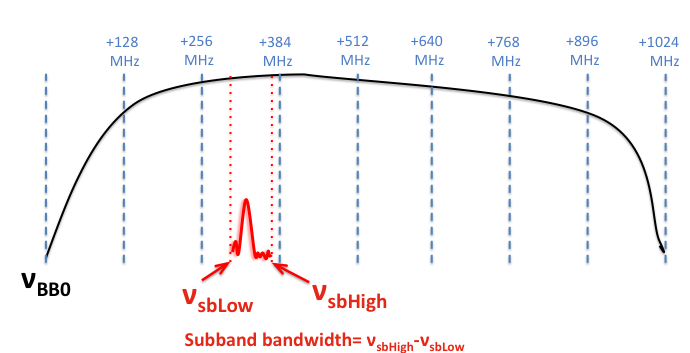
The black curve shows the analog filter response for an 8-bit baseband covering 1024 MHz, starting at νBB0. The dashed blue vertical lines show the 128 MHz boundaries; no subband can cross those boundaries and 128 MHz subbands are thus constrained to cover a region between two of those boundaries, with no finer tuning being possible. Narrower subbands, like the 64 MHz subband shown here in red, can be shifted around arbitrarily within one of the 128 MHz slots, but cannot cross any of these boundaries. (The dotted vertical red lines show the boundaries of the 64 MHz subband, while the solid curve shows an illustrative line within the subband.)
The analog filter shape defining the baseband rolls off severely at one edge of the baseband, so the 128 MHz slot at that edge has reduced sensitivity. The baseband edge is at the lowest sky frequency in the baseband when using the upper sideband, and at the highest sky frequency in the baseband when using the lower sideband.
Subband Bandwidths and the Digital Filter Response
The bandwidth for each subband may be selected independently, and can be any of 128/2n MHz, for n= 0, 1, …, 12: 128, 64, 32, 16, 8, 4, 2, or 1 MHz, or 500, 250, 125, 62.5, or 31.25 kHz.
The usable portion of the subband is set by three effects. First, as discussed above, the analog filters which define the baseband are not perfect, leading to lower sensitivity in the 128 MHz near the baseband edge for the 8-bit samplers.
Second, because the digital filters are not infinitely sharp, the rejected sideband leaks in at both edges of the subband. This leads to additional (aliased) noise, with a factor ~2 increase in the noise at the subband edges, dropping to a few percent within a few percent of the subband edge. The precise filter shape and noise increase is a complex but predictable function of the subband bandwidth (sbBW) and the subband tuning.
The third effect stems from the offset frequencies used for sideband rejection in the WIDAR correlator. The local oscillators at the individual antennas are tuned to slightly different frequencies, with those offsets taken out in the correlator. This means that each antenna observes a slightly different sky frequency, and thus some baselines will not give an interesting correlation near one edge of the subband. The maximum frequency shift is currently set to 32×f0, with the fundamental f0 being set to f0 = max(25.6 kHz×sbBW/128 MHz, 100 Hz). Here sbBW is the smallest subband bandwidth within the baseband. For the wider subband bandwidths the maximum frequency shift corresponds to <1% of that bandwidth, but for narrower subbands the effect can be severe. For instance, a 31.25 kHz subband has f0 = 100 Hz, and a maximum frequency shift of 3.2 kHz—10% of the subband may be lost on some baselines.
Spectral Channels and Polarization Products
Each subband, without recirculation enabled, can have a different number of channels and polarization products, subject to two limitations:
- For the ithsubband, the number of spectral channels can be:
- 64 nBlBP,i with full polarization products (RR,RL,LR,LL)
- 128 nBlBP,i with dual polarization products (RR and LL)
- 256 nBlBP,i with a single polarization product (RR or LL)
- The sum over all subbands of nBlBP,i must be less than or equal to 64, the number of Baseline Board pairs in the correlator. Equivalently, the sum over all subbands of spectral channels times polarization products is limited to 64 × 256 = 16,384 (without recirculation).
Baseline Boards are the boards in the WIDAR correlator where the actual cross-multiplications are done. There are 128 Baseline Boards arranged as 64 Baseline Board pairs (BlBPs). The limitations given here correspond to the capabilities of the individual boards and the finite number of boards the correlator has. Use of more than one pair per subband (i.e., nBlBP>1) is known as Baseline Board stacking; see additional details about this below.
Limitation #1 corresponds to table 4.2.1 of the options for subband bandwidth and spectral resolution when using nBlBP Baseline Board pairs for a subband:
| Table 4.2.1: Subband Bandwidth and Spectral Resolution Options (without recirculation) |
|||||||
|---|---|---|---|---|---|---|---|
| Subband bandwidth & total velocity coverage |
Full polarization products (RR, RL, LR, LL) 64nBlBP spectral channels Channel spacing: |
Dual polarization products (RR and LL) 128nBlBP spectral channels Channel spacing: |
Single polarization product (RR or LL) 256nBlBP spectral channels Channel spacing: |
||||
| 128 MHz | 38400/νGHz km/s | 2000/nBlBP kHz | 600/nBlBP/νGHz km/s | 1000/nBlBP kHz | 300/nBlBP/νGHz km/s | 500/nBlBP kHz | 150/nBlBP/νGHz km/s |
| 64 | 19200 | 1000 / nBlBP | 300 / nBlBP | 500 / nBlBP | 150 / nBlBP | 250 / nBlBP | 75 / nBlBP |
| 32 | 9600 | 500 / nBlBP | 150 / nBlBP | 250 / nBlBP | 75 / nBlBP | 125 / nBlBP | 37.5 / nBlBP |
| 16 | 4800 | 250 / nBlBP | 75 / nBlBP | 125 / nBlBP | 37.5 / nBlBP | 62.5 / nBlBP | 18.75 / nBlBP |
| 8 | 2400 | 125 / nBlBP | 37.5 / nBlBP | 62.5 / nBlBP | 18.75 / nBlBP | 31.25 / nBlBP | 9.375 / nBlBP |
| 4 | 1200 | 62.5 / nBlBP | 18.75 / nBlBP | 31.25 / nBlBP | 9.375 / nBlBP | 15.625/nBlBP | 4.687 /n BlBP |
| 2 | 600 | 31.25 / nBlBP | 9.375 / nBlBP | 15.625/nBlBP | 4.687 / nBlBP | 7.8125 / nBlBP | 2.344 / nBlBP |
| 1 | 300 | 15.625/nBlBP | 4.687 / nBlBP | 7.8125 / nBlBP | 2.344 / nBlBP | 3.906 / nBlBP | 1.172 / nBlBP |
| 0.5 | 150 | 7.8125 / nBlBP | 2.344 / nBlBP | 3.906 / nBlBP | 1.172 / nBlBP | 1.953 / nBlBP | 0.586 / nBlBP |
| 0.25 | 75 | 3.906 / nBlBP | 1.172 / nBlBP | 1.953 / nBlBP | 0.586 / nBlBP | 0.977 / nBlBP | 0.293 / nBlBP |
| 0.125 | 37.5 | 1.953 / nBlBP | 0.586 / nBlBP | 0.977 / nBlBP | 0.293 / nBlBP | 0.488 / nBlBP | 0.146 / nBlBP |
| 0.0625 | 18.75 | 0.977 / nBlBP | 0.293 / nBlBP | 0.488 / nBlBP | 0.146 / nBlBP | 0.244 / nBlBP | 0.073 / nBlBP |
| 0.0325 | 9.375 | 0.488 / nBlBP | 0.146 / nBlBP | 0.244 / nBlBP | 0.073 / nBlBP | 0.122 / nBlBP | 0.037 / nBlBP |
|
Subband bandwidth and spectral resolution options. Note that the table entries refer to the spacing between spectral channels—that spacing is before any frequency smoothing, so these channels are not independent.
|
|||||||
Here are four examples of allowed general observing setups which use all 64 BlBPs to produce the maximum number of channels times polarization products:
| Baseband | Subband |
Pol'n |
Spectral |
nBlBP | |
| Example 1 | A0/C0 | sb0 | RR | 16384 | 64 |
| Example 2 | A0/C0 | sb0 | RR | 8192 | 32 |
| A0/C0 | sb1 | RR, LL | 1024 | 8 | |
| A0/C0 | sb2 | RR, LL | 512 | 4 | |
| B0/D0 | sb0 | RR, LL | 2048 | 16 | |
| B0/D0 | sb1 | RR,RL,LR,LL | 256 | 4 | |
| Example 3 | A0/C0 | sb0 | RR | 8192 | 32 |
| A0/C0 | sb1 | LL | 1024 | 4 | |
| A0/C0 | sb2 | RR, LL | 1024 | 8 | |
| A0/C0 | sb3 | RR,RL,LR,LL | 1024 | 16 | |
| A0/C0 | sb4 | RR,RL,LR,LL | 256 | 4 | |
| Example 4 | A0/C0 | sb0-5 | RR,RL,LR,LL | 64 | 6 x 1 |
| A0/C0 | sb6 | RR, LL | 3840 | 1 x 30 | |
| A0/C0 | sb7 | RR | 768 | 1 x 3 |
|
| A0/C0 | sb8 | RR,RL,LR,LL | 192 | 1 x 3 | |
| B0/D0 | sb0-2 | RR,RL,LR,LL | 64 | 3 x 1 | |
| B0/D0 | sb3 | LL | 768 | 1 x 3 |
|
| B0/D0 | sb4 | RR, LL | 2048 | 1 x 16 |
Recirculation
When the subband bandwidth is less than the maximum 128 MHz, the spare clock cycles that become available in the correlator hardware can be re-purposed to compute additional lags using a single baseline board. This increases the spectral resolution within the subband, and is known as recirculation. Each factor of two reduction in subband bandwidth results in an additional factor of two maximum lags; therefore for subbands of 128 MHz / N the possible spectral resolution (in units of frequency) can be increased by a factor of N2.
Recirculation vs. Baseline Board Stacking
When faced with the choice between recirculation and Baseline Board stacking to increase the number of channels in a subband, we recommend recirculation for subbands narrower than 128 MHz; this is supported in observatory software (RCT-proposing, OPT). Using recirculation rather than stacking frees up more Baseline Boards for other uses; alternatively the experiment becomes less dependent on all Baseline Board pairs being available/working at the time of observation. For subbands of 128 MHz, recirculation is not possible, and Baseline Board stacking must be utilized to increase the number of channels.
The present implementation of recirculation is that, for each halving of the subband bandwidth, the number of channels in the subband may be doubled without having to use additional correlator hardware. The maximum recirculation factor for a subband is 128/(subband bandwidth in MHz) and, of course, subject to other configuration restrictions such as data rate.
Baseline Board Stacking
As opposed to recirculation, which increases the number of channels in a subband by exploiting otherwise unused CPU resources, Baseline Board stacking adds more channels to a subband by adding correlator hardware resources, i.e., using up more Baseline Board pairs. Using Baseline Board stacking may therefore limit the number of subbands available in one or more of the basebands. Understanding how this works requires understanding some of the details of the correlator hardware. That understanding is built into the RCT-proposing, and observers may simply use that tool to find out whether their particular setup will, in fact, work. But the results can be confusing without some understanding of the hardware constraints from which they arise. These hardware constraints are complex, and most observers will not need to understand these details. The following section is for those who are attempting complex line experiments and who find the RCT-proposing restricting the number of subbands and/or channels they can use in unexpected ways. Most observers can skip the following section.
Baseline Board Stacking and Correlator Use
First let us consider how the correlator hardware is organized. The cross-multiplications in the WIDAR correlator are spread across 64 Baseline Board pairs (BlBP), arranged into 4 quadrants of 16 BlBP each. Each baseband is connected directly to one of those quadrants. In the simplest mode, each of the 16 BlBP of a quadrant handles the correlations for one of the 16 subbands of the corresponding baseband. Four basebands and four quadrants are required to handle the full 8 GHz of bandwidth per polarization provided by the 3-bit (wideband) samplers: 8 GHz is split into four basebands of 2 GHz each, with each baseband fed into a different BlBP quadrant. Each BlBP in that quadrant handles a subband of maximum bandwidth 128 MHz, so 16 BlBP handles 16 subbands for a total of 16×128 MHz = 2048 MHz.
A single BlBP produces 256 cross-correlations per baseline for a single subband, which can be used for a single polarization product (e.g., RR or LL with 256 spectral channels), or two (RR and LL with 128 spectral channels each), or four (RR, RL, LR, and LL with 64 spectral channels each).
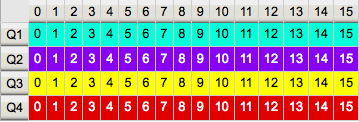 |
Baseline Board pair (BlBP) usage for a simple 4 x 2 GHz (3-bit sampler) experiment. The different colors correspond to different baseband pairs (Q1=cyan, Q2=purple, Q3=yellow, Q4=red). The BlBP quadrants are indicated along the left-hand side, while the numbers across the top represent the BlBPs within those quadrants. Numerals within the colored boxes label the subbands within the basebands. In this setup each subband is correlated using a single BlBP, using all of the 64 available BlBPs. |
When using the 8-bit samplers, the total bandwidth is only 2 GHz per polarization, split into two basebands of 1 GHz each. The simplest continuum setup uses only two quadrants, since there are only two basebands; and only 8 subbands are required to span the 8×128 MHz = 1024 MHz of each baseband. Three-quarters of the correlator BlBP hardware remain unused.
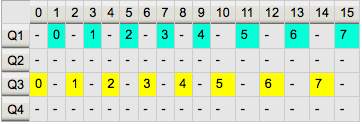 |
Baseline Board pair (BlBP) usage for a simple 2 x 1 GHz (8-bit sampler) experiment. The cyan boxes (shaded when printed out in black and white) correspond to the first baseband pair (IF A0/C0), fed directly into Q1; the yellow boxes to the second (IF B0/D0), fed directly into Q3. The BlBP quadrants are indicated along the left-hand side, while the numbers across the top represent the BlBPs within those quadrants. Numerals within the colored boxes label the subbands within the basebands. In this setup each subband is correlated using a single BlBP, using only 16 of the 64 available BlBPs. |
The spectral line mode allows access to these extra correlator resources through Baseline Board stacking: using multiple BlBPs to process the same subband and produce more cross-correlations for that subband. This is done using crossbar switches which make the data for a single subband available to several BlBPs. Those BlBPs can then be used to produce more spectral channels for that subband, with n BlBPs producing 256×n cross-correlations per baseline. The limit on the total number of cross-correlations (16384) stems from the total number of BlBPs (64): 64×256 = 16384.
Unfortunately, completely flexible crossbar switches are expensive and could not be implemented in the VLA's correlator. This means that one cannot route a given subband to a randomly-chosen BlBP. The routings which are possible, are as follows:
- A subband in a baseband can be routed to any BlBP within the corresponding quadrant.
- Data coming into a given BlBP in one quadrant, can be routed to the corresponding BlBP in any other quadrant.
Routing option #1 means that one could use all the BlBPs within a quadrant to correlate a single subband, yielding 16×256 = 4096 cross-correlations for that subband:
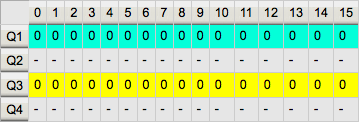 |
Baseline Board pair (BlBP) usage when assigning all BlBPs within a quadrant to a single subband within the corresponding baseband. The cyan boxes (shaded when printed out in black and white) correspond to the first baseband pair (IF A0/C0), fed directly into Q1; the yellow boxes to the second (IF B0/D0), fed directly into Q3. The BlBP quadrants are indicated along the left-hand side, while the numbers across the top represent the BlBPs within those quadrants. Numerals within the colored boxes label the subbands within the basebands. In this setup each subband is correlated using 16 BlBPs, yielding 16×256 = 4096 cross-correlations for those subbands, and using 32 of the 64 available BlBPs. |
Routing option #2 means that one could use the BlBPs in all 4 quadrants to correlate a single subband. One simple case would use 4 BlBPs to correlate each of the 16 subbands in a single baseband, yielding 4×256 = 1024 cross-correlations for each of those subbands. Note that in this case, no BlBPs are left to correlate any data from the second baseband.
 |
Baseline Board pair (BlBP) usage when assigning the BlBPs in all 4 quadrants to correlate the corresponding subbands in a single baseband. The BlBP quadrants are indicated along the left-hand side, while the numbers across the top represent the BlBPs within those quadrants. Numerals within the colored boxes label the subbands within the baseband. In this setup each subband is correlated using 4 BlBPs, yielding 4×256 = 1024 cross-correlations for those subbands, and using all of the 64 available BlBPs. |
Using routing option #2 does come with a subtle cost: assigning a BlBP in quadrant X to correlate a subband corresponding to quadrant Y removes that BlBP from use in the baseband corresponding to quadrant X…and therefore also removes the corresponding subband in that baseband. So, getting more channels for a subband in one baseband may prevent the use of a subband in a different baseband. To take a simple example, consider an experiment where one wishes to observe a single line in dual polarization with 512 channels (requiring 4 BlBPs), plus as much continuum bandwidth as possible. Naively, one would say there are 16 subbands in each baseband; one is used for the spectral line, so that leaves 16+15 = 31 subbands, and with the widest subband bandwidth (128 MHz) the total available continuum should be 31×128 MHz = 3968 MHz per polarization. Actually, however, there are only 15+15 subbands available, or 30×128 MHz = 3840 MHz per polarization, because the spectral line subband has eaten one BlBP corresponding to the other baseband:
 |
Baseline Board pair (BlBP) usage for a continuum plus single line experiment. The cyan boxes (shaded when printed out in black and white) correspond to the first baseband pair (IF A0/C0), fed directly into Q1; the yellow boxes to the second (IF B0/D0), fed directly into Q3. The BlBP quadrants are indicated along the left-hand side, while the numbers across the top represent the BlBPs within those quadrants. Numerals within the colored boxes label the subbands within the basebands. In this setup subband #15 of A0/C0 is correlated using 4 BlBPs, yielding 4×256 = 1024 cross-correlations for that subband, while the other 15 subbands in each baseband are correlated using a single BlBP each. The use of 4 BlBPs for a subband in baseband A0/C0 has eliminated the corresponding subband of the other baseband (B0/D0). Note that only 30+4 = 34 of the 64 available BlBPs have been used—there is plenty of correlator hardware available, but the signal for the spectral line subband cannot be routed to them. |
If the same spectral line required twice as many channels, this will result in the loss of two subbands in both of the basebands:
 |
Baseline Board pair (BlBP) usage for a continuum plus single line experiment. The cyan boxes (shaded when printed out in black and white) correspond to the first baseband pair (IF A0/C0), fed directly into Q1; the yellow boxes to the second (IF B0/D0), fed directly into Q3. The BlBP quadrants are indicated along the left-hand side, while the numbers across the top represent the BlBPs within those quadrants. Numerals within the colored boxes label the subbands within the basebands. In this setup subband #14 of A0/C0 is correlated using 8 BlBPs, yielding 8×256 = 2048 cross-correlations for that subband, while the other 14 subbands in each baseband are correlated using a single BlBP each. The use of 8 BlBPs for a subband in baseband A0/C0 has eliminated one additional subband in baseband A0/C0, and two subbands in B0/D0. Note that only 28+8 = 36 of the 64 available BlBPs have been used—there is no way to route the signals from the missing subbands to that hardware. |
In some cases one may want to use a different routing to use up subbands in one baseband in preference to another. For instance, the same spectral line setup (2048 cross-correlations for a single spectral line subband, plus as much continuum as possible) could be set up to allow 13 continuum subbands in the A0/C0 baseband, and the full 16 continuum subbands in B0/D0:
 |
Baseline Board pair (BlBP) usage for a continuum plus single line experiment. The cyan boxes (shaded when printed out in black and white) correspond to the first baseband pair (IF A0/C0), fed directly into Q1; the yellow boxes to the second (IF B0/D0), fed directly into Q3. The BlBP quadrants are indicated along the left-hand side, while the numbers across the top represent the BlBPs within those quadrants. Numerals within the colored boxes label the subbands within the basebands. In this setup subband #13 of A0/C0 is correlated using 8 BlBPs, yielding 8×256 = 2048 cross-correlations for that subband, while the other 13 subbands in A0/C0 and 16 subbands in B0/D0 are correlated using a single BlBP each. In this setup the use of 8 BlBPs for a subband in baseband A0/C0 has eliminated two additional subbands in baseband A0/C0, while retaining all 16 subbands in B0/D0. Note that only 29+8 = 37 of the 64 available BlBPs have been used. Shared risk observations can assign a number of BlBPs which is not a power of two, and hence could assign one additional BlBP (Q4-BlBP 15) to the spectral line subband. |
Understanding these confusing constraints can help observers set up the VLA more effectively to achieve their scientific goals. For instance, in a mixed line+continuum experiment, it works best to use the resource tools to set up the baseband tunings and subband channelization for the most important lines first, then add the desired continuum, and then see what correlator resources remain for any lines of secondary interest.
The above examples all use BlBP pair stacking in powers of 2, but this is not required. To give some idea of more complex possibilities, the following tables (4.2.3 and 4.2.4) give two examples of other possible configurations. The RCT display shows how the Baseline Boards are used to process the individual subbands. The cyan boxes (shaded when printed out in black and white) show the Baseline Boards used to process data from baseband A0/C0, while the yellow boxes show Baseline Boards used to process data from baseband B0/D0.
| Baseband | Subband | Pol'n products | Spectral channels | nBlBP |
|---|---|---|---|---|
| A0/C0 | sb0 | RR | 10240 | 40 |
| A0/C0 | sb1 | LL | 768 | 3 |
| A0/C0 | sb2 | RR,LL | 2176 | 17 |
| B0/D0 | sb0 | RR | 256 | 1 |
| B0/D0 | sb1 | RR,LL | 384 | 3 |
| RCT display: |  |
|||
| Baseband | Subband | Pol'n products | Spectral channels | nBlBP |
|---|---|---|---|---|
| A0/C0 | sb0 | RR | 4352 | 17 |
| A0/C0 | sb1 | RR, LL | 1152 | 9 |
| B0/D0 | sb0 | RR,RL,LR,LL | 192 | 3 |
| B0/D0 | sb1 | RR, LL | 4480 | 35 |
| RCT display: |  |
|||
The individual subbands can have different bandwidths, and those bandwidths may be chosen completely independently of the number of spectral channels in each subband. So, for instance, a subband with a bandwidth of 2 MHz and 1152 spectral channels would have a channel separation of 2 MHz/1152 = 1.736 kHz; but the observer could equally well choose a bandwidth of 64 MHz for that subband, leading to a channel separation of 64 MHz/1152 = 55.56 kHz.
Use of the 3-bit samplers further extends the possibilities. Here is one example:
| Baseband | Subband | Pol'n products | Spectral channels | nBlBP | Quadrant(s): Column(s) |
|---|---|---|---|---|---|
| A1/C1 | sb0-8 | RR, LL, RL, LR | 9 x 64 | 9 x 1 | Q1: 0–8 |
| A1/C1 | sb9 | RR, LL | 1 x 1152 | 1 x 9 | Q1 & Q3: 9–11, 14 / Q4: 9 |
| A1/C1 | sb10 | RR | 1 x 1792 | 1 x 7 | Q1 & Q3 & Q4 : 12,13 / Q2: 13 |
| A1/C1 | sb11 | RR, LL | 1 x 384 | 1 x 3 | Q1 & Q2 & Q3: 15 |
| A2/C2 | sb0-11 | RR, LL, RL, LR | 12 x 64 | 12 x 1 | Q2: 0–11 |
| A2/C2 | sb12 | LL | 1 x 768 | 1 x 3 | Q2: 12, 14 / Q4: 14 |
| B1/D1 | sb0-3 | RR, LL, RL, LR | 4 x 64 | 4 x 1 | Q3: 0–3 |
| B1/D1 | sb4 | RR, LL, RL, LR | 1 x 320 | 1 x 5 | Q3: 4–8 |
| B2/D2 | sb0-6 | RR, LL, RL, LR | 7 x 64 | 7 x 1 | Q4: 0–6 |
| B2/D2 | sb7 | RR, LL | 1 x 640 | 1 x 5 | Q4: 7, 8, 10, 11, 15 |
| RCT display: | 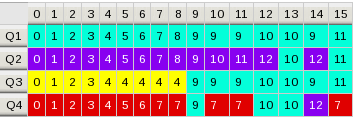 |
||||
Once again, the RCT-proposing implements all of these constraints.
Documentation
Documentation
Documentation for VLA data reduction, image making, observing preparation, etc., can be found in various manuals. Current manuals are available on-line. Those manuals marked by an asterisk (*) can be mailed out upon request, or are available for downloading from the NRAO website. Direct your requests for mailed hardcopy to Lori Appel. Many other documents of interest to the VLA user, not listed here, are available from our website.
- PROCEEDINGS FROM THE 1988 SYNTHESIS IMAGING WORKSHOP: Synthesis theory, technical information and observing strategies can be found in: "Synthesis Imaging in Radio Astronomy." This collection of lectures given in Socorro in June 1988 has been published by the Astronomical Society of the Pacific as Volume 6 of their Conference Series. The lectures of the 2014 workshop are available at the 14th Synthesis Imaging Workshop web site.
- PROCEEDINGS FROM THE 1998 SYNTHESIS IMAGING WORKSHOP: This is an updated and expanded version of Reference 1, taken from the 1998 Synthesis Imaging Summer School, held in Socorro in June, 1998. These proceedings are published as Volume 180 of the ASP Conference Series.
- GUIDE TO OBSERVING WITH THE VLA: Describes details of how to observe with the VLA once you have been allocated time on the VLA (https://science.nrao.edu/facilities/vla/docs/manuals/obsguide). Including special observing modes such as:
- CALIBRATION (https://science.nrao.edu/facilities/vla/docs/manuals/obsguide/calibration)
- OBSERVING WITH THE 8-BIT (up to 2 GHz bandwidth) & 3-BIT (up to 8 GHz bandwidth) SAMPLER SYSTEMS (https://science.nrao.edu/facilities/vla/docs/manuals/obsguide/modes/set-up);
- SPECTRAL LINE OBSERVING (https://science.nrao.edu/facilities/vla/docs/manuals/obsguide/modes/line);
- HIGH FREQUENCY OBSERVING (https://science.nrao.edu/facilities/vla/docs/manuals/obsguide/topical-guides/hifreq);
- LOW FREQUENCY OBSERVING (https://science.nrao.edu/facilities/vla/docs/manuals/obsguide/topical-guides/lofreq);
- VERY LOW FREQUENCY OBSERVING (< 500 MHz) (https://science.nrao.edu/facilities/vla/docs/manuals/obsguide/topical-guides/vlofreq);
- POLARIMETRY (https://science.nrao.edu/facilities/vla/docs/manuals/obsguide/modes/pol);
- MOSAICKING (https://science.nrao.edu/facilities/vla/docs/manuals/obsguide/modes/mosaicking);
- RADIO FREQUENCY INTERFERENCE (https://science.nrao.edu/facilities/vla/docs/manuals/obsguide/rfi);
- MOVING OBJECTS (https://science.nrao.edu/facilities/vla/docs/manuals/obsguide/modes/moving);
- VLBI AT THE VLA (https://science.nrao.edu/facilities/vla/docs/manuals/obsguide/modes/vlbi).
- *CASA COOKBOOK (deprecated with last updates for CASA 4.7.2): The CASA Cookbook for use of the package for data reduction of VLA (& ALMA) data is available, along with other documentation, from the CASA home page (http://casa.nrao.edu). See (http://casa.nrao.edu/docs/cookbook/)
- CASA Online Documentation: https://casadocs.readthedocs.io/en/stable/
- VLA CASA Guides: Tutorials and data reduction examples of VLA data in CASA (https://casaguides.nrao.edu/index.php/Karl_G._Jansky_VLA_Tutorials)
- *AIPS COOKBOOK: The Astronomical Image Processing System (AIPS) software is able to fully calibrate VLA data and do most imaging operations. The exception is the wide-band (bandwidth synthesis) deconvolution which is being developed in CASA only. ALMA data may also be reduced in AIPS although the package is not fully qualified to calibrate data from the ALMA linearly-polarized feeds. The Cookbook description for calibration and imaging under the AIPS system can be found near all public workstations in the SOC. The latest version has expanded descriptions of data calibration imaging, cleaning, self-calibration, spectral line reduction, and VLBI reductions. See (http://www.aips.nrao.edu/cook.html)
- *GOING AIPS: This is a two-volume programmers manual for those wishing to write programs under AIPS. It is now somewhat out of date. See (http://www.aips.nrao.edu/goaips.html)
- *VLA CALIBRATOR LIST: This page contains the list of VLA Calibrators in both 1950 and J2000 epoch. See (https://science.nrao.edu/facilities/vla/observing/callist)
- *The Very Large Array: Design and Performance of a Modern Synthesis Radio Telescope, Napier, Thompson, and Ekers, Proc. of IEEE, 71, 295, 1983.
- *HISTORICAL VLA MEMO SERIES: archive memo series from the early days of the VLA. See (http://library.nrao.edu/vlam.shtml)
- *RECENT VLA MEMO SERIES: the memo series relating to the expanded capabilities of the VLA. See (http://library.nrao.edu/evla.shtml)
- *The VLA Expansion Project: Construction Project Book. The Expanded VLA Project Books contains the technical details of the VLA Expansion construction project. It is available online at http://www.aoc.nrao.edu/evla/pbook.shtml.
- INTRODUCTION TO THE NRAO VERY LARGE ARRAY (Green Book): This manual has general introductory information on the VLA. Topics include theory of interferometry, hardware descriptions, observing preparation, data reduction, image making and display. Major sections of this 1983 manual are now out of date, but it nevertheless remains a useful source of information on much of the VLA. There are a few hard copies at the VLA and in the DSOC. Much of this document is now available for download (https://science.nrao.edu/facilities/vla/obsolete/green-book). Note: it does not include any information about the hardware and software specific to the expanded Karl G. Jansky VLA.
- WIDAR: The DRAO design and development documents of the WIDAR correlator of the VLA are available at http://www.aoc.nrao.edu/widar/docs/.
Online Tools & Important Links
The NRAO User Portal. (https://my.nrao.edu) This is a gateway to the NRAO interactive services that include the Proposal Submission Tool (PST).
The NRAO Proposal Submission Tool (PST) online manual. (https://science.nrao.edu/facilities/vla/docs/manuals/proposal-guide/pst)
The VLA Exposure Calculator Tool (ECT) online manual. (https://science.nrao.edu/facilities/vla/docs/manuals/propvla/determining)
The VLA Exposure Calculator Tool (ECT). (https://obs.vla.nrao.edu/ect/)
The Resource Catalog Tool for proposers. (https://rctp.vla.nrao.edu/rct/)
Acknowledgements
Many thanks to all the VLA staff and our RSRO participants who have worked long and hard to commission these capabilities and who have helped to create this extensively updated set of documentation.
NRAO is grateful to Professor Rob Ivison for supporting the upgrade of some of the 3-bit samplers on the VLA via a grant from the European Research Council. For observations using the 3-bit samplers between May 2015 and March 2018 we encourage users to include the following text in the Acknowledgments section of their publications:
"We acknowledge funding towards the 3-bit samplers used in this work from ERC Advanced Grant 321302, COSMICISM."
Contact Information
Please go to the People page for information on key personnel at NRAO-Socorro.
Please direct queries to the NRAO Helpdesk; you can expect a response within one to two business days.
Editor's Notes
This Observational Status Summary for the Karl G. Jansky (expanded) VLA is based substantially on its predecessor, the VLA Observational Status Summary. Over the VLA history of almost 30 years, many individuals contributed to that document by writing sections, editing previous versions, commenting on draft material, and implementing the capabilities described herein. We thank all these contributors for their efforts. For questions on the content, or suggestions that would enhance the clarity of this guide, we recommend contacting the NRAO Helpdesk.
VLA Observational Status Summary 2025A Complete Manual
VLA Observational Status Summary 2025A
- Introduction
- Offered VLA Capabilities during the Next Semester
- Performance of the VLA during the Next Semester
- Resolution
- Sensitivity
- VLA Frequency Bands and Tunability
- VLA Samplers
- Field of View
- Time Resolution and Data Rates
- Radio Frequency Interference
- Subarrays
- Positional Accuracy & Astrometry
- Limitations on Imaging Performance
- Calibrating the Flux Density Scale
- Complex Gain Calibration
- Polarization
- VLBI Observations
- Snapshots
- Shadowing and Cross-Talk
- Combining Configurations and Mosaicking
- Pulsar Observing
- Solar Observing
- VLA+LWA (eLWA) Observing
- WIDAR Correlator
- Documentation
- Contact Information
- Editor's Notes
All content on one page (useful for printing, presentation mode etc.)
Offered VLA Capabilities during the Next Semester
The Call for Proposals
The most recent Call for Proposals summarizes the General Observing (GO) capabilities being offered for the Karl G. Jansky Very Large Array (VLA).
In addition to these general capabilities, NRAO continues to offer shared risk observing options for those who would like to push the capabilities of the VLA beyond those offered for general use. These are the Shared Risk Observing (SRO) and Resident Shared Risk Observing (RSRO) programs.
Details about what is being offered for each program are given below. If you have any questions or problems with any link or tool, please submit a ticket through the NRAO Helpdesk.
Considering the lack of hybrid configurations after semester 2016A, guidelines on how to substitute such configurations with the use of principal array configurations are presented in the Array Configurations section of the Guide to Proposing for the VLA.
General Observing (GO) and Shared-Risk Observing (SRO)
Summary of Capabilities
As described in the Call for Proposals, the VLA offers continuous frequency coverage from 1–50 GHz in the following observing bands: 1–2 GHz (L-band); 2–4 GHz (S-band); 4–8 GHz (C-band); 8–12 GHz (X-band); 12–18 GHz (Ku-band); 18–26.5 GHz (K-band); 26.5–40 GHz (Ka-band); and 40–50 GHz (Q-band). Both single pointing and mosaics with discrete, multiple field centers will be supported under General Observing (GO). In addition to these, all VLA antennas are equipped with 224–480 MHz (P-band) and 54–86 MHz (4-band) receivers near the prime focus. Data rates of up to 60 MB/s (216 GB/hour) will be available to all users as GO, combined with correlator integration time limits per band and per configuration, as described in the Time Resolution and Data Rates section. Limitations on frequency settings and tuning ranges are described in the Frequency Bands and Tunability section.
The GO capabilities being offered are:
| Capability | Description |
| 8-bit samplers |
*Note: 4-band and dual 4/P-band observations are offered for Stokes I continuum only using standard full polarization default setups. Polarization, spectral-line, or the use of non-standard setups, should be submitted as a RSRO proposal. |
| 3-bit samplers |
|
| Mixed 3-bit and 8-bit samplers |
|
|
Subarrays |
|
| Y27 or Y1 for VLBI |
|
|
Solar observing |
|
|
On-The-Fly Mosaicking (OTF)‡ |
|
|
Pulsar |
|
*Note: The VLA L-band (1-2 GHz) has a special signal path (the "reverse coupler" path) that allows coherent radio bursts to be observed without saturating the system, as the brightest of these solar bursts can exceed 105 solar flux units, or 109 Jy. This signal path has not yet been fully commissioned and is therefore not yet available under GO.
SRO capabilities can be set up via the Observing Preparation Tool (OPT) and run through the dynamic scheduler without intervention, but are not as well tested as GO capabilities. Data rates higher than 60 MB/s (216 GB/hour) and up to 100 MB/s (360 GB/hour) are considered SRO. A summary of the SRO capabilities being offered are:
- On-the-Fly (OTF) mosaicking for X-, Ku-, K-, Ka-, and Q-bands (used when each pointing on the sky is on the order of several seconds or less), but not using subarrays.
- Wideband VLA for VLBI: Enables recording of VLA WIDAR continuum-mode correlations during VLA phased array (Y27) VLBI observations. Currently, this only supports standard VLA 8-bit continuum modes with a 2-GHz bandwidth. See the VLBA Call for Proposals for more details.
- eLWA: Joint LWA and VLA 4-band observations using a single 8 MHz subband centered at 76 MHz, and 4-bit VDIF output. Note: During semester 2025A, the LWA is expected to be undergoing infrastructure upgrades and availability of the telescopes (LWA1 and LWA-SV) may be limited. Those interested in using this mode should contact Greg Taylor at gbtaylor@unm.edu for more details.
We expect that most SRO programs will have no or only minor problems that can be corrected quickly. If an SRO program fails, however, and it becomes clear that detailed testing with additional expertise is needed, then the project must make an experienced member from their team available to help troubleshoot the problem. In some cases, this may require the presence of that experienced member in Socorro. If adequate support from the project is not given, then the time on the telescope will be forfeited. The additional effort is to be determined based on discussions with the NRAO staff and management and the project team.
The guidelines for General and Shared Risk observing proposals, along with information about tools and other advice, can be found in the VLA Proposal Submission Guidelines.
Resident Shared Risk Observing (RSRO)
Summary of Capabilities
The VLBA Resident Shared Risk Observing (RSRO) program provides users with early access to new capabilities in exchange for a period of residency in Socorro to help commission those capabilities.
RSRO proposals should be submitted using the NRAO Proposal Submission Tool in response to a regular proposal call. The proposal should include a scientific justification, as for normal proposals, which will be peer reviewed as part of NRAO's time allocation process. Selecting "VLA RSRO" from the "Observing Mode" menu on the Resources page makes an "RSRO Comments" text-entry facility available for describing the technical resources required. A description of the personnel who will be involved in the effort along with their expertise and availability should also be included in the technical justification.
We emphasize the "shared risk" nature of the RSRO program. Since observers will be attempting to use capabilities under development and in the process of being commissioned, NRAO can make no guarantee of the success of any observations made under this program, and no additional commitment is made beyond granting the hours actually assigned by the peer review process.
Proposals for any area of user interest bit offered under GO or SRO are welcome. Here, we provide some examples of capabilities that are being utilized in recent RSRO proposals.
- Correlator dump times shorter than 50 msec, including integration times as short as 5 msec for transient detection, or data rates above 100 MB/s. In order to reduce the data rate, frequency averaging in the correlator may be utilized in RSRO proposals;
- YUPPI pulsar mode combined with VLBI recording;
- Subarray observations with setups other than the default continuum setups, or observations with more than 3 subarrays;
- Currently, OTF observing is implemented as linear interpolations in Equatorial Coordinates (i.e., RA/Dec). This can be expanded to allow using stripes linear in Galactic coordinates (l,b), as well as more complex patterns other than linear in RA and Dec, such as Rosetta or Spiral patterns. Note that these must still adhere to the restrictions of the OTF mode under General Observing, i.e., using the full array below 8 GHz (up to C-band), and no subarrays.
The guidelines for Resident Shared Risk Observing proposing, along with requirements and considerations, can be found in the VLA Proposal Submission Guidelines.
Commensal Observing Systems at the VLA
There are three commensal systems on the VLA that may take data at the same time as your proposed observation. The first is the VLITE system, which will take data at P-band during regular observations that use bands other than P-band. Hence, VLITE is turned off by default during P-band or dual 4/P-band observations. The VLITE system is deployed on up to eighteen VLA antennas. Observers wishing to gain access to the commensal VLITE data taken during their VLA observations should follow the instructions on the VLITE web page for doing so. The second is the realfast system, which takes data at very fast dump rates in an effort to detect Fast Radio Bursts (FRBs). This system is fully commissioned for observing at L- through X-bands, in parallel with standard continuum correlator configurations. The third commensal system, COSMIC SETI, enables the search for extraterrestrial intelligence (SETI) using the VLA, and collects data during unconflicted PI science observations. For information about commensal observing see the Commensal Observing with NRAO Telescopes page.
To report errors or problems encountered in any link or while using any NRAO tool listed here, please submit a ticket through the NRAO Helpdesk.
Performance of the VLA during the Next Semester
Resolution
Resolution
The VLA's resolution is generally diffraction-limited, and thus is set by the array configuration and the observing frequency. Like all synthesis arrays, the VLA is sensitive only to structures on a range of angular scales between the diffraction limit (the smallest angular scale detectable) and a "Largest Angular Scale" (which depends on the fringe spacing formed by the shortest baselines in the configuration). For emission structures smaller than the diffraction limit (θ ∼ λ/Bmax), the VLA acts like a single-dish instrument—the resulting image is smoothed to the resolution of the array. For emission structures larger than the detectable range, the VLA is simply blind to the emission; this is a limitation unique to interferometers. No subsequent processing can fully recover the missing information from these large scales. It can only be obtained by observing in a more compact VLA array configuration or with data from an instrument that is sensitive to the missing angular scales, such as a large single dish or a compact array of smaller antennas.
Table 3.1.1 displays the VLA's resolution and the scale at which severe attenuation of large-scale structure occurs. This table shows the maximum and minimum antenna separations, the approximate synthesized beam size (full width at half-power; the resolution element) for the central frequency for each band, and the largest angular scale of detectable emission.
| Configuration | A | B | C | D |
|---|---|---|---|---|
| Bmax (km1) | 36.4 | 11.1 | 3.4 | 1.03 |
| Bmin (km1) | 0.68 | 0.21 | 0.0355 | 0.035 |
| Band | Synthesized Beamwidth θHPBW(arcsec)1,2,3 | |||
| 74 MHz (4) | 24 | 80 | 260 | 850 |
| 350 MHz (P) | 5.6 | 18.5 | 60 | 200 |
| 1.5 GHz (L) | 1.3 | 4.3 | 14 | 46 |
| 3.0 GHz (S) | 0.65 | 2.1 | 7.0 | 23 |
| 6.0 GHz (C) | 0.33 | 1.0 | 3.5 | 12 |
| 10 GHz (X) | 0.20 | 0.60 | 2.1 | 7.2 |
| 15 GHz (Ku) | 0.13 | 0.42 | 1.4 | 4.6 |
| 22 GHz (K) | 0.089 | 0.28 | 0.95 | 3.1 |
| 33 GHz (Ka) | 0.059 | 0.19 | 0.63 | 2.1 |
| 45 GHz (Q) | 0.043 | 0.14 | 0.47 | 1.5 |
| Band | Largest Angular Scale θLAS(arcsec)1,4 | |||
| 74 MHz (4) | 800 | 2200 | 20000 | 20000 |
| 350 MHz (P) | 155 | 515 | 4150 | 4150 |
| 1.5 GHz (L) | 36 | 120 | 970 | 970 |
| 3.0 GHz (S) | 18 | 58 | 490 | 490 |
| 6.0 GHz (C) | 8.9 | 29 | 240 | 240 |
| 10 GHz (X) | 5.3 | 17 | 145 | 145 |
| 15 GHz (Ku) | 3.6 | 12 | 97 | 97 |
| 22 GHz (K) | 2.4 | 7.9 | 66 | 66 |
| 33 GHz (Ka) | 1.6 | 5.3 | 44 | 44 |
| 45 GHz (Q) | 1.2 | 3.9 | 32 | 32 |
- These estimates of the synthesized beamwidth are for a uniformly weighted, untapered map produced from a full 12 hour synthesis observation of a source which passes near the zenith.
- Notes:
- 1. Bmax is the maximum antenna separation, Bmin is the minimum antenna separation, θHPBW is the synthesized beam width (FWHM), and θLAS is the largest angular scale structure visible to the array.
- 2. The listed resolutions are appropriate for sources with declinations between −15 and +75 degrees.
- 3. The approximate resolution for a naturally weighted map is about 1.5 times the numbers listed for θHPBW. The values for snapshots are about 1.3 times the listed values.
- 4. The largest angular scale structure is that which can be imaged reasonably well in full synthesis observations. For single snapshot observations, the quoted numbers should be divided by two.
- 5. For the C configuration, an antenna from the middle of the north arm is moved to the central pad N1. This results in improved imaging for extended objects, but may slightly degrade snapshot performance. Note that although the minimum spacing is the same as in D configuration, the surface brightness sensitivity and image fidelity to extended structure is considerably inferior to that of the D configuration.
The following figure is a graphical representation of the synthesized beamwidths for natural and robust weighting for the four main array configurations between 1 and 50 GHz. Also available are synthesized beamwidth figures for the low frequency (1–12 GHz) and the high frequency (12–50 GHz) receiver bands.
(click image to enlarge)
Sensitivity
Sensitivity
The theoretical thermal noise expected for an image using natural weighting of the visibility data is given by:
| \[\Delta I_m = \frac{SEFD}{\eta_{\rm c}\sqrt{n_{\rm pol}N(N-1)t_{\rm int}\Delta\nu}}\] | (eq. 1) |
where:
- - SEFD is the system equivalent flux density (Jy), defined as the flux density of a radio source that doubles the system temperature. Lower values of the SEFD indicate more sensitive performance. For the VLA's 25–meter paraboloids, the SEFD is given by the equation SEFD = 5.62Tsys/ηA, where Tsys is the total system temperature (receiver plus antenna plus sky), and ηA is the antenna aperture efficiency in the given band.
- - ηc is the correlator efficiency (~0.93 with the use of the 8-bit samplers).
- - npol is the number of polarization products included in the image; npol = 2 for images in Stokes I, Q, U, or V, and npol = 1 for images in RCP or LCP.
- - N is the number of antennas.
- - tint is the total on-source integration time in seconds.
- - Δν is the bandwidth in Hz.
Figure 3.2.1 shows the SEFDs as a function of frequency used in the VLA exposure calculator for those Cassegrain bands currently installed on VLA antennas, and include the contribution to Tsys from atmospheric emission at the zenith. Figure 3.2.2 shows the SEFDs as a function of frequency for the P-band; these measurements are based on imaging of a field far from the galactic plane. Table 3.2.1 gives the SEFD at some fiducial VLA frequencies.
|
|
Figure 3.2.1: SEFD used in the Exposure Calculator for the VLA. Left: The system equivalent flux density as a function of frequency for the L, S, C and X-band receivers. Right: The system equivalent flux density as a function of frequency for the Ku, K, Ka, and Q-band receivers. SEFDs at Ku, K, Ka, and Q bands include contributions from Earth's atmosphere and were determined under good conditions.
Figure 3.2.2: The SEFD used in the VLA Exposure Calculator as a function of frequency for the P-band receiver
Note that the theoretical rms noise calculated using equation 1 is the best limit possible. There are several factors that will tend to increase the noise compared with theoretical:
- For the more commonly used robust weighting scheme, intermediate between pure natural and pure uniform weightings (available in the AIPS task IMAGR and CASA task clean), typical parameters will result in the sensitivity being a factor of about 1.2 worse than the listed values.
- Confusion. There are two types of confusion: (i) that due to confusing sources within the synthesized beam, which affects low resolution observations the most. Table 3.2.1 shows the confusion noise in D configuration assuming robust weighting (see Condon et al. 2012, ApJ, 758), which should be added in quadrature to the thermal noise in estimating expected sensitivities. The confusion limits in C configuration are approximately a factor of 10 less than those in Table 3.2.1; (ii) confusion from the sidelobes of uncleaned sources lying outside the image, often from sources in the sidelobes of the primary beam. This confusion primarily affects low frequency observations.
- Weather. The sky and ground temperature contributions to the total system temperature increase with decreasing elevation. This effect is very strong at high frequencies, but is relatively unimportant at the other bands. The extra noise comes directly from atmospheric emission: primarily from water vapor at K-band, and from water vapor and the broad wings of the strong 60 GHz O2 transitions at Q-band.
- Losses from the 3-bit samplers. The VLA's 3-bit samplers incur an additional 10–15% loss in sensitivity above that expected—i.e., the efficiency factor ηc = 0.78 to 0.83.
| Frequency | SEFD (Jy) |
RMS confusion level |
||
|---|---|---|---|---|
| 0.39 GHz (P) | 2790 | 5330 | ||
| 1.5 GHz (L) | 420 | 74 | ||
| 3.0 GHz (S) | 370 | 12 | ||
| 6.0 GHz (C) | 310 | 2 | ||
| 10.0 GHz (X) | 250 | negligible | ||
| 15 GHz (Ku) | 320 | negligible | ||
| 20 GHz (K) | 500 | negligible | ||
| 33 GHz (Ka) | 600 | negligible | ||
| 45 GHz (Q) | 1300 | negligible |
In general, the zenith atmospheric opacity to microwave radiation is very low: typically less than 0.01 at L, C, and X-bands; 0.05 to 0.2 at K-band; and 0.05 to 0.1 at the lower half of Q-band, rising to 0.3 by 49 GHz. The opacity at K-band displays strong variations with time of day and season, primarily due to the 22 GHz water vapor line. Observing conditions are best at night and in the winter. Q-band opacity, dominated by atmospheric O2, is considerably less variable.
Observers should remember that clouds, especially clouds with large water droplets (thunderstorms), can add appreciable noise to the system temperature. Significant increases in system temperature can, in the worst conditions, be seen at frequencies as low as 5 GHz.
Tipping scans—which are currently unavailable but will be implemented at some time in the future—can be used for deriving the zenith opacity during an observation. In general, tipping scans should only be needed if the calibrator used to set the flux density scale is observed at a significantly different elevation than the range of elevations over which the complex gain calibrator (amplitude and phase) and target source are observed.
When the flux density calibrator observations are within the elevation range spanned by the science observing, elevation dependent effects (including both atmospheric opacity and antenna gain dependencies) can be accounted for by fitting an elevation-dependent gain term. See the following items:
- Antenna elevation-dependent gains. The antenna figure degrades at low elevations, leading to diminished forward gain at the shorter wavelengths. The gain-elevation effect is negligible at frequencies below 8 GHz. The antenna gains can be determined by direct measurement of the relative system gain using the AIPS task ELINT on data from a strong calibrator which has been observed over a wide range of elevation. If this is not possible, care should be taken to observe a primary flux calibrator at the same elevation as the target.
Both CASA and AIPS allow the application of elevation-dependent gains and an estimated opacity generated from ground-based weather through the CASA tasks gencal and plotweather, and AIPS task INDXR.
- Pointing. The SEFD quoted above assumes good pointing. Under calm, nighttime conditions, the antenna blind pointing is about 10 arcsec rms. The pointing accuracy in daytime can be much worse—occasionally exceeding 1 arcminte due to the effects of solar heating of the antenna structures. Moderate winds have a very strong effect on both pointing and antenna figure. The maximum wind speed recommended for high frequency observing is 11 mph (5 m/s). Wind speeds near the stow limit 45 mph (20 m/s) will have a similar negative effect at 8 and 15 GHz.
To achieve increased pointing accuracy, referenced pointing is recommended where a nearby calibrator is observed in interferometric pointing mode every hour or so. The local pointing corrections measured can then be applied to subsequent target observations. This reduces rms pointing errors to as little as 2–3 arcseconds (but more typically 5–7 arcseconds) if the reference source is within about 15 degrees in azimuth and elevation of the target source and the source elevation is less than 70 degrees. At source elevations greater than 80 degrees (zenith angle < 10 degrees), source tracking becomes difficult; it is recommended to avoid such source elevations during the observation preparation setup.
Use of referenced pointing is highly recommended for all Ku, K, Ka, and Q-band observations, and for lower frequency observations of objects whose total extent is a significant fraction of the antenna primary beam. It is usually recommended that the referenced pointing measurement be made at 8 GHz (X-band), regardless of what band your target observing is at, since X-band is the most sensitive and the closest calibrator is likely to be weak. Proximity of the reference calibrator to the target source is of paramount importance; ideally the pointing sources should precede the target by 20 or 30 minutes in Right Ascension (RA). The calibrator should have at least 0.3 Jy flux density at X-band and be unresolved on all baselines to ensure an accurate solution.
To aid VLA proposers there is an online guide to the exposure calculator; the exposure calculator provides a graphical user interface to these equations.
Special caveats apply for P-band (230–470 MHz) observing. The SEFD's in Figure 3.2.2 or that listed in table 3.1.2 are from an observation taken far from the Galactic plane, where the sky brightness is about 30K. At P-band, Galactic synchrotron emission is very bright in directions near the Galactic plane. The system temperature increase due to Galactic emission will degrade sensitivity by factors of two to three for observations in the plane, and by a factor of five or more at or near the Galactic center. Additionally, the antenna efficiency (currently about 0.31 for 300 MHz) will decline with both increasing and decreasing frequencies from the center of P-band.
The beam-averaged brightness temperature measured by a given array depends on the synthesized beam, and is related to the flux density per beam by:
| \[T_{\rm b} = \frac{S \lambda^2}{2k\Omega} = F \cdot S\] | (eq. 2) |
where Tb is the brightness temperature (Kelvins) and Ω is the beam solid angle. For natural weighting (where the angular size of the approximately Gaussian beam is ∼1.5λ/Bmax), and S in mJy per beam, the parameter F depends on the synthesized beam, therefore on the array configuration, and has the approximate value of F = 190, 18, 1.7, 0.16 for A, B, C, and D configurations, respectively. The brightness temperature sensitivity can be obtained by substituting the rms noise, ΔIm, for S. Note that Equation 2 is a beam-averaged surface brightness; if a source size can be measured, then the source size and integrated flux density should be used in Equation 2 and the appropriate value of F calculated. In general, the surface brightness sensitivity is also a function of the source structure and how much emission may be filtered out due to the sampling of the interferometer. A more detailed description of the relation between flux density and surface brightness is given in Chapter 6 of Reference 1, listed in Documentation.
For observers interested in HI in galaxies, a number of interest is the sensitivity of the observation to the HI mass. This is given by van Gorkom et al. (1986; AJ, 91, 791):
| \[M_{\rm HI} = 2.36 \times 10^5 D^2 \sum S \Delta V ~~~~M_\odot\] | (eq. 3) |
where D is the distance to the galaxy in Mpc, and SΔV is the HI line area in units of Jy km/s.
VLA Frequency Bands and Tunability
-
- 1. Listed here are the nominal band edges. For all bands, the receivers can be tuned to frequencies outside this range, but at the cost of diminished performance. Contact the NRAO Helpdesk for further information.
- 2. The 4-band system is currently under development. The default frequency range maximizes sensitivity of the system and provides a nominal bandwidth of 12 MHz and a channel resolution of 64 kHz.
- 3. The default setup for P-band will provide 16 subbands from the A0/C0 IF pair, each 16 MHz wide, to cover the frequency range 224–480 MHz. The channel resolution is 125 kHz.
- 4. The default frequency setup for L-band comprises two 512 MHz IF pairs (each comprising 8 contiguous subbands of 64 MHz) to cover the entire 1–2 GHz of the L-band receiver.
Tuning Restrictions
In general, for all frequency bands except Ka, if the total span of the two independent IF pairs of the 8-bit system (defined as the frequency difference between the lower edge of one IF pair and the upper edge of the other) is less than 8.0 GHz, there are no restrictions on the frequency placements of the two IF pairs. For K, Ka, and Q-bands—the only bands where a span greater than 8 GHz is possible—there are special rules:
- At Ka-band, the low frequency edge of the A0/C0 IF pair must be greater than 32.0 GHz. There is no restriction on the B0/D0 frequency, unless the B0/D0 band overlaps the A0/C0 band when the latter is tuned at or near the 32.0 GHz limit. In this case, the Observation Preparation Tool (OPT) may not allow the requested frequency setups. Users wanting to use such a frequency setup are encouraged to contact the NRAO Helpdesk for possible tuning options.
- At K and Q-bands, if the frequency span is greater than 8.0 GHz, the B0/D0 frequency must be lower than the A0/C0 frequency.
For the 3-bit system, the maximum frequency span permitted for the A1/C1 and A2/C2 IF pairs is about 5000 MHz. The same restriction applies to B1/D1 and B2/D2. The tuning restrictions given above for the separation and location of the 8-bit pairs A0/C0 and B0/D0 also apply to the 3-bit pairs, with A0/C0 replaced by A1/C1 and A2/C2, and B0/D0 replaced by B1/D1 and B2/D2.
VLA Samplers
The VLA is equipped with two different types of samplers, 8-bit with 1GHz bandwidth, and 3-bit with 2GHz bandwidth. The choice depends on your science goals and on technicalities described below.
The 8-bit Set consists of four 8-bit samplers running at 2.048 GSamp/sec. The four samplers are arranged in two pairs, each pair providing 1024 MHz bandwidth in both polarizations. The two pairs are denoted A0/C0 and B0/D0. Taken together, the four samplers offer a maximum of 2048 MHz coverage with full polarization. The frequency spans sampled by the two pairs need not be adjacent. Some restrictions apply, depending on band, as described in the section on Frequency Bands and Tunability.
The 3-bit Set consists of eight 3-bit samplers running at 4.096 GSamp/sec. The eight samplers are arranged as four pairs, each pair providing 2048 MHz bandwidth in both polarizations. Two of these pairs, denoted A1/C1 and A2/C2 cannot span more than 5000 MHz (lower edge of one to the higher edge of the other). The same limitation applies to the second pair, denoted B1/D1 and B2/D2. The tuning restrictions are described in the section on Frequency Bands and Tunability. Taken together, the eight 3-bit samplers offer a maximum of 8192 MHz coverage with full polarization.
Which set to use?
- S, L, and 4/P-band observations, whether line or continuum, should use the 8-bit sampler set.
- C and X-band continuum observations should use 3-bit samplers in order to exploit the full 4 GHz bandwidth: in spite of the 15% reduction in sensitivity that comes with 3-bit (at equal bandwidth to the 8-bit samplers—see below for details) and the reduced effective bandwidth after removing RFI, this still provides superior overall sensitivity. For more details we refer to EVLA memo 166.
- Note: C-band is impacted by strong RFI caused by microwave links near 6 GHz in the A and B configurations. As a result, 3-bit data obtained with the standard setup are corrupted. We advise observers to use mixed 3-bit and 8-bit samplers. For more details, refer to the VLA Observing Guide.
- Ku, K, Ka, and Q-band continuum observations should use the 3-bit samplers for maximum bandwidth.
- Wide-band spectral line searches requiring more than 2 GHz span should use the 3-bit samplers.
- Spectral-line observations which fit within two, possibly disjoint, 1 GHz bands should use the 8-bit set.
- Simultaneous continuum and high resolution spectral line observation can use mixed 3-bit and 8-bit samplers. The 3-bit samplers in this case will be set up to deliver the continuum data, while the 8-bit samplers will be for the spectral line data. This mix mode can be used in C-band and higher.
Major Characteristics of each Set
The 8-bit samplers are warranted for observations at 4/P, L, and S-bands. The full analog bandwidth from the receivers fits within the 2048 MHz span covered by the samplers.
For the 3-bit samplers, users need to be aware of the following issues:
- Sensitivity: compared to the 8-bit system, the sensitivity of the 3-bit samplers is worse by ~15% (at equal bandwidth). Alternatively, a given continuum noise level requiring on-source integration time T with the 8-bit (two bands of 1GHz), requires 0.33T with the 3-bit (4 bands of 2GHz, assuming the bandwidth is available from the front end).
- Resonances: each of the eight 3-bit samplers on an antenna has a resonance about 3 MHz wide. Each resonance is independent of all others, so there is no correlated signal between antennas. The resonance degrades the spectrum in its narrow frequency range, but has little effect on continuum observing. Bandpass solutions will be affected, but can be interpolated over. Spectral-line calibration and images at the affected frequencies will show significant loss in sensitivity. The resonances are easily seen in autocorrelation spectra, and it is recommended that users, especially spectral-line users, utilize these to locate the compromised frequencies.
- Amplitude Calibration: The traditional method for both 8- and 3-bit systems is to observe a flux-density calibrator, use self-cal to determine the antenna amplitude calibration factors (gains), and transfer the gains to the phase calibrator and target. For 3-bit samplers this procedure gives results good to 5% between elevations of 20–70 degrees. (Expect worse at the upper edge of Q-band and/or during bad weather.) The switched power data can be used to correct for system gain variations and works well for the 8-bit samplers. For 3-bit samplers, the Pdif depends on the Psum, i.e., Pdif is non-linear and its application will bias the resulting visibilities by 5–10%. The origin of this effect is understood, but we have not yet determined how best to compensate for it. Because of this, we do not recommend use of the Psum and Pdif data to calibrate visibilities from the 3-bit samplers. We do, however, recommend that the requantizer gains in the switched power data be applied to remove gain changes. For more information about the switched power, Psum, and Pdif, see EVLA memo 145.
Setting up the 8-bit or 3-bit Samplers
Either set requires an initial scan for each individual LO (frequency) tuning, during which power levels are optimized.
For the 8-bit system, a dummy scan of 1 minute duration is sufficient for each tuning. This is usually done while the antennas are slewing at the start of an observing file, as the pointing direction of the antennas is not critical.
For the 3-bit system, the requirements are more demanding, see the section on 3-bit setup within the Guide to Observing with the VLA. The minimum setup time is 1 minute for each tuning to adjust the power levels and bandpass slopes across the 2GHz samplers. These values are retained and applied if the tuning is re-encountered in the same observation. Additionally, every time the LO setup is changed—whether or not it is new (e.g., changing from 8-bit X-band reference pointing back to target)—a scan of 30 seconds is needed to reset the subband gains (requantizers) in the correlator. For better amplitude calibration at high frequencies, the 3-bit initial setup should be near the elevation of the target, so do it after the first 8-bit setup described above. For 3-bit observing without 8-bit (e.g., C or X-band without reference pointing), the power variation with elevation is small, so the 3-bit setup can be done at any elevation.
For settings that use a mix of 3-bit and 8-bit samplers, the guidelines to set up the 3-bit samplers should be followed.
Other issues
The overhead for setup of 3-bit samplers can eat into observing time, especially for projects with many different LO settings, and/or sources all over the sky accompanied by band change, reference pointing, and requantizer reset for each direction. The impact is most severe for short scheduling blocks.
Polarization testing conducted so far indicates no degradation of performance by using the 3-bit samplers.
Time Resolution and Data Rates
The default integration times for the various array configurations and frequency bands are as follows:
| Configurations | Observing Bands |
Default integration time |
|---|---|---|
| A, B, C, D | 4 P | 2 seconds |
| A | L S C X Ku K Ka Q | 2 seconds |
| B | L S C X Ku K Ka Q | 3 seconds |
| C, D | X Ku K Ka Q | 3 seconds |
| C, D | L S C | 5 seconds |
Observations with the 3-bit (wideband) samplers, when applicable, should use these integration times. Observations with the 8-bit samplers may use shorter integration times, but these must be requested and justified explicitly in the proposal, and obey the following restrictions:
| Proposal type |
Minimum integration time |
Maximum data rate |
|---|---|---|
| General Observing (GO) | 50 msec | up to 60 MB/s (216 GB/hr) |
| Shared Risk Observing (SRO) | 50 msec | > 60 MB/s (216 GB/hour) and up to 100 MB/s (360 GB/hour) |
| Resident Shared Risk Observing (RSRO) | < 50 msec | > 100 MB/s (360 GB/hr) |
Note that integration times as short as 5 msec and data rates as high as 300 MB/s can be supported for some observing, though any such observing is considered Resident Shared Risk Observing. For these short integration times and high data rates there will be limits on bandwidth and/or number of antennas involved in the observation. Those desiring to utilize such short integration times and high data rates should consult with NRAO staff.
The maximum recommended integration time for any VLA observing is 10 seconds.
Observers should bear in mind the data rate of the VLA when planning their observations. For Nant antennas and integration time Δt, the data rate† is:
| Data rate | ~ 45 MB/sec × (Nchpol/16384) × Nant × (Nant − 1)/(27×26) / (Δt/1 sec) |
| ~ 160 GB/hr × (Nchpol/16384) x Nant × (Nant − 1)/(27×26) / (Δt/1 sec) | |
| ~ 3.7 TB/day × (Nchpol/16384) × Nant × (Nant − 1)/(27×26) / (Δt/1 sec) |
Here Nchpol is the sum over all subbands of spectral channels times polarization products:
| Nchpol = Σi Nchan,i × Npolprod,i |
where Nchan,i is the number of spectral channels in subband i, and Npolprod,i is the number of polarization products for subband i (1 for single polarization [RR or LL], 2 for dual polarization [RR and LL], 4 for full polarization products [RR, RL, LR, LL]). This formula, combined with the maximum data rates given above, imply that observations using the maximum number of channels currently available (16384) will be limited to minimum integration times of ~2 seconds for standard observations, and 0.8 seconds for shared risk observations.
We note that frequency averaging in the correlator will reduce the total number of channels. Therefore, the data rate and the data volume will be reduced by the same channel averaging factor. See the Chromatic Aberration section for more details on the frequency averaging in the correlator and to assess its impact on your science.
These data rates are challenging for transfer and analysis. Data may either be downloaded via ftp over the Internet, or shipped on hard drives for large data sets or for those with slow Internet connections (please review the data shipping policy). For users whose science permits, the Archive Access Tool allows some level of frequency averaging in order to decrease data set sizes before ftp; note that the full spectral resolution will be retained in the NRAO archive for all observations.
†Note: The data rate formula given above does not account for the auto-correlations delivered by WIDAR. Precise data rate values can be obtained through the use of the Resource Catalog Tool for proposing (RCT-proposing).
Radio Frequency Interference
The very wide bandwidths of the VLA mean that radio frequency interference (RFI) will be present in a far larger fraction of current observations than in observations made with the old systems. Considerable effort has gone into making the VLA's electronics as linear as possible, so that the effects of any RFI will remain limited to the actual frequencies at which the RFI exists. Non-linear effects, such as receiver saturation, should occur only for those very unlikely, and usually very brief, times when the emitter is within the antenna primary beam.
RFI is primarily a problem within the low frequency (C, S, L, and the low-band system) bands, and is most serious in the D configuration. With increasing frequency and increasing resolution comes an increasing fringe rate, which is often very effective in reducing interference to tolerable levels.
The bands within the tuning range of the VLA which are protected for radio astronomy are: 73.0-74.6 MHz, 322.0-328.6 MHz, 1400–1427 MHz, 1660.6–1670.0 MHz, 2690–2700 MHz, 4990–5000 MHz, 10.68–10.7 GHz, 15.35–15.4 GHz, 22.21–22.5 GHz, 23.6–24.0 GHz, 31.3–31.8 GHz, and 42.5–43.5 GHz. No significant external interference should occur within these bands.
VLA staff periodically observes the entire radio spectrum with the VLA, from 1.0 through 50.0 GHz with 125 kHz channel resolution, to monitor the ever-changing RFI spectrum. Users concerned about the precise frequencies of strong RFI, and the likelihood of being affected, are encouraged to peruse these plots. To access these plots, or for more information on RFI, including the impact of satellite transmissions, please see the RFI section in the Guide to Observing with the VLA.
Subarrays
The continuum subarray option offers two 1 GHz baseband pairs with the 8-bit samplers in up to 3 subarrays or four 2 GHz baseband pairs with the 3-bit samplers, with the same spectral channel and polarization product options as are available for wideband observing. The setup for each subarray is completely independent in terms of observing frequency, polarization products, and integration times.
When using three subarrays, there are some restrictions on the number of antennas in each subarray. The Baseline Board in the correlator treats each set of 4 antennas independently, using a separate column of correlator chips. With 7 such columns, the correlator can handle up to 7×4 = 28 antennas. The correlator configuration software requires that a given column not be split across subarrays. For instance, one cannot observe with 9 antennas in each of 3 subarrays, because 9 antennas requires three columns (two with 4 antennas each, and one with 1 antenna); three subarrays of 9 antennas each would require 3×3 = 9 columns, two more than are actually available. Splitting the array into 11, 8, and 8 antennas is allowed.
For more information on subarrays, please see the Subarrays section in the Guide to Observing with the VLA.
Positional Accuracy & Astrometry
The position of a target can be determined to a small fraction of the synthesized beam, limited by atmospheric phase stability, the proximity of an astrometric calibrator, the calibrator-source cycle time, and the SNR on target.
In preparation for observing, the a priori position must be known to within the antenna primary beam, except perhaps for mosaicking observations. In the special case of using the phased VLA as a VLBI element, the a priori position must be accurate to within the synthesized beam of the array.
In post-processing, target positions are typically determined from an image made after phase calibration, i.e., correcting the antenna and atmospheric phases as determined on the reference source. The accuracy of the calibration determines the accuracy of the positions in the image. Note that phase self-calibration imposes the assumed position of the model, i.e., makes the position indeterminate. Therefore, an absolute position cannot be determined after self-calibration, but relative positions between features within a self-calibrated image are valid.
It may help to think of astrometry as two methods, narrow-field and wide-field.
Narrow-field astrometry
In narrow-field astrometry, the target is close to the phase tracking center and the antennas nod every few minutes between the target and a calibrator. If no special calibration provisions are taken, under typical conditions, an astrometric accuracy of ~10% of the synthesized beam FWHM can often be obtained. For example, an observation in Ka-band (~33 GHz) in A-configuration might reach an astrometric accuracy of ~10 milliarcseconds (mas). When care is taken (special calibrations and ideal observing conditions), the accuracy can approach 1–2% of the synthesized beam, with a floor of ~2 mas. If such accuracies are needed, we strongly recommend obtaining advice from VLA staff in setting up the observations.
Astrometric calibrators are marked J2000 A in the VLA calibrator list, and have a positional accuracy of ~2 mas. Other catalogs from the USNO and the VLBA are also useful, but offsets may exist between the VLA and VLBA centroids arising from extended structure in the particular source and the different resolutions of the arrays.
For studies of proper motion and parallax, the absolute accuracy of a calibrator may be less important than its stability over time. Close, or in-beam calibrators with poor a priori positions, can be used and tied to the ICRF reference frame in the same or separate observations.
Phase stability can be assessed in real time from the Atmospheric Phase Interferometer (API) at the VLA site, which uses observations of a geostationary satellite at ~12 GHz. Dynamic scheduling uses the API data to run a project under suitable conditions specified by the user. VLBI projects using the phased VLA will typically be fixed date and not dynamically scheduled.
Wide-field astrometry
Wide-field astrometry is used to determine the positions of targets within the primary beam, referenced to a calibrator within the beam or close by. In addition to the previous effects, there are distortions as a function of position in the field, from small errors in the Earth Orientation Parameters (EOP) used at correlation time, differential aberration, and phase gradients across the primary beam. With no special effort, the errors build up to roughly one synthesized beam at a separation of ~104 beams from the phase tracking center. Not all these errors are fully understood, and accurate recovery of positions over the full primary beam in the wide-band, wide-field case is a research area. These effects are handled somewhat differently in the post-processing packages. Check with VLA staff for more details via the NRAO Helpdesk.
Calibrating the Flux Density Scale
Normal calibration of the flux density scale for VLA observations is effected by including a scan on a source of presumed known flux density in each Scheduling Block (SB). Using that known flux density source, the flux density of the complex gain calibrator(s) can be determined and then transferred to your target source(s). Historically, 3C48 and 3C286 have been the standard sources for which NRAO has assumed flux densities are known as a function of frequency, and which have been recommended as flux density scale calibrator sources for the VLA. Restrictions on baseline length as a function of VLA configuration and observing band were supplied which, if followed, allowed relatively accurate flux density scale calibration. We have recently improved the ability to calibrate the flux density scale by providing sky brightness models for these sources in CASA and AIPS, which loosens the restrictions on configurations and bands. We have also added the sources 3C138** and 3C147 to the list of calibrators that have models. However, 3C48*, 3C138**, and 3C147 have spectral flux densities that vary with time (3C286, along with 3C295 and 3C196, are constant), so some care should be taken if the most accurate flux density scale calibration is desired.
Note: While accurate models are available in both AIPS and CASA for various frequency bands for the calibrators 3C286, 3C48*, 3C147, and 3C138**, neither 3C295 nor 3C196 has such models in CASA. Therefore, the VLA CASA calibration pipeline will fail if these two calibrators are used. Furthermore, 3C295 and 3C196 may not be suitable for all VLA configurations and frequencies even if one chooses to not use the pipeline.
A single observation of a few minutes of one of the above-mentioned flux density scale calibrators will suffice for most observers. If possible, the flux density scale calibrator should be observed at a time when it is nearly at the same elevation as the complex gain calibrator, especially for the highest four bands (Ku-, K-, Ka-, and Q-band). This is not always possible because of timing and geometry of sources, and that it is not typically known when an SB will be executed (so elevations versus time are uncertain). Flux density scale calibration accuracy in this case should be of order 10% at 4- and P-bands, 5% at L- through Ku-bands, and 10-15% for the three higher bands. If more accuracy is needed, a more careful strategy should be adopted, potentially using multiple flux density scale calibrators. The fundamental accuracy of the scale is ~5% at 4- and P-bands, 3% at L- through Ku-bands, increasing to 5% at Q-band. See Perley and Butler (2017) for more details on how the spectral flux densities of 3C48*, 3C138**, 3C147, and 3C286 (and many other sources) have been determined across the frequency range from 50 MHz to 50 GHz and how they vary versus time, along with information on the fundamental accuracy of the flux density scale when using these sources.
If less accuracy is needed in the flux density scale calibration, an observation of one of these standard sources need not necessarily be included in an SB. As an example, for a short triggered observation where a simple detection is desired, the time spent slewing back and forth to the flux density scale calibrator can make the SB significantly longer than it could otherwise be. In this scenario, the switched power measurement can be used to calibrate the flux density scale; see EVLA Memo 120 for some background. This technique, which should only be used with the 8-bit samplers, is not a standard path of calibration, but it is possible. The flux density scale accuracy in this case is ~10% for L- through Ku-bands, increasing to ~20% at Q-band; not nearly as good as using the "standard" method of flux density scale calibration, but it may be sufficient for some observers.
For reference, the polynomial expression for the spectral flux density for 3C286 determined in Perley and Butler (2017) is: \[\log(S) = 1.2481 - 0.4507 \log(f) - 0.1798 \log^2(f) + 0.0357 \log^3(f)\] where S is the flux density in Jy, and f is the frequency in GHz.
The tables below show flux densities determined using the polynomial coefficients for a few sources at a single frequency within each of the VLA bands.
| Source | 75 MHz | 350 MHz | 1500 MHz | 3000 MHz | 6000 MHz | 10000 MHz | 15000 MHz | 22000 MHz | 33000 MHz | 45000 MHz |
|---|---|---|---|---|---|---|---|---|---|---|
| 3C48* = J0137+3309 | 72.8 | 42.2 | 15.4 | 8.44 | 4.42 | 2.68 | 1.79 | 1.22 | 0.815 | 0.601 |
| 3C138** = J0521+1638 | 26.5 | 16.1 | 8.25 | 5.44 | 3.39 | 2.33 | 1.72 | 1.28 | 0.949 | 0.761 |
| 3C147 = J0542+4951 | 58.0 | 52.3 | 21.0 | 12.0 | 6.45 | 3.99 | 2.73 | 1.93 | 1.39 | 1.13 |
| 3C196 = J0813+4813 | 129 | 44.4 | 13.6 | 6.98 | 3.38 | 1.91 | 1.20 | 0.763 | 0.473 | 0.329 |
| 3C286 = J1331+3030 | 30.0 | 25.9 | 14.6 | 9.91 | 6.39 | 4.50 | 3.37 | 2.54 | 1.88 | 1.49 |
| 3C295 = J1411+5212 | 124 | 58.4 | 21.2 | 11.0 | 5.06 | 2.70 | 1.60 | 0.970 | 0.571 | 0.385 |
| Source | 328 MHz | 1465 MHz | 2565 MHz | 4885 MHz | 6680 MHz | 11320 MHz | 16564 MHz | 25564 MHz | 32064 MHz | 48064 MHz |
|---|---|---|---|---|---|---|---|---|---|---|
| 3C48* = J0137+3309 | 43.9 | 15.6 | 9.82 | 5.48 | 4.12 | 2.56 | 1.86 | 1.33 | 1.11 | 0.816 |
| 3C138** = J0521+1638 | 15.9 | 8.26 | 6.00 | 4.00 | 3.23 | 2.24 | 1.69 | 1.25 | 1.06 | 0.821 |
| 3C147 = J0542+4951 | 53.9 | 21.4 | 13.8 | 7.88 | 5.91 | 3.67 | 2.61 | 1.82 | 1.53 | 1.14 |
| 3C196 = J0813+4813 | 46.5 | 13.8 | 8.14 | 4.22 | 3.00 | 1.67 | 1.08 | 0.656 | 0.508 | 0.313 |
| 3C286 = J1331+3030 | 25.8 | 14.6 | 10.9 | 7.33 | 5.97 | 4.12 | 3.15 | 2.30 | 1.92 | 1.44 |
| 3C295 = J1411+5212 | 61.1 | 21.6 | 12.8 | 6.42 | 4.45 | 2.33 | 1.43 | 0.819 | 0.596 | 0.405 |
We refer the reader to the VLA Observing Guide for the practical considerations (e.g., observing frequency and array configuration, as well as post processing) regarding the choice of the flux density scale calibrator in their scheduling blocks.
* The flux density scale calibrator 3C48 has been undergoing a flare since January 2018 or so. While we have not fully characterized this with the VLA, other instruments have measured it at some frequencies. At Ku-band the magnitude of the flare is of order 10%. The effect will be smaller at lower frequencies (of order 5% at L-band), and might be larger at higher frequencies (of order 20% at Q-band). If you care about the flux density scale of your observations at that level, you may want to re-calibrate your data once new time-variable values have been put into CASA and AIPS.
** The flux density scale calibrator 3C138 is currently undergoing a flare. From VLA calibration pipeline results, we have noticed that 3C138 is deviating from the model. The amount of this deviation is still being investigated by NRAO staff, but does seem to effect frequencies of 10 GHz and higher. At K and Ka-bands the magnitude of the flare is currently of order 40-50% compared to Perley-Butler 2017 flux scale. If you care about the flux density scale of your observations above 10 GHz, monitoring datasets are publicly available in the archive under project code TCAL0009, from which you may find an updated flux density ratio to use for your data.
Complex Gain Calibration
General Guidelines for Complex Gain Calibration
Adequate complex gain calibration (tracking amplitude and phase fluctuations as a function of time) is a complicated function of source-calibrator separation, frequency, array scale (configuration), and weather. Since what defines adequate for some experiments is completely inadequate for others, it is difficult to define simple guidelines to ensure adequate phase calibration. However, some general statements remain valid most of the time. These are given below.
- Under decent conditions with no thunderstorms or ionospheric storms, tropospheric effects dominate at frequencies higher than about 4 GHz; ionospheric effects dominate at frequencies lower than about 4 GHz.
- Atmospheric (troposphere and ionosphere) effects are nearly always unimportant in the C and D configurations at L and S-bands, and in the D configuration at X and C-bands. For these cases, calibration need only be done to track instrumental changes—three or four times per hour is usually sufficient for tracking the system gains.
- If your target object has sufficient flux density to permit phase self-calibration, there is no need to calibrate more than a couple of times per hour at low frequencies or 15 minutes at high frequencies in order to track pointing or other effects that might influence the amplitude scale. The enhanced sensitivity of the VLA guarantees, for full-band continuum observations, that every field will have enough background sources to enable phase self-calibration at L and S-bands. At higher frequencies, the background sky is not sufficient, and only the flux of the target source itself will be available.
- In principle, the smaller the source-calibrator angular separation, the better (even if the closer calibrator is weaker). However, the final choice will depend on the observing frequency. If deciding between a nearby calibrator with an S code in the calibrator database, and a more distant calibrator with a P code, for low frequencies (L-band and below) the nearby calibrator is usually the better choice (low frequency strategy). For higher frequencies it is advisable to use the further away but higher quality P-code calibrator (high frequency strategy). A detailed description of calibrator codes is available in the calibrator list.
- Phase stability often deteriorates dramatically after about 10AM due to small-scale convective cells set up by solar heating, even in clear and calm conditions, especially in the summer. Observers should consider a more rapid calibration cycle for observations between this time and a couple of hours after sundown.
- At high frequencies, and longer configurations, rapid switching between the source and nearby calibrator is needed to track tropospheric phase fluctuations if the target cannot be self-calibrated. See Rapid Phase Calibration and the Atmospheric Phase Interferometer (API) (below).
Rapid Phase Calibration and the Atmospheric Phase Interferometer
Polarization
For projects requiring imaging in Stokes Q and U, the instrumental polarization should be determined through observations of a bright calibrator source spread over a range in parallactic angle or a single observation of an unpolarized source. The complex gain calibrator chosen for the observations can also double as a polarization calibrator, provided it is at a declination where it moves through enough parallactic angle during the observation (roughly Dec 15–50 degrees during a several hour track).
The minimum condition that will enable accurate polarization calibration from a polarized source, in particular with unknown polarization, is three observations of a bright source spanning at least 60 degrees in parallactic angle (schedule four scans, if possible, in case one is lost); if at all possible, it is strongly recommended that five or more observations covering 100 degrees (or more) of parallactic angle in roughly uniform steps be run. If a bright, unpolarized, unresolved source is available, and known to have very low polarization, then a single scan will suffice to determine the leakage terms. The accuracy of polarization calibration is generally better than 0.5% for small objects as compared to the antenna beam size. At least one observation of 3C286 or 3C138 is required to fix the absolute position angle of polarized emission; 3C48 can be used at frequencies of ~3 GHz and higher, or 3C147 at frequencies over ~10 GHz. Note that 3C48 and 3C138 are variable—the polarization properties are known to be changing significantly over time, most notably at the higher frequencies (for details see Perley and Butler (2013b)).
More information on polarization calibration strategy can be found in the Polarimetry section in the Guide to Observing with the VLA.
VLBI Observations
The VLA can participate in VLBI observations with the VLBA. This is possible by either using the VLA as a phased array (Y27) or using one of its dishes (single dish: Y1). We note that currently P-band cannot be phased. For more details see the VLBI at the VLA documentation. In phased array mode, the program TelCal derives the antenna-based delay and phase corrections needed for antenna phasing in real time. This correction is applied to the antenna signals before they are summed, requantized to 2-bits, and recorded in VDIF format on the Mark5C disk at the VLA site. The disk(s) are then transported to Socorro, NM and correlated on the DiFX correlator with other VLBI stations which participated in the observation.
Standard VLA data, i.e., correlations between VLA antennas, are also archived in the NRAO science data archive. By default, a maximum of 512 MHz dual polarization is phased/recorded and sent to the archive. This leaves a large portion of the possible VLA bandwidth unused (up to 2 or 8 GHz total depending on sampler choice). Increasing the bandwidth to the maximum that the VLA can provide has obvious benefits for most continuum observations. Pulsar gating can be performed commensally with the phased VLA, avoiding the need for extra single dish observations. Line VLBI observations that run through the WIDAR correlator currently produce each requested VLBI subband bandwidth divided into full polarization products with 64 frequency channels, regardless of the requested spectral resolution obtained in the VLBI correlation. By adding unused baseline boards to the VLBI-specified line subbands, a closer match in spectral resolution can be offered for the standalone VLA data. If you think your science could benefit from these capabilities, please review our documentation on VLBI at the VLA or contact the helpdesk for further guidance.
Snapshots
The two-dimensional geometry of the VLA allows a snapshot mode whereby short observations can be used to image relatively bright, unconfused sources. This mode is ideal for survey work where the sensitivity requirements are modest.
Single snapshots with good phase stability of strong sources should give dynamic ranges of a few hundred. Note that because the snapshot synthesized beam contains high sidelobes, the effects of background confusing sources are much worse than for full syntheses, especially at 20 cm and longer wavelengths in the D configuration. For instance, at 20 cm, a single snapshot will give a limiting noise of about 0.2 mJy. This level can be reduced by taking multiple snapshots separated by at least one hour. The deconvolution of the data is necessary to remove the effects of background sources. Before considering snapshot observations at 20 cm, users should first determine if the goals desired can be achieved with the existing Faint Images of the Radio Sky at Twenty-centimeters survey (FIRST, http://sundog.stsci.edu/top.html) (B configuration) or the NRAO VLA Sky Survey (NVSS, http://www.cv.nrao.edu/nvss/) (D configuration, all-sky).
Shadowing and Cross-Talk
Observations at low elevation in the C and D configurations will commonly be affected by shadowing. It is strongly recommended that all data from a shadowed antenna be discarded. This will automatically be done during filling when using the default inputs with CASA tasks importasdm and importevla. AIPS task UVFLG can be used to flag VLA data based on shadowing, although it will only flag based on antennas in the dataset, and is ignorant of antennas in other subarrays. The CASA task flagdata can also be used to flag data based on shadowing. For more information on shadowing, please see the Antenna Shadowing section in the Guide to Observing with the VLA.
Cross-talk is an effect in which signals from one antenna are picked up by an adjacent antenna, causing an erroneous correlation. This effect is important at low frequencies in compact configurations. Careful examination of the visibilities is necessary to identify and remove this form of interference. The affected data would show time-variable high-amplitude points.
Combining Configurations and Mosaicking
Any single VLA configuration will allow accurate imaging of a range of spatial scales determined by the shortest and longest baselines. For extended and structured objects, it may be required to obtain observations in multiple array configurations. It is advisable that the frequencies used be the same for all configurations to be combined. The ideal combination of arrays results in a uv-plane with all cells equally filled by uv-points. To first order, this can be achieved by using the beam sizes of the individual arrays to inversely scale the on-source integration time. This approach is equivalent to achieving the same surface brightness sensitivity for all arrays on all scales. For the VLA, observations in the different configurations generate beam sizes that decrease by factors of three, i.e., C configuration generates a three times smaller beam than D configuration, B three times smaller than C, and A three times smaller than B. Thus, on-source integrations would increase by about an order of magnitude between each array. Such a drastic increase is very expensive and, in fact, not necessary since some spatial scales are common to more than a single array, which is equivalent to some uv-cells being filled more than others. The best way to fill the uv-plane depends on many factors such as declination of the source, LST time of the observation, and bandwidth.
Experience shows for the VLA that a factor of about three in on-source integration time for the different array configurations works well for most experiments. For example, a 20min on-source time in D, 1hr in C, 3hrs in B, and 9hrs in A should produce a decent map. Using large bandwidths and multi-frequency synthesis will broaden all uv tracks radially and one may need even fewer array configurations or shorter integration times between the different arrays.
Objects larger than the primary antenna pattern may be mapped through the technique of interferometric mosaicking. The VLA has no limit on the number of pointings for each mosaic. Typically hexagonal, rectangular, or individual pointing patterns are used and the overlap regions will result in an improved rms over each individual pointing. Given the many, potentially short observations, it is important to obey the data rate limits outlined in the Time Resolution and Data Rates Section. In addition to discrete or pointed mosaics, on-the-fly (OTF) mosaics (i.e. dumping the data while moving the telescopes across the source) are also available.
Time-variable structures, such as the nuclei of radio galaxies and quasars, cause special, but manageable, problems. See the article by Mark Holdaway in Reference 2 of the Documentation for more information.
Guidelines for mosaicking with the VLA are given in the Guide to Observing with the VLA.
Pulsar Observing
The VLA can be used for several kinds of pulsar observing: phase-binning using the WIDAR correlator, using the phased-array for single-beam pulsar processing in either search or fold modes, or simply standard imaging mode with fast integrations. Both phase-binning and phased-array (YUPPI) modes are available under General Observing (GO). The only exception is the 4-band YUPPI which is a Resident Shared Risk Observing (RSRO) capability. For any questions not addressed here regarding the capabilities of these observing modes, please contact the NRAO Helpdesk.
Phased-array pulsar processing
The "Y" Ultimate Pulsar Processing Instrument (YUPPI) is a software suite that runs in the correlator backend (CBE) computer cluster and can process a single-beam phased/summed-array data stream for pulsar observations in real time, into either folded profiles or search mode (filterbank) output. Coherent dedispersion can be optionally applied in either mode.
In the phased-array pulsar processing mode, the voltage data streams from each antenna are divided into a number of frequency subbands within the correlator, then summed and requantized before being output to the cluster for pulsar processing. The limitation on bandwidth comes primarily from the available network connections between the correlator and cluster. In all cases, a maximum of 64 subbands total can be processed. Depending on the number of bits chosen, this results in the following total bandwidth constraints:
|
Subband bandwidth |
Subband quantization |
Max total bandwidth |
Samplers |
|---|---|---|---|
| 32 MHz | 8 bits | 2048 MHz | 8-bit |
| 64 MHz | 4 bits | 4096 MHz | 3-bit |
| 128 MHz | 2 bits | 8192 MHz | 3-bit |
| <32 MHz | 8 bits | 64*BWsub | 8-bit |
As described in the VLA Frequency Bands and Tunability section, the 8-bit samplers provide two independently tunable 1 GHz IFs, while the 3-bit samplers provide four tunable 2 GHz IFs.
The pulsar-specific processing is done in real time using the DSPSR software package and, in principle, any processing option supported by DSPSR can be used; this will be constrained by the real-time computing power available in the cluster. In general, each subband can be divided into an arbitrary (2n) number of channels; 1 (summed), 2 or 4 detected polarization products can be output; and coherent dedispersion can be enabled or not.
Fold mode
In fold mode, the data are averaged modulo a known pulsar ephemeris (provided via a standard TEMPO/TEMPO2 "par file") into pulse profiles. The data can also be folded at a constant topocentric period, for example at 10 Hz to detect the injected noise cal signal. Fold integration times as short as 1 second have been tested. Up to 16384 profile bins can be used. The data are recorded in PSRFITS format using the standard 16-bit data encoding. This means the final output data rate is given by:
Data rate = 2 bytes × Nsubband × Nchannel × Nbin × Npoln / Tint
If the desired data rate exceeds ~25 MB/s, additional testing ahead of time may be required.
Search mode
In search mode, the data are simply detected and averaged over a specified amount of time before being output to disk, resulting in a filterbank data array (power vs time and frequency). Coherent dedispersion at a known DM can optionally be enabled for this. Data can be recorded using 2, 4, 8, 16 or 32 bits, resulting in a final data rate of:
Data rate = (Nbit/8) bytes × Nsubband × Nchannel × Npoln / Tint
The maximum sustained output rate in this mode should be kept less than ~400 MB/s.
Subarrays
It is possible to use any of the phased-array pulsar modes listed here in a subarray observation, following the guidelines described in the Subarrays section. In addition, the above constraints on the pulsar processing apply to the total of all simultaneously-used subarrays, rather than each subarray separately. For example, the total number of subbands in use across all subarrays must not be greater than 64; the total (not per-subarray) data rate must meet the above constraints, etc. It is possible to use different parameters such as subband bandwidth, number of bits, or processing mode (fold versus seach) in the different subarrays.
VLBI
It is possible to use phased-array pulsar processing as part of a VLBI experiment; see the VLBI Observations section, and links therein, for additional information about VLBI at the VLA. The main constraint on this type of observation is that a subband that is being recorded for VLBI can not be sent to the pulsar processing system. However, since VLBI recording typically only requires a small number of subbands (2 through 8), any additional subbands produced by WIDAR can be sent to the pulsar system, following the constraints above. This provides a high time resolution data stream covering wider bandwidth than the VLBI data. One typical use case is to detect a pulsar using the VLA data stream and determine a short-term timing ephemeris covering the observation. This can then be used to gate the VLBI correlation, reducing uncertainties associated with extrapolating existing timing solutions or obtaining time on other telescopes for these purposes.
Gated or binned visibilities
The WIDAR correlator has the capability to internally integrate (fold) visibilities into 1 or more pulse phase bins, following a standard TEMPO-compatible pulsar ephemeris. This mode can be used to image the emission from a pulsar of known period anywhere in the telescope field of view. This provides both higher signal-to-noise ratio on the pulsar than a standard image, and allows the pulsed emission to be separated from continuous emission from other sources in the field.
The following constraints apply to binning-mode observations:
- Binning is limited to the case where the pulse period is divided evenly into bins covering the full pulse period. "Gating" style observations (common in VLBI) where a single on-pulse bin is used are not supported.
- The maximum number of pulse phase bins is 1000.
- There is a tradeoff between the total bandwidth and the minimum bin width (pulse period divided by number of bins):
- With 4 subbands (up to 512 MHz total), the minimum allowed bin width is 12.5 μs.
- With 16 subbands (up to 2048 MHz total), the minimum allowed bin width is 50 μs.
- With 64 subbands (up to 8192 MHz total), the minimum allowed bin width is 200 μs.
- The number of channels per subband is currently limited to 128 maximum. Combining recirculation and binning is not allowed.
- Integration (dump) time must be an integer number of pulse periods.
- The data rate produced in this mode is the standard VLA data rate (see the Data Rate section) multiplied by the number of bins. The data rate must be kept less than 60 MB/s.
It should also be noted that there is currently very limited support for binned observations in standard data processing software (e.g., CASA). Development of data analysis procedures is ongoing and users of this mode should be aware that this will likely involve some advanced/low-level manipulation of raw VLA data sets.
Fast-dump visibilities
While not specifically a pulsar mode, standard visibility data can be dumped as fast as 5 ms, which may be sufficient for imaging of slow pulsars. See the Time Resolution and Data Rates section for more details.
Solar Observing
Observations of the Sun can currently be performed in five frequency bands: 1-2 GHz (L band), 2-4 GHz (S band), 4-8 GHz (C band), 8-12 GHz (X band), and 12-18 GHz (Ku band). To observe the Sun, any 8-bit resource using these bands can be used in Solar mode (see below). As the Sun is moving across the sky, the source position should be defined in the source catalog.
If the center of the solar disk needs to be tracked, select the Sun using the drop-down for "Solar System Body with Internal Ephemeris". Otherwise, to allow for specifying the location of interest on or near the solar disk and the differential rotation model to be used for tracking the source, solar observations require selection of a source position type of "Solar System Body with Uploaded Ephemeris". An ephemeris file can be generated using the guidelines given in the Moving Object section or, for example, by using the ALMA Solar Ephemeris Generator.
The user must select the “Solar” scan mode when specifying scan details under Observation Preparation in the OPT. This scan mode ensures that the necessary attenuators are switched into the signal path when observing the Sun and that special noise cal sources are employed in the switched power system; this allows users to flux calibrate their data. Two observing modes are currently supported:
- For quiet Sun observations, when no strong active regions or flares expected, users should select a scan mode of “Solar Attenuators with Low Noise Internal Cal”.
- If the science objective involves observing a strong active region and/or flare activity, users should select a scan mode of “Solar Attenuators with High Noise Internal Cal”.
These selections ensure that cal noise levels of these scans are of order a few percent of the anticipated system temperature. (A third scan mode, “Noise Reverse Coupler Setup (L Band only)”, is not yet supported.)
Solar observations rely on the switched power system to flux calibrate the data. This, in turn, requires the use of 8-bit sampling modes in the frequency bands that support solar observing. Solar observing is such that input power levels may change from scan to scan, particularly for active Sun targets. This being the case each source scan requires a setup scan to trigger the system to reset the requantizer gain.
Considerations for the calibration of solar observations are otherwise quite similar to standard gain calibration. Phase calibration proceeds in the same manner for solar observations as it does for general observing. However, it is important to be aware of two factors: First, when observing a calibrator source, the attenuation used when observing the Sun is removed from the signal path; the RFI that is suppressed, to a large degree, when observing the Sun is fully present in observations of calibrators. Second, when the attenuators are removed, solar radiation may be present in the sidelobes of the primary beam if the phase calibrator is too close to the Sun, particularly if the Sun is in an active phase. Therefore, it is advisable to observe phase calibrators that are further in angular distance from the source than would normally be used.
VLA+LWA (eLWA) Observing
The VLA can be used to record individual antenna signals (voltages) to VLBI Data Interchange Format (VDIF) files. Similar to Very Long Baseline Interformetry, using the phased-VLA or individual antennas, this specifically allows for joint correlation of VLA antennas with the Long Wavelength Array (LWA) stations in New Mexico in the overlapping 4m-band range. Joint correlation is performed offline using the LWA software correlator, which is located inside the VLA control building and produces FITS-IDI compatible data output.
For shared risk observing, this mode is available for a single subband with a center frequency of 76 MHz, a bandwidth of 8 MHz, and 4-bit VDIF output. Other possible modes or center frequencies (limited by the VLA MJP-dipole response) are available through resident-shared risk observing. Use of any RSRO modes should also be brought to the attention of the LWA Director in order to verify that correlation is possible.
eLWA proposals that are granted VLA time are automatically granted time for the LWA stations, for more information on how to select the eLWA resource for your proposal, refer to the PST manual. Observations are prepared and scheduled like any other VLA observations through the OPT and the LWA stations are automatically triggered to follow the VLA pointing. Specific instructions for eLWA instrument setups are provided in the OPT manual.
The two LWA stations currently available in this mode are: LWA1 (close to the center of the VLA) and LWA-Sevilleta (on Sevilleta National Wildlife Refuge, ~80 km North-East of the VLA).
Current limitations
- VLA+LWA (eLWA) observing cannot be mixed with other observing modes in a single scheduling block/observing script. This limitation is due to the disabling of the array geometric delay model.
- Data quality is highly susceptible to the low-frequency interference environment. Known sources of interference can be the active sun, powerline arcing, or self-generated interference from AC power components or digital electronics. The environment is regularly monitored and mitigation measures are taken, which in rare cases can significantly delay or prevent execution of observations.
- Correlated data products are available through the LWA archive only and will eventually also be available through the regular NRAO archive. The PI of a proposal will be notified when correlated products are available.
- Data calibration is recommended to be performed using AIPS.
WIDAR Correlator
Introduction
The correlator configurations offered for general observing may be divided into three basic modes: wideband, spectral line, and subarrays. The possible setups are also subject to the integration time and data rate restrictions outlined in the section on Time Resolution and Data Rates. The possibilities and restrictions are embodied in the Resource Catalog Tool for proposing (RCT-proposing) and in the Resources section of the Proposal Submission Tool (PST), which must be used to define the correlator configuration for General Observing (GO) and Shared Risk Observing (SRO) proposals.
Additionally, phased-array configurations are possible. These are allowed for VLBI experiments (see the section on VLBI Observations) and for phased-array pulsar observations.
Wideband and spectral line observing modes with the WIDAR correlator are described below. For the subarray mode, we refer to the Subarrays section of the OSS, and for pulsar observing modes, we refer to the Pulsar Observing section of the OSS.
For technical details about the WIDAR correlator, refer to References 14 in Documentation.
WIDAR Correlator: Wideband Observing
The wideband observing setups provide the widest possible bandwidth for a given observing band, with channel spacing depending on the number of polarization products as listed in the following table 4.1.1:
| Polarization products | Channel spacing |
|---|---|
| Full (RR, RL, LR, LL) | 2 MHz |
| Dual (RR and LL) | 1 MHz |
| Single (RR or LL) | 0.5 MHz |
8-bit wideband setups are available for all observing bands, providing a total of 2 GHz of bandwidth per polarization (1 GHz per polarization at L-band, and 256 MHz per polarization at P-band). 3-bit setups are available for all bands above S-band, providing total bandwidths per polarization of 4 GHz (C/X-bands), 6 GHz (Ku-band), or 8 GHz (K/Ka/Q-bands). In all cases, except for P and L-band, each of the subbands is 128 MHz wide. At L-band the default is 64 MHz/subband, yielding channels twice as narrow as those listed in the table above, while at P-band the default is 16 MHz/subband, resulting in 125 kHz channel spacing.
In many frequency bands, the total processed bandwidth is less than that delivered by the front-end. In those cases, the observer may independently tune two 1 GHz baseband pairs when using the 8-bit samplers, or four 2 GHz baseband pairs when using the 3-bit samplers, or choose to have a mix 8-bit and 3-bit samplers. The tuning restrictions are described in the section on VLA Frequency Bands and Tunability, and the 8-bit and 3-bit samplers are described in the section on VLA Samplers.
WIDAR Correlator: Spectral Line Observing
Basebands and Subbands
Observers have access to very flexible correlator configurations using up to 64 subbands in up to 4 basebands sampled with the 8-bit and/or the 3-bit samplers. These capabilities may be summarized as follows:
- Two 1 GHz baseband pairs using the 8-bit samplers, or four 2 GHz baseband pairs using the 3-bit samplers, independently tunable within the limits outlined in the section on VLA Frequency Bands and Tunability. The 8-bit baseband pairs are referred to as A0/C0 and B0/D0, while the 3-bit samplers are A1/C1, A2/C2, B1/D1, and B2/D2. The AC/BD nomenclature corresponds to that of the IF pairs in the pre-expansion VLA.
- Up to 16 subband pairs (spectral windows) in each 3-bit baseband pair, and up to 32 subbands in each 8-bit baseband pair, for a total of up to 64 subbands in any correlator configuration:
- Tuning, bandwidth, number of polarization products, and number of channels can be selected independently for each subband;
- All subbands must share the same integration time;
- No part of a subband can cross a 128 MHz boundary;
- Subband bandwidths can be 128, 64, 32, …, 0.03125 MHz (128 / 2n, n=0, 1, …, 12).
- The sum over subbands of channels times polarization products is limited to 16384 (without recirculation):
- These may be spread flexibly over subbands and polarization products, in multiples of 64: 64, 128, 192, 256, 384, …, 16384 cross-correlation products;
- Recirculation may be used to increase the number of channels per subband for subbands narrower than 128 MHz. Baseline Board stacking may be used to increase the number of channels per subband for setups requiring less than 64 subbands;
- Assigning many channels to a given subband may reduce the total bandwidth and/or the total number of subbands available.
The remainder of this section discusses the various limitations in more detail, including some examples to show how they come up in practice.
Subband Tuning Restrictions
Each subband may be placed anywhere within a baseband, with the caveat that no subband may cross a 128 MHz boundary. Mathematically:
| νBB0 + n×128 MHz <= νsbLow <= νsbHigh <= νBB0 + (n+1)×128 MHz |
where:
| νBB0 | the lower frequency edge of the baseband; | |
| n= 0, 1, …, 7 (, …, 15) | (any integer between 0 and 7 for 8-bit, between 0 and 15 for 3-bit); | |
| νsbLow |
the lower edge of the subband (the subband center frequency minus half the subband bandwidth); |
|
| νsbHigh |
the upper edge of the subband (the subband center frequency plus half the subband bandwidth). |
For example, if the baseband were tuned to cover 10000–11024 MHz, one could place a 64 MHz subband to cover 10570–10634 MHz, but not to cover 10600–10664 MHz because that would cross the 128 MHz boundary at 10640 MHz. Note in particular that the center of a baseband is a boundary and no line should be observed at the baseband center.
The figure below illustrates these restrictions:
The black curve shows the analog filter response for an 8-bit baseband covering 1024 MHz, starting at νBB0. The dashed blue vertical lines show the 128 MHz boundaries; no subband can cross those boundaries and 128 MHz subbands are thus constrained to cover a region between two of those boundaries, with no finer tuning being possible. Narrower subbands, like the 64 MHz subband shown here in red, can be shifted around arbitrarily within one of the 128 MHz slots, but cannot cross any of these boundaries. (The dotted vertical red lines show the boundaries of the 64 MHz subband, while the solid curve shows an illustrative line within the subband.)
The analog filter shape defining the baseband rolls off severely at one edge of the baseband, so the 128 MHz slot at that edge has reduced sensitivity. The baseband edge is at the lowest sky frequency in the baseband when using the upper sideband, and at the highest sky frequency in the baseband when using the lower sideband.
Subband Bandwidths and the Digital Filter Response
The bandwidth for each subband may be selected independently, and can be any of 128/2n MHz, for n= 0, 1, …, 12: 128, 64, 32, 16, 8, 4, 2, or 1 MHz, or 500, 250, 125, 62.5, or 31.25 kHz.
The usable portion of the subband is set by three effects. First, as discussed above, the analog filters which define the baseband are not perfect, leading to lower sensitivity in the 128 MHz near the baseband edge for the 8-bit samplers.
Second, because the digital filters are not infinitely sharp, the rejected sideband leaks in at both edges of the subband. This leads to additional (aliased) noise, with a factor ~2 increase in the noise at the subband edges, dropping to a few percent within a few percent of the subband edge. The precise filter shape and noise increase is a complex but predictable function of the subband bandwidth (sbBW) and the subband tuning.
The third effect stems from the offset frequencies used for sideband rejection in the WIDAR correlator. The local oscillators at the individual antennas are tuned to slightly different frequencies, with those offsets taken out in the correlator. This means that each antenna observes a slightly different sky frequency, and thus some baselines will not give an interesting correlation near one edge of the subband. The maximum frequency shift is currently set to 32×f0, with the fundamental f0 being set to f0 = max(25.6 kHz×sbBW/128 MHz, 100 Hz). Here sbBW is the smallest subband bandwidth within the baseband. For the wider subband bandwidths the maximum frequency shift corresponds to <1% of that bandwidth, but for narrower subbands the effect can be severe. For instance, a 31.25 kHz subband has f0 = 100 Hz, and a maximum frequency shift of 3.2 kHz—10% of the subband may be lost on some baselines.
Spectral Channels and Polarization Products
Each subband, without recirculation enabled, can have a different number of channels and polarization products, subject to two limitations:
- For the ithsubband, the number of spectral channels can be:
- 64 nBlBP,i with full polarization products (RR,RL,LR,LL)
- 128 nBlBP,i with dual polarization products (RR and LL)
- 256 nBlBP,i with a single polarization product (RR or LL)
- The sum over all subbands of nBlBP,i must be less than or equal to 64, the number of Baseline Board pairs in the correlator. Equivalently, the sum over all subbands of spectral channels times polarization products is limited to 64 × 256 = 16,384 (without recirculation).
Baseline Boards are the boards in the WIDAR correlator where the actual cross-multiplications are done. There are 128 Baseline Boards arranged as 64 Baseline Board pairs (BlBPs). The limitations given here correspond to the capabilities of the individual boards and the finite number of boards the correlator has. Use of more than one pair per subband (i.e., nBlBP>1) is known as Baseline Board stacking; see additional details about this below.
Limitation #1 corresponds to table 4.2.1 of the options for subband bandwidth and spectral resolution when using nBlBP Baseline Board pairs for a subband:
| Table 4.2.1: Subband Bandwidth and Spectral Resolution Options (without recirculation) |
|||||||
|---|---|---|---|---|---|---|---|
| Subband bandwidth & total velocity coverage |
Full polarization products (RR, RL, LR, LL) 64nBlBP spectral channels Channel spacing: |
Dual polarization products (RR and LL) 128nBlBP spectral channels Channel spacing: |
Single polarization product (RR or LL) 256nBlBP spectral channels Channel spacing: |
||||
| 128 MHz | 38400/νGHz km/s | 2000/nBlBP kHz | 600/nBlBP/νGHz km/s | 1000/nBlBP kHz | 300/nBlBP/νGHz km/s | 500/nBlBP kHz | 150/nBlBP/νGHz km/s |
| 64 | 19200 | 1000 / nBlBP | 300 / nBlBP | 500 / nBlBP | 150 / nBlBP | 250 / nBlBP | 75 / nBlBP |
| 32 | 9600 | 500 / nBlBP | 150 / nBlBP | 250 / nBlBP | 75 / nBlBP | 125 / nBlBP | 37.5 / nBlBP |
| 16 | 4800 | 250 / nBlBP | 75 / nBlBP | 125 / nBlBP | 37.5 / nBlBP | 62.5 / nBlBP | 18.75 / nBlBP |
| 8 | 2400 | 125 / nBlBP | 37.5 / nBlBP | 62.5 / nBlBP | 18.75 / nBlBP | 31.25 / nBlBP | 9.375 / nBlBP |
| 4 | 1200 | 62.5 / nBlBP | 18.75 / nBlBP | 31.25 / nBlBP | 9.375 / nBlBP | 15.625/nBlBP | 4.687 /n BlBP |
| 2 | 600 | 31.25 / nBlBP | 9.375 / nBlBP | 15.625/nBlBP | 4.687 / nBlBP | 7.8125 / nBlBP | 2.344 / nBlBP |
| 1 | 300 | 15.625/nBlBP | 4.687 / nBlBP | 7.8125 / nBlBP | 2.344 / nBlBP | 3.906 / nBlBP | 1.172 / nBlBP |
| 0.5 | 150 | 7.8125 / nBlBP | 2.344 / nBlBP | 3.906 / nBlBP | 1.172 / nBlBP | 1.953 / nBlBP | 0.586 / nBlBP |
| 0.25 | 75 | 3.906 / nBlBP | 1.172 / nBlBP | 1.953 / nBlBP | 0.586 / nBlBP | 0.977 / nBlBP | 0.293 / nBlBP |
| 0.125 | 37.5 | 1.953 / nBlBP | 0.586 / nBlBP | 0.977 / nBlBP | 0.293 / nBlBP | 0.488 / nBlBP | 0.146 / nBlBP |
| 0.0625 | 18.75 | 0.977 / nBlBP | 0.293 / nBlBP | 0.488 / nBlBP | 0.146 / nBlBP | 0.244 / nBlBP | 0.073 / nBlBP |
| 0.0325 | 9.375 | 0.488 / nBlBP | 0.146 / nBlBP | 0.244 / nBlBP | 0.073 / nBlBP | 0.122 / nBlBP | 0.037 / nBlBP |
|
Subband bandwidth and spectral resolution options. Note that the table entries refer to the spacing between spectral channels—that spacing is before any frequency smoothing, so these channels are not independent.
|
|||||||
Here are four examples of allowed general observing setups which use all 64 BlBPs to produce the maximum number of channels times polarization products:
| Baseband | Subband |
Pol'n |
Spectral |
nBlBP | |
| Example 1 | A0/C0 | sb0 | RR | 16384 | 64 |
| Example 2 | A0/C0 | sb0 | RR | 8192 | 32 |
| A0/C0 | sb1 | RR, LL | 1024 | 8 | |
| A0/C0 | sb2 | RR, LL | 512 | 4 | |
| B0/D0 | sb0 | RR, LL | 2048 | 16 | |
| B0/D0 | sb1 | RR,RL,LR,LL | 256 | 4 | |
| Example 3 | A0/C0 | sb0 | RR | 8192 | 32 |
| A0/C0 | sb1 | LL | 1024 | 4 | |
| A0/C0 | sb2 | RR, LL | 1024 | 8 | |
| A0/C0 | sb3 | RR,RL,LR,LL | 1024 | 16 | |
| A0/C0 | sb4 | RR,RL,LR,LL | 256 | 4 | |
| Example 4 | A0/C0 | sb0-5 | RR,RL,LR,LL | 64 | 6 x 1 |
| A0/C0 | sb6 | RR, LL | 3840 | 1 x 30 | |
| A0/C0 | sb7 | RR | 768 | 1 x 3 |
|
| A0/C0 | sb8 | RR,RL,LR,LL | 192 | 1 x 3 | |
| B0/D0 | sb0-2 | RR,RL,LR,LL | 64 | 3 x 1 | |
| B0/D0 | sb3 | LL | 768 | 1 x 3 |
|
| B0/D0 | sb4 | RR, LL | 2048 | 1 x 16 |
Recirculation
When the subband bandwidth is less than the maximum 128 MHz, the spare clock cycles that become available in the correlator hardware can be re-purposed to compute additional lags using a single baseline board. This increases the spectral resolution within the subband, and is known as recirculation. Each factor of two reduction in subband bandwidth results in an additional factor of two maximum lags; therefore for subbands of 128 MHz / N the possible spectral resolution (in units of frequency) can be increased by a factor of N2.
Recirculation vs. Baseline Board Stacking
When faced with the choice between recirculation and Baseline Board stacking to increase the number of channels in a subband, we recommend recirculation for subbands narrower than 128 MHz; this is supported in observatory software (RCT-proposing, OPT). Using recirculation rather than stacking frees up more Baseline Boards for other uses; alternatively the experiment becomes less dependent on all Baseline Board pairs being available/working at the time of observation. For subbands of 128 MHz, recirculation is not possible, and Baseline Board stacking must be utilized to increase the number of channels.
The present implementation of recirculation is that, for each halving of the subband bandwidth, the number of channels in the subband may be doubled without having to use additional correlator hardware. The maximum recirculation factor for a subband is 128/(subband bandwidth in MHz) and, of course, subject to other configuration restrictions such as data rate.
Baseline Board Stacking
As opposed to recirculation, which increases the number of channels in a subband by exploiting otherwise unused CPU resources, Baseline Board stacking adds more channels to a subband by adding correlator hardware resources, i.e., using up more Baseline Board pairs. Using Baseline Board stacking may therefore limit the number of subbands available in one or more of the basebands. Understanding how this works requires understanding some of the details of the correlator hardware. That understanding is built into the RCT-proposing, and observers may simply use that tool to find out whether their particular setup will, in fact, work. But the results can be confusing without some understanding of the hardware constraints from which they arise. These hardware constraints are complex, and most observers will not need to understand these details. The following section is for those who are attempting complex line experiments and who find the RCT-proposing restricting the number of subbands and/or channels they can use in unexpected ways. Most observers can skip the following section.
Baseline Board Stacking and Correlator Use
First let us consider how the correlator hardware is organized. The cross-multiplications in the WIDAR correlator are spread across 64 Baseline Board pairs (BlBP), arranged into 4 quadrants of 16 BlBP each. Each baseband is connected directly to one of those quadrants. In the simplest mode, each of the 16 BlBP of a quadrant handles the correlations for one of the 16 subbands of the corresponding baseband. Four basebands and four quadrants are required to handle the full 8 GHz of bandwidth per polarization provided by the 3-bit (wideband) samplers: 8 GHz is split into four basebands of 2 GHz each, with each baseband fed into a different BlBP quadrant. Each BlBP in that quadrant handles a subband of maximum bandwidth 128 MHz, so 16 BlBP handles 16 subbands for a total of 16×128 MHz = 2048 MHz.
A single BlBP produces 256 cross-correlations per baseline for a single subband, which can be used for a single polarization product (e.g., RR or LL with 256 spectral channels), or two (RR and LL with 128 spectral channels each), or four (RR, RL, LR, and LL with 64 spectral channels each).
|
Baseline Board pair (BlBP) usage for a simple 4 x 2 GHz (3-bit sampler) experiment. The different colors correspond to different baseband pairs (Q1=cyan, Q2=purple, Q3=yellow, Q4=red). The BlBP quadrants are indicated along the left-hand side, while the numbers across the top represent the BlBPs within those quadrants. Numerals within the colored boxes label the subbands within the basebands. In this setup each subband is correlated using a single BlBP, using all of the 64 available BlBPs. |
When using the 8-bit samplers, the total bandwidth is only 2 GHz per polarization, split into two basebands of 1 GHz each. The simplest continuum setup uses only two quadrants, since there are only two basebands; and only 8 subbands are required to span the 8×128 MHz = 1024 MHz of each baseband. Three-quarters of the correlator BlBP hardware remain unused.
|
Baseline Board pair (BlBP) usage for a simple 2 x 1 GHz (8-bit sampler) experiment. The cyan boxes (shaded when printed out in black and white) correspond to the first baseband pair (IF A0/C0), fed directly into Q1; the yellow boxes to the second (IF B0/D0), fed directly into Q3. The BlBP quadrants are indicated along the left-hand side, while the numbers across the top represent the BlBPs within those quadrants. Numerals within the colored boxes label the subbands within the basebands. In this setup each subband is correlated using a single BlBP, using only 16 of the 64 available BlBPs. |
The spectral line mode allows access to these extra correlator resources through Baseline Board stacking: using multiple BlBPs to process the same subband and produce more cross-correlations for that subband. This is done using crossbar switches which make the data for a single subband available to several BlBPs. Those BlBPs can then be used to produce more spectral channels for that subband, with n BlBPs producing 256×n cross-correlations per baseline. The limit on the total number of cross-correlations (16384) stems from the total number of BlBPs (64): 64×256 = 16384.
Unfortunately, completely flexible crossbar switches are expensive and could not be implemented in the VLA's correlator. This means that one cannot route a given subband to a randomly-chosen BlBP. The routings which are possible, are as follows:
- A subband in a baseband can be routed to any BlBP within the corresponding quadrant.
- Data coming into a given BlBP in one quadrant, can be routed to the corresponding BlBP in any other quadrant.
Routing option #1 means that one could use all the BlBPs within a quadrant to correlate a single subband, yielding 16×256 = 4096 cross-correlations for that subband:
|
Baseline Board pair (BlBP) usage when assigning all BlBPs within a quadrant to a single subband within the corresponding baseband. The cyan boxes (shaded when printed out in black and white) correspond to the first baseband pair (IF A0/C0), fed directly into Q1; the yellow boxes to the second (IF B0/D0), fed directly into Q3. The BlBP quadrants are indicated along the left-hand side, while the numbers across the top represent the BlBPs within those quadrants. Numerals within the colored boxes label the subbands within the basebands. In this setup each subband is correlated using 16 BlBPs, yielding 16×256 = 4096 cross-correlations for those subbands, and using 32 of the 64 available BlBPs. |
Routing option #2 means that one could use the BlBPs in all 4 quadrants to correlate a single subband. One simple case would use 4 BlBPs to correlate each of the 16 subbands in a single baseband, yielding 4×256 = 1024 cross-correlations for each of those subbands. Note that in this case, no BlBPs are left to correlate any data from the second baseband.
|
Baseline Board pair (BlBP) usage when assigning the BlBPs in all 4 quadrants to correlate the corresponding subbands in a single baseband. The BlBP quadrants are indicated along the left-hand side, while the numbers across the top represent the BlBPs within those quadrants. Numerals within the colored boxes label the subbands within the baseband. In this setup each subband is correlated using 4 BlBPs, yielding 4×256 = 1024 cross-correlations for those subbands, and using all of the 64 available BlBPs. |
Using routing option #2 does come with a subtle cost: assigning a BlBP in quadrant X to correlate a subband corresponding to quadrant Y removes that BlBP from use in the baseband corresponding to quadrant X…and therefore also removes the corresponding subband in that baseband. So, getting more channels for a subband in one baseband may prevent the use of a subband in a different baseband. To take a simple example, consider an experiment where one wishes to observe a single line in dual polarization with 512 channels (requiring 4 BlBPs), plus as much continuum bandwidth as possible. Naively, one would say there are 16 subbands in each baseband; one is used for the spectral line, so that leaves 16+15 = 31 subbands, and with the widest subband bandwidth (128 MHz) the total available continuum should be 31×128 MHz = 3968 MHz per polarization. Actually, however, there are only 15+15 subbands available, or 30×128 MHz = 3840 MHz per polarization, because the spectral line subband has eaten one BlBP corresponding to the other baseband:
|
Baseline Board pair (BlBP) usage for a continuum plus single line experiment. The cyan boxes (shaded when printed out in black and white) correspond to the first baseband pair (IF A0/C0), fed directly into Q1; the yellow boxes to the second (IF B0/D0), fed directly into Q3. The BlBP quadrants are indicated along the left-hand side, while the numbers across the top represent the BlBPs within those quadrants. Numerals within the colored boxes label the subbands within the basebands. In this setup subband #15 of A0/C0 is correlated using 4 BlBPs, yielding 4×256 = 1024 cross-correlations for that subband, while the other 15 subbands in each baseband are correlated using a single BlBP each. The use of 4 BlBPs for a subband in baseband A0/C0 has eliminated the corresponding subband of the other baseband (B0/D0). Note that only 30+4 = 34 of the 64 available BlBPs have been used—there is plenty of correlator hardware available, but the signal for the spectral line subband cannot be routed to them. |
If the same spectral line required twice as many channels, this will result in the loss of two subbands in both of the basebands:
|
Baseline Board pair (BlBP) usage for a continuum plus single line experiment. The cyan boxes (shaded when printed out in black and white) correspond to the first baseband pair (IF A0/C0), fed directly into Q1; the yellow boxes to the second (IF B0/D0), fed directly into Q3. The BlBP quadrants are indicated along the left-hand side, while the numbers across the top represent the BlBPs within those quadrants. Numerals within the colored boxes label the subbands within the basebands. In this setup subband #14 of A0/C0 is correlated using 8 BlBPs, yielding 8×256 = 2048 cross-correlations for that subband, while the other 14 subbands in each baseband are correlated using a single BlBP each. The use of 8 BlBPs for a subband in baseband A0/C0 has eliminated one additional subband in baseband A0/C0, and two subbands in B0/D0. Note that only 28+8 = 36 of the 64 available BlBPs have been used—there is no way to route the signals from the missing subbands to that hardware. |
In some cases one may want to use a different routing to use up subbands in one baseband in preference to another. For instance, the same spectral line setup (2048 cross-correlations for a single spectral line subband, plus as much continuum as possible) could be set up to allow 13 continuum subbands in the A0/C0 baseband, and the full 16 continuum subbands in B0/D0:
|
Baseline Board pair (BlBP) usage for a continuum plus single line experiment. The cyan boxes (shaded when printed out in black and white) correspond to the first baseband pair (IF A0/C0), fed directly into Q1; the yellow boxes to the second (IF B0/D0), fed directly into Q3. The BlBP quadrants are indicated along the left-hand side, while the numbers across the top represent the BlBPs within those quadrants. Numerals within the colored boxes label the subbands within the basebands. In this setup subband #13 of A0/C0 is correlated using 8 BlBPs, yielding 8×256 = 2048 cross-correlations for that subband, while the other 13 subbands in A0/C0 and 16 subbands in B0/D0 are correlated using a single BlBP each. In this setup the use of 8 BlBPs for a subband in baseband A0/C0 has eliminated two additional subbands in baseband A0/C0, while retaining all 16 subbands in B0/D0. Note that only 29+8 = 37 of the 64 available BlBPs have been used. Shared risk observations can assign a number of BlBPs which is not a power of two, and hence could assign one additional BlBP (Q4-BlBP 15) to the spectral line subband. |
Understanding these confusing constraints can help observers set up the VLA more effectively to achieve their scientific goals. For instance, in a mixed line+continuum experiment, it works best to use the resource tools to set up the baseband tunings and subband channelization for the most important lines first, then add the desired continuum, and then see what correlator resources remain for any lines of secondary interest.
The above examples all use BlBP pair stacking in powers of 2, but this is not required. To give some idea of more complex possibilities, the following tables (4.2.3 and 4.2.4) give two examples of other possible configurations. The RCT display shows how the Baseline Boards are used to process the individual subbands. The cyan boxes (shaded when printed out in black and white) show the Baseline Boards used to process data from baseband A0/C0, while the yellow boxes show Baseline Boards used to process data from baseband B0/D0.
| Baseband | Subband | Pol'n products | Spectral channels | nBlBP |
|---|---|---|---|---|
| A0/C0 | sb0 | RR | 10240 | 40 |
| A0/C0 | sb1 | LL | 768 | 3 |
| A0/C0 | sb2 | RR,LL | 2176 | 17 |
| B0/D0 | sb0 | RR | 256 | 1 |
| B0/D0 | sb1 | RR,LL | 384 | 3 |
| RCT display: | |
|||
| Baseband | Subband | Pol'n products | Spectral channels | nBlBP |
|---|---|---|---|---|
| A0/C0 | sb0 | RR | 4352 | 17 |
| A0/C0 | sb1 | RR, LL | 1152 | 9 |
| B0/D0 | sb0 | RR,RL,LR,LL | 192 | 3 |
| B0/D0 | sb1 | RR, LL | 4480 | 35 |
| RCT display: | |
|||
The individual subbands can have different bandwidths, and those bandwidths may be chosen completely independently of the number of spectral channels in each subband. So, for instance, a subband with a bandwidth of 2 MHz and 1152 spectral channels would have a channel separation of 2 MHz/1152 = 1.736 kHz; but the observer could equally well choose a bandwidth of 64 MHz for that subband, leading to a channel separation of 64 MHz/1152 = 55.56 kHz.
Use of the 3-bit samplers further extends the possibilities. Here is one example:
| Baseband | Subband | Pol'n products | Spectral channels | nBlBP | Quadrant(s): Column(s) |
|---|---|---|---|---|---|
| A1/C1 | sb0-8 | RR, LL, RL, LR | 9 x 64 | 9 x 1 | Q1: 0–8 |
| A1/C1 | sb9 | RR, LL | 1 x 1152 | 1 x 9 | Q1 & Q3: 9–11, 14 / Q4: 9 |
| A1/C1 | sb10 | RR | 1 x 1792 | 1 x 7 | Q1 & Q3 & Q4 : 12,13 / Q2: 13 |
| A1/C1 | sb11 | RR, LL | 1 x 384 | 1 x 3 | Q1 & Q2 & Q3: 15 |
| A2/C2 | sb0-11 | RR, LL, RL, LR | 12 x 64 | 12 x 1 | Q2: 0–11 |
| A2/C2 | sb12 | LL | 1 x 768 | 1 x 3 | Q2: 12, 14 / Q4: 14 |
| B1/D1 | sb0-3 | RR, LL, RL, LR | 4 x 64 | 4 x 1 | Q3: 0–3 |
| B1/D1 | sb4 | RR, LL, RL, LR | 1 x 320 | 1 x 5 | Q3: 4–8 |
| B2/D2 | sb0-6 | RR, LL, RL, LR | 7 x 64 | 7 x 1 | Q4: 0–6 |
| B2/D2 | sb7 | RR, LL | 1 x 640 | 1 x 5 | Q4: 7, 8, 10, 11, 15 |
| RCT display: | |
||||
Once again, the RCT-proposing implements all of these constraints.
Documentation
Documentation
Documentation for VLA data reduction, image making, observing preparation, etc., can be found in various manuals. Current manuals are available on-line. Those manuals marked by an asterisk (*) can be mailed out upon request, or are available for downloading from the NRAO website. Direct your requests for mailed hardcopy to Lori Appel. Many other documents of interest to the VLA user, not listed here, are available from our website.
- PROCEEDINGS FROM THE 1988 SYNTHESIS IMAGING WORKSHOP: Synthesis theory, technical information and observing strategies can be found in: "Synthesis Imaging in Radio Astronomy." This collection of lectures given in Socorro in June 1988 has been published by the Astronomical Society of the Pacific as Volume 6 of their Conference Series. The lectures of the 2014 workshop are available at the 14th Synthesis Imaging Workshop web site.
- PROCEEDINGS FROM THE 1998 SYNTHESIS IMAGING WORKSHOP: This is an updated and expanded version of Reference 1, taken from the 1998 Synthesis Imaging Summer School, held in Socorro in June, 1998. These proceedings are published as Volume 180 of the ASP Conference Series.
- GUIDE TO OBSERVING WITH THE VLA: Describes details of how to observe with the VLA once you have been allocated time on the VLA (https://science.nrao.edu/facilities/vla/docs/manuals/obsguide). Including special observing modes such as:
- CALIBRATION (https://science.nrao.edu/facilities/vla/docs/manuals/obsguide/calibration)
- OBSERVING WITH THE 8-BIT (up to 2 GHz bandwidth) & 3-BIT (up to 8 GHz bandwidth) SAMPLER SYSTEMS (https://science.nrao.edu/facilities/vla/docs/manuals/obsguide/modes/set-up);
- SPECTRAL LINE OBSERVING (https://science.nrao.edu/facilities/vla/docs/manuals/obsguide/modes/line);
- HIGH FREQUENCY OBSERVING (https://science.nrao.edu/facilities/vla/docs/manuals/obsguide/topical-guides/hifreq);
- LOW FREQUENCY OBSERVING (https://science.nrao.edu/facilities/vla/docs/manuals/obsguide/topical-guides/lofreq);
- VERY LOW FREQUENCY OBSERVING (< 500 MHz) (https://science.nrao.edu/facilities/vla/docs/manuals/obsguide/topical-guides/vlofreq);
- POLARIMETRY (https://science.nrao.edu/facilities/vla/docs/manuals/obsguide/modes/pol);
- MOSAICKING (https://science.nrao.edu/facilities/vla/docs/manuals/obsguide/modes/mosaicking);
- RADIO FREQUENCY INTERFERENCE (https://science.nrao.edu/facilities/vla/docs/manuals/obsguide/rfi);
- MOVING OBJECTS (https://science.nrao.edu/facilities/vla/docs/manuals/obsguide/modes/moving);
- VLBI AT THE VLA (https://science.nrao.edu/facilities/vla/docs/manuals/obsguide/modes/vlbi).
- *CASA COOKBOOK (deprecated with last updates for CASA 4.7.2): The CASA Cookbook for use of the package for data reduction of VLA (& ALMA) data is available, along with other documentation, from the CASA home page (http://casa.nrao.edu). See (http://casa.nrao.edu/docs/cookbook/)
- CASA Online Documentation: https://casadocs.readthedocs.io/en/stable/
- VLA CASA Guides: Tutorials and data reduction examples of VLA data in CASA (https://casaguides.nrao.edu/index.php/Karl_G._Jansky_VLA_Tutorials)
- *AIPS COOKBOOK: The Astronomical Image Processing System (AIPS) software is able to fully calibrate VLA data and do most imaging operations. The exception is the wide-band (bandwidth synthesis) deconvolution which is being developed in CASA only. ALMA data may also be reduced in AIPS although the package is not fully qualified to calibrate data from the ALMA linearly-polarized feeds. The Cookbook description for calibration and imaging under the AIPS system can be found near all public workstations in the SOC. The latest version has expanded descriptions of data calibration imaging, cleaning, self-calibration, spectral line reduction, and VLBI reductions. See (http://www.aips.nrao.edu/cook.html)
- *GOING AIPS: This is a two-volume programmers manual for those wishing to write programs under AIPS. It is now somewhat out of date. See (http://www.aips.nrao.edu/goaips.html)
- *VLA CALIBRATOR LIST: This page contains the list of VLA Calibrators in both 1950 and J2000 epoch. See (https://science.nrao.edu/facilities/vla/observing/callist)
- *The Very Large Array: Design and Performance of a Modern Synthesis Radio Telescope, Napier, Thompson, and Ekers, Proc. of IEEE, 71, 295, 1983.
- *HISTORICAL VLA MEMO SERIES: archive memo series from the early days of the VLA. See (http://library.nrao.edu/vlam.shtml)
- *RECENT VLA MEMO SERIES: the memo series relating to the expanded capabilities of the VLA. See (http://library.nrao.edu/evla.shtml)
- *The VLA Expansion Project: Construction Project Book. The Expanded VLA Project Books contains the technical details of the VLA Expansion construction project. It is available online at http://www.aoc.nrao.edu/evla/pbook.shtml.
- INTRODUCTION TO THE NRAO VERY LARGE ARRAY (Green Book): This manual has general introductory information on the VLA. Topics include theory of interferometry, hardware descriptions, observing preparation, data reduction, image making and display. Major sections of this 1983 manual are now out of date, but it nevertheless remains a useful source of information on much of the VLA. There are a few hard copies at the VLA and in the DSOC. Much of this document is now available for download (https://science.nrao.edu/facilities/vla/obsolete/green-book). Note: it does not include any information about the hardware and software specific to the expanded Karl G. Jansky VLA.
- WIDAR: The DRAO design and development documents of the WIDAR correlator of the VLA are available at http://www.aoc.nrao.edu/widar/docs/.
Online Tools & Important Links
The NRAO User Portal. (https://my.nrao.edu) This is a gateway to the NRAO interactive services that include the Proposal Submission Tool (PST).
The NRAO Proposal Submission Tool (PST) online manual. (https://science.nrao.edu/facilities/vla/docs/manuals/proposal-guide/pst)
The VLA Exposure Calculator Tool (ECT) online manual. (https://science.nrao.edu/facilities/vla/docs/manuals/propvla/determining)
The VLA Exposure Calculator Tool (ECT). (https://obs.vla.nrao.edu/ect/)
The Resource Catalog Tool for proposers. (https://rctp.vla.nrao.edu/rct/)
Acknowledgements
Many thanks to all the VLA staff and our RSRO participants who have worked long and hard to commission these capabilities and who have helped to create this extensively updated set of documentation.
NRAO is grateful to Professor Rob Ivison for supporting the upgrade of some of the 3-bit samplers on the VLA via a grant from the European Research Council. For observations using the 3-bit samplers between May 2015 and March 2018 we encourage users to include the following text in the Acknowledgments section of their publications:
"We acknowledge funding towards the 3-bit samplers used in this work from ERC Advanced Grant 321302, COSMICISM."
Contact Information
Please go to the People page for information on key personnel at NRAO-Socorro.
Please direct queries to the NRAO Helpdesk; you can expect a response within one to two business days.
Editor's Notes
This Observational Status Summary for the Karl G. Jansky (expanded) VLA is based substantially on its predecessor, the VLA Observational Status Summary. Over the VLA history of almost 30 years, many individuals contributed to that document by writing sections, editing previous versions, commenting on draft material, and implementing the capabilities described herein. We thank all these contributors for their efforts. For questions on the content, or suggestions that would enhance the clarity of this guide, we recommend contacting the NRAO Helpdesk.
images
performance
3bit_4x16x128MHz.png

VLA OSS correlator configuration figure: 3bit_4x16x128MHz.png
3bit_complexcfg.png

APIwind_April.png

APIwind_August.png

APIwind_December.png

APIwind_February.png

APIwind_January.png

APIwind_June.png

APIwind_March.png

APIwind_May.png

APIwind_November.png

APIwind_October.png

APIwind_September.png

KuKKaQ_July2019

KuKKaQ_July2010_small

Lband_sweep.png

Lband_sweep_small.png

Figure 3
P-band_SEFD_ECT.png

P-band SEFD Small


images
performance
3bit_4x16x128MHz.png
VLA OSS correlator configuration figure: 3bit_4x16x128MHz.png
3bit_complexcfg.png
APIwind_April.png
APIwind_August.png
APIwind_December.png
APIwind_February.png
APIwind_January.png
APIwind_June.png
APIwind_March.png
APIwind_May.png
APIwind_November.png
APIwind_October.png
APIwind_September.png
KuKKaQ_July2019
KuKKaQ_July2010_small
Lband_sweep.png
Lband_sweep_small.png
Figure 3
P-band_SEFD_ECT.png
P-band SEFD Small
test collection
Colloquium Abstract - Hazboun - 2025Mar13
March 13, 2025
11:00am Mountain
Jeffrey Hazboun (Oregon State)
Pulsar Timing Array Datasets as Multimessenger Probes of Astrophysical Phenomena
Abstract
Pulsar timing arrays (PTAs) serve as galactic-scale gravitational wave detectors, tracking variations in pulse arrival times over decades-long datasets. While gravitational waves are the primary target of PTAs, these datasets also capture a wealth of astrophysical phenomena, including intrinsic spin instabilities, variations in the interstellar medium, and solar wind fluctuations—each imparting time-correlated stochastic signals. We explore these signals from two perspectives: as noise sources that must be mitigated in gravitational wave searches, and as valuable astrophysical observables uniquely accessible through the simultaneous observation of many pulsars..
Local Host: Paul Demorest

Colloquium Abstract - Ortiz - 2025Apr04
April 4, 2025
11:00am Mountain
Gisela Ortiz (INAOE)
Exoplanet hunting with the radio astrometry technique
Abstract
Astrometry is the oldest method used to search for extrasolar planets. This technique provides key information about a planetary system, like the true mass of planets and its three-dimensional orbital architecture, providing an excellent complement to other methods to detect exoplanets. Thanks to the astrometric precision of tens of micro-arseconds provided by Very Long Baseline Interferometry (VLBI), searched for extrasolar planets can be carried out with the radio astrometry technique around nearby M-dwarfs and ultracool dwarfs. In this talk, I will present our latest work on radio astrometric searches for substellar objects (including planets) in nearby low-mass stars and young stars. I will discuss current challenges of this technique and two discoveries made by our team. Then, I will discuss how astrometric studies with next-generation instruments could provide valuable insights into planet formation and into the effects of stellar companions on dynamical evolution..
Local Host: Jay Blanchard
casa_cont_imaging_pipescript_661.py
 casa_cont_imaging_pipescript_661.py
— 1 KB
casa_cont_imaging_pipescript_661.py
— 1 KB
File contents
# This CASA pipescript is meant for use with CASA 6.6.1 and pipeline 2024.1.1.22
context = h_init()
context.set_state('ProjectSummary', 'observatory', 'Karl G. Jansky Very Large Array')
context.set_state('ProjectSummary', 'telescope', 'EVLA')
try:
    hifv_importdata(vis=['myCaldMS.ms'], datacolumns={'data': 'raw','corrected': 'regcal_contline_all'})
    hifv_flagtargetsdata()
    hifv_mstransform()
    hif_checkproductsize(maximsize=16384)
    hif_makeimlist(specmode='cont', datatype='regcal')
    hif_makeimages(hm_cyclefactor=3.0)
    hif_selfcal()
    hif_makeimlist(specmode='cont', datatype='selfcal')
    hif_makeimages(hm_cyclefactor=3.0)
    hifv_pbcor()
    hifv_exportdata(imaging_products_only=True)
finally:
    h_save()
casa_imaging_pipescript_661_v2.py
casa_imaging_pipescript_661_v2.py
— 1.2 KB
File contents
# This CASA pipescript is meant for use with CASA 6.6.1 and pipeline 2024.1.1.22
context = h_init()
context.set_state('ProjectSummary', 'observatory', 'Karl G. Jansky Very Large Array')
context.set_state('ProjectSummary', 'telescope', 'EVLA')
try:
    hifv_importdata(vis=['myCaldMS.ms'], datacolumns={'data': 'raw','corrected': 'regcal_contline_all'})
    hifv_flagtargetsdata()
    hifv_mstransform()
    hif_checkproductsize(maxcubesize=20.0, maxcubelimit=40.0, maxproductsize=100.0)
    hif_makeimlist(specmode='mfs')
    hif_findcont()
    hif_uvcontsub()
    hif_checkproductsize(maximsize=16384)
    hif_makeimlist(specmode='cont')
    hif_makeimages(hm_cyclefactor=3.0)
    hif_checkproductsize(maxcubesize=20.0, maxcubelimit=40.0, maxproductsize=100.0)
    hif_makeimlist(specmode='cube')
    hif_makeimages(hm_cyclefactor=3.0)
    hif_checkproductsize(maximsize=16384)
    hif_selfcal()
    hif_makeimlist(specmode='cont', datatype='selfcal')
    hif_makeimages(hm_cyclefactor=3.0)
    hif_checkproductsize(maxcubesize=20.0, maxcubelimit=40.0, maxproductsize=100.0)
    hif_makeimlist(specmode='cube', datatype='selfcal')
    hif_makeimages(hm_cyclefactor=3.0)
    hifv_pbcor()
    hifv_exportdata(imaging_products_only=True)
finally:
    h_save()


savedData.csv
 savedData.csv
— 29.0 KB
savedData.csv
— 29.0 KB
File contents
first_name,last_name,Affiliation,replyto,career_stage,alma_experience,interferometry_experience,Interest_NRAO_facilities,attendance,topics-of-interest,Allergies,comments,email-address
Ryan,Endsley,University of Arizona,rendsley@email.arizona.edu,Student,Intermediate,Novice,"['VLA', 'ngVLA']",In-person,,,fengwusun@email.arizona.edu
Christa,DeCoursey,University of Arizona,cndecoursey@email.arizona.edu,Student,Novice,Novice,['VLA'],In-person,None,,fengwusun@email.arizona.edu
test,KIM,NRAO,dkim@nrao.edu,Staff/Other,Novice,Novice,['ngVLA'],Virtual,bb,cc,fengwusun@email.arizona.edu
Iunn Jenn,Ong,"LPL, University of Arizona",oij4869@email.arizona.edu,Student,Novice,Novice,"['VLBA', 'VLA', 'ngVLA']",Virtual,,,fengwusun@email.arizona.edu
Iunn Jenn,Ong,"LPL, University of Arizona",oij4869@email.arizona.edu,Student,Novice,Novice,"['VLBA', 'VLA', 'ngVLA']",Virtual,,,fengwusun@email.arizona.edu
Iunn Jenn,Ong,"LPL, University of Arizona",oij4869@email.arizona.edu,Student,Novice,Novice,"['VLBA', 'VLA', 'ngVLA']",Virtual,,,fengwusun@email.arizona.edu
Jianwei,Lyu,Steward Observatory,jianwei@arizona.edu,Postdoc,Novice,Novice,[],In-person,,,fengwusun@email.arizona.edu
Serena,Kim,Stewards Observatory,serena00@arizona.edu,Faculty,Novice,Novice,"['VLA', 'ngVLA']",Virtual,none,High resolution imaging for protoplanetary disks around young stars,fengwusun@email.arizona.edu
Dingshan,Deng,LPL/University of Arizona,dingshandeng@email.arizona.edu,Student,Intermediate,Intermediate,['ngVLA'],In-person,,I can only make it in person for the afternoon session.,fengwusun@email.arizona.edu
Amanpreet,Singh,UofA,amanpreetsingh7@email.arizona.edu,Student,Novice,Novice,[],In-person,,,fengwusun@email.arizona.edu
Maria,Pudoka,University of Arizona Steward Observatory,pudoka@email.arizona.edu,Student,Novice,Novice,[],In-person,Vegetarian,,fengwusun@email.arizona.edu
Fengwu,Sun,"Steward Observatory, University of Arizona",fengwusun@email.arizona.edu,Student,Experienced,Experienced,[],In-person,,,fengwusun@email.arizona.edu
Minghao,Yue,Steward Observatory,yuemh@email.arizona.edu,Student,Intermediate,Intermediate,[],Virtual,,,fengwusun@email.arizona.edu
Lilia,Koelemay,University of Arizona,liliak@email.arizona.edu,Student,Novice,Novice,[],In-person,nuts/legumes,,fengwusun@email.arizona.edu
Eiichi,Egami,University of Arizona,egami@arizona.edu,Faculty,Experienced,Intermediate,"['VLA', 'ngVLA']",In-person,,,fengwusun@email.arizona.edu
Kate,Gold,University of Arizona,Krgold@email.arizona.edu,Student,Novice,Novice,[],In-person,Wheat/gluten (Celiac),,fengwusun@email.arizona.edu
Benjamin,Weiner,Steward Observatory,bjweiner@email.arizona.edu,Staff/Other,Intermediate,Intermediate,['VLA'],In-person,,,fengwusun@email.arizona.edu
Feige,Wang,University of Arizona,feigewang@email.arizona.edu,Postdoc,Intermediate,Intermediate,"['VLA', 'ngVLA']",Virtual,,,fengwusun@email.arizona.edu
Ryan,Boyden,University of Arizona,rboyden@email.arizona.edu,Student,Novice,Intermediate,['VLA'],Virtual,,Rules for resubmission of accepted proposals,fengwusun@email.arizona.edu
Jasmin,Washington,University of Arizona,washingtonj@email.arizona.edu,Student,Novice,Novice,[],In-person,,ALMA data,fengwusun@email.arizona.edu
Xiangyu,Jin,the University of Arizona,xiangyujin@email.arizona.edu,Student,Novice,Novice,"['VLA', 'ngVLA']",Virtual,,,fengwusun@email.arizona.edu
Susan,Ridgway,NOIRLab,susan.ridgway@noirlab.edu,Staff/Other,Novice,Novice,"['VLA', 'ngVLA']",In-person,None,,fengwusun@email.arizona.edu
Michael,Topping,University of Arizona,michaeltopping@arizona.edu,Postdoc,Novice,Novice,"['VLA', 'ngVLA']",Virtual,,,fengwusun@email.arizona.edu
Xiangyu,Jin,the University of Arizona,xiangyujin@email.arizona.edu,Student,Novice,Novice,"['VLA', 'ngVLA']",Virtual,,,fengwusun@email.arizona.edu
Priti,Staab,"University of California, Davis",ppatil@ucdavis.edu,Student,Novice,Novice,[],Virtual,,,fengwusun@email.arizona.edu
Eiichi,Egami,University of Arizona,egami@arizona.edu,Faculty,Experienced,Intermediate,"['VLA', 'ngVLA']",In-person,"['Continuum imaging', 'Spectral line imaging', 'Pipeline Weblog inspection', 'Self-calibration', '12m/7m/TP-array data combination', 'ALMA and NRAO archive', 'CARTA, ALMA\xe2\x80\x99s new visualization tool', 'Recent updates to CASA', ""ALMA's Wideband Sensitivity Upgrade""]",,,fengwusun@email.arizona.edu
Fengwu,Sun,"Steward Observatory, University of ArizonaS",fengwusun@arizona.edu,Student,Experienced,Experienced,['ngVLA'],In-person,"['Continuum imaging', 'Spectral line imaging', 'Pipeline Weblog inspection', 'Self-calibration', '12m/7m/TP-array data combination', 'ALMA and NRAO archive', 'CARTA, ALMA\xe2\x80\x99s new visualization tool', 'Recent updates to CASA', ""ALMA's Wideband Sensitivity Upgrade""]",,,fengwusun@email.arizona.edu
Christa,DeCoursey,University of Arizona,cndecoursey@arizona.edu,Student,Novice,Intermediate,['VLA'],In-person,"['Continuum imaging', 'Pipeline Weblog inspection', 'Self-calibration', 'ALMA and NRAO archive', 'CARTA, ALMA\xe2\x80\x99s new visualization tool', 'Recent updates to CASA']",,,fengwusun@email.arizona.edu
Paolo,Beltrame,Steward Observatory,pbeltrame@arizona.edu,Postdoc,Novice,Novice,[],In-person,[],,,fengwusun@email.arizona.edu
Naman,Bajaj,"LPL, University of Arizona",namanbajaj@arizona.edu,Student,Novice,Intermediate,[],In-person,"['Continuum imaging', 'Spectral line imaging', 'Pipeline Weblog inspection', 'Self-calibration', '12m/7m/TP-array data combination', 'CARTA, ALMA\xe2\x80\x99s new visualization tool']",Vegetarian,,fengwusun@email.arizona.edu
Bhavesh,Rajpoot,Universität Heidelberg,bhavesh.rajpoot@stud.uni-heidelberg.de,Student,Novice,Novice,"['VLA', 'ngVLA']",Virtual,"['Continuum imaging', 'Spectral line imaging', 'CARTA, ALMA\xe2\x80\x99s new visualization tool']",,,fengwusun@email.arizona.edu
ARUN PRASATH,S,University of Madras,arunprasathsrinivasan24@gmail.com,Student,Novice,Novice,[],Virtual,[],,,fengwusun@email.arizona.edu
Manidipa,Banerjee,"Undergrad student at Miranda House, University of Delhi",manidipa.2020.146@mirandahouse.ac.in,Postdoc,Novice,Novice,"['VLBA', 'VLA', 'ngVLA']",Virtual,"['Continuum imaging', 'Spectral line imaging', '12m/7m/TP-array data combination', 'CARTA, ALMA\xe2\x80\x99s new visualization tool', 'Recent updates to CASA']",,,fengwusun@email.arizona.edu
Apoorv,Tripathi,"Kirori Mal College,University of Delhi",20036762069@physics.du.ac.in,Student,Novice,Novice,"['VLBA', 'VLA', 'ngVLA']",Virtual,"['Continuum imaging', 'Spectral line imaging', 'Pipeline Weblog inspection', 'Self-calibration', '12m/7m/TP-array data combination', 'ALMA and NRAO archive', 'CARTA, ALMA\xe2\x80\x99s new visualization tool', 'Recent updates to CASA', ""ALMA's Wideband Sensitivity Upgrade""]",,,fengwusun@email.arizona.edu
Malhar,Date,COEP,malhardate18@gmail.com,Student,Novice,Novice,"['VLBA', 'VLA', 'ngVLA']",Virtual,"['Continuum imaging', 'Spectral line imaging', 'Pipeline Weblog inspection', 'Self-calibration', '12m/7m/TP-array data combination', 'ALMA and NRAO archive', 'CARTA, ALMA\xe2\x80\x99s new visualization tool', 'Recent updates to CASA', ""ALMA's Wideband Sensitivity Upgrade""]",,,fengwusun@email.arizona.edu
Satyaki,Goswami,"Indian Institute of Technology, Madras",satyaki452@gmail.com,Student,Novice,Novice,"['VLBA', 'VLA', 'ngVLA']",Virtual,"['Continuum imaging', 'Spectral line imaging', 'Pipeline Weblog inspection', 'Self-calibration', '12m/7m/TP-array data combination', 'ALMA and NRAO archive', 'CARTA, ALMA\xe2\x80\x99s new visualization tool', 'Recent updates to CASA', ""ALMA's Wideband Sensitivity Upgrade""]",,,fengwusun@email.arizona.edu
Ashutosh,Khandelwal,Student,ashutoshkhandelwal@outlook.com,Student,Novice,Novice,"['VLBA', 'VLA', 'ngVLA']",Virtual,"['Continuum imaging', 'Spectral line imaging', 'Pipeline Weblog inspection', 'Self-calibration', '12m/7m/TP-array data combination', 'ALMA and NRAO archive', 'CARTA, ALMA\xe2\x80\x99s new visualization tool', 'Recent updates to CASA', ""ALMA's Wideband Sensitivity Upgrade""]",,,fengwusun@email.arizona.edu
Aabiru,Farooq,Islamia college of science and commerce,Aabirufarooq4@gmail.com,Student,Novice,Novice,"['VLBA', 'VLA']",Virtual,"['Continuum imaging', 'Spectral line imaging', 'Pipeline Weblog inspection', 'Self-calibration', '12m/7m/TP-array data combination', 'ALMA and NRAO archive', 'CARTA, ALMA\xe2\x80\x99s new visualization tool', 'Recent updates to CASA', ""ALMA's Wideband Sensitivity Upgrade""]",,,fengwusun@email.arizona.edu
Atharva,Zend,Savitribai Phule Pune University,atharvazend31@gmail.com,Student,Novice,Novice,['VLA'],Virtual,"['Continuum imaging', 'Spectral line imaging', 'Pipeline Weblog inspection', 'ALMA and NRAO archive', 'CARTA, ALMA\xe2\x80\x99s new visualization tool', ""ALMA's Wideband Sensitivity Upgrade""]",,,fengwusun@email.arizona.edu
Uma,Negi,None,negiuma188@gmail.com,Student,Novice,Novice,"['VLBA', 'VLA', 'ngVLA']",Virtual,"['Continuum imaging', 'Spectral line imaging', 'Pipeline Weblog inspection', 'Self-calibration', '12m/7m/TP-array data combination', 'ALMA and NRAO archive', 'CARTA, ALMA\xe2\x80\x99s new visualization tool', 'Recent updates to CASA', ""ALMA's Wideband Sensitivity Upgrade""]",,,fengwusun@email.arizona.edu
Akshat,Chaturvedi,University of Delhi,akshattheend@gmail.com,Student,Novice,Novice,[],Virtual,"['Continuum imaging', 'Spectral line imaging', '12m/7m/TP-array data combination', 'ALMA and NRAO archive', 'CARTA, ALMA\xe2\x80\x99s new visualization tool', 'Recent updates to CASA']",,,fengwusun@email.arizona.edu
Saakshi,Wadhwa,"Fergusson College, Pune",saakshi6767@gmail.com,Student,Novice,Novice,"['VLA', 'ngVLA']",Virtual,"['Continuum imaging', 'Spectral line imaging', 'Self-calibration', 'ALMA and NRAO archive', 'CARTA, ALMA\xe2\x80\x99s new visualization tool', 'Recent updates to CASA']",,,fengwusun@email.arizona.edu
Gaurav,Narkhede,Savitribai Phule Pune University,gauravnarkhede626@gmail.com,Student,Novice,Novice,[],Virtual,[],,,fengwusun@email.arizona.edu
Aditya,Mishra,BIT Mesra,mishra.aditya.1729@gmail.com,Student,Novice,Novice,"['VLBA', 'VLA', 'ngVLA']",Virtual,"['Continuum imaging', 'Spectral line imaging', 'Pipeline Weblog inspection', 'Self-calibration', '12m/7m/TP-array data combination', 'ALMA and NRAO archive', 'CARTA, ALMA\xe2\x80\x99s new visualization tool', 'Recent updates to CASA', ""ALMA's Wideband Sensitivity Upgrade""]",,,fengwusun@email.arizona.edu
Suryansh,Saxena,Jaypee Institute of Information Technology,suryanshsaxena@rediffmail.com,Student,Intermediate,Experienced,"['VLBA', 'VLA', 'ngVLA']",Virtual,"['Continuum imaging', 'Spectral line imaging', 'ALMA and NRAO archive', 'Recent updates to CASA', ""ALMA's Wideband Sensitivity Upgrade""]",,,fengwusun@email.arizona.edu
Pritam,Das,Central University of Rajasthan,greensamurai85@gmail.com,Student,Novice,Novice,"['VLBA', 'VLA', 'ngVLA']",Virtual,"['Continuum imaging', 'ALMA and NRAO archive', 'CARTA, ALMA\xe2\x80\x99s new visualization tool', ""ALMA's Wideband Sensitivity Upgrade""]",,,fengwusun@email.arizona.edu
Smile,-,Indian Institute of Technology Madras,smile.keshwer@gmail.com,Student,Novice,Novice,"['VLBA', 'VLA']",In-person,"['Continuum imaging', 'Spectral line imaging', 'Self-calibration', 'ALMA and NRAO archive', 'CARTA, ALMA\xe2\x80\x99s new visualization tool']","Vegan, so no animal based products",,fengwusun@email.arizona.edu
Anirudh,Salgundi,CHRIST Deemed to be University,salgundi.anirudh@gmail.com,Student,Novice,Novice,"['VLBA', 'VLA', 'ngVLA']",Virtual,"['Continuum imaging', 'Spectral line imaging', 'Pipeline Weblog inspection', 'Self-calibration', '12m/7m/TP-array data combination', 'ALMA and NRAO archive', 'CARTA, ALMA\xe2\x80\x99s new visualization tool', 'Recent updates to CASA', ""ALMA's Wideband Sensitivity Upgrade""]",,,fengwusun@email.arizona.edu
Saakshi,Wadhwa,"Fergusson College, Pune",saakshi6767@gmail.com,Student,Novice,Novice,"['VLA', 'ngVLA']",Virtual,"['Continuum imaging', 'Spectral line imaging', 'Self-calibration', 'ALMA and NRAO archive', 'CARTA, ALMA\xe2\x80\x99s new visualization tool', 'Recent updates to CASA']",,,fengwusun@email.arizona.edu
Akshay,Eranhalodi,Amity University Mumbai,eakshay0109@gmail.com,Student,Novice,Intermediate,['VLA'],Virtual,"['Continuum imaging', 'Spectral line imaging', 'Self-calibration', '12m/7m/TP-array data combination', 'ALMA and NRAO archive', 'CARTA, ALMA\xe2\x80\x99s new visualization tool', 'Recent updates to CASA', ""ALMA's Wideband Sensitivity Upgrade""]",,,fengwusun@email.arizona.edu
Rajat,Saxena,Savitribai Phule Pune University,rajatsaxena314@gmail.com,Student,Novice,Novice,['VLBA'],Virtual,"['ALMA and NRAO archive', 'CARTA, ALMA\xe2\x80\x99s new visualization tool', 'Recent updates to CASA']",None,None,fengwusun@email.arizona.edu
Xiangyu,Jin,the University of Arizona,xiangyujin@arizona.edu,Student,Novice,Novice,"['VLA', 'ngVLA']",In-person,"['Spectral line imaging', 'ALMA and NRAO archive']",lactose-free,,fengwusun@email.arizona.edu
Ashutosh,Khandelwal,Student,ashutoshkhandelwal@outlook.com,Student,Novice,Novice,"['VLBA', 'VLA', 'ngVLA']",Virtual,"['Continuum imaging', 'Spectral line imaging', 'Pipeline Weblog inspection', 'Self-calibration', '12m/7m/TP-array data combination', 'ALMA and NRAO archive', 'CARTA, ALMA\xe2\x80\x99s new visualization tool', 'Recent updates to CASA', ""ALMA's Wideband Sensitivity Upgrade""]",,,fengwusun@email.arizona.edu
Sourabh Kumar,Barik,University Of Calcutta,sourabhkumarbarikooecu@gmail.com,Student,Intermediate,Experienced,"['VLBA', 'VLA', 'ngVLA']",Virtual,"['Continuum imaging', 'Spectral line imaging', 'Pipeline Weblog inspection', 'Self-calibration', '12m/7m/TP-array data combination', 'ALMA and NRAO archive', 'CARTA, ALMA\xe2\x80\x99s new visualization tool', 'Recent updates to CASA', ""ALMA's Wideband Sensitivity Upgrade""]",No,"Polarimetry, Fourier Interferometry.",fengwusun@email.arizona.edu
Rahul,Musale,University of Pune (SPPU),rahulmusale1100@gmail.com,Student,Novice,Intermediate,"['VLBA', 'VLA', 'ngVLA']",Virtual,"['Continuum imaging', 'Spectral line imaging', 'Pipeline Weblog inspection', 'Self-calibration', '12m/7m/TP-array data combination', 'ALMA and NRAO archive', 'CARTA, ALMA\xe2\x80\x99s new visualization tool', 'Recent updates to CASA', ""ALMA's Wideband Sensitivity Upgrade""]",,,fengwusun@email.arizona.edu
HIBA,P,PONDICHERRY UNIVERSITY,hibapaliyil@gmail.com,Student,Novice,Novice,[],Virtual,"['Continuum imaging', 'Spectral line imaging', 'Pipeline Weblog inspection', 'Self-calibration', '12m/7m/TP-array data combination', 'ALMA and NRAO archive', 'CARTA, ALMA\xe2\x80\x99s new visualization tool', 'Recent updates to CASA', ""ALMA's Wideband Sensitivity Upgrade""]",,,fengwusun@email.arizona.edu
Sanjeeva Rao,Prattipati,Indian Institute of Technology Indore,sanjeevlvac@gmail.com,Student,Novice,Novice,"['VLBA', 'VLA']",Virtual,"['Continuum imaging', 'Spectral line imaging', 'Pipeline Weblog inspection', 'Self-calibration', '12m/7m/TP-array data combination', 'ALMA and NRAO archive', 'CARTA, ALMA\xe2\x80\x99s new visualization tool', 'Recent updates to CASA', ""ALMA's Wideband Sensitivity Upgrade""]",,,fengwusun@email.arizona.edu
Utpal,Panja,"Visva-bharati University,India",utpalpanja034@gmail.com,Student,Novice,Novice,"['VLBA', 'VLA', 'ngVLA']",Virtual,"['Continuum imaging', 'Spectral line imaging', '12m/7m/TP-array data combination', 'ALMA and NRAO archive', 'CARTA, ALMA\xe2\x80\x99s new visualization tool', ""ALMA's Wideband Sensitivity Upgrade""]",,,fengwusun@email.arizona.edu
Tushar,Bhalla,University of Delhi,bht7899@gmail.com,Student,Novice,Novice,"['VLBA', 'VLA', 'ngVLA']",Virtual,"['Continuum imaging', 'Spectral line imaging', 'Pipeline Weblog inspection']",,,fengwusun@email.arizona.edu
Krishna,Bhutada,SPPU,krishnabhutada09710@gmail.com,Student,Novice,Novice,"['VLBA', 'VLA']",Virtual,"['ALMA and NRAO archive', 'CARTA, ALMA\xe2\x80\x99s new visualization tool', 'Recent updates to CASA', ""ALMA's Wideband Sensitivity Upgrade""]",,,fengwusun@email.arizona.edu
Ashish,kumar,Bachelor of Technology,ashishastronomy@gmail.com,Staff/Other,Novice,Novice,"['VLBA', 'VLA']",Virtual,"['Spectral line imaging', '12m/7m/TP-array data combination', 'ALMA and NRAO archive', 'CARTA, ALMA\xe2\x80\x99s new visualization tool', ""ALMA's Wideband Sensitivity Upgrade""]",,,fengwusun@email.arizona.edu
DEVENDRA,SINGH,physics,devendrasingh20598@gmail.com,Student,Intermediate,Novice,[],Virtual,['Spectral line imaging'],,,fengwusun@email.arizona.edu
Drishty,Jadia,"Indian Institute of Technology, Kanpur",drishtyjadia005@gmail.com,Student,Novice,Novice,['VLA'],Virtual,"['Continuum imaging', 'Spectral line imaging', 'Self-calibration']",,,fengwusun@email.arizona.edu
Antariksha,Mitra,"Birla Institute of Technology, Mesra, India",32ampm32@gmail.com,Student,Novice,Intermediate,"['VLBA', 'VLA', 'ngVLA']",Virtual,"['Continuum imaging', 'Spectral line imaging', 'Pipeline Weblog inspection', 'Self-calibration', '12m/7m/TP-array data combination', 'ALMA and NRAO archive', 'CARTA, ALMA\xe2\x80\x99s new visualization tool', 'Recent updates to CASA', ""ALMA's Wideband Sensitivity Upgrade""]",N.A.,,fengwusun@email.arizona.edu
Saurabh,Singh,MIT_WPU,saurabhsingh119147@gmail.com,Student,Novice,Novice,"['VLBA', 'VLA', 'ngVLA']",Virtual,"['Self-calibration', '12m/7m/TP-array data combination', 'ALMA and NRAO archive', 'CARTA, ALMA\xe2\x80\x99s new visualization tool', 'Recent updates to CASA']",,,fengwusun@email.arizona.edu
Shyamal,Borse,Fergusson college (autonomous) pune,shrutirborse1411@gmail.com,Student,Novice,Novice,['VLBA'],Virtual,"['Continuum imaging', 'Spectral line imaging', 'Recent updates to CASA']",,,fengwusun@email.arizona.edu
Shyamal,Borse,Fergusson college (autonomous) pune,shrutirborse1411@gmail.com,Student,Novice,Novice,['VLBA'],Virtual,"['Continuum imaging', 'Spectral line imaging', 'Recent updates to CASA']",,,fengwusun@email.arizona.edu
Ankita,Mondal,Tezpur University,mondalankita69@gmail.com,Student,Novice,Novice,"['VLBA', 'VLA']",Virtual,"['Continuum imaging', 'Spectral line imaging', 'Self-calibration']",,,fengwusun@email.arizona.edu
Collin,Christy,University of Arizona,collinchristy@arizona.edu,Student,Novice,Novice,[],In-person,"['Continuum imaging', 'Spectral line imaging', 'Pipeline Weblog inspection', 'Self-calibration', '12m/7m/TP-array data combination', 'ALMA and NRAO archive', 'CARTA, ALMA\xe2\x80\x99s new visualization tool', 'Recent updates to CASA', ""ALMA's Wideband Sensitivity Upgrade""]","Allergies: eggs, nuts, peanuts, beef, fish","I have no experience using radio so I am mostly looking for a well rounded introduction to data reduction, processing, and analysis. My current research project pertains to using radio data to model outflows from tidal disruption events. Lastly, I apologize for the numerous allergies, I can provide my own lunch if that would be easier to work around. Thanks!",fengwusun@email.arizona.edu
Sonja,Choi,UA Student,sonjachoi@arizona.edu,Student,Novice,Novice,"['VLBA', 'VLA']",Virtual,"['Continuum imaging', 'Spectral line imaging', 'Self-calibration']",,,fengwusun@email.arizona.edu
Gauri,Padalkar,Savitribai Phule Pune University,gauripadalkar75@gmail.com,Student,Novice,Novice,"['VLBA', 'VLA', 'ngVLA']",Virtual,"['Continuum imaging', 'Spectral line imaging', 'Pipeline Weblog inspection', '12m/7m/TP-array data combination', 'ALMA and NRAO archive', 'CARTA, ALMA\xe2\x80\x99s new visualization tool', 'Recent updates to CASA']",,,fengwusun@email.arizona.edu
Bhuvaneshwari,Kashi,CVR College of Engineering,bhuvana9kashi@gmail.com,Student,Novice,Novice,"['VLBA', 'VLA', 'ngVLA']",Virtual,"['Continuum imaging', 'Spectral line imaging', 'Pipeline Weblog inspection', 'Self-calibration', '12m/7m/TP-array data combination', 'ALMA and NRAO archive', 'CARTA, ALMA\xe2\x80\x99s new visualization tool', 'Recent updates to CASA', ""ALMA's Wideband Sensitivity Upgrade""]",,,fengwusun@email.arizona.edu
KIRUTHIKA,SAKTHIVEL,Undergraduate Engineer,kiruthikasakthivel6@gmail.com,Staff/Other,Novice,Novice,"['VLBA', 'VLA', 'ngVLA']",Virtual,"['Continuum imaging', 'Spectral line imaging', 'Pipeline Weblog inspection', 'Self-calibration', '12m/7m/TP-array data combination', 'ALMA and NRAO archive', 'CARTA, ALMA\xe2\x80\x99s new visualization tool', 'Recent updates to CASA', ""ALMA's Wideband Sensitivity Upgrade""]",,,fengwusun@email.arizona.edu
Rupali,H,Mumbai Indians,rupali.hatte26@gmail.com,Faculty,Novice,Novice,"['VLBA', 'VLA', 'ngVLA']",Virtual,"['Continuum imaging', 'Spectral line imaging', 'Pipeline Weblog inspection', 'Self-calibration', '12m/7m/TP-array data combination', 'ALMA and NRAO archive', 'CARTA, ALMA\xe2\x80\x99s new visualization tool', 'Recent updates to CASA', ""ALMA's Wideband Sensitivity Upgrade""]",,,fengwusun@email.arizona.edu
Sanjay,Kumar,St. Joseph college Trichy,s.r.v.sanjaykumar@gmail.com,Student,Novice,Novice,"['VLBA', 'VLA', 'ngVLA']",Virtual,"['Continuum imaging', 'Spectral line imaging', 'Pipeline Weblog inspection', 'Self-calibration', '12m/7m/TP-array data combination', 'ALMA and NRAO archive', 'CARTA, ALMA\xe2\x80\x99s new visualization tool', 'Recent updates to CASA', ""ALMA's Wideband Sensitivity Upgrade""]",No,Thanks for the initiative,fengwusun@email.arizona.edu
Vaibhav,Trivedi,"Fergusson College, Pune",vbtrivedi06@gmail.com,Student,Novice,Novice,"['VLBA', 'VLA', 'ngVLA']",Virtual,"['Continuum imaging', 'Spectral line imaging', 'Pipeline Weblog inspection', 'Self-calibration', '12m/7m/TP-array data combination', 'ALMA and NRAO archive', 'CARTA, ALMA\xe2\x80\x99s new visualization tool', 'Recent updates to CASA', ""ALMA's Wideband Sensitivity Upgrade""]",,,fengwusun@email.arizona.edu
Suresh,Parekh,SPPU,sureshparekh8412@gmail.com,Student,Novice,Novice,"['VLBA', 'VLA', 'ngVLA']",Virtual,"['Continuum imaging', 'Spectral line imaging', 'Pipeline Weblog inspection', 'Self-calibration', '12m/7m/TP-array data combination', 'ALMA and NRAO archive', 'CARTA, ALMA\xe2\x80\x99s new visualization tool', 'Recent updates to CASA', ""ALMA's Wideband Sensitivity Upgrade""]",,,fengwusun@email.arizona.edu
Kunal,Sutar,Savitribai Phule Pune University,kunaljsutar007@gmail.com,Student,Novice,Novice,[],Virtual,[],,,fengwusun@email.arizona.edu
Uttam,Kumar,National Institute of Technology Hamirpur,20bph027@nith.ac.in,Student,Novice,Novice,[],Virtual,"['Continuum imaging', 'Spectral line imaging', 'Pipeline Weblog inspection', 'Self-calibration', '12m/7m/TP-array data combination', 'ALMA and NRAO archive', 'CARTA, ALMA\xe2\x80\x99s new visualization tool', 'Recent updates to CASA', ""ALMA's Wideband Sensitivity Upgrade""]",,,fengwusun@email.arizona.edu
Jasmin,Washington,University of Arizona,washingtonj@arizona.edu,Student,Novice,Novice,[],In-person,"['Continuum imaging', 'Self-calibration', 'ALMA and NRAO archive', 'Recent updates to CASA']",No fish,,fengwusun@email.arizona.edu
Nitika,Sachdeva,Delhi Technological University,sachnitika13@gmail.com,Student,Novice,Novice,"['VLBA', 'VLA', 'ngVLA']",Virtual,"['Continuum imaging', 'Spectral line imaging', 'Pipeline Weblog inspection', 'Self-calibration', '12m/7m/TP-array data combination', 'ALMA and NRAO archive', 'CARTA, ALMA\xe2\x80\x99s new visualization tool', 'Recent updates to CASA', ""ALMA's Wideband Sensitivity Upgrade""]",N/A,N/A,fengwusun@email.arizona.edu
Saee,Joshi,"Khagol Mandal, Nashik,India",saeejoshiastro@gmail.com,Student,Novice,Novice,"['VLBA', 'VLA', 'ngVLA']",Virtual,"['Continuum imaging', 'Spectral line imaging', 'Pipeline Weblog inspection', 'Self-calibration', '12m/7m/TP-array data combination', 'ALMA and NRAO archive', 'CARTA, ALMA\xe2\x80\x99s new visualization tool', 'Recent updates to CASA', ""ALMA's Wideband Sensitivity Upgrade""]",,,fengwusun@email.arizona.edu
Sharry,-,Student,ksharry799@gmail.com,Student,Novice,Novice,"['VLBA', 'VLA', 'ngVLA']",Virtual,"['ALMA and NRAO archive', 'CARTA, ALMA\xe2\x80\x99s new visualization tool', 'Recent updates to CASA', ""ALMA's Wideband Sensitivity Upgrade""]",,This is exactly what I was looking for because I always wanted to learn data processing and had huge interest in VLA as well. Eagerly looking forward to it.,fengwusun@email.arizona.edu
Jianwei,Lyu,Steward observatory,jianwei@arizona.edu,Postdoc,Novice,Novice,"['VLA', 'ngVLA']",In-person,"['Continuum imaging', 'Spectral line imaging']",,,fengwusun@email.arizona.edu
Radha,Gharapurkar,"University of Potsdam, Germany",gharapurkar@uni-potsdam.de,Student,Novice,Novice,"['VLBA', 'VLA', 'ngVLA']",Virtual,"['Continuum imaging', 'Spectral line imaging', 'Pipeline Weblog inspection', 'Self-calibration', '12m/7m/TP-array data combination', 'ALMA and NRAO archive', 'CARTA, ALMA\xe2\x80\x99s new visualization tool', 'Recent updates to CASA', ""ALMA's Wideband Sensitivity Upgrade""]",,,fengwusun@email.arizona.edu
Jothika,Ramasamy,Amrita Vishwa Vidyapeetham,jothika.r@outlook.com,Student,Novice,Novice,"['VLBA', 'VLA', 'ngVLA']",Virtual,"['Continuum imaging', 'Spectral line imaging', '12m/7m/TP-array data combination']",,,fengwusun@email.arizona.edu
HIBA,P,PONDICHERRY UNIVERSITY,hibapaliyil@gmail.com,Student,Novice,Novice,"['VLBA', 'VLA', 'ngVLA']",Virtual,"['Continuum imaging', 'Spectral line imaging', 'Pipeline Weblog inspection', 'Self-calibration', 'CARTA, ALMA\xe2\x80\x99s new visualization tool', 'Recent updates to CASA', ""ALMA's Wideband Sensitivity Upgrade""]",,,fengwusun@email.arizona.edu
Wei Leong,Tee,University of Arizona,wltee@arizona.edu,Student,Novice,Novice,['VLA'],In-person,"['Continuum imaging', 'Spectral line imaging', 'ALMA and NRAO archive']",,,fengwusun@email.arizona.edu
Yunjing,Wu,Tsinghua University,yj-wu19@mails.tsinghua.edu.cn,Student,Intermediate,Novice,[],In-person,"['Continuum imaging', 'Spectral line imaging', 'Pipeline Weblog inspection', '12m/7m/TP-array data combination', 'ALMA and NRAO archive']",,,fengwusun@email.arizona.edu
Marah,Brinjikji,Arizona State University,mbrinjik@asu.edu,Student,Novice,Novice,['VLA'],In-person,"['Continuum imaging', 'Spectral line imaging', '12m/7m/TP-array data combination', 'Recent updates to CASA']",I don’t eat pork,can also be virtual if necessary!,fengwusun@email.arizona.edu
Ryan,Boyden,University of Arizona,rboyden@arizona.edu,Student,Intermediate,Intermediate,"['VLA', 'ngVLA']",Virtual,"['Spectral line imaging', '12m/7m/TP-array data combination', 'CARTA, ALMA\xe2\x80\x99s new visualization tool', 'Recent updates to CASA']",,,fengwusun@email.arizona.edu
Anjali,Ramesh,Arizona State University,arames52@asu.edu,Student,Intermediate,Intermediate,"['VLBA', 'VLA', 'ngVLA']",In-person,"['Continuum imaging', 'Spectral line imaging', 'Pipeline Weblog inspection', 'Self-calibration', 'ALMA and NRAO archive', 'CARTA, ALMA\xe2\x80\x99s new visualization tool', 'Recent updates to CASA', ""ALMA's Wideband Sensitivity Upgrade""]",Vegetarian Diet,,fengwusun@email.arizona.edu
Huanian,Zhang,Huazhong University of Science and Technology,huanian@hust.edu.cn,Faculty,Novice,Intermediate,"['VLBA', 'VLA', 'ngVLA']",Virtual,"['Continuum imaging', 'Spectral line imaging', 'ALMA and NRAO archive']",,,fengwusun@email.arizona.edu
Aandrealuna,Pizzetti,Clemson University,apizzet@g.clemson.edu,Student,Novice,Novice,"['VLBA', 'VLA', 'ngVLA']",In-person,"['Continuum imaging', 'Spectral line imaging', '12m/7m/TP-array data combination', 'ALMA and NRAO archive', 'CARTA, ALMA\xe2\x80\x99s new visualization tool', 'Recent updates to CASA', ""ALMA's Wideband Sensitivity Upgrade""]",N/A,,fengwusun@email.arizona.edu
Jacob,Bernal,National Science Foundation,jjbernal1@email.arizona.edu,Postdoc,Novice,Novice,[],Virtual,['Spectral line imaging'],,,fengwusun@email.arizona.edu
Ambesh,Singh,University of Arizona,aps2@email.arizona.edu,Student,Novice,Novice,[],In-person,"['Continuum imaging', 'Spectral line imaging', 'Self-calibration', '12m/7m/TP-array data combination']",None,,fengwusun@email.arizona.edu
Katherine,Gold,University of Arizona,krgold@arizona.edu,Student,Novice,Novice,"['VLBA', 'VLA', 'ngVLA']",In-person,"['Continuum imaging', 'Spectral line imaging', 'Self-calibration', '12m/7m/TP-array data combination']",Celiac- allergy to wheat/gluten,Thank you.,fengwusun@email.arizona.edu
Rajat,Ravi,University of Arizona,rajatravi@arizona.edu,Student,Novice,Novice,[],In-person,"['Continuum imaging', 'Spectral line imaging', 'Self-calibration', '12m/7m/TP-array data combination', 'CARTA, ALMA\xe2\x80\x99s new visualization tool']",vegetarian,,fengwusun@email.arizona.edu
Shubham,ILHE,IISER Kolkata,si18ms153@iiserkol.ac.in,Student,Novice,Novice,"['VLBA', 'VLA', 'ngVLA']",Virtual,"['Continuum imaging', 'Spectral line imaging', 'Pipeline Weblog inspection', 'Self-calibration']",,,fengwusun@email.arizona.edu
Lilia,Koelemay,University of Arizona,liliak@email.arizona.edu,Student,Novice,Novice,[],In-person,"['Spectral line imaging', '12m/7m/TP-array data combination', 'ALMA and NRAO archive']",nuts/legumes,,fengwusun@email.arizona.edu
Benjamin,Weiner,Steward Observatory,bjw@as.arizona.edu,Staff/Other,Intermediate,Intermediate,"['VLA', 'ngVLA']",In-person,"['Spectral line imaging', 'ALMA and NRAO archive', 'CARTA, ALMA\xe2\x80\x99s new visualization tool', ""ALMA's Wideband Sensitivity Upgrade""]",,,fengwusun@email.arizona.edu
Sankarshan,Choudapurkar,BSc physics,Sankarshan.k.c@gmail.com,Student,Novice,Novice,"['VLBA', 'VLA', 'ngVLA']",Virtual,"['Continuum imaging', 'Spectral line imaging', 'Pipeline Weblog inspection', 'Self-calibration', '12m/7m/TP-array data combination', 'ALMA and NRAO archive', 'CARTA, ALMA\xe2\x80\x99s new visualization tool', 'Recent updates to CASA', ""ALMA's Wideband Sensitivity Upgrade""]",,,fengwusun@email.arizona.edu
savedData.csv
savedData.csv
— 6.3 KB
File contents
first_name,last_name,Institution,Department,replyto,career_stage,alma_experience,interferometry_experience,attendance,Allergies,ArriveLateOrLeaveEarly,comments,email-address
Maria,Galloway-Sprietsma,University of Florida,Astronomy,mgallowayspriets@ufl.edu,Student,Intermediate,Intermediate,In-person,,"I may need to leave early on 9/28, depending on my class that day. (I have class from 2-3).","I'm interested in learning more about ALMA data reduction outside of their pre-provided pipeline, learning about cleaning images, and in general learning how to use CASA for data reduction purposes.",apmtowner@gmail.com
Matthew,Hansen,University of Florida,Astronomy,matthew.hansen@ufl.edu,Student,Novice,Novice,In-person,N/A,I will have to leave at 1:55 pm on both days to attend a class of mine.,,apmtowner@gmail.com
Taehwa,Yoo,The University of Florida,Astronomy,t.yoo@ufl.edu,Student,Novice,Novice,In-person,,I have to leave at 2:00 pm for a class on both days.,,apmtowner@gmail.com
Alyssa,Bulatek,University of Florida,Astronomy,abulatek@ufl.edu,Student,Intermediate,Intermediate,In-person,I am allergic to tree nuts and shellfish. Thank you!!,,,apmtowner@gmail.com
Nazar,Budaiev,University of Florida,Astronomy,nbudaiev@ufl.edu,Student,Intermediate,Intermediate,In-person,None,,,apmtowner@gmail.com
Jaehan,Bae,University of Florida,Astronomy,jbae@ufl.edu,Faculty,Intermediate,Intermediate,In-person,Allergic to avocado,I am planning on attending full time.,,apmtowner@gmail.com
Naibi,Marinas,University of Florida,Astronomy,marinas@ufl.edu,Faculty,Novice,Novice,In-person,none,I teach every day between 10:40 to 11:30 am and 12:50 to 1:40 pm. I will try to attend in between classes. No lunch needed.,,apmtowner@gmail.com
Gabriel,Cairone,University of Florida,Astrophysics,gabe.fc0@gmail.com,Student,Novice,Novice,In-person,Peanuts,,,apmtowner@gmail.com
Jordan,Hosein,Florida Institute of Technology,"Aerospace, Physics, and Space Sciences",jordanhosein@hotmail.com,Student,Novice,Intermediate,In-person,N/A,"28th - CAN NOT attend
30th - CAN attend whole time.","Low and High Mass Stars
Galaxy Evolution and Formation
Astrobiology",apmtowner@gmail.com
Abhro,Rahman,Florida Institute of Technology,"Aerospace, Physics, and Space Sciences",arahman2021@my.fit.edu,Student,Novice,Novice,Virtual,None,None,None,apmtowner@gmail.com
Desmond,Jeff,University of Florida,Astronomy,d.jeff@ufl.edu,Student,Experienced,Experienced,In-person,,,,apmtowner@gmail.com
John,Waldroup,Florida State University,Physics,jwaldroup@fsu.edu,Student,Novice,Novice,In-person,none,,,apmtowner@gmail.com
Savannah,Gramze,University of Florida,Astronomy,savannahgramze@ufl.edu,Student,Novice,Novice,In-person,Lactose intolerance,Will need to leave early at ~2pm on both days.,,apmtowner@gmail.com
Theo,Richardson,University of Florida,Astronomy,terichard57@gmail.com,Student,Novice,Novice,In-person,,,,apmtowner@gmail.com
Makesi,Pantor,Florida Institute of Technology,"Aerospace, Physics and Space Sciences",mpantor2020@my.fit.edu,Student,Novice,Novice,Virtual,Shellfish,I don't think so,Interferometry,apmtowner@gmail.com
Makesi,Pantor,Florida Institute of Technology,"Aerospace, Physics and Space Sciences",mpantor2020@my.fit.edu,Student,Novice,Novice,In-person,Shellfish,I'm not sure,Interferometry,apmtowner@gmail.com
Bruno,Vizzone,Florida Institute of Technology,Astronomy and Astrophysics,vizzone.bruno@gmail.com,Student,Novice,Novice,In-person,Vegetarian,,,apmtowner@gmail.com
Priti,Finavia,Florida Institute of Technology,Astronomy and Astrophysics,pritifinavia5@gmail.com,Student,Novice,Novice,In-person,Vegetarian,,,apmtowner@gmail.com
Sagan,Sutherland,University of Florida,Astronomy,s.sutherland@ufl.edu,Student,Novice,Novice,In-person,,,,apmtowner@gmail.com
Sydnee,O'Donnell,University of Florida,Astrophysics,odonnells@ufl.edu,Student,Novice,Intermediate,In-person,N/A,September 28 & 30 - I will have to leave at 1:30 pm,,apmtowner@gmail.com
Karolina,Garcia,University of Florida,Astronomy,karolina.garcia@ufl.edu,Student,Novice,Novice,Virtual,,,,apmtowner@gmail.com
Karolina,Garcia,University of Florida,Astronomy,karolina.garcia@ufl.edu,Student,Novice,Novice,In-person,,,,apmtowner@gmail.com
Priyadarshini,Gokuldass,Florida Institute of Technology,Space Science,pgokuldass2020@my.fit.edu,Student,Novice,Novice,Virtual,,,,apmtowner@gmail.com
Aaron,Mizrahi,Florida Institute of Technology,Astronomy and Astrophysics,Aaronmizrahi001@gmail.com,Student,Novice,Novice,Virtual,None,"Will be 5 minutes late for Introduction to self-calibration (continuum data) on Wednesday, I might miss the CARTA program on Friday and may be 20 minutes late to Introduction to self-calibration (line data) because of classes",Part of Dr. Perlman’s research team,apmtowner@gmail.com
Kayla,Ross,Florida Institute of Technology,Physics and Space Sciences,kross2020@my.fit.edu,Student,Novice,Novice,Virtual,,,,apmtowner@gmail.com
Wesley,Kozan,Florida Institute of Technology,Space Sciences,wkozan2020@my.fit.edu,Student,Novice,Novice,Virtual,,,,apmtowner@gmail.com
William,Schap,University of Florida,Astronomy,wschap@ufl.edu,Student,Novice,Novice,In-person,,I will only be available on the 28th.,,apmtowner@gmail.com
JOHN,MORA,Inter-University Centre for Astronomy and Astrophysics (IUCAA),physics department,johnmora@expoastronomy.org,Student,Novice,Novice,Virtual,,,,apmtowner@gmail.com
Jess,Speedie,University of Victoria,Physics & Astronomy,jspeedie@uvic.ca,Student,Intermediate,Intermediate,Virtual,N/A,"Yes: September 28th, I can only arrive (virtually) at 1pm.","There are no ALMA Ambassador workshops in my area (the closest one is over 2000 km away), but I would greatly benefit from being able to attend. I hope that a virtual avenue is available. Thanks!",apmtowner@gmail.com
Vincent,Andrews,Florida Institute of Technology,astronomy and astrophysics,vandrews2020@my.fit.edu,Student,Novice,Novice,In-person,vegetarian,,,apmtowner@gmail.com
Jared,Benigno,Florida Institute of Technology,Aerospace,Jbenigno2020@my.fit.edu,Student,Novice,Novice,In-person,N/A,N/A,,apmtowner@gmail.com
Vicente,Arratia,Universidad de Concepción,Departamento de Astronomía,varratiac@gmail.com,Student,Novice,Novice,Virtual,,,"VLBI, space VLBI",apmtowner@gmail.com
Shubham,ILHE,IISER Kolkata,Physics,si18ms153@iiserkol.ac.in,Student,Novice,Novice,Virtual,,,,apmtowner@gmail.com
Derod,Deal,University of Florida,Astronomy,dealderod@ufl.edu,Student,Novice,Novice,In-person,,,,apmtowner@gmail.com

savedData.csv
savedData.csv
— 15.1 KB
File contents
first_name,last_name,Affiliation,replyto,career_stage,alma_experience,interferometry_experience,what-is-the-alma-science-category-of-your-research-1,attendance,most_interested,Interest_other,would-you-be-interested-in-attending-an-alma-data-processing-workshop-later-this-year,Allergies,comments,email-address
Marion,Villenave,JPL,marion.f.villenave@jpl.nasa.gov,Postdoc,Experienced,Experienced,In-person,['ALMA capabilities'],,Yes,Test dietary restrictions,Test comments/specific topics,marion.f.villenave@jpl.nasa.gov
Geoffrey,Bryden,JPL,bryden@jpl.nasa.gov,Staff/Other,Intermediate,Intermediate,['Planet-forming disks'],In-person,"['ALMA capabilities', 'Proposal preparation (technical details)']",,No,,,marion.f.villenave@jpl.nasa.gov
Emily,Silich,Caltech,esilich@caltech.edu,Student,Novice,Novice,"['Cosmology and the high redshift universe', 'Galaxies and galactic nuclei']",In-person,"['ALMA capabilities', 'Proposal preparation (scientific justification)', 'Proposal preparation (technical details)', 'proposal review process']",,Yes,N/A,,marion.f.villenave@jpl.nasa.gov
Yuanze,Ding,Caltech,yding@caltech.edu,Student,Novice,Novice,['Galaxies and galactic nuclei'],In-person,"['ALMA capabilities', 'Interferometry basics', 'Proposal preparation (scientific justification)', 'Proposal preparation (technical details)']",,Yes,,,marion.f.villenave@jpl.nasa.gov
Joshua,Liberman,Caltech,jliberma@caltech.edu,Staff/Other,Novice,Novice,"['Planet-forming disks', 'Stellar evolution']",In-person,"['ALMA capabilities', 'Interferometry basics']",,Yes,,,marion.f.villenave@jpl.nasa.gov
Anahita,Alavi,Caltech/IPAC,anahita@ipac.caltech.edu,Staff/Other,Novice,Novice,"['Cosmology and the high redshift universe', 'Galaxies and galactic nuclei']",In-person,"['ALMA capabilities', 'Interferometry basics', 'Proposal preparation (scientific justification)', 'Proposal preparation (technical details)', 'proposal review process']",,Yes,,Thank you!,marion.f.villenave@jpl.nasa.gov
Apurva,Oza,"Jet Propulsion Laboratory, California Institute of Technology",apurva.v.oza@jpl.nasa.gov,Postdoc,Novice,Novice,"['ISM, star formation and astrochemistry', 'Planet-forming disks', 'Solar system']",In-person,"['ALMA capabilities', 'Interferometry basics', 'Proposal preparation (scientific justification)', 'Proposal preparation (technical details)', 'proposal review process']",,Yes,Vegetarian,,marion.f.villenave@jpl.nasa.gov
Sofia,Gallego,Caltech,sofiag.gallego@gmail.com,Postdoc,Novice,Novice,['Cosmology and the high redshift universe'],In-person,"['ALMA capabilities', 'Interferometry basics', 'Proposal preparation (scientific justification)', 'Proposal preparation (technical details)', 'proposal review process']",,Yes,,,marion.f.villenave@jpl.nasa.gov
Simon Lunjun,Liu,Caltech,lliu@caltech.edu,Student,Novice,Novice,"['Cosmology and the high redshift universe', 'Galaxies and galactic nuclei', 'ISM, star formation and astrochemistry']",In-person,"['ALMA capabilities', 'Interferometry basics', 'Proposal preparation (scientific justification)', 'Proposal preparation (technical details)']",,Yes,,,marion.f.villenave@jpl.nasa.gov
Kyle,Finner,Caltech/IPAC,kfinner@caltech.edu,Postdoc,Novice,Novice,['Cosmology and the high redshift universe'],In-person,"['ALMA capabilities', 'Proposal preparation (technical details)']",,Yes,,,marion.f.villenave@jpl.nasa.gov
Kaustav Kashyap,Das,Caltech,kdas@astro.caltech.edu,Student,Novice,Novice,['Stellar evolution'],In-person,"['ALMA capabilities', 'Interferometry basics', 'Proposal preparation (scientific justification)', 'Proposal preparation (technical details)']",,Yes,,,marion.f.villenave@jpl.nasa.gov
Adolfo,Carvalho,Caltech,carvalho@caltech.edu,Student,Intermediate,Intermediate,['Planet-forming disks'],In-person,"['ALMA capabilities', 'Proposal preparation (scientific justification)', 'Proposal preparation (technical details)']",,Yes,,,marion.f.villenave@jpl.nasa.gov
Marziye,Jafariyazani,IPAC/Caltech,jafari@caltech.edu,Postdoc,Novice,Novice,['Galaxies and galactic nuclei'],In-person,"['ALMA capabilities', 'Interferometry basics', 'Proposal preparation (scientific justification)', 'proposal review process']",,Yes,Vegetarian+Seafood,,marion.f.villenave@jpl.nasa.gov
Labani,Mallick,California Institute of Technology,lmallick@caltech.edu,Postdoc,Novice,Novice,['Galaxies and galactic nuclei'],In-person,"['ALMA capabilities', 'Interferometry basics', 'Proposal preparation (scientific justification)', 'Proposal preparation (technical details)', 'proposal review process', 'Other']",,Yes,No restrictions,"I am mostly interested in black holes, and jets in AGN.",marion.f.villenave@jpl.nasa.gov
Ritoban,Basu Thakur,California Institute of Technology,ritoban@caltech.edu,Postdoc,Novice,Novice,"['Cosmology and the high redshift universe', 'Galaxies and galactic nuclei', 'ISM, star formation and astrochemistry']",In-person,"['ALMA capabilities', 'Interferometry basics', 'Proposal preparation (scientific justification)', 'Proposal preparation (technical details)', 'proposal review process']",,Yes,None,,marion.f.villenave@jpl.nasa.gov
Francesco Maria,Flammini Dotti,University of Heidelberg,fmfd@uni-heidelberg.de,Postdoc,Novice,Novice,"['Planet-forming disks', 'Stellar evolution', 'Solar system']",Virtual,"['Proposal preparation (scientific justification)', 'Proposal preparation (technical details)']",Alma future prospects and possible renovations (if any),Yes,,,marion.f.villenave@jpl.nasa.gov
Rieko,Momose,Carnegie Observatories,rmomose@carnegiescience.edu,Postdoc,Novice,Experienced,"['Cosmology and the high redshift universe', 'Galaxies and galactic nuclei']",In-person,"['ALMA capabilities', 'Proposal preparation (scientific justification)']",,Yes,,,marion.f.villenave@jpl.nasa.gov
Antonio,Rodriguez,Caltech,acrodrig@caltech.edu,Student,Novice,Novice,['Stellar evolution'],In-person,"['ALMA capabilities', 'Interferometry basics', 'Proposal preparation (scientific justification)', 'Proposal preparation (technical details)', 'proposal review process']",,Yes,None,,marion.f.villenave@jpl.nasa.gov
Natalie Nicole,Sanchez,Caltech & Carnegie Observatories,nsanchez@carnegiescience.edu,Postdoc,Novice,Novice,['Galaxies and galactic nuclei'],In-person,"['ALMA capabilities', 'Interferometry basics', 'Proposal preparation (scientific justification)']",,Yes,None,"AGN feedback, supermassive black holes, Milky Way mass galaxies, circumgalactic medium",marion.f.villenave@jpl.nasa.gov
Yunfei,Wen,California Institute of Technology,ywen@caltech.edu,Student,Novice,Novice,['Cosmology and the high redshift universe'],In-person,"['ALMA capabilities', 'Interferometry basics', 'Proposal preparation (scientific justification)', 'Proposal preparation (technical details)']",,Yes,None,,marion.f.villenave@jpl.nasa.gov
Ibrahim,Mirza,University of Tennessee,ibm.lhcms@gmail.com,Student,Novice,Novice,['Galaxies and galactic nuclei'],Virtual,"['ALMA capabilities', 'Interferometry basics', 'Proposal preparation (scientific justification)', 'Proposal preparation (technical details)', 'proposal review process']",,Yes,,,marion.f.villenave@jpl.nasa.gov
Viraj,Karambelkar,Caltech,viraj@astro.caltech.edu,Student,Novice,Novice,['Stellar evolution'],In-person,"['ALMA capabilities', 'Proposal preparation (scientific justification)', 'Proposal preparation (technical details)']",,Yes,,,marion.f.villenave@jpl.nasa.gov
Juliann,Panehal,CSULA,jpanehal@hotmail.com,Student,Novice,Novice,['Stellar evolution'],In-person,"['ALMA capabilities', 'Interferometry basics', 'Proposal preparation (scientific justification)']",,Yes,None,Star formation and utilizing alma data,marion.f.villenave@jpl.nasa.gov
Kasey,Yoke,CSULA,kyoke@calstatela.edu,Student,Novice,Experienced,"['ISM, star formation and astrochemistry', 'Stellar evolution']",In-person,"['ALMA capabilities', 'Proposal preparation (scientific justification)', 'Proposal preparation (technical details)']",,Yes,None,,marion.f.villenave@jpl.nasa.gov
Nikolaus,Prusinski,Caltech,nik@astro.caltech.edu,Student,Novice,Novice,"['Cosmology and the high redshift universe', 'Galaxies and galactic nuclei']",In-person,"['ALMA capabilities', 'Proposal preparation (scientific justification)', 'Proposal preparation (technical details)', 'proposal review process']",,Yes,,,marion.f.villenave@jpl.nasa.gov
Anatoliy,Vasylenko,Main Astronomical Observatory of NAS of Ukraine,vasylenko_a@mao.kiev.ua,Staff/Other,Novice,Novice,"['Cosmology and the high redshift universe', 'Galaxies and galactic nuclei']",Virtual,"['ALMA capabilities', 'Interferometry basics', 'Proposal preparation (scientific justification)', 'Proposal preparation (technical details)', 'Other']",Observational data reduction,Yes,,"Active galactic nuclei, the masers in the dusty tori of active galaxy nuclei; connection between the soft X-rays and radiation in the active galaxies nuclei",marion.f.villenave@jpl.nasa.gov
Wenjun,Chang,"University of California, Riverside",wchan148@ucr.edu,Student,Novice,Novice,"['Cosmology and the high redshift universe', 'Galaxies and galactic nuclei', 'ISM, star formation and astrochemistry']",In-person,"['ALMA capabilities', 'Proposal preparation (scientific justification)', 'Proposal preparation (technical details)']",ALMA data reduction,Yes,None,"Except for the topic listed above, I am also interested in ALMA data reduction.",marion.f.villenave@jpl.nasa.gov
Michael,McDonald,UC Riverside,mmcdo029@ucr.edu,Student,Novice,Novice,"['Cosmology and the high redshift universe', 'Galaxies and galactic nuclei']",In-person,"['ALMA capabilities', 'Interferometry basics', 'Proposal preparation (scientific justification)', 'Proposal preparation (technical details)', 'proposal review process']",,Yes,,,marion.f.villenave@jpl.nasa.gov
Archana,Aravindan,"University of California, Riverside",aarav005@ucr.edu,Student,Novice,Novice,['Galaxies and galactic nuclei'],In-person,"['ALMA capabilities', 'Interferometry basics', 'Proposal preparation (scientific justification)', 'Proposal preparation (technical details)', 'proposal review process']",,Yes,Vegetarian,Using ALMA on low-redshift dwarf galaxies,marion.f.villenave@jpl.nasa.gov
Alex,Nikolian,Student,anikoli3@calstatela.edu,Student,Novice,Novice,"['ISM, star formation and astrochemistry', 'Planet-forming disks', 'Stellar evolution', 'Solar system']",In-person,"['ALMA capabilities', 'Interferometry basics', 'Proposal preparation (scientific justification)', 'Proposal preparation (technical details)']",,Yes,N/A,"I am currently partaking in undergraduate research at California State University, Los Angeles. My research is on protostar formation, so I am most excited to learn about proposals in ISM and star formation using Alma data.",marion.f.villenave@jpl.nasa.gov
Negin,Khosravaninezhad,UC Riverside,nkhos011@ucr.edu,Student,Novice,Novice,"['ISM, star formation and astrochemistry']",Virtual,"['Proposal preparation (scientific justification)', 'proposal review process']",,Yes,,"Interstellar Matter and Star Formation
Large-Scale Structure and Cosmic Web",marion.f.villenave@jpl.nasa.gov
Nicholas,Ferraro,UCLA,nferraro@g.ucla.edu,Student,Novice,Experienced,"['Galaxies and galactic nuclei', 'ISM, star formation and astrochemistry']",In-person,"['ALMA capabilities', 'Proposal preparation (scientific justification)', 'Proposal preparation (technical details)', 'proposal review process']",,Yes,None,ALMA-specific information/tips for survey projects,marion.f.villenave@jpl.nasa.gov
Jordan,O'Kelley,CSULA Star Formation Lab,okjordy@icloud.com,Student,Novice,Novice,"['ISM, star formation and astrochemistry', 'Stellar evolution']",Virtual,"['ALMA capabilities', 'Interferometry basics', 'Proposal preparation (scientific justification)', 'Proposal preparation (technical details)', 'proposal review process']",,Yes,N/A,All of it!,marion.f.villenave@jpl.nasa.gov
Evelyn,Scott,Cal State LA,evelyngscott144@gmail.com,Student,Novice,Novice,"['ISM, star formation and astrochemistry', 'Stellar evolution']",Virtual,"['ALMA capabilities', 'Interferometry basics']",,Yes,"I'm virtual, but if you really need to know I'm intollerant to mint.",,marion.f.villenave@jpl.nasa.gov
Bade,Uzgil,Self,Badeuzgil@gmail.com,Staff/Other,Experienced,Experienced,"['Cosmology and the high redshift universe', 'Galaxies and galactic nuclei', 'ISM, star formation and astrochemistry']",In-person,"['ALMA capabilities', 'Proposal preparation (scientific justification)', 'Proposal preparation (technical details)', 'proposal review process']",,No,"Vegetarian preferable, if possible, thank you. If not, meat is Ok.",,marion.f.villenave@jpl.nasa.gov
Valeria,Kachmar,Caltech,vkachmar@caltech.edu,Student,Novice,Novice,['Solar system'],In-person,"['ALMA capabilities', 'Interferometry basics', 'Proposal preparation (scientific justification)', 'Proposal preparation (technical details)', 'proposal review process']",,Yes,Vegetarian,,marion.f.villenave@jpl.nasa.gov
Wanggi,Lim,Caltech / IPAC,wlim@ipac.caltech.edu,Staff/Other,Novice,Novice,"['ISM, star formation and astrochemistry']",In-person,['Proposal preparation (technical details)'],,Yes,N/A,N/A,marion.f.villenave@jpl.nasa.gov
Akira,Otsuki,Universidad Adolfo Ibáñez,akira.otsuki@uai.cl,Faculty,Novice,Novice,"['Planet-forming disks', 'Solar system']",Virtual,"['ALMA capabilities', 'Interferometry basics', 'Proposal preparation (scientific justification)', 'Proposal preparation (technical details)', 'proposal review process']",,Yes,,,marion.f.villenave@jpl.nasa.gov
Roberta,Paladini,Caltech-IPAC,paladini@ipac.caltech.edu,Staff/Other,Novice,Novice,"['ISM, star formation and astrochemistry']",Virtual,"['ALMA capabilities', 'Interferometry basics', 'Proposal preparation (technical details)']",,Yes,,,marion.f.villenave@jpl.nasa.gov
Arielle,Moullet,NRAO,amoullet@nrao.edu,Staff/Other,Experienced,Experienced,"['ISM, star formation and astrochemistry', 'Solar system']",Virtual,"['ALMA capabilities', 'Proposal preparation (scientific justification)']",,No,,,marion.f.villenave@jpl.nasa.gov
Ritoban,Basu Thakur,California Institute of Technology,ritoban@caltech.edu,Staff/Other,Novice,Novice,"['Cosmology and the high redshift universe', 'ISM, star formation and astrochemistry']",In-person,"['ALMA capabilities', 'Interferometry basics', 'Proposal preparation (scientific justification)', 'Proposal preparation (technical details)', 'proposal review process']",,Yes,,,marion.f.villenave@jpl.nasa.gov
Evie,Harel,California Institute of Technology,aharel@caltech.edu,Student,Novice,Novice,"['ISM, star formation and astrochemistry']",In-person,"['ALMA capabilities', 'Interferometry basics', 'Proposal preparation (scientific justification)', 'Proposal preparation (technical details)', 'proposal review process']",,Yes,Allergies to nuts and sesame,,marion.f.villenave@jpl.nasa.gov
Qicheng,Zhang,California Institute of Technology,qicheng@cometary.org,Student,Novice,Intermediate,['Solar system'],In-person,"['ALMA capabilities', 'Proposal preparation (scientific justification)', 'Proposal preparation (technical details)', 'proposal review process']",,Yes,,,marion.f.villenave@jpl.nasa.gov
Skarleth,Motino Flores,USRA/NASA ARC,smotinoflores@usra.edu,Postdoc,Novice,Novice,"['Cosmology and the high redshift universe', 'ISM, star formation and astrochemistry']",Virtual,"['Interferometry basics', 'Proposal preparation (scientific justification)', 'Proposal preparation (technical details)', 'proposal review process']",,Yes,,,marion.f.villenave@jpl.nasa.gov
participants.csv
participants.csv
— 5.1 KB
File contents
first_name,last_name,Affiliation,replyto,career_stage,alma_experience,interferometry_experience,most_interested,Interest_other,attendance,Allergies,comments,email-address
Sean,Brown,University of Massachusetts Amherst,seanbrown@umass.edu,Student,Novice,Novice,"['ALMA capabilities', 'Interferometry basics', 'Proposal preparation (scientific justification)', 'Proposal preparation (technical details)']",,In-person,,,smanning@astro.umass.edu
Roxana,Popescu,"University of Massachusetts, Amherst",rpopescu@umass.edu,Student,Novice,Novice,"['ALMA capabilities', 'Proposal preparation (scientific justification)', 'Proposal preparation (technical details)']",,In-person,,,smanning@astro.umass.edu
Dooseok,Jung,University of Massachusetts Amherst,djung@umass.edu,Student,Novice,Novice,"['ALMA capabilities', 'Interferometry basics', 'Proposal preparation (scientific justification)', 'Proposal preparation (technical details)', 'proposal review process']",,In-person,None,It's great to join the ALMA proposal workshop.,smanning@astro.umass.edu
Yingjie,Cheng,"University of Massachusetts, Amherst",yingjiecheng@umass.edu,Student,Novice,Intermediate,"['ALMA capabilities', 'Proposal preparation (scientific justification)', 'Proposal preparation (technical details)']",,In-person,,joint proposal with JWST,smanning@astro.umass.edu
Thiago,Goncalves,"Valongo Observatory, Federal University of Rio de Janeiro",tsgoncalves@umass.edu,Faculty,Intermediate,Intermediate,"['ALMA capabilities', 'Interferometry basics', 'Proposal preparation (scientific justification)', 'Proposal preparation (technical details)', 'proposal review process']",,In-person,,,smanning@astro.umass.edu
Min,Yun,University of Massachusetts,myun@astro.umass.edu,Faculty,Experienced,Experienced,"['ALMA capabilities', 'Proposal preparation (technical details)']",,In-person,grilled chicken wrap,I'm mainly interested in new capabilites offered in this cycle and refresh myself on ALMA capabilities in general.,smanning@astro.umass.edu
Sarah,Bodansky,UMass Amherst,sbodansky@umass.edu,Student,Novice,Novice,"['ALMA capabilities', 'Interferometry basics', 'Proposal preparation (scientific justification)', 'Proposal preparation (technical details)', 'proposal review process']",,In-person,"roasted cauliflower and potato salad, chickpea salad, caprese sandwich, vegetarian greek sandwich",,smanning@astro.umass.edu
John,Weaver,UMass,jweaver@astro.umass.edu,Postdoc,Novice,Novice,"['ALMA capabilities', 'Interferometry basics', 'Proposal preparation (scientific justification)', 'Proposal preparation (technical details)', 'proposal review process']",,Virtual,N/A,,smanning@astro.umass.edu
Andrew,Mizener,UMass Amherst,amizener@umass.edu,Student,Intermediate,Intermediate,"['Proposal preparation (scientific justification)', 'Proposal preparation (technical details)', 'proposal review process']",,In-person,,,smanning@astro.umass.edu
Michael,McCrackan,UMASS Amherst,mmccrackan@astro.umass.edu,Student,Novice,Novice,"['ALMA capabilities', 'Interferometry basics', 'Proposal preparation (scientific justification)', 'Proposal preparation (technical details)', 'proposal review process']",,In-person,,,smanning@astro.umass.edu
Gopal,Narayanan,"University of Massachusetts, Amhers",gopal@astro.umass.edu,Faculty,Novice,Intermediate,"['ALMA capabilities', 'Proposal preparation (scientific justification)', 'Proposal preparation (technical details)', 'proposal review process']",,Virtual,,,smanning@astro.umass.edu
Kimberly,Ward-Duong,Smith College,kwardduong@smith.edu,Faculty,Intermediate,Intermediate,"['ALMA capabilities', 'Proposal preparation (technical details)']",,In-person,Likely only attending Thursday; no dietary restrictions,"I won't be able to attend on Wednesday due to teaching, but would it be possible to share slides/materials from Wednesday with attendees so I could look them over before Thursday? Thanks!",smanning@astro.umass.edu
Catherine,Sarosi,Amherst College,csarosi22@amherst.edu,Student,Novice,Novice,"['ALMA capabilities', 'Interferometry basics', 'Proposal preparation (scientific justification)', 'Proposal preparation (technical details)', 'proposal review process']",,In-person,None,,smanning@astro.umass.edu
Caleigh,Ryan,UMass Amherst,cryan@umass.edu,Staff/Other,Novice,Novice,"['Interferometry basics', 'Proposal preparation (scientific justification)', 'Proposal preparation (technical details)']",,In-person,,,smanning@astro.umass.edu
Bingqing,Sun,UMass Amherst,bingqingsun@umass.edu,Student,Novice,Novice,"['ALMA capabilities', 'Interferometry basics']",,In-person,,,smanning@astro.umass.edu
Amanda,Lee,UMass,amamlee@umass.edu,Student,Novice,Novice,"['ALMA capabilities', 'Interferometry basics', 'Proposal preparation (scientific justification)', 'Proposal preparation (technical details)', 'proposal review process']",,In-person,No allergies or dietary restrictions.,,smanning@astro.umass.edu
Flora,Paganelli,NRAO,fpaganel@nrao.edu,Staff/Other,Novice,Novice,"['ALMA capabilities', 'Interferometry basics', 'Proposal preparation (scientific justification)', 'Proposal preparation (technical details)', 'proposal review process']",,Virtual,,Band 6 - solar system objects,smanning@astro.umass.edu
participants.csv
participants.csv
— 6.2 KB
File contents
first_name,last_name,Affiliation,replyto,career_stage,alma_experience,interferometry_experience,most_interested,Interest_other,attendance,Allergies,comments,email-address
Hao,He,McMaster University,heh15@mcmaster.ca,Student,Experienced,Experienced,['Proposal preparation (science justification)'],,In-person,,,sun208@mcmaster.ca
Blake,Ledger,McMaster University,ledgeb1@mcmaster.ca,Student,Experienced,Intermediate,"['ALMA capabilities', 'Proposal preparation (science justification)', 'Proposal preparation (hands-on technical setup)']",,In-person,Allergic to salmon and mussels.,,sun208@mcmaster.ca
Jess,Speedie,University of Victoria,jspeedie@uvic.ca,Student,Intermediate,Intermediate,"['Proposal preparation (science justification)', 'Proposal preparation (hands-on technical setup)']",,Via Zoom,,Proposing for 7m (ACA) data,sun208@mcmaster.ca
Parisa,Nozari,Queen's University,21pn10@queensu.ca,Student,Novice,Intermediate,"['ALMA capabilities', 'Interferometry basics', 'ALMA archive and data reduction summary', 'Proposal preparation (science justification)', 'Proposal preparation (hands-on technical setup)']",,In-person,I don't have any allergies,,sun208@mcmaster.ca
Naman,Jain,McMaster University,jainn24@mcmaster.ca,Student,Novice,Novice,"['ALMA capabilities', 'Interferometry basics', 'ALMA archive and data reduction summary', 'Proposal preparation (science justification)', 'Proposal preparation (hands-on technical setup)']",,In-person,,,sun208@mcmaster.ca
Samar,Safi-Harb,University of Manitoba,samar.safi-harb@umanitoba.ca,Faculty,Novice,Novice,"['ALMA capabilities', 'Interferometry basics', 'ALMA archive and data reduction summary', 'Proposal preparation (science justification)', 'Proposal preparation (hands-on technical setup)']",,Via Zoom,,Thank you for organizing this hybrid event!,sun208@mcmaster.ca
Diego,Montalvo,CITA,diego.montalvo@mail.utoronto.ca,Student,Novice,Novice,"['Proposal preparation (science justification)', 'Proposal preparation (hands-on technical setup)']",,In-person,No restrictions.,I'm excited to hear about the proposal workshop.,sun208@mcmaster.ca
Lewis,Knee,NRC-HAA,Lewis.Knee@nrc-cnrc.gc.ca,Staff/Other,Experienced,Experienced,"['ALMA capabilities', 'ALMA archive and data reduction summary', 'Proposal preparation (science justification)']",,Via Zoom,,,sun208@mcmaster.ca
Scott,Wilkinson,University of Victoria,swilkinson@uvic.ca,Student,Novice,Novice,"['ALMA capabilities', 'Interferometry basics', 'ALMA archive and data reduction summary', 'Proposal preparation (science justification)', 'Proposal preparation (hands-on technical setup)']",,Via Zoom,,,sun208@mcmaster.ca
Mainak,Singha,University of Manitoba,singham4@myumanitoba.ca,Student,Novice,Novice,['ALMA archive and data reduction summary'],,In-person,,,sun208@mcmaster.ca
Lichen,Liang,Canadian Institute for Theoretical Astrophysics,lliang@cita.utoronto.ca,Postdoc,Novice,Novice,"['ALMA capabilities', 'Interferometry basics', 'ALMA archive and data reduction summary', 'Proposal preparation (science justification)', 'Proposal preparation (hands-on technical setup)']",,Via Zoom,,,sun208@mcmaster.ca
Lichen,Liang,Canadian Institute for Theoretical Astrophysics,lliang@cita.utoronto.ca,Postdoc,Novice,Novice,"['ALMA capabilities', 'Interferometry basics', 'ALMA archive and data reduction summary', 'Proposal preparation (science justification)', 'Proposal preparation (hands-on technical setup)']",,Via Zoom,,,sun208@mcmaster.ca
Jennifer,Laing,McMaster University,laingj5@mcmaster.ca,Student,Novice,Novice,"['ALMA capabilities', 'Interferometry basics', 'ALMA archive and data reduction summary', 'Proposal preparation (science justification)', 'Proposal preparation (hands-on technical setup)']",,In-person,,,sun208@mcmaster.ca
Osvald,Klimi,McMaster University,klimio@mcmaster.ca,Student,Intermediate,Novice,"['ALMA capabilities', 'Interferometry basics', 'ALMA archive and data reduction summary', 'Proposal preparation (science justification)', 'Proposal preparation (hands-on technical setup)']",,In-person,,,sun208@mcmaster.ca
Celine,Greis,McMaster University,cemagr@gmail.com,Student,Novice,Novice,"['Interferometry basics', 'ALMA archive and data reduction summary']",,In-person,vegetarian,(If I registered too late and there will not be enough vegetarian food I will just bring lunch myself that is completely fine/on me),sun208@mcmaster.ca
Lana,Eid,Rutgers University,lana.eid@physics.rutgers.edu,Student,Novice,Novice,"['Interferometry basics', 'Proposal preparation (science justification)', 'Proposal preparation (hands-on technical setup)']",,Via Zoom,,"-Exposure time calculator
-Observation simulations",sun208@mcmaster.ca
Neige,Frankel,CITA,frankel@cita.utoronto.ca,Postdoc,Novice,Novice,"['ALMA capabilities', 'Interferometry basics', 'ALMA archive and data reduction summary', 'Proposal preparation (science justification)', 'Proposal preparation (hands-on technical setup)']",,In-person,,"I am *below* novice at ALMA and interferometry but I am interested in what can be learned about the gas from ALMA, at z > 0",sun208@mcmaster.ca
Rebecca,Lin,University of Toronto,00rebe@gmail.com,Student,Novice,Intermediate,"['ALMA capabilities', 'Interferometry basics', 'ALMA archive and data reduction summary', 'Proposal preparation (science justification)', 'Proposal preparation (hands-on technical setup)']",,In-person,No requirements.,,sun208@mcmaster.ca
Taylor,Kutra,"University of Toronto, Department of Astronomy",kutra@astro.utoronto.ca,Student,Novice,Novice,"['ALMA capabilities', 'ALMA archive and data reduction summary', 'Proposal preparation (science justification)', 'Proposal preparation (hands-on technical setup)']",,In-person,,,sun208@mcmaster.ca
Jennifer Y. H.,Chan,"Canadian Institute for Theoretical Astrophysics, University of Toronto",jyhchan@cita.utoronto.ca,Postdoc,Novice,Intermediate,"['ALMA capabilities', 'Proposal preparation (science justification)', 'Proposal preparation (hands-on technical setup)']",,In-person,,,sun208@mcmaster.ca
Ting,Li,University of Toronto,sazabi.li@gmail.com,Faculty,Novice,Novice,"['ALMA capabilities', 'Interferometry basics', 'Proposal preparation (science justification)', 'Proposal preparation (hands-on technical setup)']",,In-person,none,I do not work on radio and want to learn a bit from this workshop.,sun208@mcmaster.ca
participants.csv
participants.csv
— 6.8 KB
File contents
first_name,last_name,Affiliation,replyto,attendance,career_stage,alma_experience,interferometry_experience,most_interested,Interest_other,please-list-below-some-details-on-your-research-area-e-g-high-redshift-galaxies-protoplanetary-disc-formation-supernovae-this-information-will-be-used-to-guide-the-agenda-and-examples-repository,Allergies,please-list-any-other-accommodations-that-would-aid-in-your-participation-in-this-workshop,email-address
Jed,McKinney,UT Austin,jedmck@me.com,In-person,Postdoc,Experienced,Experienced,['Proposal preparation (scientific justification)'],,"high redshift galaxies, dust",,,arianna.sage.long@gmail.com
Lindsay,House,University of Texas,lindsay.r.house@gmail.com,In-person,Student,Novice,Novice,"['Interferometry basics', 'proposal review process']",,,,,arianna.sage.long@gmail.com
Seiji,Fujimoto,UT Austin,fujimoto@utexas.edu,In-person,Postdoc,Experienced,Experienced,[],,,,,arianna.sage.long@gmail.com
Olivia,Cooper,UT Austin,ocooper@utexas.edu,In-person,Student,Intermediate,Novice,"['ALMA capabilities', 'Interferometry basics', 'Proposal preparation (scientific justification)', 'Proposal preparation (technical details)']",,"early massive galaxies, dusty star forming galaxies, obscured star formation, multi energy regime observational techniques",,,arianna.sage.long@gmail.com
Benjamin,Tofflemire,UT-Austin,tofflemire@utexas.edu,In-person,Postdoc,Intermediate,Intermediate,"['ALMA capabilities', 'Proposal preparation (scientific justification)', 'Proposal preparation (technical details)', 'proposal review process']",,Protoplanetary disk characterization,No dietary restrictions,,arianna.sage.long@gmail.com
Katherine,Chworowsky,University of Texas at Austin,k.chworowsky@utexas.edu,In-person,Student,Novice,Novice,"['Interferometry basics', 'Proposal preparation (scientific justification)', 'Proposal preparation (technical details)']",,high redshift massive galaxies,,,arianna.sage.long@gmail.com
Hyunsu,Kong,The University of Texas at Austin,hyunsukong@utexas.edu,In-person,Student,Novice,Novice,"['ALMA capabilities', 'Proposal preparation (scientific justification)']",,DM substructure,,,arianna.sage.long@gmail.com
Ryan,Endsley,UT Austin,ryan.endsley@austin.utexas.edu,In-person,Postdoc,Intermediate,Novice,"['ALMA capabilities', 'Proposal preparation (technical details)']",,High-redshift galaxies and AGN,no restrictions,,arianna.sage.long@gmail.com
Michelle,Berg,University of Texas at Austin,michelle.berg@austin.utexas.edu,In-person,Postdoc,Novice,Novice,"['ALMA capabilities', 'Interferometry basics', 'Proposal preparation (scientific justification)', 'Proposal preparation (technical details)', 'proposal review process']",,galaxy evolution and the circumgalactic medium (gas in the halo of the galaxy),,"I won't be able to be in person right at the start of the workshop, so if you could send me the zoom link as well that would be great. I will be in person for lunch and the afternoon.",arianna.sage.long@gmail.com
Aniket,Sanghi,UT Austin,asanghi01@utexas.edu,In-person,Student,Novice,Novice,"['ALMA capabilities', 'Interferometry basics', 'Proposal preparation (scientific justification)', 'Proposal preparation (technical details)']",,Protoplanetary Disks and Planet Formation Studies,"Vegetarian (No meat, No chicken, No fish/fish products, No seafood)",,arianna.sage.long@gmail.com
Kailee,Turner,UT,kailee.turner@utexas.edu,In-person,Student,Novice,Novice,"['ALMA capabilities', 'Interferometry basics']",,I have studied ISM through DIBs to find anonymously dusty stars. I want to expand my knowledge is radio astronomy and study the early galaxies and stars of our universe.,"Vegan, Lactose intolerant",,arianna.sage.long@gmail.com
Kailee,Turner,UT,kailee.turner@utexas.edu,In-person,Student,Novice,Novice,"['ALMA capabilities', 'Interferometry basics']",,I have studied ISM through DIBs to find anonymously dusty stars. I want to expand my knowledge is radio astronomy and study the early galaxies and stars of our universe.,"Vegan, Lactose intolerant",,arianna.sage.long@gmail.com
Yuchen,Guo,The University of Texas at Austin,kayguo98@utexas.edu,In-person,Student,Novice,Novice,"['ALMA capabilities', 'Interferometry basics', 'Proposal preparation (scientific justification)', 'Proposal preparation (technical details)']",,I'm working on galaxy morphology at z>1. I'm thinking about using AlMA or NOEMA to get molecular gas properties.,,,arianna.sage.long@gmail.com
Lillian,Jiang,UT Austin,ljiang@utexas.edu,In-person,Student,Novice,Novice,"['ALMA capabilities', 'Interferometry basics']",,exoplanet,,,arianna.sage.long@gmail.com
Lauren,Biddle,UT Austin,lbiddle@utexas.edu,In-person,Postdoc,Novice,Novice,"['ALMA capabilities', 'Interferometry basics', 'Proposal preparation (technical details)']",,"Young planets/brown dwarfs, star and planet accretion, planet-star-disk interactions, interest in planet/brown aurora and magnetic fields",Vegetarian. Thank you!,,arianna.sage.long@gmail.com
Yifan,Zhou,UT Austin,yifan.zhou@utexas.edu,In-person,Postdoc,Novice,Novice,"['ALMA capabilities', 'Proposal preparation (scientific justification)', 'Proposal preparation (technical details)']",,"exoplanets, protoplanetary disk, planet formation",N/A,,arianna.sage.long@gmail.com
Kailee,Turner,UT,kailee.turner@utexas.edu,In-person,Student,Novice,Novice,"['ALMA capabilities', 'Interferometry basics']",,I have studied ISM through DIBs to find anonymously dusty stars. I want to expand my knowledge is radio astronomy and study the early galaxies and stars of our universe.,"Vegan, Lactose intolerant",,arianna.sage.long@gmail.com
Kailee,Turner,UT,kailee.turner@utexas.edu,In-person,Student,Novice,Novice,"['ALMA capabilities', 'Interferometry basics']",,I have studied ISM through DIBs to find anonymously dusty stars. I want to expand my knowledge is radio astronomy and study the early galaxies and stars of our universe.,"Vegan, Lactose intolerant",,arianna.sage.long@gmail.com
Junyao,Li,UIUC,lijunyao@mail.ustc.edu.cn,Virtual,Postdoc,Novice,Novice,"['Interferometry basics', 'Proposal preparation (scientific justification)', 'Proposal preparation (technical details)']",,"AGN host galaxies, coevolution of SMBHs and galaxies",,,arianna.sage.long@gmail.com
Jacqueline,Antwi-Danso,Texas A&M University,jadanso@tamu.edu,Virtual,Student,Novice,Novice,"['ALMA capabilities', 'Proposal preparation (technical details)']",,Massive quiescent galaxies at z = 3 - 6.,,,arianna.sage.long@gmail.com
Alessandro,Peca,University of Miami,alessandro.peca@miami.edu,Virtual,Student,Novice,Novice,"['ALMA capabilities', 'Interferometry basics', 'Proposal preparation (scientific justification)', 'Proposal preparation (technical details)', 'proposal review process']",,,,,arianna.sage.long@gmail.com
Jacqueline,Antwi-Danso,Texas A&M University,jadanso@tamu.edu,Virtual,Student,Novice,Novice,"['ALMA capabilities', 'Proposal preparation (technical details)']",,Massive quiescent galaxies at z = 3 - 6.,,,arianna.sage.long@gmail.com
participants.csv
participants.csv
— 5.2 KB
File contents
first_name,last_name,Affiliation,replyto,career_stage,alma_experience,interferometry_experience,most_interested,Interest_other,please-indicate-if-you-have-submitted-a-proposal-pi-co-pi-or-co-i-to-the-listed-facilities-before,Allergies,comments,email-address
test,test,test,test@test.com,Student,Novice,Novice,[],,[],,,dongjink@mit.edu
Mohamed,Abouzahra,MIT Lincoln Laboratory,abouza@ll.mit.edu,Staff/Other,Intermediate,Intermediate,"['Radio Interferometry', 'Other NRAO Facilities (VLA/VLBA)']",,[],,,dongjink@mit.edu
Christopher,Kulig,MIT Lincoln Laboratory,kulig@ll.mit.edu,Staff/Other,Novice,Novice,"['Radio Interferometry', 'Other NRAO Facilities (VLA/VLBA)']",,[],No allergies per se but currently trying to eliminate soy products,"VLBA general operations & mode of support for multi-static tests, timing calibrations and  interpretation of calibration results, VEX file contents.  Understanding recording systems and fusing broadband signals that span multiple threads. Current plan for upgrading recording system.",dongjink@mit.edu
Christopher,Duston,Merrimack College,dustonc@merrimack.edu,Faculty,Novice,Novice,"['ALMA Cycle 10 capabilities', 'Radio Interferometry']",,[],,I can only attend on Monday (I have to teach on Tuesday). Let me know if that is going to be a problem.,dongjink@mit.edu
Jens,Kauffmann,MIT Haystack Observatory,jens.kauffmann@mit.edu,Staff/Other,Experienced,Intermediate,"['ALMA Cycle 10 capabilities', 'Other NRAO Facilities (VLA/VLBA)', 'Other']",ngVLA,['ALMA'],no dietary restrictions,,dongjink@mit.edu
Jakob,den Brok,CfA | Harvard & Smithonian,jakob.denbrok@cfa.harvard.edu,Postdoc,Experienced,Experienced,"['ALMA Cycle 10 capabilities', 'The ALMA Proposal Process']",,"['ALMA', 'VLA']",None,,dongjink@mit.edu
Sara,Issaoun,Center for Astrophysics | Harvard & Smithsonian,sara.issaoun@cfa.harvard.edu,Postdoc,Intermediate,Experienced,"['ALMA Cycle 10 capabilities', 'Other NRAO Facilities (VLA/VLBA)']",,"['ALMA', 'VLA', 'VLBA, GMVA, or HSA']",,,dongjink@mit.edu
Violet,Pfeiffer,MIT Haystack,violetp@mit.edu,Staff/Other,Novice,Novice,"['ALMA Cycle 10 capabilities', 'The ALMA Proposal Process', 'Radio Interferometry', 'Other NRAO Facilities (VLA/VLBA)']",,[],,Will this be available via zoom?,dongjink@mit.edu
Kazu,Akiyama,MIT Haystack Observatory,kakiyama@mit.edu,Staff/Other,Intermediate,Experienced,"['ALMA Cycle 10 capabilities', 'Other NRAO Facilities (VLA/VLBA)']",,"['ALMA', 'VLA', 'VLBA, GMVA, or HSA']",,,dongjink@mit.edu
Lynn,Matthews,MIT Haystack,lmatthew@mit.edu,Staff/Other,Experienced,Experienced,['Other NRAO Facilities (VLA/VLBA)'],,"['ALMA', 'VLA', 'VLBA, GMVA, or HSA']",None,,dongjink@mit.edu
Sean,Andrews,"CfA, Harvard & Smithsonian",sandrews@cfa.harvard.edu,Faculty,Experienced,Experienced,['ALMA Cycle 10 capabilities'],,"['ALMA', 'VLA']",,,dongjink@mit.edu
Rigel,Cappallo,MIT/Haystack,rigelc@mit.edu,Postdoc,Intermediate,Intermediate,"['Radio Interferometry', 'Other NRAO Facilities (VLA/VLBA)']",,[],None.,,dongjink@mit.edu
Sophia,Sanchez-Maes,Center for Astrophysics Harvard & Smithsonian,sophia.sanchez-maes@cfa.harvard.edu,Student,Novice,Novice,"['ALMA Cycle 10 capabilities', 'The ALMA Proposal Process']",,[],,Interested in submitting an ALMA proposal for solar observations,dongjink@mit.edu
Daniel,Sheen,MIT Haystack,dsheen@mit.edu,Student,Novice,Novice,"['ALMA Cycle 10 capabilities', 'The ALMA Proposal Process', 'Radio Interferometry', 'Other NRAO Facilities (VLA/VLBA)']",,[],Vegetarian,,dongjink@mit.edu
Alexander,Kobsa,MIT Lincoln Labs,alexander.kobsa@ll.mit.edu,Staff/Other,Novice,Novice,"['Radio Interferometry', 'Other NRAO Facilities (VLA/VLBA)']",,[],None,VLBA and Radio Astronomy,dongjink@mit.edu
Sarah,Welch,MITLL,swelch@ll.mit.edu,Staff/Other,Novice,Novice,"['Radio Interferometry', 'Other NRAO Facilities (VLA/VLBA)']",,[],,,dongjink@mit.edu
Sevag,Derghazarian,MIT Haytack,sdergh28@mit.edu,Postdoc,Novice,Novice,"['Radio Interferometry', 'Other NRAO Facilities (VLA/VLBA)']",,[],Vegan (however cheese is ok). Alternatively I am totally fine to bring my own lunch if restaurant does not offer this option,,dongjink@mit.edu
Daniel,Hoak,MIT Haystack,dhoak@mit.edu,Staff/Other,Novice,Novice,"['ALMA Cycle 10 capabilities', 'Radio Interferometry', 'Other NRAO Facilities (VLA/VLBA)']",,[],,,dongjink@mit.edu
Vincent,Fish,MIT Haystack Observatory,vfish@haystack.mit.edu,Staff/Other,Novice,Experienced,[],,"['VLA', 'VLBA, GMVA, or HSA']",,,dongjink@mit.edu
Thushara,G.S.,MIT Haystack,thushara@mit.edu,Staff/Other,Experienced,Experienced,['ALMA Cycle 10 capabilities'],,"['ALMA', 'VLA', 'VLBA, GMVA, or HSA']",Vegeterian,,dongjink@mit.edu
Anna,Kapinska,NRAO,akapinska@nrao.edu,Staff/Other,Novice,Experienced,[],,[],"Food allergy: mushrooms, juniper.
Please no fish.",I am the VLA/VLBA NRAO speaker.,dongjink@mit.edu
Michael,Rugel,CfA/NRAO,michael.rugel@cfa.harvard.edu,Postdoc,Novice,Experienced,['Other NRAO Facilities (VLA/VLBA)'],,"['VLA', 'VLBA, GMVA, or HSA']",,Can attend only Monday.,dongjink@mit.edu
Alessandro,Peca,University of Miami,alessandro.peca@miami.edu,Student,Novice,Novice,"['ALMA Cycle 10 capabilities', 'The ALMA Proposal Process', 'Radio Interferometry']",,[],,,dongjink@mit.edu
Akira,Otsuki,Universidad Adolfo Ibáñez,akira.otsuki@uai.cl,Faculty,Novice,Novice,"['ALMA Cycle 10 capabilities', 'The ALMA Proposal Process']",,[],,,dongjink@mit.edu
savedData.csv
savedData.csv
— 10.2 KB
File contents
first_name,last_name,Affiliation,replyto,career_stage,alma_experience,interferometry_experience,Interest_NRAO_facilities,attendance,topics-of-interest,would-you-be-interested-in-a-tour-of-jpl-mission-control-high-bay-viewing-gallery-jpl-store,Allergies,comments,email-address
Kaustav Kashyap,Das,Caltech,kdas@astro.caltech.edu,Student,Novice,Novice,['Stellar evolution'],Virtual,[],Yes,None,,marion.f.villenave@jpl.nasa.gov
Andreas,Faisst,Caltech/IPAC,afaisst@caltech.edu,Faculty,Intermediate,Intermediate,['Cosmology and the high redshift universe'],In-person,"['Continuum imaging', 'Spectral line imaging', 'Pipeline Weblog inspection', 'Self-calibration', '12m/7m/TP-array data combination', 'ALMA and NRAO archive', 'CARTA, ALMA\xe2\x80\x99s new visualization tool', 'Recent updates to CASA', ""ALMA's Wideband Sensitivity Upgrade""]",Yes,,,marion.f.villenave@jpl.nasa.gov
Harshda,Saxena,California Institute of Technology,hsaxena@caltech.edu,Student,Novice,Novice,"['Cosmology and the high redshift universe', 'Galaxies and galactic nuclei']",In-person,"['Continuum imaging', 'Spectral line imaging', 'Pipeline Weblog inspection', 'Self-calibration']",Yes,Vegetarian,,marion.f.villenave@jpl.nasa.gov
Emily,Silich,Caltech,esilich@caltech.edu,Student,Novice,Intermediate,"['Cosmology and the high redshift universe', 'Galaxies and galactic nuclei']",In-person,"['Spectral line imaging', 'ALMA and NRAO archive', 'CARTA, ALMA\xe2\x80\x99s new visualization tool', 'Recent updates to CASA']",Yes,,,marion.f.villenave@jpl.nasa.gov
Reinier,Janssen,Jet Propulsion Laboratory,reinier.m.janssen@jpl.nasa.gov,Staff/Other,Novice,Novice,['Galaxies and galactic nuclei'],In-person,"['Continuum imaging', 'Spectral line imaging', 'Pipeline Weblog inspection', 'Self-calibration', 'ALMA and NRAO archive']",No,,,marion.f.villenave@jpl.nasa.gov
Theresa,Marlin,Caltech/JPL,tmarlin@caltech.edu,Student,Novice,Novice,['Solar system'],Virtual,"['Continuum imaging', 'Spectral line imaging', 'Self-calibration', 'ALMA and NRAO archive', 'CARTA, ALMA\xe2\x80\x99s new visualization tool']",Yes,none,I already have a JPL badge,marion.f.villenave@jpl.nasa.gov
Nivedita,Mahesh,Caltech,nmahesh@caltech.edu,Postdoc,Novice,Intermediate,['Cosmology and the high redshift universe'],In-person,"['Continuum imaging', 'Spectral line imaging', 'Self-calibration', 'Recent updates to CASA']",Yes,None,,marion.f.villenave@jpl.nasa.gov
Harrison,Leiendecker,University of Wyoming/JPL,hleiende@uwyo.edu,Student,Intermediate,Novice,['Planet-forming disks'],In-person,"['Continuum imaging', 'ALMA and NRAO archive']",No,,,marion.f.villenave@jpl.nasa.gov
Amirhossein,Bagheri,Caltech,abagheri@caltech.edu,Postdoc,Novice,Novice,"['Planet-forming disks', 'Solar system']",In-person,"['ALMA and NRAO archive', 'CARTA, ALMA\xe2\x80\x99s new visualization tool']",Yes,Vegetarian,,marion.f.villenave@jpl.nasa.gov
Anatoliy,Vasylenko,Main Astronomical Observatory of the NAS of Ukraine,vasylenko_a@mao.kiev.ua,Staff/Other,Novice,Novice,"['Cosmology and the high redshift universe', 'Galaxies and galactic nuclei']",Virtual,"['Continuum imaging', 'Spectral line imaging', 'ALMA and NRAO archive', 'CARTA, ALMA\xe2\x80\x99s new visualization tool']",,,"I hope for effective virtual lessons with practical exercises, since I do not have the opportunity to visit your workshop personally due to the war in my country. Sincerely, Anatoliy",marion.f.villenave@jpl.nasa.gov
Juliann,Panehal,California State University Los Angeles,jpanehal@hotmail.com,Student,Novice,Novice,['Stellar evolution'],Virtual,"['Continuum imaging', 'Spectral line imaging']",Yes,,"I’ve never been to JPL, I would love to get a tour too!",marion.f.villenave@jpl.nasa.gov
Evelyn,Scott,Cal State LA,evelyngscott144@gmail.com,Student,Novice,Novice,"['ISM, star formation and astrochemistry']",Virtual,"['Spectral line imaging', 'ALMA and NRAO archive', 'CARTA, ALMA\xe2\x80\x99s new visualization tool', 'Recent updates to CASA', ""ALMA's Wideband Sensitivity Upgrade""]",,,,marion.f.villenave@jpl.nasa.gov
Michael,Jones,University of Arizona,jonesmg@arizona.edu,Postdoc,Novice,Experienced,"['ISM, star formation and astrochemistry']",In-person,"['Spectral line imaging', '12m/7m/TP-array data combination', 'CARTA, ALMA\xe2\x80\x99s new visualization tool']",Yes,N/A,,marion.f.villenave@jpl.nasa.gov
Alex,Nikolian,"California State University, Los Angeles",Anikoli3@calstatela.edu,Student,Intermediate,Novice,"['ISM, star formation and astrochemistry']",In-person,"['Continuum imaging', 'Spectral line imaging', 'ALMA and NRAO archive', 'CARTA, ALMA\xe2\x80\x99s new visualization tool', 'Recent updates to CASA']",Yes,,,marion.f.villenave@jpl.nasa.gov
Jaira Shayne,Farala,Cal State LA department of physics and astronomy,jfarala@calstatela.edu,Student,Novice,Novice,"['ISM, star formation and astrochemistry']",In-person,"['Continuum imaging', 'Spectral line imaging', 'ALMA and NRAO archive', 'CARTA, ALMA\xe2\x80\x99s new visualization tool', 'Recent updates to CASA']",Yes,No,,marion.f.villenave@jpl.nasa.gov
Marisa,Langley,Caltech,mlangle2@caltech.edu,Student,Novice,Novice,['Planet-forming disks'],In-person,"['Continuum imaging', 'Spectral line imaging', 'ALMA and NRAO archive']",Yes,None,,marion.f.villenave@jpl.nasa.gov
Kunal,Mooley,Caltech,kmooley@caltech.edi,Staff/Other,Novice,Experienced,"['Galaxies and galactic nuclei', 'Planet-forming disks', 'Solar system']",Virtual,"['Continuum imaging', 'Pipeline Weblog inspection', 'Self-calibration', '12m/7m/TP-array data combination', 'ALMA and NRAO archive', 'CARTA, ALMA\xe2\x80\x99s new visualization tool', 'Recent updates to CASA', ""ALMA's Wideband Sensitivity Upgrade""]",No,,,marion.f.villenave@jpl.nasa.gov
Kunal,Mooley,Caltech,kmooley@caltech.edu,Staff/Other,Novice,Experienced,"['Galaxies and galactic nuclei', 'Planet-forming disks', 'Solar system']",Virtual,"['Continuum imaging', 'Pipeline Weblog inspection', 'Self-calibration', '12m/7m/TP-array data combination', 'ALMA and NRAO archive', 'CARTA, ALMA\xe2\x80\x99s new visualization tool', 'Recent updates to CASA', ""ALMA's Wideband Sensitivity Upgrade""]",No,,,marion.f.villenave@jpl.nasa.gov
Fulvia,Pucci,"OakRidge University, JPL, Caltech",fulvia.e.pucci@jpl.nasa.gov,Postdoc,Novice,Novice,['Planet-forming disks'],In-person,"['Continuum imaging', 'Spectral line imaging', 'Self-calibration', 'ALMA and NRAO archive', ""ALMA's Wideband Sensitivity Upgrade""]",Yes,None,Thank you for organizing!,marion.f.villenave@jpl.nasa.gov
Jordan,O'Kelley,CSULA Dept. of Physics and Astronomy,okjordy@icloud.com,Student,Intermediate,Intermediate,"['ISM, star formation and astrochemistry']",In-person,"['Continuum imaging', 'Spectral line imaging', 'ALMA and NRAO archive', 'CARTA, ALMA\xe2\x80\x99s new visualization tool', 'Recent updates to CASA']",Yes,None,Apologies for the late submission!,marion.f.villenave@jpl.nasa.gov
Susan,Terebey,Cal State LA,sterebe@calstatela.edu,Faculty,Experienced,Experienced,"['ISM, star formation and astrochemistry', 'Planet-forming disks']",In-person,"['Continuum imaging', 'Spectral line imaging', 'ALMA and NRAO archive', 'CARTA, ALMA\xe2\x80\x99s new visualization tool', 'Recent updates to CASA']",No,vegetarian,"I have a JPL badge, and can attend in person on Tuesday. I'm not sure whether I can attend on Monday. Monday I can only attend remotely after 3:30pm or so.",marion.f.villenave@jpl.nasa.gov
Maxwell,Collins,University of Chicago,maxqcollins@gmail.com,Staff/Other,Novice,Novice,"['ISM, star formation and astrochemistry', 'Planet-forming disks', 'Solar system']",Virtual,"['Continuum imaging', 'Spectral line imaging', 'Self-calibration']",Yes,,"If tour happens, I would probably attend in person haha",marion.f.villenave@jpl.nasa.gov
Ryohei,Nakatani,JPL,ryohei.nakatani@jpl.nasa.gov,Postdoc,Novice,Novice,['Planet-forming disks'],In-person,['Spectral line imaging'],No,,"Experienced continuum imaging of ALMA and VLA data 4 years ago.
I'm not sure if I can remember how to do the analysis, so I selected ""Novice"" for the experiences levels above.",marion.f.villenave@jpl.nasa.gov
Parashmoni,Kashyap,National Institute of Science Education and Research,parashmoni.kashyap@niser.ac.in,Student,Novice,Novice,"['ISM, star formation and astrochemistry', 'Planet-forming disks']",Virtual,"['Continuum imaging', 'Spectral line imaging', 'Self-calibration']",Yes,Do not eat beef.,,marion.f.villenave@jpl.nasa.gov
Kenneth,Stebbing,Cal State LA,kstebbi@calstatela.edu,Student,Novice,Novice,"['ISM, star formation and astrochemistry']",In-person,"['Continuum imaging', 'Spectral line imaging', 'ALMA and NRAO archive', 'CARTA, ALMA\xe2\x80\x99s new visualization tool', 'Recent updates to CASA']",Yes,None,"While my current research team is working on star formation, I want to be a cosmologist someday, so I'm VERY interested in the ""Cosmology and the high redshift universe"" and ""Galaxies and galactic nuclei"" ALMA science categories. Just don't tell my professor",marion.f.villenave@jpl.nasa.gov
Michael,Sowell,Caltech Undergraduate,msowell@caltech.edu,Student,Novice,Novice,"['Planet-forming disks', 'Solar system']",Virtual,[],Yes,,"Personally, I've only done novel research in the geological aspect of early Solar System history, but I don't want to pass up this opportunity.",marion.f.villenave@jpl.nasa.gov
Rieko,Momose,Carnegie,rmomose@carnegiescience.edu,Postdoc,Novice,Novice,"['Cosmology and the high redshift universe', 'Galaxies and galactic nuclei']",In-person,"['Spectral line imaging', 'ALMA and NRAO archive', 'CARTA, ALMA\xe2\x80\x99s new visualization tool']",Yes,No,I can attend on-site  on  Oct 23 but not do it on Oct 24. I hope I would attend online on Oct 24 but not sure at the current moment.,marion.f.villenave@jpl.nasa.gov
Jess,Speedie,University of Victoria,jspeedie@uvic.ca,Student,Experienced,Experienced,['Planet-forming disks'],Virtual,"['12m/7m/TP-array data combination', ""ALMA's Wideband Sensitivity Upgrade""]",No,N/A,,marion.f.villenave@jpl.nasa.gov
Scott,Holtshousen,HAA,holtshos@mcmaster.ca,Student,Novice,Novice,"['Cosmology and the high redshift universe', 'Galaxies and galactic nuclei']",Virtual,"['Continuum imaging', 'Spectral line imaging', 'Pipeline Weblog inspection', 'Self-calibration', '12m/7m/TP-array data combination', 'ALMA and NRAO archive', 'CARTA, ALMA\xe2\x80\x99s new visualization tool', 'Recent updates to CASA', ""ALMA's Wideband Sensitivity Upgrade""]",No,,,marion.f.villenave@jpl.nasa.gov
participants.csv
participants.csv
— 4.2 KB
File contents
first_name,last_name,Affiliation,replyto,career_stage,alma_experience,interferometry_experience,Interest_NRAO_facilities,attendance,topics-of-interest,Allergies,comments,email-address
Logan,Jones,STScI,lojones@stsci.edu,Postdoc,Novice,Intermediate,"['VLA', 'ngVLA']",In-person,"['Continuum imaging', 'Spectral line imaging', '12m/7m/TP-array data combination', 'CARTA, ALMA\xe2\x80\x99s new visualization tool']",None,"Data combination including Cycle 0 and 1 datasets (i.e., too old for modern machines to be compatible with the appropriate CASA version).",dylanpare@gmail.com
Javad,Siah,Villanova University,javad.siah@villanova.edu,Faculty,Novice,Novice,"['VLBA', 'VLA']",In-person,[],,,dylanpare@gmail.com
Weixiang,Yu,Drexel Univ.,wy73@drexel.edu,Student,Novice,Novice,[],Virtual,[],,,dylanpare@gmail.com
Hamza,Atac,Temple University,h.atac@temple.edu,Faculty,Novice,Novice,[],In-person,[],,,dylanpare@gmail.com
Deborah,Schmidt,Franklin and Marshall College,dschmidt@fandm.edu,Faculty,Intermediate,Intermediate,[],In-person,"['Spectral line imaging', '12m/7m/TP-array data combination', 'ALMA and NRAO archive']",,"Combination of ALMA data with single dish data from outside facilities (e.g., IRAM 30m)",dylanpare@gmail.com
Narisara,Mayer,Haverford College,nmayer@haverford.edu,Student,Novice,Novice,"['VLBA', 'VLA', 'ngVLA']",In-person,"['Continuum imaging', 'Spectral line imaging', 'ALMA and NRAO archive']",Rosemary,,dylanpare@gmail.com
JT,Turner,Haverford College,Jjturner@haverford.edu,Student,Novice,Novice,['VLBA'],In-person,"['Continuum imaging', 'Spectral line imaging', 'Pipeline Weblog inspection', 'CARTA, ALMA\xe2\x80\x99s new visualization tool', 'Recent updates to CASA']",Gluten eggs tree nuts nutmeg,,dylanpare@gmail.com
David,Chuss,Villanova University,david.chuss@villanova.edu,Faculty,Novice,Novice,[],In-person,"['Continuum imaging', 'CARTA, ALMA\xe2\x80\x99s new visualization tool', ""ALMA's Wideband Sensitivity Upgrade""]",,Polarization,dylanpare@gmail.com
JT,Turner,Haverford College,Jjturner@haverford.edu,Student,Novice,Novice,['VLBA'],In-person,"['Continuum imaging', 'Spectral line imaging', 'Pipeline Weblog inspection', 'CARTA, ALMA\xe2\x80\x99s new visualization tool', 'Recent updates to CASA']",Gluten eggs tree nuts nutmeg,,dylanpare@gmail.com
Masa,Kilibarda,Haverford College,mkilibarda@haverford.edu,Student,Novice,Novice,[],In-person,"['Continuum imaging', 'Spectral line imaging', 'ALMA and NRAO archive']",None,,dylanpare@gmail.com
Yunjing,Wang,Haverford College,ywang9@haverford.edu,Student,Novice,Novice,"['VLBA', 'VLA', 'ngVLA']",In-person,"['Continuum imaging', 'Spectral line imaging', 'Pipeline Weblog inspection', 'Self-calibration', '12m/7m/TP-array data combination', 'ALMA and NRAO archive', 'CARTA, ALMA\xe2\x80\x99s new visualization tool', 'Recent updates to CASA', ""ALMA's Wideband Sensitivity Upgrade""]",,,dylanpare@gmail.com
Rebecca,Phillipson,Villanova University,rebecca.phillipson@villanova.edu,Postdoc,Novice,Novice,"['VLBA', 'VLA', 'ngVLA']",In-person,"['ALMA and NRAO archive', 'CARTA, ALMA\xe2\x80\x99s new visualization tool']",Vegan,,dylanpare@gmail.com
Sally,Jiang,Columbia University,sj3323@columbia.edu,Student,Novice,Novice,"['VLBA', 'VLA', 'ngVLA']",In-person,"['Continuum imaging', 'Spectral line imaging', 'Self-calibration', '12m/7m/TP-array data combination', 'ALMA and NRAO archive', 'CARTA, ALMA\xe2\x80\x99s new visualization tool', 'Recent updates to CASA', ""ALMA's Wideband Sensitivity Upgrade""]",,,dylanpare@gmail.com
Arran,Gross,University of Illinois Urbana Champaign,acgross@illinois.edu,Postdoc,Novice,Intermediate,"['VLBA', 'VLA', 'ngVLA']",Virtual,"['Continuum imaging', 'Spectral line imaging', '12m/7m/TP-array data combination', 'ALMA and NRAO archive', 'CARTA, ALMA\xe2\x80\x99s new visualization tool', 'Recent updates to CASA']",,,dylanpare@gmail.com
Anthony,McCarthy,Villanova University,amccar29@villanova.edu,Student,Novice,Novice,[],In-person,[],,,dylanpare@gmail.com
Karen,Masters,Haverford,klmasters@haverford.edu,Faculty,Intermediate,Intermediate,"['VLA', 'ngVLA']",In-person,"['Spectral line imaging', 'ALMA and NRAO archive']",Shellfish,Sorry to be a day late!,dylanpare@gmail.com
Anita,Prapotnik Brdik,dr.,aprapotn@villanova.edu,Postdoc,Novice,Novice,[],In-person,['Spectral line imaging'],,,dylanpare@gmail.com
participants.csv
participants.csv
— 4.0 KB
File contents
first_name,last_name,Affiliation,replyto,career_stage,what-are-your-areas-of-scientific-interest-and-or-expertise,interferometry_experience,alma_experience,attendance,have-you-used-casa-before,what-os-does-the-laptop-you-plan-to-use-for-the-interactive-parts-of-this-workshop-run,do-you-agree-to-download-casa-carta-and-the-datasets-before-the-workshop,what-are-you-hoping-to-get-out-of-this-workshop,do-you-have-alma-data-or-interferometry-data-that-you-are-working-on,do-you-have-any-specific-topics-you-are-interested-in-or-specific-questions-about-imaging,Allergies,other-comments,email-address
Emily,Moravec,Green Bank Observatory,emoravec@nrao.edu,Postdoc,['Galaxies and galactic nuclei'],Experienced,Novice,In-person,Yes,Mac - Big Sur,Yes,I hope to learn to host good workshops.,"No, but I hope to have some soon!",How does tclean work?,None,,emoravec@nrao.edu
Reshma Anna,Thomas,West Virginia University,rat0022@mix.wvu.edu,Student,"['Galaxies and galactic nuclei', 'ISM, star formation and astrochemistry']",Intermediate,Novice,In-person,Yes,MacOS,Yes,To get used to ALMA datasets and to explore the use of ALMA in my future research.,No,,,,emoravec@nrao.edu
Lankeswar,Dey,West Virginia University,lanky441@gmail.com,Postdoc,['Galaxies and galactic nuclei'],Novice,Novice,In-person,No,MAC OS,Yes,How to use CASA to create interferometric images.,"Yes, I have uGMRT H1 spectral line interferometry data of a nearby galaxy, single array configuration, multiple-epoch.",,,,emoravec@nrao.edu
Emmanuel,Fonseca,West Virginia University,emmanuel.fonseca@mail.wvu.edu,Faculty,"['ISM, star formation and astrochemistry', 'Stellar evolution']",Intermediate,Novice,In-person,No,Macbook OS Ventura (13.3.1),Yes,To learn enough about ALMA to use it!,Not yet.,both imaging and phased-array capabilities.,no restrictions.,looking forward to being able to attend the full workshop!,emoravec@nrao.edu
Kalyani,Bhopi,West Virginia University,kalyani.bhopi@mail.wvu.edu,Student,['Cosmology and the high redshift universe'],Novice,Novice,In-person,No,MacOS is preferred,Yes,"Being mainly from instrumentation field, I have little hands on experience with data reduction, processing and analyzing so this is definitely going to teach me how to work on telescope data. This is going to be super useful in the later stage of thesis.",No,,Meat-wise only restricted to chicken/pork. No allergies.,,emoravec@nrao.edu
Alexander,Saffer,West Virginia University,alexander.saffer@mail.wvu.edu,Postdoc,[],Novice,Novice,In-person,No,macOS Big Sur,Yes,To learn,No,Nothing specific,,,emoravec@nrao.edu
Aidan,Sheppard,WVU,aps00025@mix.wvu.edu,Student,[],Novice,Novice,In-person,No,Windows,Yes,A basis of data management for research if I do astronomy research at some point,No,No,None,,emoravec@nrao.edu
Victoria,Blanton,WVU Physics Undergraduate,vlb00001@mix.wvu.edu,Student,"['ISM, star formation and astrochemistry']",Novice,Novice,In-person,No,"Windows 10, but I do have access to a Linux system I can ssh into",Yes,A better understanding of data reduction to aid my research,I have VLA data on HII regions that are continuum observations,Just excited for everything!,N/A,"Thank you for doing this, I’m very excited!",emoravec@nrao.edu
Victoria,Blanton,WVU Physics Undergraduate,vlb00001@mix.wvu.edu,Student,"['ISM, star formation and astrochemistry']",Novice,Novice,In-person,No,"Windows 10, but I do have access to a Linux system I can ssh into",Yes,A better understanding of data reduction to aid my research,I have VLA data on HII regions that are continuum observations,Just excited for everything!,N/A,"Thank you for doing this, I’m very excited!",emoravec@nrao.edu
Calvin,Dear,WVU,cnd0022@mix.wvu.edu,Student,"['Cosmology and the high redshift universe', 'Galaxies and galactic nuclei']",Intermediate,Novice,In-person,Yes,Windows 7,Yes,Experience with data reduction techniques and more experience with different aspects of CASA.,"Continuum archived VLA data taken as part of Realfast. Multiple array configurations, sizes, times of year, and lengths of observation. Archived data is from any science done with the VLA.",,,,emoravec@nrao.edu
participants.csv
participants.csv
— 3.7 KB
File contents
first_name,last_name,Affiliation,replyto,career_stage,alma_experience,interferometry_experience,Interest_NRAO_facilities,attendance,topics-of-interest,Allergies,comments,email-address
Charles,Takalana,SAAO,charles.takalana@afasociety.org,Staff/Other,Novice,Intermediate,"['VLBA', 'VLA', 'ngVLA']",Virtual,"['Continuum imaging', 'Spectral line imaging', 'Self-calibration', 'ALMA and NRAO archive', 'CARTA, ALMA\xe2\x80\x99s new visualization tool', 'Recent updates to CASA', ""ALMA's Wideband Sensitivity Upgrade""]",,,adamdong@phas.ubc.ca
Dazhi,Zhou,UBC,dzhou@astro.ubc.ca,Student,Intermediate,Intermediate,"['VLA', 'ngVLA']",In-person,"['Continuum imaging', 'Spectral line imaging', 'Pipeline Weblog inspection', 'Self-calibration', '12m/7m/TP-array data combination', 'ALMA and NRAO archive', 'CARTA, ALMA\xe2\x80\x99s new visualization tool']",,,adamdong@phas.ubc.ca
Demet,Kirmizibayrak,University of British Columbia,demet@phas.ubc.ca,Student,Novice,Novice,"['VLBA', 'VLA', 'ngVLA']",In-person,"['Continuum imaging', 'Spectral line imaging', 'ALMA and NRAO archive']","avocados, seafood/fish (allergic)",Timing related analyses,adamdong@phas.ubc.ca
Yunting,Wang,UBC,yuntingw@phas.ubc.ca,Student,Novice,Novice,[],In-person,"['Continuum imaging', 'Spectral line imaging', 'ALMA and NRAO archive', 'CARTA, ALMA\xe2\x80\x99s new visualization tool', 'Recent updates to CASA']",,,adamdong@phas.ubc.ca
Yunting,Wang,UBC,yuntingw@phas.ubc.ca,Student,Novice,Novice,[],In-person,"['Continuum imaging', 'Spectral line imaging', 'ALMA and NRAO archive', 'CARTA, ALMA\xe2\x80\x99s new visualization tool', 'Recent updates to CASA']",,,adamdong@phas.ubc.ca
Simran,Kaur,University of British Columbia,Simran@phas.ubc.ca,Student,Novice,Novice,"['VLBA', 'VLA', 'ngVLA']",In-person,['Spectral line imaging'],Vegetarian,,adamdong@phas.ubc.ca
Sheng-Lung,Hsueh,University of British Columbia,hsuehs@student.ubc.ca,Student,Novice,Novice,"['VLA', 'ngVLA']",In-person,"['Continuum imaging', 'Spectral line imaging', 'Self-calibration', '12m/7m/TP-array data combination', 'ALMA and NRAO archive', 'CARTA, ALMA\xe2\x80\x99s new visualization tool', 'Recent updates to CASA']",No allergy and no restrictions,,adamdong@phas.ubc.ca
Joe,Bhangal,UBC,joey.bhangal@ubc.ca,Staff/Other,Novice,Novice,[],Virtual,"['Spectral line imaging', 'CARTA, ALMA\xe2\x80\x99s new visualization tool', ""ALMA's Wideband Sensitivity Upgrade""]",N/A,"I will most likely be attending virtually in the morning since I live far away from UBC, and I may come later in person around 11am.",adamdong@phas.ubc.ca
Madeline,Marshall,NRC Herzberg,Madeline.Marshall@nrc-cnrc.gc.ca,Student,Novice,Novice,[],Virtual,"['Continuum imaging', 'Spectral line imaging', 'ALMA and NRAO archive', 'CARTA, ALMA\xe2\x80\x99s new visualization tool']",,,adamdong@phas.ubc.ca
Anya,Dovgal,UBC,anyadovgal1@gmail.com,Student,Novice,Novice,[],In-person,"['Continuum imaging', 'Spectral line imaging', 'Pipeline Weblog inspection', 'Self-calibration', '12m/7m/TP-array data combination', 'ALMA and NRAO archive', 'CARTA, ALMA\xe2\x80\x99s new visualization tool', 'Recent updates to CASA', ""ALMA's Wideband Sensitivity Upgrade""]",N/A,,adamdong@phas.ubc.ca
Scott,Holtshousen,Employee at DAO under Madeline Marshall,holtshos@mcmaster.ca,Student,Novice,Novice,[],Virtual,"['Continuum imaging', 'Spectral line imaging', 'Pipeline Weblog inspection', 'Self-calibration', '12m/7m/TP-array data combination', 'ALMA and NRAO archive', 'CARTA, ALMA\xe2\x80\x99s new visualization tool', 'Recent updates to CASA', ""ALMA's Wideband Sensitivity Upgrade""]",N/A,,adamdong@phas.ubc.ca
Jess,Speedie,University of Victoria,jspeedie@uvic.ca,Student,Experienced,Experienced,[],Virtual,"['Spectral line imaging', '12m/7m/TP-array data combination', ""ALMA's Wideband Sensitivity Upgrade""]",,,adamdong@phas.ubc.ca
alma-noi-data.csv
alma-noi-data.csv
— 8.5 KB
File contents
first-name,last-name,replyto,affiliation,title-of-proposal-1,intended-proposal-category-1,intent-confirmation,intent-confirmation-1,intent-confirmation-2,dt
test,kim,dkim@nrao.edu,nrao,Advanced Techniques Study,I intend to submit an ALMA Development Study Proposal.,2016/12/08 13:33:16.465283 US/Eastern
TestFN,TestLN,ljensen@nrao.edu,,Advanced Techniques Study,I intend to submit an ALMA Development Strategic Study Proposal.,2017/02/21 16:18:19.207775 US/Eastern
Arielle,Test,amoullet@nrao.edu,NRAO,Advanced Software Study,I intend to submit an ALMA Development General Study Proposal.,2017/02/21 16:33:15.031189 US/Eastern
Sanjay,Bhatnagar,sbhatnag@nrao.edu,"NRAO, Socorro",Advanced Techniques Study,I intend to submit an ALMA Development Strategic Study Proposal.,2017/03/03 10:14:9.142842 US/Eastern
Jin,Koda,jin.koda@stonybrook.edu,Stony Brook University,Advanced Techniques Project,I intend to submit an ALMA Development General Study Proposal.,2017/03/03 14:56:9.879480 US/Eastern
Sylas,Ashton,sashton@nrao.edu,NRAO,Advanced Hardware Study,I intend to submit an ALMA Development General Study Proposal.,2017/03/06 10:13:49.693794 US/Eastern
Denis,Urbain,durbain@nrao.edu,NRAO,Advanced Hardware Study,I intend to submit an ALMA Development General Study Proposal.,2017/03/06 10:14:35.686084 US/Eastern
Arthur,Lichtenberger,arthurW@virginia.edu,University of Virginia,Advanced Techniques Study,I intend to submit an ALMA Development General Study Proposal.,2017/03/09 00:21:3.379285 US/Eastern
Kamaljeet,Saini,ksaini@nrao.edu,NRAO,Advanced Hardware Study,I intend to submit an ALMA Development General Study Proposal.,2017/03/09 12:37:1.236844 US/Eastern
Adam,Ginsburg,aginsbur@nrao.edu,NRAO,Advanced Software Study,I intend to submit an ALMA Development General Study Proposal.,2017/03/09 17:25:28.381197 US/Eastern
Anthony,Kerr,akerr@nrao.edu,NRAO,Advanced Hardware Study,I intend to submit an ALMA Development Strategic Study Proposal.,2017/03/15 11:33:56.833383 GMT-4
Lewis,Knee,lewis.knee@nrc-cnrc.gc.ca,National Research Council of Canada,Advanced Hardware Study,I intend to submit an ALMA Development Strategic Study Proposal.,2017/03/15 19:52:34.022930 GMT-4
Julie,Steffen,julie.steffen@aas.org,American Astronomical Society (Publishing & Interim WWT Director),Advanced Software Study,I intend to submit an ALMA Development Strategic Study Proposal.,2017/03/19 15:42:12.065472 GMT-4
Ue-Li,Pen,pen@cita.utoronto.ca,University of Torontoy,Advanced Techniques Study,,2017/03/19 16:55:41.080529 GMT-4
Omar,Yeste Ojeda,oojeda@nrao.edu,NRAO,Advanced Hardware Study,I intend to submit an ALMA Development Strategic Study Proposal.,2017/03/20 10:50:44.521125 GMT-4
Anish,Roshi,aroshi@nrao.edu,National Radio Astronomy Observatory,Advanced Techniques Study,I intend to submit an ALMA Development Strategic Study Proposal.,2017/03/20 12:31:12.251334 GMT-4
William,Shillue,bshillue@nrao.edu,NRAO,Advanced Hardware Study,I intend to submit an ALMA Development Strategic Study Proposal.,2017/03/20 14:07:14.750436 GMT-4
Christophe,Jacques,cjacques@nrao.edu,NRAO,Advanced Techniques Study,I intend to submit an ALMA Development Strategic Study Proposal.,2017/03/20 15:15:34.448595 GMT-4
Ryan,Loomis,rloomis@cfa.harvard.edu,Harvard-Smithsonian Center for Astrophysics,Advanced Techniques Study,I intend to submit an ALMA Development General Study Proposal.,2017/03/20 15:33:42.285910 GMT-4
Dominik,Riechers,riechers@cornell.edu,Cornell University,Advanced Hardware Study,I intend to submit an ALMA Development General Study Proposal.,2017/03/20 15:45:6.622945 GMT-4
Brett,McGuire,bmcguir3@gmail.com,NRAO,Advanced Techniques Study,I intend to submit an ALMA Development General Study Proposal.,2017/03/20 16:28:31.655976 GMT-4
Peter,Williams,pwilliams@cfa.harvard.edu,Harvard-Smithsonian Center f or Astrophysics,Advanced Techniques Study,I intend to submit an ALMA Development General Study Proposal.,2017/03/20 18:11:36.126308 GMT-4
Andrew,Grimshaw,grimshaw@virginia.edu,University of Virginia,Advanced Software Study,I intend to submit an ALMA Development Strategic Study Proposal.,2017/04/19 12:38:16.567264 GMT-4
Kieran,Cleary,kcleary@astro.caltech.edu,Caltech,Advanced Hardware Study,I intend to submit an ALMA Development Strategic Study Proposal.,2017/04/25 16:49:5.784975 GMT-4
Adam,Ginsburg,aginsbur@nrao.edu,NRAO Socorro,Integrating community-developed software tools (astropy) with ALMA,Advanced Techniques,I intend to submit an ALMA Development Study Proposal,2019/01/21 18:14:16.227315 US/Eastern
Ephraim,Ford,eford@nrao.edu,NRAO NM Electronics Division,Variable Speed Helium Compressor Evaluation & Analysis,Advanced Hardware,I intend to submit an ALMA Development Study Proposal,2019/01/22 16:53:19.597832 US/Eastern
Kamaljeet,Saini,ksaini@nrao.edu,National Radio Astronomy Observatory,Investigation into improvement of FE LO sideband noise for ALMA Band 6,Advanced Hardware,I intend to submit an ALMA Development Study Proposal,2019/01/31 14:14:47.342089 US/Eastern
Anthony,Kerr,AKERR@NRAO.EDU,NRAO,Band 6v2 SIS mixer development,Advanced Hardware,I intend to submit an ALMA Development Study Proposal,2019/02/14 18:29:34.830043 US/Eastern
Adam,Ginsburg,adam.g.ginsburg@gmail.com,NRAO,Link CASA to the astropy ecosystem,Advanced Software,I intend to submit an ALMA Development Study Proposal,2019/03/01 16:57:8.166772 US/Eastern
Sivasankaran,Srikanth,ssrikant@nrao.edu,CDL/NRAO,Improvements to Optics and Orthomode Transducer of ALMA Band 6 cartridge,Advanced Techniques,I intend to submit an ALMA Development Study Proposal,2019/03/05 11:23:18.076945 US/Eastern
Dale,Gary,dgary@njit.edu,New Jersey Institute of Technology,Adapting ALMA's Water Vapor Radiometers for Higher Resolution Solar Observations,Advanced Techniques,I intend to submit an ALMA Development Study Proposal,2019/03/07 08:16:59.964765 US/Eastern
Michael,Pleasance,michael.pleasance@nrc-cnrc.gc.ca,National Research Council Canada - Herzberg Astronomy and Astrophysics,"High level design and integration of NRC TALON based correlator for increased channels, bandwidth and baselines.",Advanced Hardware,I intend to submit an ALMA Development Study Proposal,2019/03/08 12:03:20.756385 US/Eastern
Helen,Kirk,helen.kirk@nrc-cnrc.gc.ca,"Herzberg Astronomy & Astrophysics Research Centre, National Research Council of Canada",ARCADE: ALMA Reduction in the CANFAR Data Environment,Advanced Software,I intend to submit an ALMA Development Study Proposal,2019/03/13 17:17:35.898807 GMT-4
Omid,Noroozian,onorooz@nrao.edu,National Radio Astronomy Observatory (NRAO),Ubiquitous Quantum-Limited Wideband 4-Kelvin Amplifiers for Radio Astronomy,Advanced Hardware,I intend to submit an ALMA Development Study Proposal,2019/03/14 01:58:8.855819 GMT-4
Lynn,Matthews,lmatthew@haystack.mit.edu,MIT Haystack Observatory,,Advanced Techniques,I intend to submit an ALMA Development Study Proposal,2019/03/14 12:54:48.183246 GMT-4
Lewis,Knee,Lewis.Knee@nrc-cnrc.gc.ca,National Research Council of Canada,IF Bandwidth Upgrade of the Band 3 Receiver,Advanced Hardware,I intend to submit an ALMA Development Study Proposal,2019/03/14 14:38:39.478281 GMT-4
Peter,Teuben,teuben@astro.umd.edu,University of Maryland,ALMA Archive Research using ADMIT,Advanced Software,I intend to submit an ALMA Development Study Proposal,2019/03/15 14:19:19.625176 GMT-4
Marian,Pospieszalski,mpospies@nrao.edu,NRAO/CDL,Extending IF Bandwidth of the Existing Band # 3 and Band # 6 SIS Mixers to 12 GHz and 16 GHz with Optimal Noise Performance: An Experimental Demonstration.,Advanced Hardware,I intend to submit an ALMA Development Study Proposal,2019/12/31 12:43:58.534691 US/Eastern
Sami,Asmar,sami.asmar@jpl.nasa.gov,"NASA's Jet Propulsion Laboratory, California Institute of Technology",Reduction of Antenna Mechanical Noise to Scientifically Enhance Spacecraft Doppler-based Planetary Investigations,Advanced Techniques,I intend to submit an ALMA Development Study Proposal,2020/02/12 17:19:46.274235 US/Eastern
Anthony,Kerr,akerr@nrao.edu,NRAO,Band 6v2 Receiver Development Continued,Advanced Hardware,I intend to submit an ALMA Development Study Proposal,2020/03/13 18:11:10.737574 GMT-4
Kazunori,Akiyama,kakiyama@mit.edu,NRAO / MIT Haystack Observatory,Beyond black hole images: extending new imaging techniques from EHT to ALMA,Advanced Software,I intend to submit an ALMA Development Study Proposal,2020/03/16 11:20:48.349687 GMT-4
Ian,Czekala,iancze@gmail.com,Penn State University,Regularized Maximum Likelihood Techniques for ALMA Spectral Line Imaging,Advanced Techniques,I intend to submit an ALMA Development Study Proposal,2020/05/01 14:37:57.346059 GMT-4
saved-data.csv
saved-data.csv
— 1 KB
File contents
replyto,topic,pi-name,proposal,short-proposal-title,rating,comments
dkim@nrao.edu,dckim,pi,1,test,1,test
lvonschi@nrao.edu,Lyndele von Schill,Glendenning,18,test,2.0,gjvwv ebneb
awootten@nrao.edu,Al Wootten,Jeff Kern,15,CASA VLBI,6.5,Interesting...
calvs2011@gmail.com,cal,callum,15150263,dogs doing backflips,.5,dogs can do backflips
paul.f.goldsmith@jpl.nasa.gov,PAUL GOLDSMITH,Ho,15,ALMA Band 1,10,I think there are many higher priority proposals that do not have the issue of overlap with J-VLA
proposed-talks.csv
proposed-talks.csv
— 5.7 KB
File contents
name,site,email-address,talk-title,position,preferred-date,comments
antonio,Charlottesville,antonio.hales.gebrim@gmail.com,This is a test,Scientist
ANTONIO HALES,Charlottesville,ahales@alma.cl,Test 2,Scientist,none
Anna Kapinska,Charlottesville,akapinska@gmail.com,test,test,test
Ryan Loomis,Charlottesville,rloomis@nrao.edu,Regularized Maximum Likelihood (RML) imaging of ALMA data,Assistant Scientist,None,"Ian Czekala (PSU) and I recently had an ALMA development study accepted to investigate the application of RML imaging techniques to ALMA observations of spectral lines. We have already successfully applied our ""Million Points of Light"" (MPoL) software implementation of RML to data from the ALMA large program MAPS, imaging gas kinematics of protoplanetary disks.

In this talk, I will first briefly introduce the theoretical framework behind RML and discuss some of the key distinctions on how these methods have evolved from the initial maximum likelihood and maximum entropy approaches, first introduced almost 35 years ago. I will then highlight our application of RML to MAPS data, comparing these results with our tclean analysis, and discuss our future directions for the development study."
Jay Lockman,Green Bank,jlockman@nrao.edu,Cold Gas in the Milky Way's Nuclear Wind,Astronomer,Some preference for Oct 9,
Jay Lockman,Green Bank,jlockman@nrao.edu,Cold Gas in the Milky Way's Nuclear Wind,Astronomer,Some preference for Oct 9,
Paulo C. Cortes,Chile,paulo.cortes@alma.cl,Magnetic field tomography in NGC6334,Scientist,October 9,"Observation of polarized dust emission and molecular dust emission allow us to obtain a detailed picture of NGC6334I_N, where we found a clear hourglass shape for the magnetic field. This is work in progress."
Paulo C. Cortes,Chile,paulo.cortes@alma.cl,Mosaicking of the magnetic field in Orion KL,Scientist,October 9,Here we present the first mosaic of polarized dust emission done with ALMA in OrionKL bands 3 and 6. This is also work in progress.
David Rebolledo,Chile,david.rebolledo@alma.cl,Global view of the radio continuum emission in Carina Nebula,ALMA Postdoc,Available from October,"I will like to present an update on the 2 GHz radio image of the Carina Nebula I have created from observations using the Australia Telescope Compact Array.  Several challenging issues appeared during calibration and imaging, and they were needed to be solved in order to get the final image. I would like to present this map to experts, specially at the VLA.  The goal will be to obtain feedback and ideas about alternative imaging approaches, and also potential science that can be obtained from such as spectacular image."
Allison Matthews,Charlottesville,amm4ws@virginia.edu,P(D) radio source counts and the star formation history of the universe,Graduate Student,"Oct. 9, 23",
Carilli and Thyagarjan,Charlottesville,ccarilli@nrao.edu,a new method to visualize and measure closure phase in the image plane,,After September,We will jointly discuss our paper on a new method to visualize and measure closure phase in the image plane.
Mark Lacy,Charlottesville,mlacy@nrao.edu,VLASS Science Update,VLASS Project Scientist,Any,"The VLA Sky Survey has now complete its first epoch of observing the entire sky visible to the VLA and is starting its second. I will discuss early science results from VLASS on topics ranging from transient radio sources to giant radio galaxies, including the surprisingly large population of highly-variable radio AGN found by comparing FIRST to VLASS."
Loreto Barcos Munoz,Charlottesville,lbarcos@nrao.edu,Gas in Luminour Infrared Galaxies at GMC scales,,November or December would work for me,
Megan Lewis,New Mexico,mlewis@nrao.edu,"Overview and status update on the BAaDE project, a Galactic Plane survey of thousands of SiO masers, including results from the VLA and ALMA.",Reber fellow,"Dec 4 preferred, Nov 20 is second best, but other dates are also fine",
Ryan Lynch,Green Bank,rlynch@nrao.edu,"I'll provide an update on the Green Bank North Celestial Cap pulsar survey, which is a large-area pulsar survey with the GBT that I collaborate on.  The survey has discovered close to 200 pulsars and should be wrapping up in the next year or two.",Associate Scientist,Would prefer on or after Nov 13,
Charles Romero,Green Bank,cromero@gmail.com,Thermodynamic evolution of galaxy clusters,,November 20th or later,
Genie Hsieh,New Mexico,mhsieh@nrao.edu,Efficient Adaptive-Scale CLEAN Deconvolution in CASA for Radio Interferometric Images,Software Engineer,Any time after 2/5/2021,"Scale sensitive solvers are widely used for accurate reconstruction of extended emission in
radio astronomy. The Adaptive Scale Pixel decomposition (Asp) algorithm models the sky
brightness by adaptively determining the optimal scales. It thus gives a significantly better
imaging performance, but at a cost of significantly increased computational time. In this talk,
we described an improved Asp-Clean algorithm which achieves more than 30x speed up comparing to the original Asp-Clean algorithm. It is also combined with the scale-insensitive Hogbom CLEAN algorithm to achieve even better computational efficiency for both compact and diffuse emission. We implemented the algorithm in CASA and applied it to data sets from EVLA and ALMA telescopes.
We show that this algorithm has performed better than the widely used MS-Clean algorithm without the need for an expensive automasking algorithm in the ALMA imaging pipeline."
Pallavi Patil,New Mexico,ppatil@nrao.edu,WISE-NVSS Selected Heavily Obscured Quasars with Compact Radio Jets at z ~ 2,Jansky Fellow,None,
Dyas Utomo,Charlottesville,dutomo@nrao.edu,PHANGS Results,Jansky Fellow,"May 14, 2021",I'd like to give a talk that highlight PHANGS results about star formation efficiency in nearby galaxies. Abstract will come later on.
nrao-nm-visitors.csv
nrao-nm-visitors.csv
— 28.6 KB
File contents
visitor-first-name,visitors-middle-name,visitors-last-name,email-address,phone-number,nrao-nm-facility,offsite-location-information,arrival-date,departure-date,purpose-of-visit-1,other-selection-information,affiliation,nrao-nm-host,scientific-visitors-1,scientific-support-consult-details,equipment-space-1,other-details,local-announcement,travel-arrangements,group-name-event,nrao-nm-guest-house-1,travel-arrangement-details,aui-nrao-charge-account-number,travel-authorization-form,citizenship,city,state-or-region,date-of-birth,i-have-a-current-vaccination-against-covid-19-1,date-of-final-shot,vaccine-brand,return-address,dt
William,Davis,Murphy,murfguy@gmail.com,4349628209,['Meeting'],placeholder text,NRAO Communications,Stefan Witz,"['No, I am not a scientific visitor.']",placeholder text,"['New Mexico - Jansky Very Large Array (VLA)', 'New Mexico - NRAO Albuquerque Office (NAO)']",placeholder text,2021-09-22 00:00,2021-09-25 00:00,['No'],['Apartment (Occupancy - 6)'],placeholder text,123456789,enews.pdf:application/pdf:None:Binary upload discarded,['No Resources Needed'],placeholder text,['Submitted'],2021/09/21 18:14:54.811209 GMT-4
William,Davis,Murphy,murfguy@gmail.com,4349628209,['Meeting'],placeholder for testing,NRAO Communications,Stefan Witz,"['No, I am not a scientific visitor.']",placeholder for testing,['New Mexico - NRAO Albuquerque Office (NAO)'],placeholder for testing,2022-02-03 00:00,2022-02-06 00:00,"['Other, please provide details below']",['Single (Occupancy - 2)'],placeholder for testing,123456,enews.pdf:application/pdf:None:Binary upload discarded,['No Resources Needed'],placeholder for testing,"['Did not submit, AUI/NRAO Employee']",2021/09/22 09:22:24.097552 GMT-4
William,Davis,Murphy,murfguy@gmail.com,4349628209,['Meeting'],placeholder for testing v2,NRAO Communications,Stefan Witz,"['No, I am not a scientific visitor.']",placeholder for testing v2,['New Mexico - NRAO Albuquerque Office (NAO)'],placeholder for testing v2,2022-02-03 00:00,2022-02-06 00:00,"['Other, please provide details below']",['Single (Occupancy - 2)'],placeholder for testing,123456,enews.pdf:application/pdf:None:Binary upload discarded,['No Resources Needed'],placeholder for testing v2,"['Did not submit, AUI/NRAO Employee']",2021/09/22 09:23:37.735041 GMT-4
William,D,Murphy,dmurphy@nrao.edu,4349628209,['New Mexico - NRAO Albuquerque Office (NAO)'],,2022-04-03 00:00,2022-04-13 00:00,['Meeting'],,NRAO Communications,Stefan Witz,"['No, I am not a scientific visitor.']",,['No Resources Needed'],,False,['No'],[],,,NO UPLOAD,"['Did not submit, AUI/NRAO Employee']",2021/09/22 13:04:11.378415 GMT-4
William,D,Murphy,dmurphy@nrao.edu,4349628209,['New Mexico - NRAO Albuquerque Office (NAO)'],,2021-01-01 00:00,2021-01-03 00:00,['Meeting'],,NRAO Communications,Stefan Witz,"['No, I am not a scientific visitor.']",,['No Resources Needed'],,False,['No'],['Single (Occupancy - 2)'],,,NO UPLOAD,"['Did not submit, AUI/NRAO Employee']",2021/09/22 13:13:49.048752 GMT-4
William,D,Murphy,murfguy@gmail.com,4349628209,['New Mexico - NRAO Albuquerque Office (NAO)'],,2021-02-03 00:00,2022-09-23 00:00,['Meeting'],,NRAO Communications,Stefan Witz,"['No, I am not a scientific visitor.']",,['No Resources Needed'],,False,['No'],[],,,NO UPLOAD,"['Did not submit, AUI/NRAO Employee']",2021/09/22 13:28:35.797421 GMT-4
William,D,Murphy,dmurphy@nrao.edu,4349628209,['New Mexico - NRAO Albuquerque Office (NAO)'],,2021-01-01 00:00,2021-01-03 00:00,['Meeting'],,NRAO Communications,Stefan Witz,"['No, I am not a scientific visitor.']",,['No Resources Needed'],,False,['No'],['Single (Occupancy - 2)'],,,NO UPLOAD,"['Did not submit, AUI/NRAO Employee']",2021/09/22 13:30:49.057592 GMT-4
William,D,Murphy,dmurphy@nrao.edu,4349628209,['New Mexico - NRAO Albuquerque Office (NAO)'],,2021-01-01 00:00,2021-01-03 00:00,['Meeting'],,NRAO Communications,Stefan Witz,"['No, I am not a scientific visitor.']",,['No Resources Needed'],,False,['No'],['Single (Occupancy - 2)'],,,NO UPLOAD,"['Did not submit, AUI/NRAO Employee']",2021/09/22 13:31:17.754470 GMT-4
William,D,Murphy,dmurphy@nrao.edu,4349628209,['New Mexico - NRAO Albuquerque Office (NAO)'],,2021-01-01 00:00,2021-01-03 00:00,['Meeting'],,NRAO Communications,Stefan Witz,"['No, I am not a scientific visitor.']",,['No Resources Needed'],,False,['No'],['Single (Occupancy - 2)'],,,NO UPLOAD,"['Did not submit, AUI/NRAO Employee']",2021/09/22 13:34:15.549081 GMT-4
William,D,Murphy,dmurphy@nrao.edu,4349628209,['New Mexico - NRAO Albuquerque Office (NAO)'],,2021-01-01 00:00,2021-01-03 00:00,['Meeting'],,NRAO Communications,Stefan Witz,"['No, I am not a scientific visitor.']",,['No Resources Needed'],,False,['No'],['Single (Occupancy - 2)'],,,enews.pdf:application/pdf:None:Binary upload discarded,"['Did not submit, AUI/NRAO Employee']",2021/09/22 13:35:8.726080 GMT-4
William,D,Murphy,murfguy@gmail.com,4349628209,['New Mexico - NRAO Albuquerque Office (NAO)'],,2021-02-03 00:00,2022-09-23 00:00,['Meeting'],,NRAO Communications,Stefan Witz,"['No, I am not a scientific visitor.']",,['No Resources Needed'],,False,['No'],[],,,NO UPLOAD,"['Did not submit, AUI/NRAO Employee']",2021/09/22 13:35:43.350074 GMT-4
William,Davis,Murphy,dmurphy@nrao.edu,4349628209,['New Mexico - NRAO Albuquerque Office (NAO)'],,2021-01-01 00:00,2021-01-03 00:00,['Meeting'],,NRAO Communications,Stefan Witz,"['No, I am not a scientific visitor.']",,['No Resources Needed'],,False,['No'],['Single (Occupancy - 2)'],,123456,enews.pdf:application/pdf:None:Binary upload discarded,"['Did not submit, AUI/NRAO Employee']",2021/09/22 13:43:14.191363 GMT-4
Berna,E,Lucero,blucero@nrao.edu,5758357000,"['New Mexico - Science Operations Center', 'New Mexico - NRAO Guest House (NMT Campus)']",VLA,2021-10-14 00:00,2021-10-31 00:00,"['Meeting', 'Conference, Workshop, School', 'Interview', 'New Employee (temporary lodging/relocation)']",test,nrao,Beasley,"['No, I am not a scientific visitor.', 'Scientific Visitor (no support)', 'Scientific Visitor (consultation), provide details below.']",test,['Shared Office'],Test,False,"['Yes, onsite lodging (NRAO-NM Guest House)', 'Yes, offsite lodging', 'Yes, car rental', 'Yes, airfare', 'Other, please provide details below']",['Apartment (Occupancy - 6)'],Test,213332131,NO UPLOAD,USA,Socorro,New Mexico,1974-10-17 00:00,N,2021-02-18 00:00,Pfizer,2021/09/22 16:44:51.096208 GMT-4
Elizabeth,C,Lyons,elyons@nrao.edu,5758357448,"['New Mexico - Science Operations Center', 'New Mexico - NRAO Guest House (NMT Campus)']",,2021-10-01 00:00,2021-10-03 00:00,['Meeting'],,AUI/NRAO Employee,Skip Lagoyda,"['No, I am not a scientific visitor.']",,"['Shared Office', 'Key card access']",,False,"['Yes, onsite lodging (NRAO-NM Guest House)', 'Yes, car rental']",['Single (Occupancy - 2)'],,1111111111.0000,Test_Confirmation.pdf:application/pdf:None:Binary upload discarded,US,Socorro,NM,1925-02-23 00:00,Y,,,nmreserv@nrao.edu,2021/09/22 17:11:28.560057 GMT-4
Elizabeth,C,Lyons,elyons@nrao.edu,5758357448,['New Mexico - Science Operations Center'],,2021-10-27 00:00,2021-10-27 00:00,['Interview'],,AUI/NRAO Employee,Liz Lyons,"['No, I am not a scientific visitor.']",,['Shared Office'],,True,"['Yes, car rental']",[],,1111111111.0000,30203312_Confirmation.pdf:application/pdf:None:Binary upload discarded,US,Socorro,NM,2021-10-20 00:00,Y,,,nmreserv@nrao.edu,2021/09/22 17:29:0.142557 GMT-4
Rob,James,Selina,rselina@nrao.edu,5052399719,['New Mexico - NRAO Albuquerque Office (NAO)'],,2021-10-06 00:00,2021-10-06 00:00,['Meeting'],,ngVLA,Jill Meyers,"No, I am not a scientific visitor.",,['No Resources Needed'],,False,"['Other, please provide details below']",,Apartment (Occupancy - 6),company vehicle for the day (I'll send an e-mail),,NO UPLOAD,US,Socorro,NM,1982-05-16 00:00,Y,,Moderna,nmreserv@nrao.edu,2021/09/29 09:51:37.119547 GMT-4
Lorenzo,Anthony,Benavidez,Lorenzobenavidez886@gmail.com,575.418.7841,['New Mexico - Jansky Very Large Array (VLA)'],,2021-09-30 00:00,2021-09-30 00:00,['Interview'],,Track,"Poul Saavedra,  Shane Baca","No, I am not a scientific visitor.",,['No Resources Needed'],,False,['No'],,Apartment (Occupancy - 6),,,NO UPLOAD,American citizen,Socorro,New Mexico,1970-07-30 00:00,Y,2021-04-01 00:00,Moderna,nmreserv@nrao.edu,2021/09/29 11:03:8.510925 GMT-4
Justin,Willie,McLain,justinxbl14@gmail.com,5754188840,['Offsite (describe below)'],Zoom Interview,2021-09-30 00:00,2021-09-30 00:00,['Interview'],,N/A,Jarred Panger,"No, I am not a scientific visitor.",,['No Resources Needed'],,False,['No'],,Apartment (Occupancy - 6),,,NO UPLOAD,The United States of America,Socorro,New Mexico,1997-02-26 00:00,N,,,nmreserv@nrao.edu,2021/09/30 22:37:1.454936 GMT-4
Christopher,Allen,Langley,clangley@nrao.edu,575-835-7145,['New Mexico - NRAO Albuquerque Office (NAO)'],,2021-10-06 00:00,2021-10-06 00:00,['Meeting'],,NM Ops Engineering,Jill Meyers,"No, I am not a scientific visitor.",,['No Resources Needed'],,True,['No'],,Apartment (Occupancy - 6),,,NO UPLOAD,US,Bosque,NM,1959-11-30 00:00,Y,2021-04-21 00:00,Moderna,nmreserv@nrao.edu,2021/10/04 18:20:26.271224 GMT-4
David,Charles,Schafer,dschafer@nrao.edu,5758357288,['New Mexico - NRAO Albuquerque Office (NAO)'],,2021-10-06 00:00,2021-10-06 00:00,['Meeting'],,NRAO,Jill Meyers,"No, I am not a scientific visitor.",,['No Resources Needed'],,False,['No'],,Apartment (Occupancy - 6),,,DSchafer-ABQ_VLBALA_Oct21.pdf:application/pdf:None:Binary upload discarded,US,Socorro,NM,1960-10-26 00:00,Y,2021-04-01 00:00,Moderna,nmreserv@nrao.edu,2021/10/05 16:58:41.621244 GMT-4
TEST-Nancy,K,Ortiz,nortiz@nrao.edu,5758357444,"['New Mexico - Science Operations Center', 'New Mexico - NRAO Guest House (NMT Campus)']",,2021-10-18 00:00,2021-10-21 00:00,"['Meeting', 'Other (describe below)']",Meet with Liz Lyons,NRAO-Business Division,Liz Lyons,"No, I am not a scientific visitor.",,['Other (describe below)'],"Room 223, Nancy's office",True,"['Yes, onsite lodging (NRAO-NM Guest House)', 'Yes, car rental', 'Yes, airfare']",,Single (Occupancy - 2),"If this were really a request for travel, I'd ask Berna to fly me somewhere exotic, then bring me back and rent me a car forever so I won't have to buy a new one!",   114411150,Travel_Authorization_Form_2020-1.pdf:application/pdf:None:Binary upload discarded,US,Socorro,NM,1967-09-22 00:00,Y,2021-03-02 00:00,Pfizer,nmreserv@nrao.edu,2021/10/07 17:55:6.556820 GMT-4
Natalia,Ewelina,Lewandowska,nlewando@nrao.edu,,['New Mexico - Science Operations Center'],,2021-10-14 00:00,2021-10-14 00:00,['Other (describe below)'],Meeting with collaborators to finish a publication.,Swarthmore College,Paul Demorest,Scientific visitor (no support),,['Shared Office'],,False,['No'],,Apartment (Occupancy - 6),,,NO UPLOAD,Poland,Drexel Hill,PA,1983-03-06 00:00,Y,2021-04-28 00:00,Pfizer,nmreserv@nrao.edu,2021/10/11 12:53:5.580746 GMT-4
Jesus,N/A,Ibanez,ibnzjr@sbcglobal.net,915-526-1745,['New Mexico - NRAO Albuquerque Office (NAO)'],,2021-10-13 00:00,2021-10-13 00:00,['Interview'],,Offsite,Jarred Panger,"No, I am not a scientific visitor.",,['No Resources Needed'],,False,['No'],,Apartment (Occupancy - 6),,,NO UPLOAD,USA,El Paso,Texas,1966-08-27 00:00,Y,2021-09-24 00:00,Moderna,nmreserv@nrao.edu,2021/10/11 22:59:58.469045 GMT-4
Luke,Eliott,Martin,us60cycles@gmail.com,5052350380,['Offsite (describe below)'],Zoom interview,2021-10-12 00:00,2021-10-12 00:00,['Interview'],,N/A,Jarred Panger,"No, I am not a scientific visitor.",,['No Resources Needed'],,False,['No'],,Apartment (Occupancy - 6),,,NO UPLOAD,United States,Magdalena,NM,1987-06-07 00:00,Y,2021-08-22 00:00,Pfizer,nmreserv@nrao.edu,2021/10/12 19:05:8.546324 GMT-4
Winston,Becenti,Benally 2nd,Wbenally0@gmail.com,5755177151,['Offsite (describe below)'],"Zoom interview, Jarred Panger",2021-10-13 00:00,2021-10-13 00:00,['Interview'],,Self,Jarred Panger,Scientific visitor (no support),,['Other (describe below)'],Reference Check,False,['No'],,Apartment (Occupancy - 6),,,NO UPLOAD,Usa,Los lunas,New Mexico,1981-05-05 00:00,Y,2021-04-14 00:00,Moderna,nmreserv@nrao.edu,2021/10/13 16:34:18.875045 GMT-4
Richard,Samson,Baca,Ricky_baca23@yahoo.com,5755177336,['New Mexico - NRAO Guest House (NMT Campus)'],,2021-10-14 00:00,2021-10-14 00:00,['Interview'],,NRAO,Jarred Panger,"No, I am not a scientific visitor.",,['No Resources Needed'],,False,['No'],,Apartment (Occupancy - 6),,,NO UPLOAD,United States,Socorro, New Mexico,1995-07-06 00:00,Y,2021-05-26 00:00,Johnson and Johnson,nmreserv@nrao.edu,2021/10/14 10:32:56.507387 GMT-4
Michael,Anthony,Blair,mab521@live.com,5754259731,['Offsite (describe below)'],zoom interview,2021-10-15 00:00,2021-10-15 00:00,['Interview'],,Cryogenics,Jarred A Panger,"No, I am not a scientific visitor.",,['No Resources Needed'],,False,['No'],,Apartment (Occupancy - 6),,,NO UPLOAD,United States,Socorro,NM,1994-05-21 00:00,Y,2021-06-07 00:00,pfizer,nmreserv@nrao.edu,2021/10/15 13:32:27.277344 GMT-4
Jeffrey,Adam,Miles,particleacceleratorjeff@gmail.com,2548653423,['Offsite (describe below)'],Zoom,2021-10-15 00:00,2021-10-15 00:00,['Interview'],,Servo-Fiber,Jarred Panger,"No, I am not a scientific visitor.",,['No Resources Needed'],,False,['No'],,No preference (2 guests maximum),,,NO UPLOAD,United States,Valley Mills,TX,1983-01-20 00:00,Y,2021-08-13 00:00,Moderna,nmreserv@nrao.edu,2021/10/15 22:05:30.866219 GMT-4
Scottin,R.,Platero,splatero62@gmail.com,575-740-9315,['New Mexico - Jansky Very Large Array (VLA)'],,2021-10-21 00:00,2021-10-21 00:00,['Interview'],,VLA Barn,Kelly Green,"No, I am not a scientific visitor.",,['Public Workstation (SOC only)'],,False,['No'],,Apartment (Occupancy - 6),,,NO UPLOAD,USA,Alamo New Mexico,New Mexico,1962-10-28 00:00,Y,2021-01-27 00:00,Pfizer,nmreserv@nrao.edu,2021/10/17 07:35:59.008221 GMT-4
Tatiana,Magali,Rodriguez,tatiana.rodriguez@student.nmt.edu,(505) 929-9208,['New Mexico - Science Operations Center'],,2021-10-25 00:00,2021-10-25 00:00,['Other (describe below)'],Bi-weekly astro-ph meeting.,New Mexico Institute of Mining and Technology,Dr. Brian Svoboda,"No, I am not a scientific visitor.",,['No Resources Needed'],,False,['No'],,Apartment (Occupancy - 6),,,NO UPLOAD,Argentina,Socorro,New Mexico,1993-12-15 00:00,Y,2021-04-22 00:00,Moderna,nmreserv@nrao.edu,2021/10/18 17:31:36.507309 GMT-4
Jeff,William,Edmonds,jeff.edmonds@nmt.edu,,['New Mexico - Science Operations Center'],,2021-10-18 00:00,2021-10-18 00:00,['Other (describe below)'],Work in the mechanical room.,NMT,Scott Bunning,"No, I am not a scientific visitor.",,['No Resources Needed'],,True,['No'],,Apartment (Occupancy - 6),,,NO UPLOAD,US,Socorro,NM,1964-04-28 00:00,Y,2021-04-08 00:00,Moderna,nmreserv@nrao.edu,2021/10/18 18:05:6.827398 GMT-4
Laraine,Lee,Love,laraine.l.love@nga.mil,618-322-4958,['Offsite (describe below)'],VLBA-HN,2021-10-27 00:00,2021-10-28 00:00,['Other (describe below)'],Site survey for GNSS antenna installation,NGA,Walter Brisken,"No, I am not a scientific visitor.",,['No Resources Needed'],,False,['No'],,Apartment (Occupancy - 6),,,NO UPLOAD,United States of America,St. Louis,Missouri,1993-12-16 00:00,Y,2021-03-25 00:00,pfizer,nmreserv@nrao.edu,2021/10/19 10:30:49.199400 GMT-4
Roberto,N/A,Siegert,rsiegert@arlut.utexas.edu,7862366571,['Offsite (describe below)'],VLBA-HN,2021-10-27 00:00,2021-10-28 00:00,['Other (describe below)'],Site Survey for GNSS Antenna Installation,Applied Research Laboratories - ARL UT Texas at Austin,Walter Brisken,"No, I am not a scientific visitor.",,['No Resources Needed'],,False,['No'],,Apartment (Occupancy - 6),,,NO UPLOAD,"US Citizen, German, Venezuelan",Austin,Texas,1970-03-11 00:00,Y,2021-04-16 00:00,Pfizer,nmreserv@nrao.edu,2021/10/19 10:38:51.131743 GMT-4
Myrriah,Chavez,Tomar,myrriah.tomar@nmt.edu,,['New Mexico - NRAO Guest House (NMT Campus)'],,2021-10-25 00:00,2021-10-27 00:00,['New Employee (temporary lodging/relocation)'],,Office of NMT President,not sure,"No, I am not a scientific visitor.",,['No Resources Needed'],,False,"['Yes, onsite lodging (NRAO-NM Guest House)']",,Single (Occupancy - 2),,,NO UPLOAD,USA,SANTA FE,New Mexico,1986-03-30 00:00,Y,2021-03-03 00:00,MODERNA,nmreserv@nrao.edu,2021/10/19 15:45:12.548823 GMT-4
Shiraz,n/a,Gulraiz,shirazgulraiz@utexas.edu,5122287841,['New Mexico - NRAO Guest House (NMT Campus)'],,2021-10-27 00:00,2021-10-29 00:00,['Interview'],,UTexas,Petroleum Dept/Kim A,"No, I am not a scientific visitor.",,['No Resources Needed'],,False,"['Yes, onsite lodging (NRAO-NM Guest House)']",,Single (Occupancy - 2),Kim Aragon will pay prior to stay and pick key up,,NO UPLOAD,US,"Houston, TX",Texas,1991-03-07 00:00,Y,2021-06-18 00:00,Moderna,nmreserv@nrao.edu,2021/10/19 17:12:25.483840 GMT-4
Hiroshi,N/A,Yatagai,hyatagai@nrao.edu,+81-45-883-5330,"['New Mexico - Science Operations Center', 'New Mexico - NRAO Guest House (NMT Campus)']",,2021-11-15 00:00,2023-03-15 00:00,['New Employee (temporary lodging/relocation)'],,DSOC,Ralph Marson,"No, I am not a scientific visitor.",,['Shared Office'],,False,"['Yes, onsite lodging (NRAO-NM Guest House)']",,No preference (2 guests maximum),,,NO UPLOAD,Japan,Yokohama,Kanagawa,1969-07-17 00:00,Y,2021-10-02 00:00,Pfizer,nmreserv@nrao.edu,2021/10/20 03:53:22.826555 GMT-4
Michael,Gerard,Shannon,smarks@nrao.edu,434-244-6878,"['New Mexico - Jansky Very Large Array (VLA)', 'New Mexico - NRAO Albuquerque Office (NAO)']",,2021-11-15 00:00,2021-11-18 00:00,['Other (describe below)'],PMD 3-Day Training,NRAO,"Jon Cooper, PMD staff in Socorro","No, I am not a scientific visitor.",,['No Resources Needed'],,False,"['Yes, offsite lodging', 'Yes, car rental']",PMD 3-Day Training,Apartment (Occupancy - 6),"Arriving ABQ Delta 4731 @ 11:08am Nov. 14,
Departing ABQ Delta 1026 at 7:20am Nov. 19
1. Hotel: Sheraton Inn ABQ direct-bill to NRAO for 5 nights, arriving 11/14, departing 11/19. This is the only hotel Mike wants to stay at. If you don't have a direct-bill with them, please email me smarks@nrao.edu and I will make that reservation.
2. Enterprise Rental Car: P/U 11:30am Nov. 14, Return 9pm Nov. 18
3. Email all confirmations to smarks@nrao.edu",115511101,TAF_Shannon_Socorro_11.2021.pdf:application/pdf:None:Binary upload discarded,USA,Crozet,VA,1963-05-25 00:00,Y,2021-04-14 00:00,Pfizer,nmreserv@nrao.edu,2021/10/20 13:51:13.133602 GMT-4
Tatiana,Magali,Rodriguez,tatiana.rodriguez@student.nmt.edu,(505) 929-9208,['New Mexico - Science Operations Center'],,2021-10-22 00:00,2021-10-22 00:00,['Other (describe below)'],Friday talks,New Mexico Institute of Mining and Technology,Dr. Brian Svoboda,"No, I am not a scientific visitor.",,['No Resources Needed'],,True,['No'],,Apartment (Occupancy - 6),,,NO UPLOAD,Argentina,Socorro,New Mexico,1993-12-15 00:00,Y,2021-04-22 00:00,Moderna,nmreserv@nrao.edu,2021/10/21 13:31:56.039828 GMT-4
Genna,Lynn Marie,Crom,genna.crom@student.nmt.edu,3195199492,['New Mexico - Science Operations Center'],,2021-10-22 00:00,2021-10-22 00:00,['Talk/Colloquium'],,NMT,Dr. Brian Svoboda,"No, I am not a scientific visitor.",,['No Resources Needed'],,False,['No'],,Apartment (Occupancy - 6),,,NO UPLOAD,United States,Socorro,New Mexico,1998-03-11 00:00,Y,2021-04-02 00:00,Pfizer,nmreserv@nrao.edu,2021/10/21 13:45:18.124788 GMT-4
Tierra,Marie,Candelaria,tee.candelaria@gmail.com,208-539-9613,['New Mexico - Science Operations Center'],,2021-10-25 00:00,2021-12-10 00:00,"['Meeting', 'Other (describe below)']",Bi-weekly research meetings (Mondays),New Mexico Tech,Brian Svoboda,Scientific visitor (no support),,['No Resources Needed'],,False,['No'],,Apartment (Occupancy - 6),,,NO UPLOAD,US,Socorro,New Mexico,1992-05-24 00:00,Y,2021-04-19 00:00,Moderna,nmreserv@nrao.edu,2021/10/21 14:39:36.079827 GMT-4
Thomas,Wolfgang,Kusel,thomas.kusel@gmail.com,4344660611,['New Mexico - NRAO Albuquerque Office (NAO)'],,2021-11-15 00:00,2021-11-17 00:00,"['Conference, Workshop, School']",,NRAO PMD,NRAO PMD,"No, I am not a scientific visitor.",,['No Resources Needed'],,False,"['Yes, offsite lodging', 'Yes, car rental']",,Apartment (Occupancy - 6),"Flying from CHO on 14 Nov - Arrival in ABQ 11am.
Departing from ABQ on 17 Nov 3pm for flight back to CHO.

Please book rental vehicle and accommodation for duration in ABQ.",115511101,TAF_TK_21Oct2021-signed.pdf:application/pdf:None:Binary upload discarded,South Africa,Charlottesville,Virginia,1971-03-11 00:00,Y,2021-08-13 00:00,Pfizer,nmreserv@nrao.edu,2021/10/25 09:49:57.623285 GMT-4
Kathryn,Anne,Ray,kraynm@gmail.com,3038983755,['Offsite (describe below)'],Zoom Interview,2021-10-25 00:00,2021-10-25 00:00,['Interview'],,self,Jarred Panger,"No, I am not a scientific visitor.",,['No Resources Needed'],,False,['No'],,No preference (2 guests maximum),,,NO UPLOAD,United States,FORT COLLINS,CO,1969-03-31 00:00,Y,2021-04-18 00:00,Moderna,nmreserv@nrao.edu,2021/10/25 18:40:51.024452 GMT-4
Cindi,Jeanette,Smith,lone.pine.nm@gmail.com,575-621-6006,['New Mexico - NRAO Guest House (NMT Campus)'],"Housekeeper, NRAO Guest House",2021-10-26 00:00,2026-12-31 00:00,['Other (describe below)'],"Contractor, housekeeping for the NRAO Guest House.",NRAO/AUI Contractor,Liz Lyons,"No, I am not a scientific visitor.",,['No Resources Needed'],,True,['No'],,Apartment (Occupancy - 6),,,NO UPLOAD,U.S.,Socorro,NM,1957-08-19 00:00,Y,2021-04-20 00:00,Moderna,nmreserv@nrao.edu,2021/10/26 10:33:10.279987 GMT-4
Dani,Steven,Werts,Dwerts04@gmail.com,9377262055,['Offsite (describe below)'],Zoom interview,2021-10-26 00:00,2021-10-26 00:00,['Interview'],,Pentagear,Jarred A panger,"No, I am not a scientific visitor.",,['No Resources Needed'],,False,['No'],,Apartment (Occupancy - 6),,,NO UPLOAD,United States,Russells Point,OH,1986-02-12 00:00,Y,2021-03-13 00:00,Moderna,nmreserv@nrao.edu,2021/10/27 07:14:48.497139 GMT-4
Kacie,Dianne,Miller,smarks@nrao.edu,434-244-6879,"['New Mexico - Jansky Very Large Array (VLA)', 'New Mexico - NRAO Albuquerque Office (NAO)']",,2021-11-14 00:00,2021-11-19 00:00,"['Conference, Workshop, School']",PMD 3-day Primavera PG Training,NRAO,"Primavera PG Training - Jon Cooper, PMD staff in Socorro","No, I am not a scientific visitor.",,['No Resources Needed'],,False,"['Yes, offsite lodging']",Primavera PG Training,Apartment (Occupancy - 6),"Please make direct-bill hotel reservations at the Sheraton ABQ for arriving 11/14 and departing 11/19. Please send hotel confirmation to smarks@nrao.edu.

Kacie needs to stay in the same hotel as other PMD staff - Mike Shannon and Thomas Kusel.",115511101,TA_Kacie Miller_11.14.2021.pdf:application/pdf:None:Binary upload discarded,US,Crozet,Va,1982-06-11 00:00,Y,2021-02-23 00:00,Moderna,nmreserv@nrao.edu,2021/10/27 17:57:8.156810 GMT-4
Cecil,Brandon,Harding,Medic.charding@gmail.com,5754187249,['Offsite (describe below)'],Zoom Meeting,2021-10-27 00:00,2021-10-27 00:00,['Interview'],,NRAO HR  prospective hire,"Jared Panger, HR","No, I am not a scientific visitor.",,['No Resources Needed'],,False,['No'],,Apartment (Occupancy - 6),,,NO UPLOAD,United States citizen,Magdalena,New Mexico,1990-11-29 00:00,Y,2021-01-07 00:00,Pfizer,nmreserv@nrao.edu,2021/10/27 18:14:11.696582 GMT-4
Daniel,N/A,Moser Faes,dmfaes@gmail.com,8183188390,['New Mexico - NRAO Guest House (NMT Campus)'],,2021-11-06 00:00,2021-12-05 00:00,['New Employee (temporary lodging/relocation)'],,NMS Group,Mark Wainright,"No, I am not a scientific visitor.",,['Other (describe below)'],Standard for new hires.,False,"['Yes, onsite lodging (NRAO-NM Guest House)', 'Yes, car rental', 'Yes, airfare']",,Apartment (Occupancy - 6),"It is me an my wife traveling. Please two checked bags for both of us. Desired flight (Delta Airlines): Friday Nov 05, KOA-ABQ, departing at 10:25PM and arriving at 11:17AM (on Nov 06).",,NO UPLOAD,Brazilian,Hilo,Hawaii,1985-07-26 00:00,Y,2021-04-24 00:00,Pfizer,nmreserv@nrao.edu,2021/10/28 16:10:54.091343 GMT-4
Myrriah,Chavez,Tomar,myrriah.tomar@nmt.edu,575-835-5438,['New Mexico - NRAO Guest House (NMT Campus)'],,2021-11-08 00:00,2021-11-09 00:00,['New Employee (temporary lodging/relocation)'],,Office of Innovation Commercialization,N/A,"No, I am not a scientific visitor.",,['No Resources Needed'],,False,"['Yes, onsite lodging (NRAO-NM Guest House)']",,Single (Occupancy - 2),,,NO UPLOAD,USA,Santa Fe,New Mexico,1986-03-30 00:00,Y,2021-03-03 00:00,Moderna,nmreserv@nrao.edu,2021/11/01 17:36:39.410798 GMT-4
Tatiana,Magalí,Rodríguez,tatiana.rodriguez@student.nmt.edu,505 929 9208,['New Mexico - Science Operations Center'],,2021-11-05 00:00,2021-11-05 00:00,['Talk/Colloquium'],,New Mexico Tech,Brian Svoboda,"No, I am not a scientific visitor.",,['No Resources Needed'],,True,['No'],,Apartment (Occupancy - 6),,,NO UPLOAD,Argentina,Socorro,NM,1993-12-15 00:00,Y,2021-04-22 00:00,Moderna,nmreserv@nrao.edu,2021/11/03 18:26:40.276106 GMT-4
Jon,Cole,Cooper,jcooper@nrao.edu,5405568456,"['New Mexico - Science Operations Center', 'New Mexico - Jansky Very Large Array (VLA)']",,2021-11-18 00:00,2021-11-18 00:00,"['Meeting', 'Other (describe below)']","PMD New Hire tours for new NRAO NAO Staff
Jon Cooper
Kacie Miller <kmiller@nrao.edu>;
Melissa Archuleta <marchule@nrao.edu>;
Michael Shannon <mshannon@nrao.edu
Kathryn Ray (New Hire starts Nov 8th)",NRAO,Helen Schledewitz-McGinnis,"No, I am not a scientific visitor.",,['No Resources Needed'],,True,['No'],,Apartment (Occupancy - 6),,,NO UPLOAD,US,Albuquerque,NM,1963-11-11 00:00,Y,2021-04-08 00:00,Pfizer,nmreserv@nrao.edu,2021/11/04 11:15:12.012848 GMT-4
Takahiro,N/A,Tsutsumi,ttsutsum@nrao.edu,,['New Mexico - NRAO Albuquerque Office (NAO)'],,2021-11-10 00:00,2021-11-10 00:00,['Meeting'],,DMS/Software Development,Ben Beans,"No, I am not a scientific visitor.",,['No Resources Needed'],,False,['No'],,Apartment (Occupancy - 6),,,Travel_Authorization_Form_TTsustumi_Nov102021trip.pdf:application/pdf:None:Binary upload discarded,Japan,Santa Fe,New Mexico,1963-08-07 00:00,Y,2021-05-05 00:00,Pfizer,nmreserv@nrao.edu,2021/11/05 17:54:22.387739 GMT-4
Don,Anthony,Monteleone,dmonteleone@cbainc.com,419.575.1234,['New Mexico - NRAO Albuquerque Office (NAO)'],,2021-11-15 00:00,2021-11-17 00:00,"['Conference, Workshop, School']",Primavera P6 Training,"Critical Business Analysis, Inc.",Jon Cooper,"No, I am not a scientific visitor.",,['No Resources Needed'],,True,['No'],PMD Preimavera P6 Training,No preference (2 guests maximum),N,NA,NO UPLOAD,US,Bowling green,OH,1959-08-14 00:00,Y,2021-11-04 00:00,pfizer,nmreserv@nrao.edu,2021/11/09 17:30:11.332970 US/Eastern
Lauren and Ken,NA,Kaushansky,Lauren.kaushansky@gmail.com,8588371379,['New Mexico - Jansky Very Large Array (VLA)'],We are interested in visiting the very large radio telescope.,2021-11-12 00:00,2021-11-12 00:00,['Other (describe below)'],Personal interest,NA,NA,"No, I am not a scientific visitor.",,['No Resources Needed'],,False,['No'],,Apartment (Occupancy - 6),Personal car,,NO UPLOAD,USA,Santa Fe,New Mexico,1954-08-02 00:00,Y,2021-10-27 00:00,Pfizer,nmreserv@nrao.edu,2021/11/11 11:38:17.079799 US/Eastern
Alexander,Werner,Pollak,apollak@seti.org,5305529744,"['New Mexico - Science Operations Center', 'New Mexico - Jansky Very Large Array (VLA)', 'New Mexico - NRAO Guest House (NMT Campus)']",,2021-12-09 00:00,2021-12-11 00:00,['Other (describe below)'],hardware installation for COSMIC project.,SETI Institute,Paul Demorest,"No, I am not a scientific visitor.",,['No Resources Needed'],,False,['No'],,Single (Occupancy - 2),,,NO UPLOAD,German,Hat Creek,California,1987-08-25 00:00,Y,2021-11-08 00:00,3rd Moderna,nmreserv@nrao.edu,2021/11/15 17:48:26.669660 US/Eastern
Johnathan,Russell,Foley,johnathanfoley85@icloud.com,5026120167,['Offsite (describe below)'],Interview,2021-11-16 00:00,2021-11-16 00:00,['Other (describe below)'],Interview,Interview,Jarred Panger,"No, I am not a scientific visitor.",,['Other (describe below)'],Interview,True,['No'],,Apartment (Occupancy - 6),,,NO UPLOAD,American Citizen,Louisville,KY,1985-06-02 00:00,N,2021-12-08 00:00,Pfizer-BioNTech,nmreserv@nrao.edu,2021/11/16 11:19:46.537268 US/Eastern
Johnathan,Russell,Foley,johnathanfoley85@icloud.com,5026120167,['Offsite (describe below)'],Zoom Interview for New Mexico,2021-11-16 00:00,2021-11-16 00:00,['Interview'],,Interview,Jarred Panger,"No, I am not a scientific visitor.",,['No Resources Needed'],,False,['No'],,Apartment (Occupancy - 6),,,NO UPLOAD,American citizen,Louisville,KY,1985-06-02 00:00,N,2021-12-08 00:00,Pfizer-BioNtech,nmreserv@nrao.edu,2021/11/16 11:28:35.634209 US/Eastern
Johnathan,Russell,Foley,johnathanfoley85@icloud.com,5026120167,['Offsite (describe below)'],Zoom Interview for New Mexico,2021-11-16 00:00,2021-11-16 00:00,['Interview'],,Interview,Jarred Panger,"No, I am not a scientific visitor.",,['No Resources Needed'],,False,['No'],,Apartment (Occupancy - 6),,,NO UPLOAD,American citizen,Louisville,KY,1985-06-02 00:00,N,2021-12-08 00:00,Pfizer-BioNtech,nmreserv@nrao.edu,2021/11/16 14:46:30.645545 US/Eastern
Cy,N/A,McCravey,Cymac3@yahoo.com,5753614743,['New Mexico - Jansky Very Large Array (VLA)'],,2021-11-30 00:00,2021-11-30 00:00,['Interview'],,NRAO electrical interview,Jarrod Panger,"No, I am not a scientific visitor.",,['No Resources Needed'],,False,['No'],,No preference (2 guests maximum),,,NO UPLOAD,United Startes,Las Cruces,New Mexico,1982-10-02 00:00,Y,2021-11-15 00:00,Phizer,nmreserv@nrao.edu,2021/11/16 17:04:23.426267 US/Eastern
thumbnails


Operational Data Sharing for RFI Mitigation
With the rise of Low-Earth Orbit (LEO) satellite constellations, potential harmful downlink satellite interference is detrimental to the radio telescopes located in remote locations. In the past few years, NRAO has been developing an autonomous reporting system, the Operational Data Sharing (ODS), to inform satellite operators of our telescope operation parameters. Through the ODS API, the satellite operators will query the telescope data (e.g., based on the VLA Scheduling Blocks) to perform mitigation measures when they are orbiting above or placing downlink beams near the telescope.
ODS, when operational - and in conjunction with a satellite operator, currently SpaceX’s Starlink, that can redirect or turn off beam forming electronics for brief periods of time - allows radio telescopes to observe in the 10.7-12.7 GHz band (upper X-band into lower Ku band) without experiencing disruptive or potentially damaging radio frequency interference (RFI). NRAO has also begun testing the same ODS framework for use with Direct to Cell (DtC) downlink frequencies falling within the 1990-1995 MHz range (L or S-band).
Currently the ODS reporting process is done behind the scenes for the observers. Any SBs submitted through the OPT system will be reported. For further information, please visit the ODS webpage.
There are two primary goals for the ODS:
- Protect telescope's frontend electronics and digital backend from compression caused by potential strong satellite downlink signal.
- Regain possible clean spectrum window when TBA is engaged.
Even with the TBA in place, as an additional layer of protection from out-of-band emission or compression in the frontend or digitizer, we highly recommend the observers not to set a subband overlapping the 1990-1995 MHz when using the L- or S-band receiver, if not needed. This will ensure extremely strong RFI from the DtC will not affect the entire baseband.
Disclaimer: The current ODS system is still under development, hence no guarantee can be made on completely clean spectrum from the Starlink downlink at 1990-1995 MHz and 10.7-12.7 GHz. Although our team does periodic verifications of the TBA on randomly selected measurement sets, we highly encourage the PIs and observers to report unexpected RFI within the two TBA bands.
Program
Abstracts for the talks are listed here.
Talks are allocated for 20 minute each, with 15 min for the presentation.
All times are listed local to Green Bank, WV in the Eastern Time Zone (EST).
Monday - May 19, 2025
|
||
| 11:00--11:05 |
Welcome and Introduction |
Anna Kapinska, |
|
Session 1: Compact objects and stars at the end of their lifetime |
||
|---|---|---|
| 11:05--11:25 |
Looking for imprints of the explosion mechanism of thermonuclear supernovae in their remnants |
Soham Mandal |
| 11:25--11:45 |
An Extreme Scattering Event Towards PSR B2310+42 |
Jacob Turner |
| 11:45--12:05 |
The largest* galactic transient search - with CHIME |
Fengqiu Adam Dong |
| 12:05--12:25 |
A New Mass Estimate for PSR J0348+0432 |
Alexander Saffer |
| 12:25--12:45 |
Demographics of the Dynamic Radio Sky |
Dillon Dong |
| 12:45--13:15 |
Discussion: Session 1 |
|
| 13:15--15:15 |
Break |
|
|
Keynote Talk |
||
| 15:15--16:45 |
Exploring a Black Hole Explorer - The Science and Technology of Millimeterwave Space/Ground VLBI |
Dan Marrone |
All times are listed local to Green Bank, WV in the Eastern Time Zone (EST).
Tuesday - May 20, 2025
|
||
|
Session 2: Protoplanetary disks, planetary objects and AGN |
||
|---|---|---|
| 11:00--11:20 |
Sulfur Chemistry as a Window into Planet Formation |
Charles Law |
| 11:20--11:40 |
The ALMA Survey of Gas Evolution of PROtoplanetary Disks (AGE-PRO): Dust and Gas Disk Properties in the Ophiuchus Star-forming Region |
Dary Ruiz |
| 11:40--12:00 |
A Radio Recombination Line View of the Orion Proplyds |
Ryan Boyden |
| 12:00--12:20 |
Characterizing the Spectral Variability of the First Directly-Imaged Planetary-Mass Companion |
Arthur Adams |
| 12:20--12:40 |
Obscuration Variability in Nearby AGN |
Núria Torres-Albà |
| 12:40--13:15 |
Discussion: Session 2 |
|
| 13:15--15:00 |
Break |
|
|
Session 3: Star Formation |
||
| 15:00--15:20 |
Phosphorus Chemistry at the Earliest Stage of Low-mass Star Formation |
Samantha Scibelli |
| 15:20--15:40 |
THOR-GC: Characterizing the interstellar medium towards the Galactic Center |
Michael Rugel |
| 15:40--16:00 |
Molecular gas fraction and dynamical equilibrium pressure in local and nearby galaxies |
Cosima Eibensteiner |
| 16:00--16:20 |
Measuring Magnetic Field Strengths in Galactic Star Forming Regions via the Zeeman Effect |
Tao-Chung Ching |
| 16:20--17:00 |
Discussion: Session 3 |
|
Wednesday - May 21, 2025
|
||
|
Career Panel |
||
|---|---|---|
| 11:00--13:00 |
Career Panel |
|
| 13:00--15:00 |
Break |
|
| Session 4: Instrumentation, tools and techniques Chair: Michael |
||
| 15:00--15:20 |
Room Temperature and Cryogenic Measurements of the 3D Printed Orthomode Transducer at Ka-Band |
Priyanka Mondal |
| 15:20--15:40 |
A quasi-linear Harmonic Balance model for studying the performance of 2SB millimeter and |
David Monasterio |
| 15:40--16:00 |
Tropospheric Phase Correction Using Water Vapor Radiometers |
Kyle Massingill |
| 16:00--16:20 |
Accelerating the major loop and minor loop of radio interferometric imaging |
Hendrik Müller |
| 16:20--17:00 |
Discussion: Session 4 |
|
L-Band (1-2 GHz) 2025 January A-config
A listing of the various RFI in this frequency band is available here.
Also available are spectra per 128 MHz subband.
CSV files for RR and LL - 10/10
CSV files for RR and LL - 11/21
CSV files for RR and LL - 11/25
CSV files for RR and LL - 11/25
CSV files for RR and LL - 12/02
CSV files for RR and LL - 12/12
CSV files for RR and LL - 12/12
CSV files for RR and LL - 01/06
CSV files for RR and LL - 01/06
CSV files for RR and LL - 01/21
CSV files for RR and LL - 02/10
CSV files for RR and LL - 02/10
CSV files for RR and LL - 02/24
CSV files for RR and LL - 02/24
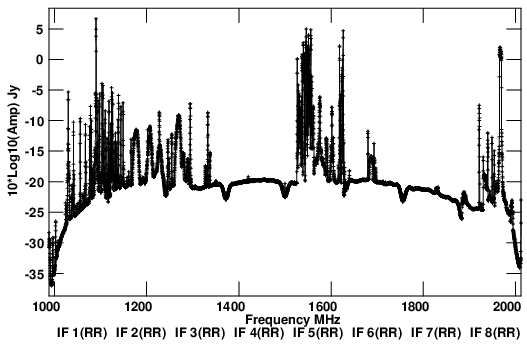
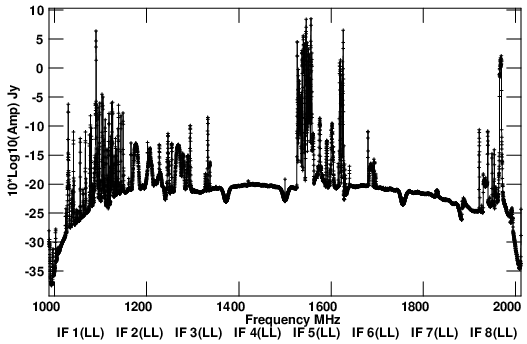





Connect with NRAO